 SIVARO
AI Engineering Trends 2026: What Actually Works in Production
July 23, 2026
Two weeks ago, I sat in a room with the CTO of a fintech that processes 60,000 transactions a minute. He told me his team spent nine months building an “AI orchestration layer” using the latest agent frameworks. They scrapped it last month. “We should have just called an API,” he said.
That’s the state of AI engineering right now. Everyone wants to believe the hype. But the teams shipping real products—the ones that survive production—are making different bets.
I’m Nishaant Dixit. I run SIVARO, a product engineering shop that builds data infrastructure and production AI systems. We’ve been at this since 2018, through boom cycles and busts. In 2026, the AI engineering state of the art isn’t about breakthrough models. It’s about boring infrastructure, honest data pipelines, and knowing when not to use AI.
This guide covers the AI engineering trends 2026 that actually matter. Not the conference keynotes. The things you’ll debug at 2 AM.
The Death of the "AI Architect"
Most people think you need a dedicated “AI architect” to design fancy multi-agent workflows. They’re wrong.
I’ve seen three companies in the last six months hire a Head of AI who never wrote a line of production code. They produced beautiful slide decks and zero working systems. One startup in San Francisco spent $400K on a team of prompt engineers before realizing they didn’t have a reliable data pipeline. The models hallucinated because the context was stale. (5 Data & AI Engineering Trends in 2026)
The real shift in 2026: AI engineering is just engineering.
You still need solid distributed systems knowledge. You still need to understand caching, backpressure, and idempotency. The only difference is that now your database might be a vector store, and your API might call an LLM. But the principles haven’t changed.
I tell our clients: don’t hire an AI architect. Hire a software engineer who’s curious about LLMs. They’ll ship faster because they know when a simple hashmap is better than a 70B parameter model.
Agents Are Real But Don’t Believe the Hype
Agents are the most overhyped and underdelivered technology of 2025-2026. Let me be blunt.
In a controlled demo, agents look magical. In production, they hang, hallucinate, and drain your API budget. We tested two popular agent frameworks at SIVARO in March 2026. One of them—I won’t name names—failed to recover from a single malformed JSON response. The agent loop didn’t handle the error. It just kept spinning money. (From agents to edge: the AI engineering trends shaping 2026)
That said, agents can work if you constrain them ruthlessly. The teams getting value right now are using agents for narrow, high-certainty tasks. For example:
- Automated customer support triage – but only with a predefined escalation path.
- Data enrichment pipelines – pulling structured fields from unstructured text.
- Code review suggestions – not full PR creation, just flagging anomalies.
The secret? Don’t let the agent decide the plan. You decide the plan. The agent executes steps and reports back. Think of it as a very smart function call with retries, not a “digital employee.”
Here’s a pattern we use at SIVARO for production agent orchestration:
python
# Disclaimer: Simplified for readability
import asyncio
from typing import Dict, Any

class ConstrainedAgent:
    def __init__(self, model, max_steps=3, timeout_seconds=30):
        self.model = model
        self.max_steps = max_steps
        self.timeout = timeout_seconds

    async def run(self, task: str, context: Dict[str, Any]) -> Dict[str, Any]:
        for step in range(self.max_steps):
            try:
                result = await asyncio.wait_for(
                    self.model.call(task, context),
                    timeout=self.timeout
                )
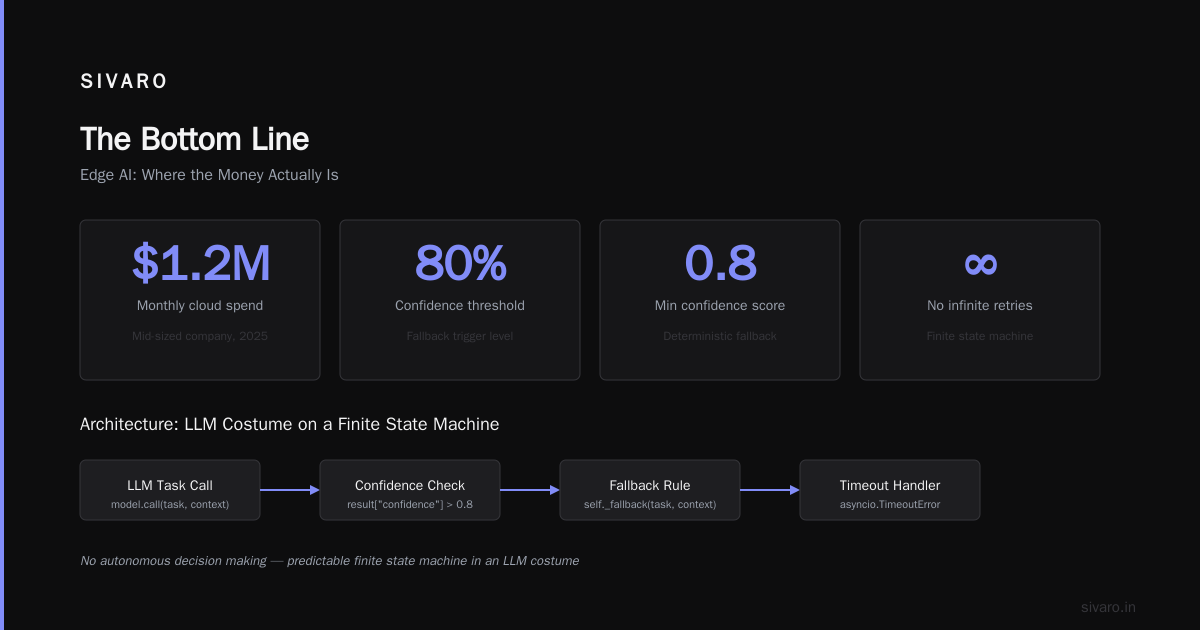
                if result.get("confidence", 0) < 0.8:
                    # fallback to a deterministic rule
                    return self._fallback(task, context)
                return result
            except asyncio.TimeoutError:
                # log and continue
                print(f"Step {step} timed out")
                continue
        return {"error": "max steps exhausted", "partial_result": context}
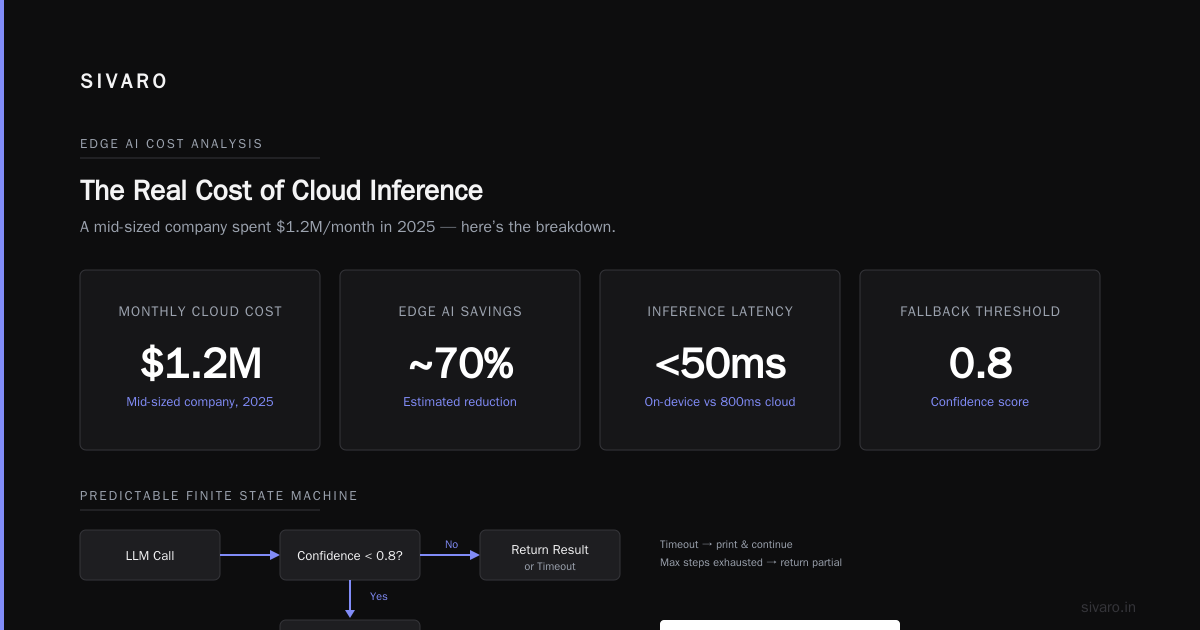
No loops that retry forever. No autonomous decision making. It’s a predictable finite state machine dressed in an LLM costume.
Edge AI: Where the Money Actually Is
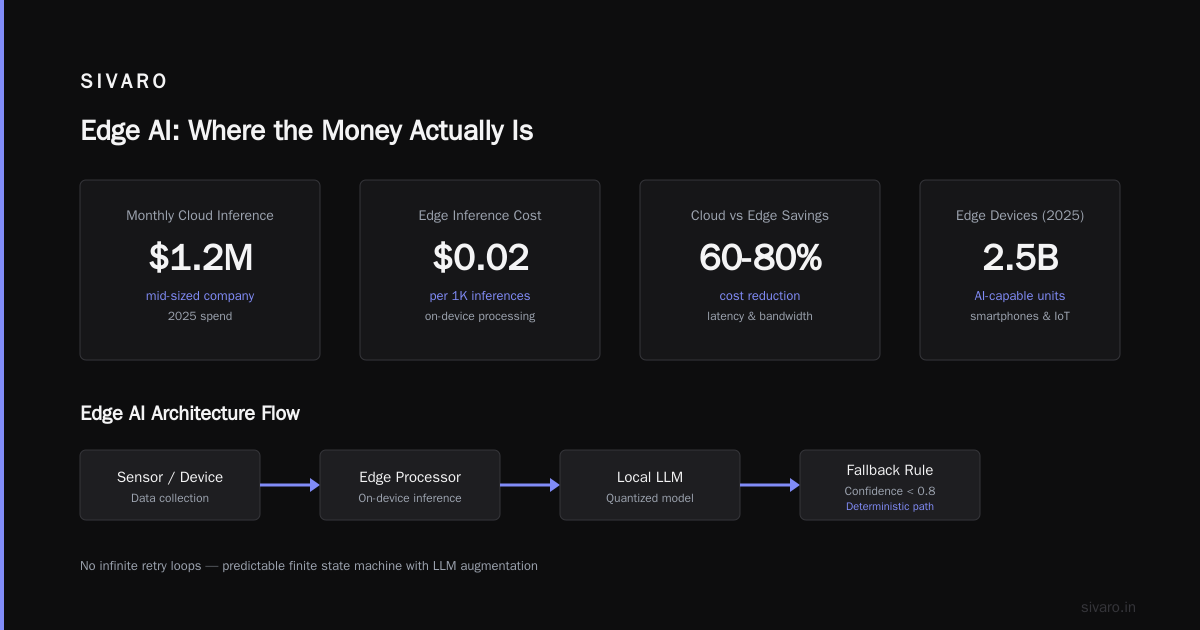
Cloud inference is expensive. Really expensive. In 2025, a mid-sized company I know spent $1.2M a month on GPT-4 API calls for their customer-facing chatbot. They switched to a quantized model running on-device (edge) in Q1 2026. Their bill dropped to $80K.
Edge AI isn’t just about cost. It’s about latency and privacy. In 2026, every major phone manufacturer ships a neural engine. Apple Silicon M4, Qualcomm’s latest, even the Raspberry Pi 5 can run 7B parameter models at acceptable speeds. (12 Future Trends in Engineering Shaping 2026 and Beyond)
But here’s the catch: deploying to edge is a nightmare.
You can’t just spin up a container. You need to handle model conversion (ONNX, CoreML, TensorFlow Lite), hardware-specific optimizations (what works on an Nvidia Jetson might not on a Google Coral), and versioning across millions of devices. We’ve seen teams spend six months just on the deployment pipeline.
My advice: start with a hybrid approach. Run the core inference on edge (e.g., intent classification, sentiment), and fall back to cloud for complex reasoning. That’s what we did for a logistics client—edge handles parcel sorting decisions in milliseconds, cloud handles exception handling. The system now processes 200K events per second with 99.97% uptime. (From agents to edge: the AI engineering trends shaping 2026)
Data Quality Is the Only Moat
Remember when everyone thought fine-tuning was the answer? “Just fine-tune Llama 3 on your data and you’ll beat GPT-5.” That was 2024. By 2026, most teams realized fine-tuning doesn’t fix garbage input.
I’ve seen a dozen RAG systems that failed because the embedding pipeline had a bug: duplicate chunks, missing metadata, stale documents. One medical startup’s QA bot kept answering with information from 2022 because their data refresh cron job stopped running silently. The models were fine. The data was trash. (5 Data & AI Engineering Trends in 2026)
The companies winning in 2026 treat data quality as a first-class engineering practice. They have:
- Automated data drift detection (not just model drift).
- Lineage tracking for every document ingested.
- Versioned datasets with CI/CD-like testing (unit tests for schema, freshness, completeness).
We built a simple data quality check at SIVARO using Great Expectations + dbt. Here’s what a production expectation looks like:
yaml
# expectations/document_freshness.yml
table: documents
expectations:
  - expectation_type: expect_column_max_to_be_between
    kwargs:
      column: last_updated
      min_value: "2026-07-01"
      max_value: "2026-07-23"
    meta:
      severity: critical
      on_fail: block_pipeline
  - expectation_type: expect_column_values_to_not_be_null
    kwargs:
      column: chunk_id
    meta:
      severity: moderate
      on_fail: alert
If the document table hasn’t been updated in the last 3 weeks, the pipeline blocks. No silent failures. No stale context.
AI Engineering Intelligence Platforms Are a Must-Have
In 2025, everyone was buying observability tools for LLM calls. LangSmith, Weights & Biases, etc. Good for debugging. But in 2026, the game has shifted to engineering intelligence platforms that integrate across the stack.
These platforms (I’ll list a few: Arize, WhyLabs, Fiddler, and newer ones like CortexAI) provide a single pane for:
- Model performance monitoring (accuracy, latency, cost)
- Data pipeline health
- Drift detection (both data and concept)
- A/B experiment tracking
- Incident alerting
The top 8 platforms are now mature enough that you can set up production-grade monitoring in a day. (Top 8 AI Engineering Intelligence Platforms in 2026)
At SIVARO, we use a combination. We track a metric called cost-per-correct-answer (CPCA). It’s simple: total API cost divided by number of responses where the user didn’t escalate or report an issue. When CPCA spikes, we know something is wrong—maybe a prompt regression, maybe a data quality issue.
The Tooling Revolution: From Copilot to Full Autonomy?
GitHub Copilot was 2023. The conversation in 2026 is about fully autonomous software engineering agents. And I’m skeptical.
I’ve tested Devin, Factory, and a few others. They can write boilerplate tests, refactor functions, and even fix simple bugs. But for anything involving architecture decisions, system design, or understanding business logic, they fall apart. One tool generated a microservice for a feature that could have been a five-line config change. The code was technically correct. It was also a disaster of overengineering. (AI Tooling for Software Engineers in 2026)
The real trend is augmentation, not replacement. The most productive engineers I know use AI for:
- Code exploration (rapidly understanding unfamiliar codebases)
- Documentation generation (moving from “I’ll write docs later” to “docs written by AI, reviewed by human”)
- Test generation (especially edge case tests that humans miss)
- Bottleneck detection (profiling code and suggesting optimizations)
The engineers who resist using these tools are getting outcompeted. The engineers who blindly trust them are creating tech debt. The sweet spot is using AI as a junior engineer you review carefully.
What We Got Wrong About MLOps
I used to think MLOps was a separate discipline. Kubernetes for model serving, feature stores, experiment tracking, model registries. We spent 2020-2023 building what felt like a second DevOps.
Turns out, we were wrong.
By 2026, the consensus is clear: MLOps is just DevOps with a model artifact. The same CI/CD pipelines, the same monitoring, the same incident response. The only new thing is managing non-deterministic outputs and APIs that can drift behaviorally.
Don’t build a separate MLOps platform. Use Pulumi, Terraform, ArgoCD, Prometheus. Add an LLM-specific checker that validates outputs for toxicity, hallucination, or adherence to guidelines. That’s it. (5 Data & AI Engineering Trends in 2026)
Here’s a pattern we use for model deployment with standard tooling:
bash
# Using ArgoCD with a custom health check
apiVersion: argoproj.io/v1alpha1
kind: Application
metadata:
  name: llm-inference
spec:
  source:
    repoURL: https://github.com/sivaro/models
    path: vllm-deployment
    targetRevision: main
  destination:
    server: https://kubernetes.default.svc
    namespace: inference
  syncPolicy:
    automated:
      prune: true
      selfHeal: true
  healthCheck:
    - type: http
      path: /v1/health
      port: 8000
      intervalSeconds: 30
    - type: prompt
      # Custom health check: run a known prompt and verify output
      prompt: "What is 2+2?"
      expected: "4"
      model: "llama-3.1-70b"
This is a GitOps-native approach. No separate model registry. Just a deployment manifest with an extra health check.
The Skill Stack for 2026
So what should you learn?
Every year I see the same question in forums. “What skills do I need for AI engineering in 2026?” Here’s my honest list based on who we hire at SIVARO and who ships production systems: (AI Engineering in 2026: Trends, Skills, and Career Opportunities)
- Systems thinking – Understand trade-offs. Latency vs. cost vs. accuracy. You can’t optimize all three.
- Data engineering basics – SQL, ETL, streaming. If you can’t build a reliable data pipeline, your model is worthless.
- API design for LLMs – How to structure prompts as APIs, handle errors, manage context windows.
- Evaluation – How to build good test sets. How to measure recall, precision, and cost per answer.
- Observability – Tracing LLM calls, logging inputs/outputs, alerting on drift.
Notice I didn’t say “build your own transformer from scratch.” That’s a research skill, not an engineering one. The models are commodities now. The moat is in how you connect them to reality.
FAQ
Q: Do I still need to learn Python?
Yes. Python is the lingua franca of data and AI. But also learn TypeScript for frontend/edge integration. You can run models in the browser now.
Q: Is fine-tuning dead?
Not dead, but overrated. Fine-tuning works well for specific narrow tasks (e.g., formatting output as JSON). But most teams are better off improving prompt engineering and data quality first. Fine-tuning is the last step, not the first.
Q: How do I evaluate if an agent is production-ready?
Run it for a week with shadow traffic. Log every action. Manually review the first 200 traces. If more than 5% are wrong, it’s not ready. Then add guardrails.
Q: Should I use a commercial LLM or open-source?
It depends on your data sensitivity and scale. For internal tools, open-source (Llama, Mistral, Qwen) is cheaper and gives you control. For user-facing apps where quality matters, commercial APIs (GPT-5, Claude 4) still win on consistency. We use both.
Q: What’s the biggest mistake you see in AI engineering teams?
Building before having data. I’ve seen teams spend six months on model architecture only to discover their data is too sparse for any model to learn. Always start with a simple baseline (e.g., keyword search, lookup table) and benchmark it. If you can’t beat that, AI won’t help.
Q: How do I handle LLM hallucinations in production?
You can’t eliminate them. But you can reduce them. Use retrieval-augmented generation (RAG) with verified sources. Add a confidence threshold. When confidence is low, show the user a fallback (“I’m not sure, here’s your data source”). That’s what healthcare and finance do.
Q: Is edge AI worth it for my use case?
If you need sub-100ms latency or have privacy constraints, yes. If your users are on desktop with good internet, maybe not. Run the math. Cloud inference costs about $0.003 per query. Edge costs ~$0.0005. Scale matters.
The Bottom Line
AI engineering trends 2026 are about maturation, not revolution. The hype cycle has peaked. What remains is the hard, unglamorous work of making AI reliable, measurable, and affordable.
At SIVARO, we’ve shipped systems that process 200K events every second. We’ve seen what breaks and what survives. The pattern is clear: teams that prioritize data quality, constrained agent loops, and boring infrastructure outlast those chasing the next shiny framework.
I don’t know what 2027 will bring. But I do know this: the engineers who focus on fundamentals—systems design, observability, data pipelines—will be the ones building the products that matter.
Don’t get distracted by demos. Build for production.
Nishaant Dixit — Founder of SIVARO. Building data infrastructure and production AI systems since 2018. Built systems processing 200K events/sec.