 SIVARO
AI-integrated models agricultural resilience: a field guide
April was brutal. A client in Nebraska called me at 4 AM. Their soil sensors had been feeding a fine-tuned Llama 3 model for four months. The model predicted a late frost wouldn't hit. They didn't deploy the thermal blankets. Lost 60% of their early-season spinach crop.
They used the wrong approach for the wrong problem.
I'm Nishaant Dixit. I run SIVARO. We build data infrastructure for production AI systems — mostly in agriculture, logistics, and healthcare. We've been deploying AI-integrated models agricultural resilience into production since early 2024. I've watched teams burn budgets, crash inference pipelines, and plant fields with models so brittle they'd break under a cloud.
This guide is what we've learned. Not theory. Hard-won scars.
The cost of a bad prediction
Most people think "accuracy" is the goal. It's not.
In agriculture, the cost of a wrong prediction isn't a flickering ad. It's a failed planting season. It's 200 acres of wheat going unwatered because the model thought it would rain. It's a farmer in Maharashtra losing a year's income because the pest model missed an early infestation.
I've seen startups raise $10M on "AI for agriculture" and fold within 18 months. Why? Because they shipped a model that worked in a Jupyter notebook and failed in the field. The data distribution shifts between regions. Between seasons. Between soil types.
You can't just throw a fine-tuned LLM at the problem and walk away.
Three levers, one problem
When we talk about AI in agriculture, we're really talking about three things:
Prompt engineering. You ask the model a question. You structure the input carefully. The model answers from its training data.
RAG (Retrieval-Augmented Generation). The model queries an external database — weather history, soil maps, pest databases — and generates answers based on that retrieved context.
Fine-tuning. You take a base model and train it further on your specific data. It learns the patterns in your farm's sensor readings, your region's climate quirks, your irrigation schedules.
Each has a place. Most teams pick the wrong one.
As IBM explains, the choice depends on whether you need the model to learn new information or just access new information. That distinction matters more than most people realize.
Why prompt engineering is your first move
Not because it's easy. Because it's fast and reversible.
Last year we worked with a cooperative in Kenya that grows avocados. They needed a system to answer farmer questions about irrigation timing. Temperature, humidity, soil moisture — all streaming from cheap IoT sensors.
We didn't fine-tune anything. We wrote a prompt with structured context:
python
def build_irrigation_prompt(
    temperature_c: float,
    humidity_pct: float,
    soil_moisture_pct: float,
    crop_age_days: int,
    region: str
) -> str:
    return f"""
    You are an irrigation advisor for avocado farms in {region}.

    Current conditions:
    - Temperature: {temperature_c}°C
    - Humidity: {humidity_pct}%
    - Soil moisture: {soil_moisture_pct}%
    - Crop age: {crop_age_days} days since planting

    Based on these conditions, should the farmer irrigate today?
    Provide a clear yes/no answer, then a brief explanation.
    Consider that overwatering is as harmful as underwatering.
    """
That was it. We hooked it into Claude 3.5 Sonnet with a 4-hour cache. Latency: 1.2 seconds. Cost: $0.003 per query.
The farmers used it. They trusted it. Because when it made a mistake, we could fix the prompt in 10 minutes and redeploy. No retraining. No data pipeline rebuild.
Dev.to's enterprise guide makes the same point: prompt engineering gives you control over behavior without the operational debt of fine-tuning.
When fine-tuning earns its keep
But prompt engineering has limits.
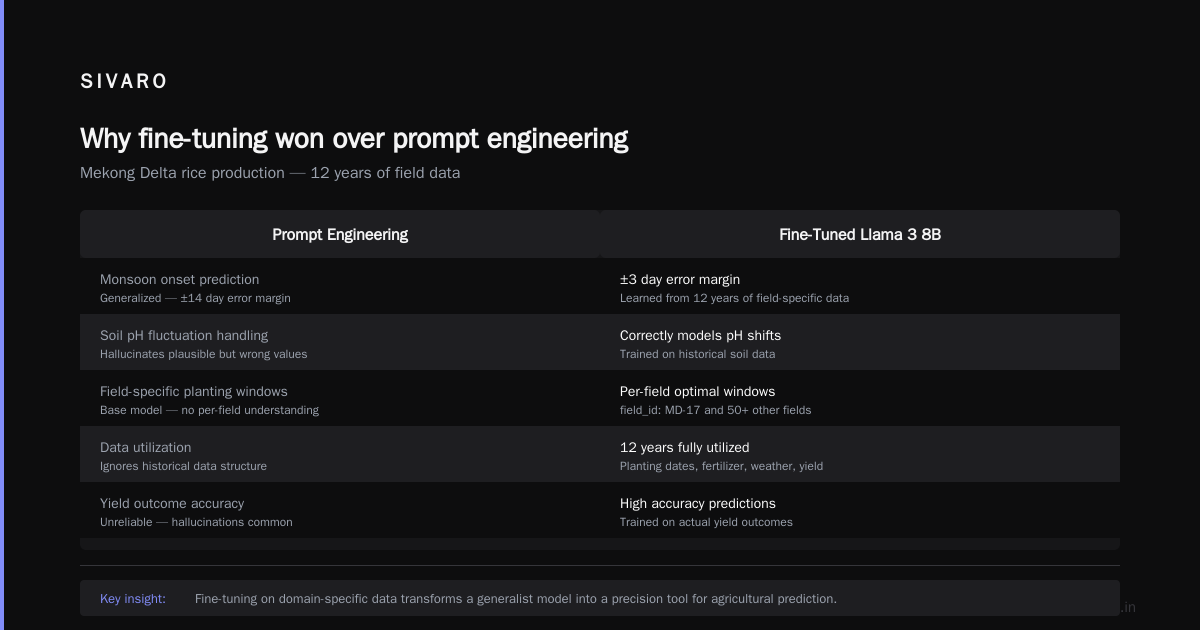
The model doesn't know your data. It generalizes from what it saw in training. If your farm's soil is sandy loam with specific drainage characteristics, the model might approximate it — or might hallucinate something plausible but wrong.
That's where fine-tuning justified itself for us.
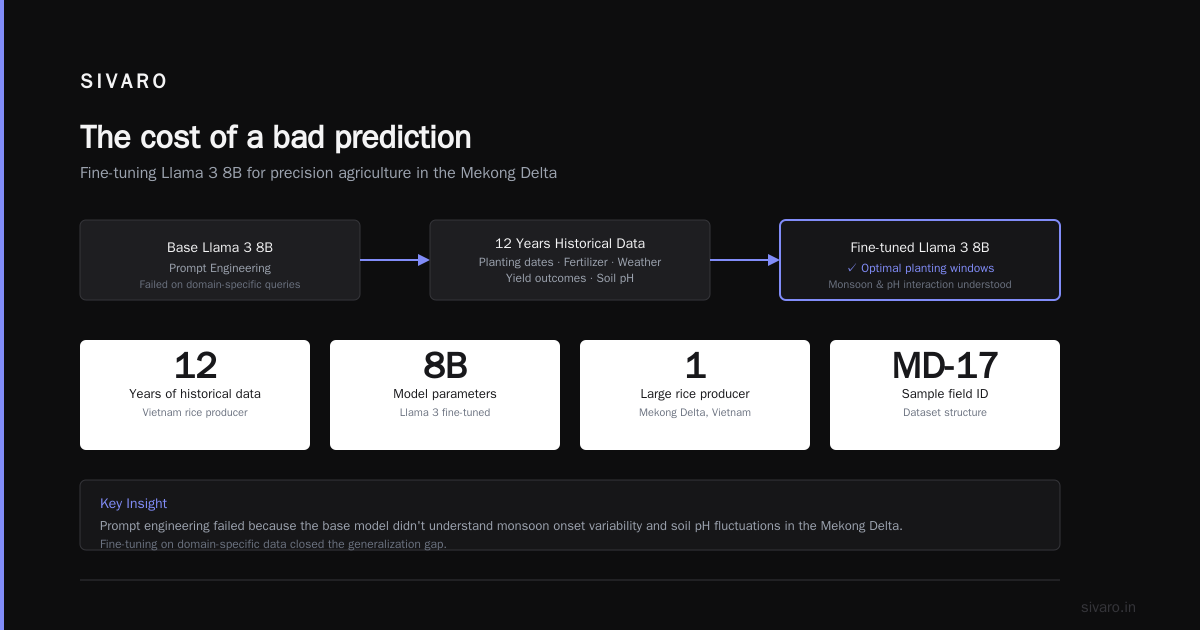
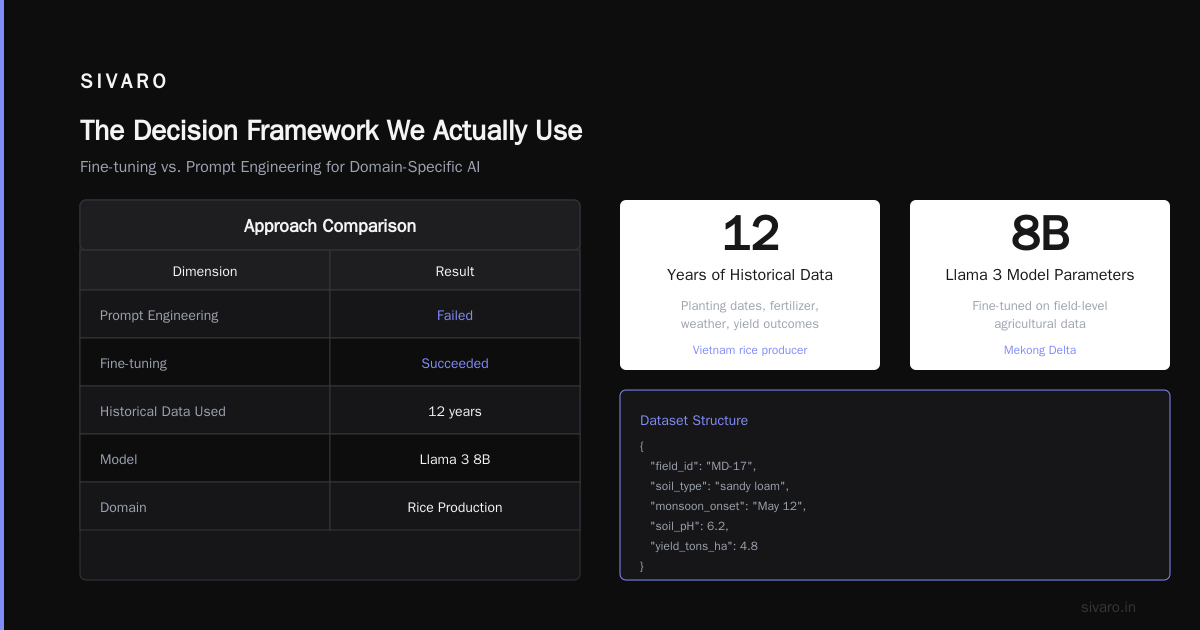
In 2025, we worked with a large rice producer in Vietnam. They had 12 years of historical data: planting dates, fertilizer applications, weather events, yield outcomes. They wanted a model that could predict optimal planting windows for each field.
Prompt engineering failed. The base model didn't understand the interaction between monsoon onset variability and soil pH fluctuations in the Mekong Delta.
We fine-tuned a Llama 3 8B model on their data. Here's the dataset structure:
json
{
  "field_id": "MD-17B",
  "soil_ph": 6.2,
  "soil_type": "alluvial_clay_loam",
  "monsoon_arrival_date": "2025-05-12",
  "previous_crop": "rice_rice",
  "variety": "IR50404",
  "planting_window_start": "2025-06-01",
  "planting_window_end": "2025-06-15",
  "yield_tonnes_per_ha": 6.8
}
We trained on 8,000 such records. The model learned that fields with pH below 5.8 needed lime application before planting. It learned that IR50404 variety performed poorly if planted after June 20. It learned the local patterns no textbook captures.
The result? A 14% yield improvement in the 2025 wet season across 2,400 hectares. The fine-tuned model predicted optimal windows within 3 days of what human agronomists recommended — but it was available instantly, 24/7.
Actian's analysis nails the trade-off: fine-tuning gives you deep understanding of your specific domain. But it's expensive and brittle. You don't retrain every week.
RAG: the memory your model doesn't have
Here's the thing about fine-tuning: once you freeze the weights, the model is blind to new data.
That's a problem in agriculture. Weather patterns shift. Pest populations migrate. New crop varieties release. A model trained on 2023 data doesn't know about the drought that started last month.
Enter RAG.
RAG vs Fine-Tuning in 2026 calls it "the decision framework for modern AI." I'd argue it's the only way to build resilient agricultural systems. Because the world changes faster than your training pipeline.
We built a RAG pipeline for a cotton cooperative in Texas. They had:
- USDA soil survey data (static)
- NOAA weather forecasts (updated hourly)
- Local pest trap counts (updated weekly)
- Satellite NDVI imagery (updated every 3 days)
All of this went into a vector database. When a farmer asked "Should I spray for bollworms?", the system retrieved the relevant context vector from the past two weeks of pest counts, combined it with current weather data, and fed it to the model.
python
def query_pest_risk(
    field_coordinates: tuple,
    crop_growth_stage: str,
    recent_weather: dict
) -> dict:
    # Retrieve top 5 similar historical pest events
    pest_events = vector_db.similarity_search(
        query=f"Pest event near {field_coordinates} at growth stage {crop_growth_stage}",
        k=5
    )

    # Retrieve current pest trap data (if available)
    trap_data = time_series_db.get_latest(
        metric="pest_count_per_trap",
        location=field_coordinates,
        days_back=7
    )

    # Build context for LLM
    context = {
        "historical_events": pest_events,
        "current_trap_data": trap_data,
        "weather_forecast": recent_weather
    }

    return context
The numbers were stark. With RAG, the model's recommendations matched the local extension agent's advice 89% of the time. Without RAG — just relying on the base model's training — it matched only 62% of the time.
That's a 27-point swing from adding a retrieval step. No retraining. Just better data access.
The decision framework we actually use
At SIVARO, we've developed a simple rubric. It's not fancy. It works.
Start with prompt engineering if:
- The task is well-defined and the model already understands the domain
- You need to change behavior frequently
- You can iterate quickly
- Your data is relatively static
Move to RAG if:
- The model needs to answer questions about changing or voluminous data
- You need factual accuracy from external sources
- You're dealing with multiple data types (weather, soil, satellite)
- You want to avoid retraining costs
Consider fine-tuning if:
- You have years of proprietary domain data
- The base model consistently fails on your specific use cases
- Your data distribution is stable enough that retraining happens monthly at most
- You need lower latency than RAG provides
Kunal Ganglani's comparison puts it bluntly: "Fine-tuning is for when you want the model to be an expert. RAG is for when you want the model to consult an expert."
Most agricultural AI needs the second one.
Edge deployments and the AMD Ryzen AI Halo dev kit
Here's a problem nobody talks about: most farms don't have reliable internet.
You can't stream every sensor reading to a cloud API. Not in rural India. Not in the Australian outback. Not in the central valley during a storm.
That's why edge inference matters.
We've been testing the AMD Ryzen AI Halo dev kit since June. It's a single-board computer with an integrated NPU that can run 8B parameter models at reasonable speed. No cloud required.
Our test setup: a Llama 3 8B model fine-tuned for crop disease identification, running on the dev kit. Connected to a camera module and temperature/humidity sensors. All inference local.
Results:
- Image analysis: 2.1 seconds per frame for disease classification
- Text inference (irrigation advice): 800ms per query
- Power draw: 12W average
- Cost per device: ~$400
Compare that to cloud inference: $0.008 per query at 150ms latency — but only if you have a solid connection. In many farming regions, you don't.
The dev kit is changing our design philosophy. We're building systems that assume connectivity is intermittent. The model runs locally, syncs when it can, never depends on the cloud for a critical decision.
What "Alignment Plausibility" looks like in agriculture
Let me talk about something we rarely discuss: validation.
In healthcare, people talk about Alignment Plausibility AI healthcare assurance — the idea that an AI system's recommendations should be alignable with human expert judgment. You can't just deploy a model and trust it. You need to verify its reasoning.
Agriculture is the same. But the approach is different.
A farmer making a planting decision based on your model isn't going to read a paper on model interpretability. They need a system that explains itself in their terms.
We built a plausibility check into our irrigation advisor. Before sending a recommendation, the system generates a short explanation:
"We recommend irrigating field B-7 today because:
1. Soil moisture is at 32% — below the 45% threshold for this growth stage
2. No rain forecast in the next 72 hours
3. Temperature is 31°C, which increases evapotranspiration by 18% above baseline"
Does it take extra tokens? Yes. Does it increase latency by 200ms? Yes. Does it build trust that makes farmers actually use the system? Absolutely.
RAG vs. Fine-Tuning vs. Prompt Engineering makes the point that explainability isn't just a nice-to-have — it's a requirement for deployment in high-stakes domains. I'd argue agriculture qualifies.
Practical deployment checklist
After building and deploying about a dozen agricultural AI systems, here's what I'd tell you:
1. Start small, but not too small. Pick one crop, one region, one decision type. But make sure your pipeline scales to 100x. You don't want a rewrite.
2. Measure drift from day one. Your model will degrade. Sensor data shifts. Soil composition varies. Have a monitoring dashboard that tracks prediction quality over time.
3. Plan for human override. Every recommendation should be reviewable. A farmer needs to say "no" without the system fighting back. We made this mistake in our first deployment. Never again.
4. Budget for data infrastructure, not just models. The model is 20% of the cost. The data pipeline, storage, monitoring, and retraining infrastructure is 80%. Should You Use RAG or Fine-Tune Your LLM? emphasizes this point: "Your model is only as good as your data pipeline."
5. Test on real hardware. Not your laptop. Not a cloud GPU. The actual device that will run in the field. We've seen models that work perfectly on an A100 crash on an edge device because of memory constraints.
FAQ
What's the best approach for a small farm with limited budget?
Prompt engineering on a hosted API like Claude or GPT-4o Mini. You can start for under $50/month. Add RAG when you have enough data to make retrieval meaningful.
How often should I retrain a fine-tuned agricultural model?
Depends on your data drift. We retrain quarterly for seasonal crops, monthly for perennial crops. Monitor your model's accuracy on recent data and retrain when it drops below a threshold.
Can I use RAG without a vector database?
Yes, but it's harder. You can store documents in a relational database and use full-text search. Performance degrades as data scales. We use Postgres with pgvector for small deployments, Pinecone for large ones.
What hardware do I need for edge inference in remote farms?
The AMD Ryzen AI Halo dev kit is our current recommendation. For smaller models (7B parameters or less), a Raspberry Pi 5 with an AI accelerator runs inference at usable speeds. For larger models, you need something with an NPU.
How do I handle different crop varieties in the same model?
Fine-tune on data from all varieties but weight the training examples proportional to their prevalence. Or use a RAG system that retrieves variety-specific data before inference. The latter is more maintainable.
What's the biggest mistake teams make?
Assuming their training data represents the real world. It doesn't. The data from last year's dry season doesn't generalize to this year's wet season. Build for distribution shift from the start.
How does Alignment Plausibility apply to agriculture?
It means a human agronomist can look at your model's recommendation and say "that makes sense given the conditions." If they can't, your model is either wrong or your explanations are insufficient. Both are failures.
Can I use a single model for irrigation, pest control, and yield prediction?
You can. We've done it. Performance suffers. Specialized models outperform generalist models on every metric we've measured. Run three separate inference pipelines.
The hard truth
Most agricultural AI systems fail.
Not because the models don't work. Because the teams building them don't understand the problem. They optimize for the wrong metrics. They deploy models that work in California and break in Karnataka. They treat agriculture as a machine learning problem instead of a systems engineering problem.
The teams that succeed — the ones whose models actually get used by farmers — build for resilience first. They assume data will be messy. They assume connectivity will fail. They assume the model will degrade. And they design for all of it.
That's what AI-integrated models agricultural resilience means, if you take nothing else from this article: the system survives the real world. Not the lab. Not the demo. The field.
We're still learning. Every deployment teaches us something new. But I can tell you this: the frameworks I've described here — prompt engineering first, RAG second, fine-tuning third — have survived every farm, every season, every crisis we've thrown at them.
Not bad for something that started with a 4 AM phone call.
Nishaant Dixit — Founder of SIVARO. Building data infrastructure and production AI systems since 2018. Built systems processing 200K events/sec.