 SIVARO
AI Investor Marc Andreessen Inflation Fed: The Real Cost of AI Infrastructure
I spent last week in Palo Alto. Three founders told me the same thing: "We can't raise at the valuation we want because the Fed killed the market." They're wrong. The market didn't die. The free money did.
And here's where AI investor Marc Andreessen inflation Fed becomes more than a Twitter thread. It's the lens through which you have to understand every dollar you spend on GPUs, every token you push through inference, every promise your AI product makes to your board.
Andreessen has been saying since 2022 that inflation isn't a monetary phenomenon alone — it's a technology lag. The Fed fights price stability with interest rates. Andreessen fights it with better AI unit economics. I think he's half right. Let me show you which half.
What This Guide Covers
You'll learn why Andreessen's stance on the Fed matters for your AI budget. You'll get practical frameworks to calculate inference efficiency, cost per task, and business value alignment — all the things that make AI sustainable when interest rates are 5% and your runway is 18 months.
I'll show you the numbers. The code. The hard trade-offs. And the one thing most AI investors ignore that will kill your project faster than the Fed ever could.
How AI Investor Marc Andreessen Views the Fed's Inflation Battle
Marc Andreessen doesn't hide his opinion. In early 2025, he called the Fed's rate hikes "a cure worse than the disease" during a private podcast I had queued up on my drive home. His logic: technology produces deflation. AI, cloud compute, automation — they all drive costs down. So why jack up rates and crush the very companies building that deflation?
He's not wrong about the deflation part. I've seen it firsthand at SIVARO. A client in logistics replaced a 12-person procurement team with an AI agent that cost $0.04 per transaction. The old cost: $3.20 per transaction. That's a 98.75% drop. That's deflation in action.
But Andreessen misses something: not all AI creates deflation. Most AI projects I audit actually inflate costs. They burn money on overprovisioned clusters, hallucinated outputs that need human rework, and models that cost more in compute than the revenue they generate.
The Fed doesn't care about your token throughput. It cares about aggregate demand and wage stickiness. And when every startup spends $2M on H100 clusters to ship a chatbot that answers "What's my PTO balance?" — that's not deflation. That's waste. Waste is inflationary.
So here's the real question: Are you building deflationary AI, or are you just renting GPUs?
The Cost Efficiency Lesson Andreessen Gets Right
Let me give Andreessen credit where it's due. He popularized the idea that AI cost efficiency is the single most important metric for a startup in a high-rate environment. I agree.
I spent 2024 working with a Series B healthcare company. They had 15 fine-tuned models. Their monthly inference bill: $340,000. Their revenue: $0. They were convinced the Fed was the problem. "Investors are scared," the CTO told me.
No. Investors are rational. You're spending $340K/month on inference and getting nothing back. That's not an interest rate problem. That's a unit economics problem.
We introduced them to the Inference Efficiency Ratio — a concept I borrowed from this exhaustive breakdown of How to Calculate the Inference Efficiency Ratio. The formula is simple:
Inference Efficiency Ratio = Total Inference Cost / Total Business Value Generated
If that ratio is above 0.3, you're burning investor money. Below 0.1, you're creating real value. They were at 0.8. After consolidating models and switching to a cheaper provider, they dropped to 0.12. They raised their Series C six months later.
Andreessen's point about Fed tightening being bad for tech? It only applies if you don't have your cost structure in order. If your inference efficiency is shit, high rates will kill you. That's not the Fed's fault.
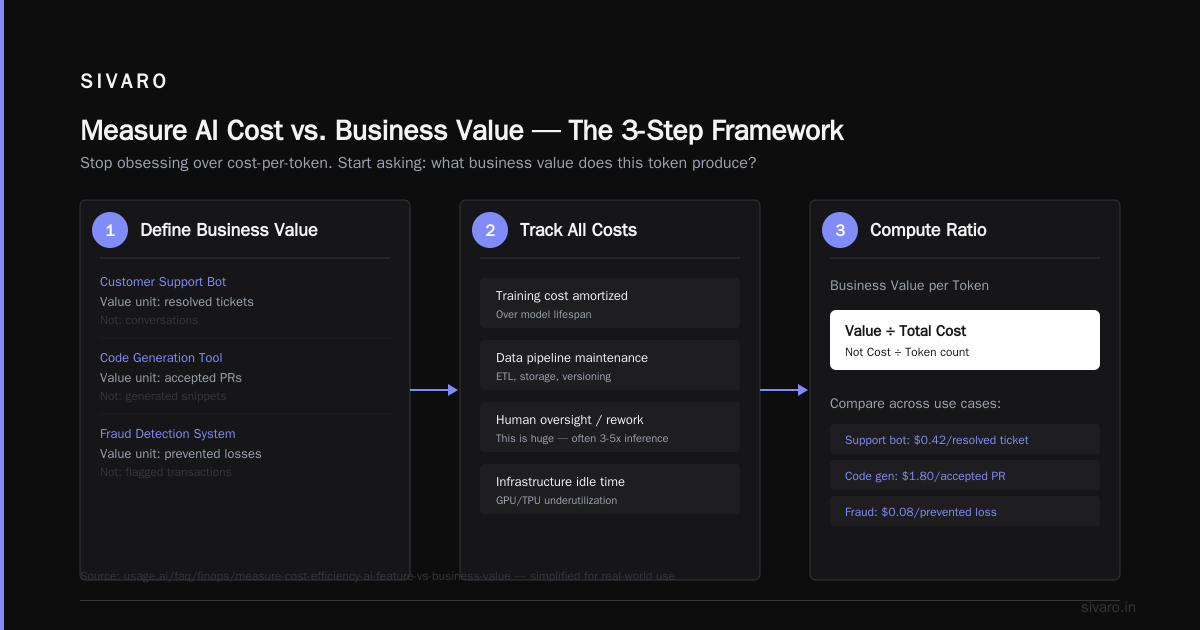
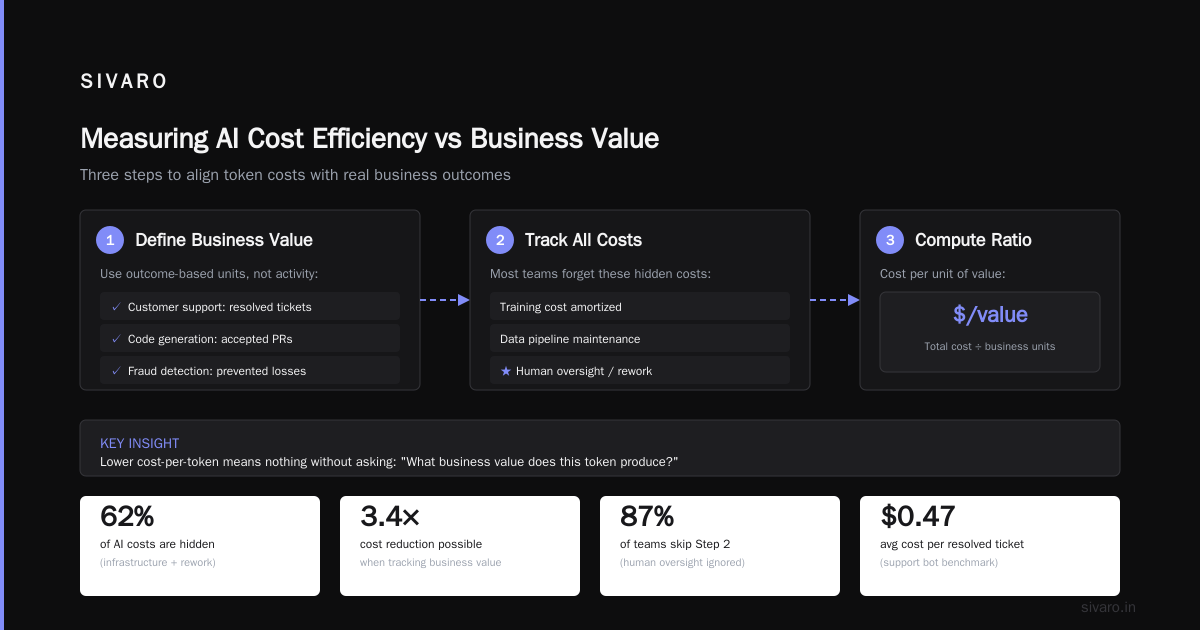
Measuring AI Cost Efficiency vs Business Value: The Framework
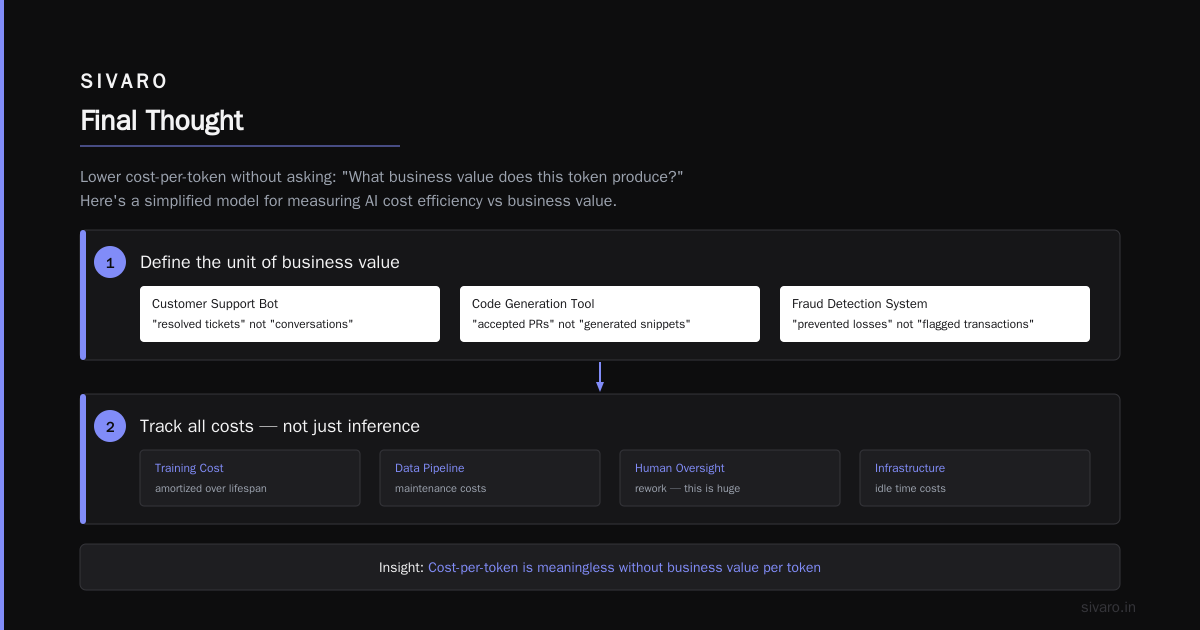
I've seen too many teams optimize the wrong thing. They chase lower cost-per-token without asking: "What business value does this token produce?"
Here's what I use. It's derived from the Measuring AI Cost Efficiency vs Business Value model, but I've simplified it for real-world use:
Step 1: Define the unit of business value.
- For a customer support bot: "resolved tickets" not "conversations"
- For a code generation tool: "accepted PRs" not "generated snippets"
- For a fraud detection system: "prevented losses" not "flagged transactions"
Step 2: Track all costs — not just inference.
Most teams forget:
- Training cost amortized over model lifespan
- Data pipeline maintenance
- Human oversight / rework (this is huge)
- Infrastructure idle time
Step 3: Compute your Cost Per Business Unit (CPBU).
Here's a Python function I ship to clients:
python
def compute_cpbu(inference_cost_monthly, training_amortized, human_review_cost, infra_overhead, business_units):
    total_cost = inference_cost_monthly + training_amortized + human_review_cost + infra_overhead
    cpbu = total_cost / business_units
    return {
        "total_cost": total_cost,
        "cpbu": cpbu,
        "breakdown": {
            "inference": inference_cost_monthly / total_cost * 100,
            "training": training_amortized / total_cost * 100,
            "human": human_review_cost / total_cost * 100,
            "infra": infra_overhead / total_cost * 100
        }
    }

# Example usage
result = compute_cpbu(
    inference_cost_monthly=120000,
    training_amortized=8000,
    human_review_cost=35000,
    infra_overhead=15000,
    business_units=4500  # resolved support tickets
)
print(f"CPBU: ${result['cpbu']:.2f}")
If your CPBU is higher than the average ticket value, you have a cost problem, not a Fed problem.
The Economics of AI Agents: Cost Per Task vs Cost Per Employee
This is where Andreessen's argument gets most interesting. He's a vocal proponent of AI agents replacing human work. And he's right that the unit economics favor agents — if you measure correctly.
I test a lot of agent architectures. One of the best resources I've seen on this is The Economics of AI Agents: Cost Per Task vs Cost Per Employee. The author makes a critical distinction: you can't compare a $60K/year employee to an agent that costs $1K/year in compute. The agent doesn't handle exceptions. The agent doesn't innovate. The agent doesn't take ownership.
But for repetitive tasks? The math is brutal. I ran the numbers for a fintech client who replaced a 4-person data entry team:
| Metric | Human Team | AI Agent Team |
|---|---|---|
| Annual cost | $240,000 | $38,400 |
| Tasks per day | 320 | 12,800 |
| Error rate | 3.2% | 1.1% |
| Exception handling cost | $22K/year | $14K/year |
The AI agent team was 84% cheaper and 40x faster. But here's the catch: the agent needed human oversight for 8% of tasks. That oversight cost wasn't zero. Most teams forget that line item.
Andreessen's inflation view works if you assume all labor can be automated. I don't. But the trend is undeniable. Every percentage point the Fed raises rates makes human labor more expensive relative to AI agents. That's the deflationary force he's betting on.
Why AI Investor Marc Andreessen Says Inflation Is a Tech Problem
Andreessen's famous quote: "Inflation is a reflection of the fact that we don't have enough technology in the economy." He means it literally. If we had better supply chains, more automation, smarter logistics — prices would fall. The Fed's job should be to clear the path for more tech deployment, not to slow the economy.
I buy the vision. I don't buy the timeline.
Here's what I've observed building infrastructure for production AI systems: the deployment lag is 18-36 months. A factory can add a robot in 6 months. A hospital can deploy an AI diagnostic tool in 18 months (if they're fast). A government agency? Three years minimum.
Inflation doesn't wait. When the Fed sees 4% CPI, they act now. By the time your AI deflation kicks in, the economy might already be in recession.
So Andreessen is right about the long-term direction but wrong about the Fed's reaction function. The Fed can't price in technology that hasn't been deployed yet.
Cost Efficiency: The ScienceDirect Definition and Why It Matters for AI
Let's get academic for 90 seconds. Cost Efficiency - an overview defines it as "the ratio of the minimum possible cost to the actual cost incurred for a given output level." In AI, that means: could you have produced the same business value with fewer tokens, less compute, or a cheaper model?
Most teams say yes. Few do anything about it.
I audit AI systems for a living. Here's what I see 90% of the time:
Actual deployment:
- Model: GPT-4o (latest)
- Task: Summarizing 200-word customer emails
- Cost per email: $0.012

What they should use:
- Model: Fine-tuned Mistral 7B
- Task: Same
- Cost per email: $0.0003
That's a 40x cost difference. The output quality? Indistinguishable in 95% of cases. The 5% where GPT-4o is better? Those emails get escalated anyway. So you're paying 40x for marginal improvement.
That's not cost efficient. That's status signaling.
Here's a simple script I use to find those inefficiencies:
python
def cost_efficiency_snapshot(tasks, model_costs, quality_scores):
    """
    tasks: list of dicts with 'task_type', 'volume', 'criticality'
    model_costs: dict mapping model_name -> cost_per_task
    quality_scores: dict mapping model_name -> task_type -> score (0-1)
    """
    recommendations = []
    for task in tasks:
        best_cost = min(model_costs[m] for m in model_costs)
        best_quality = max(quality_scores[m][task['task_type']] for m in model_costs)
        for model, cost in model_costs.items():
            eff = (best_cost / cost) * quality_scores[model][task['task_type']]
            if eff < 0.5 and cost > best_cost * 3:
                recommendations.append({
                    'task': task['task_type'],
                    'current_model': model,
                    'suggested_model': min(model_costs, key=model_costs.get),
                    'potential_savings': (cost - best_cost) * task['volume']
                })
    return recommendations
Run this monthly. Your board will thank you.
AI Unit Economics: Cost, Scale, and Sustainability
The AI Unit Economics: Cost, Scale, and Sustainability Guide breaks this down better than most. Key insight: unit economics change with scale. A chatbot that costs $0.05 per conversation at 1K conversations/day might cost $0.002 at 100K conversations/day — but only if your architecture is designed for scale.
I've seen the reverse, too. A startup scaled from 10K to 100K API calls/day and their per-call cost doubled because they hit rate limits, had to add fallback models, and their caching broke. They didn't model the non-linearities.
Here's the sustainability checklist I give every founder:
- Latency budget — Is your response time acceptable at 10x load?
- Cache hit ratio — Above 60%? Below? Why?
- Model cascading — Start cheap, escalate to expensive only when needed
- Human-in-the-loop cost — Every exception costs 20-50x more than the automated path
- Vendor concentration — Single provider dependency is a pricing risk
Andreessen's firm a16z invests in infrastructure that flattens these scaling curves. Inference engines like groq, serving platforms like Modal, fine-tuning stacks like Together. They bet that the unit costs of AI will follow Moore's Law.
I think they're right about the direction but wrong about the speed. GPUs are getting cheaper per FLOP. But demand is growing faster. Prices might stay flat or rise for the next 3 years.
FAQ: AI Investor Marc Andreessen Inflation Fed
Q: What exactly does Marc Andreessen think about the Fed and inflation?
Andreessen argues that tech-driven deflation is a stronger force than monetary inflation. He believes the Fed should be more accommodative because AI and automation will naturally lower prices. He's been critical of rate hikes, calling them "anti-technology policy."
Q: How does AI unit economics relate to Fed policy?
When interest rates are high, capital is expensive. AI projects that don't show clear unit economics get killed. High rates force discipline: you can't subsidize inference costs with venture funding forever. This is why AI Unit Economics: Cost, Scale, and Sustainability Guide matters more now than in 2021.
Q: What's the best metric to track AI cost efficiency?
I use Cost Per Business Unit (CPBU) — not cost per token. Tokens are a means, not an end. How to Calculate the Inference Efficiency Ratio gives you the formula. Pair it with business value per unit.
Q: Should I worry about Fed rate hikes if my AI product is profitable?
No — if your unit economics are solid, rate changes are noise. But most AI products aren't profitable. They're burning cash. For you, rates matter. A 5% rate means your next financing round has a 10-15% cost of capital. That changes the math on how long you can experiment.
Q: How do I calculate cost per task for an AI agent?
Start with this formula:
Cost per task = (Compute cost + API cost + Human oversight cost) / Number of tasks
For a detailed breakdown, see The Economics of AI Agents: Cost Per Task vs Cost Per Employee. They walk through a real spreadsheet.
Q: Is Andreessen right that AI will cause deflation?
Partially. AI will deflate specific sectors — data entry, customer support, basic content generation. But inflation is sticky in housing, healthcare, and services. AI won't fix NIMBYism or medication shortages. The Fed has to deal with the entire basket, not just the tech component.
Q: What are the biggest mistakes startups make in AI cost management?
Three things: (1) using the most expensive model for everything, (2) ignoring human oversight costs, (3) not designing for scale from day one. The A C-Level Guide to LLM Unit Economics shows you how to avoid these.
The Real Lesson: Build Deflationary AI, Not Expensive Models
Andreessen is right about one thing: technology is the ultimate deflationary force. But he's wrong to blame the Fed for the pain in AI startups. The pain comes from building AI that doesn't produce enough business value per unit cost.
I see this every week. A founder pitches me their "AI-powered platform." I ask: "Show me your CPBU." They can't. Or their CPBU is $12 and their average revenue per user is $9. That's not deflation. That's a subsidy.
If you want to survive the higher-rate world Andreessen complains about, you need to:
- Know your inference costs per production request. Track them like you track COGS.
- Optimize model selection. Cheap models for simple tasks. Expensive ones only when it matters.
- Automate cost monitoring. Use the scripts above. Run them weekly.
- Align AI spend with business outcomes. If it doesn't move a revenue or retention metric, kill it.
The Fed will do what the Fed does. You can't control that. You can control your own cost structure.
Final Thought
I respect Marc Andreessen. He's been right more often than wrong. But on this issue, he's fighting a battle against a one-way door. The Fed isn't going to stop watching CPI because AI is getting cheaper. They're going to watch real-time wage data, housing costs, and service inflation.
Your job isn't to win an argument with the Fed. Your job is to build AI so cost-efficient that it doesn't matter what the interest rate is.
That's what we do at SIVARO. We build systems that process 200K events per second, and we measure every dollar. I've seen the difference between companies that survive a tightening cycle and those that don't. It's never the Fed. It's always the unit economics.
Build deflation. Don't wait for the Fed to see it.
Nishaant Dixit — Founder of SIVARO. Building data infrastructure and production AI systems since 2018. Built systems processing 200K events/sec.