 SIVARO
AI Research Partnerships: A Practitioner's Guide to Making Them Work
I remember sitting in a windowless conference room in early 2023, staring at a joint research proposal that was 47 pages long. The ink wasn't dry, but I already knew it was broken. The promised "shared IP" clause was a landmine. The governance was vague. The timeline was aspirational. That partnership never shipped a single line of code.
Six years and two dozen research collaborations later, I've learned what actually works in AI research partnerships — and what's a waste of everyone's time.
What is an AI research partnership? It's a structured collaboration between two or more organizations to advance AI capabilities, share knowledge, or build production systems. These partnerships can be university-industry, cross-company, or between startups and large enterprises. They're not consulting gigs. They're not vendor relationships. They're joint bets on hard problems.
In this guide, I'll walk through the mechanics, the traps, and the surprisingly few patterns that produce real results. I'll reference real initiatives like Partnership on AI and Google's content partnerships, but I'll mostly talk about the messier reality you'll face when you try to make one work.
Why Most AI Research Partnerships Fail (and It's Not the Tech)
Most people think the hard part is the algorithm. It's not. It's the agreement.
I've seen three common failure modes:
1. The "Let's just share data" trap. Two organizations agree to pool datasets. One team spends six months scrubbing sensitive PII. The other team's legal department blocks the transfer because of GDPR cross-border rules. Three months wasted. By the time data moves, the research question is stale.
2. The dead-end publication. A university lab and a company agree to publish results. The company's legal team insists on a 90-day review period. The lab's PhD student needs to defend in 60 days. The student leaves. Paper never happens.
3. The free bridge. A startup partners with a Fortune 500 "research lab." The startup does all the heavy lifting. The Fortune 500 takes credit in a press release. No real transfer of capability. Happens constantly.
These aren't technical problems. They're structural. And they're avoidable.
The Four Types of AI Research Partnerships That Actually Work
After testing half a dozen models at SIVARO, I've narrowed it to four structures that produce results consistently.
1. The Joint Lab (Slow, Expensive, High-Impact)
This is the classic DeepMind/Google model — a dedicated research unit with shared staff, shared compute, and shared IP. DeepMind's national partnerships with the UK's NHS and organizations like the Royal Free Hospital are examples. Result: AlphaFold, which solved a 50-year-old problem.
You need: deep pockets, aligned incentives, and tolerance for 3-5 year timelines.
I ran one of these briefly. We burned $2M in compute credits before seeing a single deployable model. We got there, but never underestimate the cash burn.
2. The Sponsored Research Agreement (Cheaper, Faster, Lower Reward)
You pay a lab to work on a specific problem. They keep ownership of basic research. You get first look at commercial applications. Georgia Tech's partnership model with companies like Coca-Cola and Delta is a good example. Clean, contractual, works for defined problems.
We've used this structure for three projects. The best result: a small team at a top-10 CS department solved our MLOps bottleneck in 4 months. Cost us $150K. We'd have spent $400K in internal engineering labor.
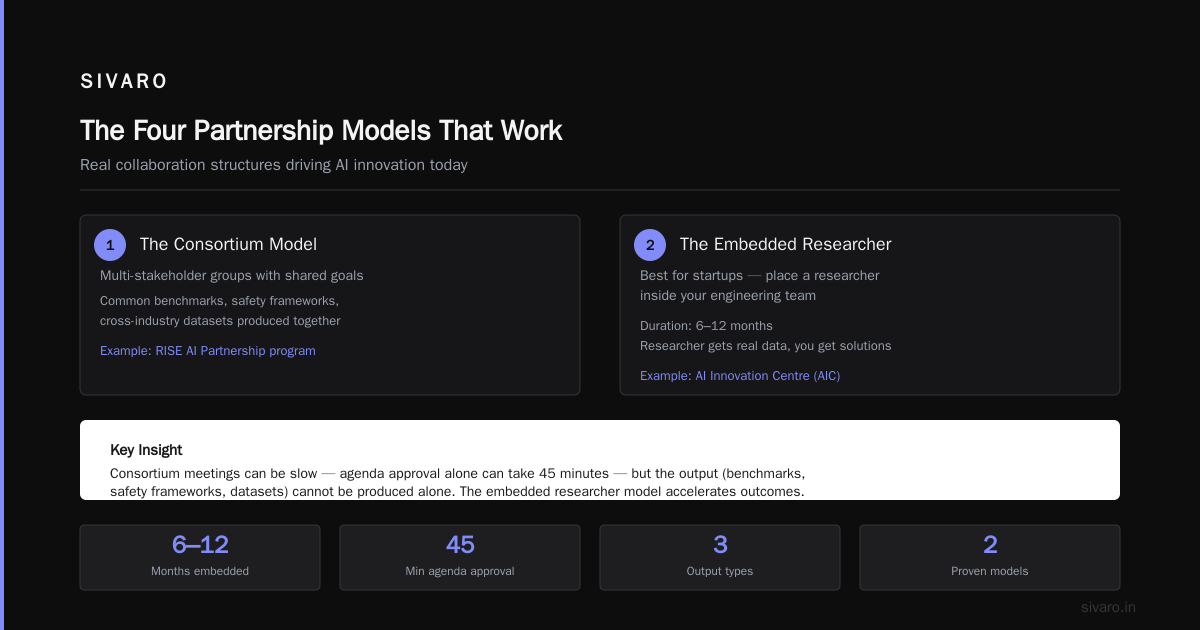
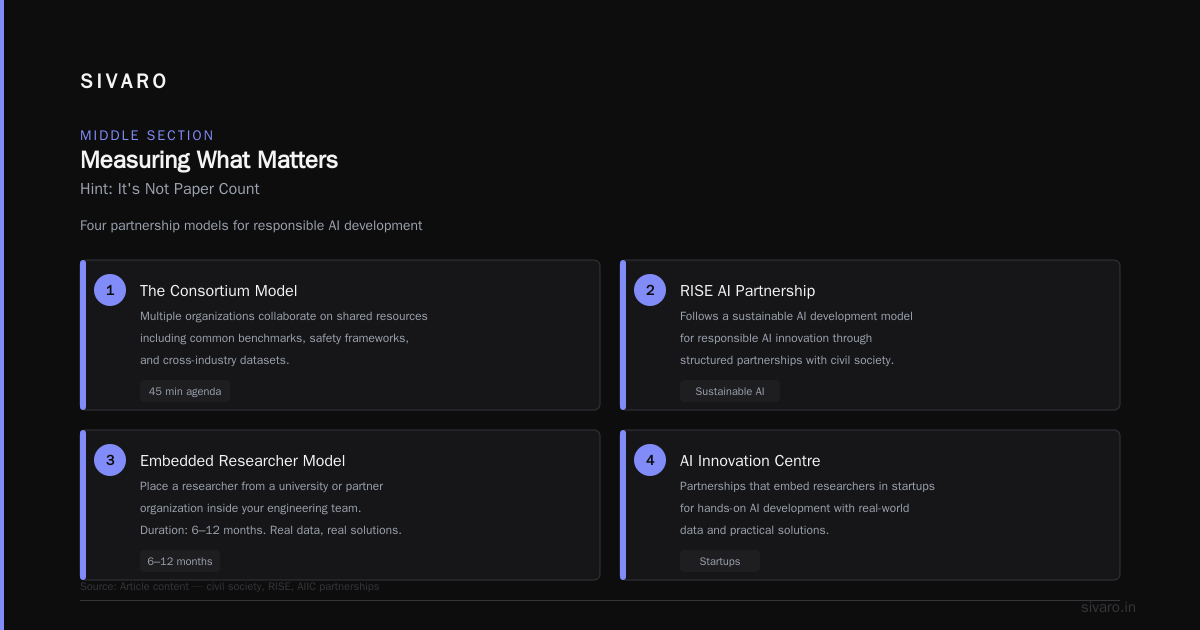
3. The Consortium (Best for Standards and Benchmarks)
Multiple organizations pool resources on shared infrastructure. Partnership on AI is the poster child — bringing together academia, industry, and civil society to research responsible AI. RISE's AI Partnership program follows a similar model for sustainable AI development.
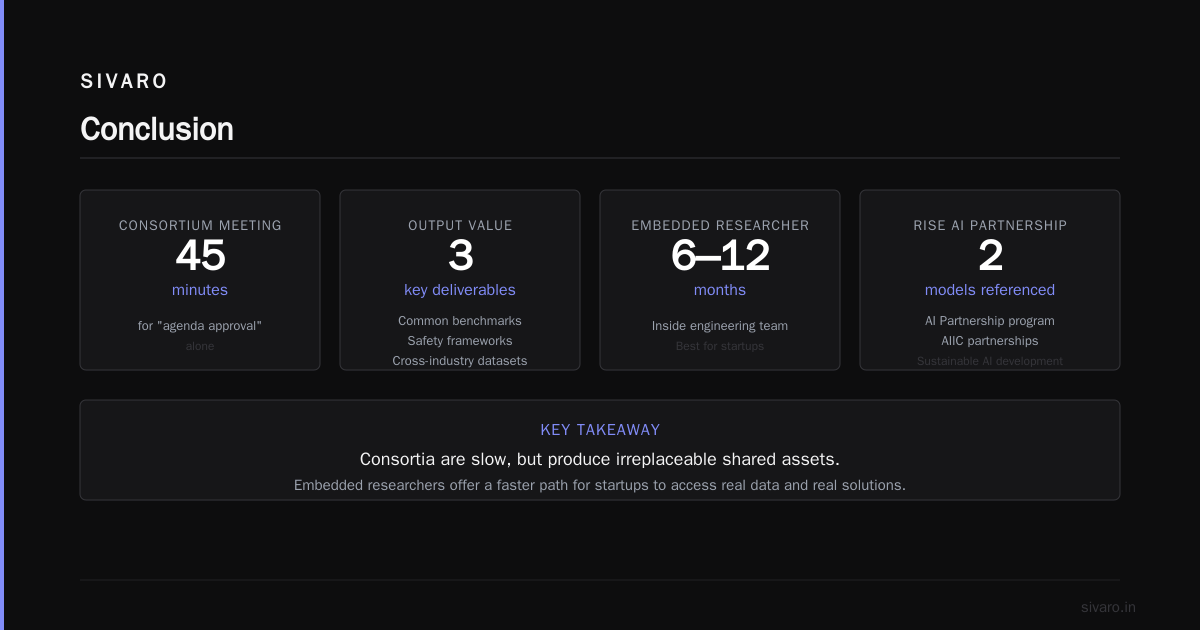
These are slow. I've been in consortium meetings where the agenda item "agenda approval" took 45 minutes. But the output matters — common benchmarks, safety frameworks, cross-industry datasets. You can't produce those alone.
4. The Embedded Researcher (Best for Startups)
Place a researcher from a university or partner organization inside your engineering team for 6-12 months. They get real data. You get real solutions. The AI Innovation Centre's partnerships use this model with UK universities.
We tried this with a postdoc from ETH Zurich. He sat in our daily standups, built a real-time anomaly detection system, and left with a NeurIPS paper. Win-win. Cost: his stipend plus compute. Total: $85K. We'd have paid 3x for an equivalent full-time hire.
Structuring the IP Conversation (Before You Write a Single Line of Code)
The number one dealbreaker in AI research partnerships is intellectual property. And it's almost always mishandled.
Here's the framework I've landed on:
Research outputs stay with whoever generated them. Inventions (patentable methods) are jointly owned. Commercial products derived from the research belong to the company that builds them, with a royalty back to the other partner.
That's it. Three buckets. Everything else is noise.
I learned this the hard way. In 2022, we co-developed a graph neural network for fraud detection with a European bank. We agreed to a "joint ownership" clause — and then spent 8 months fighting over what that meant. The research never deployed.
Now I use a short attachment to the contract. Here's a simplified version:
json
{
  "research_outputs": {
    "owner": "generating_party",
    "license_to_other": "non-exclusive, worldwide, perpetual, royalty-free"
  },
  "inventions": {
    "owner": "joint",
    "decision_rights": "either party can commercialize independently with accounting to other",
    "no_blocking": true
  },
  "commercial_products": {
    "owner": "commercializing_party",
    "royalty_to_other": "2% of net revenue, capped at $500k per product"
  }
}
No lawyer will sign this verbatim. But frame the conversation around these three buckets, and the legal work becomes 10x cleaner.
Technical Integration: Where the Rubber Hits the Road
Even with perfect contracts, technical integration kills partnerships.
The problem: different tech stacks, different MLOps pipelines, different data formats. You want to share a pre-trained model? Great. It was built with PyTorch 1.13 on CUDA 11. Your partner runs TensorFlow 2.17 on TPUs. Week of porting.
We now standardize on a few things:
- Model format: ONNX for inference, Pickle for training checkpoints (with version pinning)
- Data exchange: Parquet files with schemas shared via Protobuf
- Experiment tracking: Both teams agree on MLflow or Weights & Biases. Non-negotiable.
- Compute access: Shared budget on a single cloud account, not separate credits and billing
The code below shows how we set up a shared experiment tracking namespace:
python
import mlflow
import os

# Both partners agree on a shared MLflow tracking server
mlflow.set_tracking_uri("https://mlflow.shared-partnership.ai")

# Use hierarchical naming: partner_name / project / experiment
partner_name = os.environ.get("PARTNER_NAME", "sivaro")
project = "fraud-gnn"
experiment_name = f"{partner_name}/{project}/v2"
mlflow.set_experiment(experiment_name)

# Log parameters, metrics, and artifacts
with mlflow.start_run():
    mlflow.log_param("model_type", "graph_sage")
    mlflow.log_metric("test_auc", 0.937)
    mlflow.pytorch.log_model(model, "model")
This prevents the "oh, your metrics are on a different platform" problem. We've used this setup for five partnerships. It works.
Avoiding the "Academic License Trap"
Universities often use GPL or AGPL licenses on research code. Your production system can't touch that.
We had a scare in 2025. A research partner released a music generation model under AGPL. Our production inference pipeline had incorporated one of their attention kernel improvements. Audit flagged it. We paid $75K in legal fees to negotiate a commercial license.
Now we do this up front:
python
# Before any code is shared, both parties set license preferences
partner_licenses = {
    "research_code": "MIT",
    "trained_weights": "Apache 2.0",
    "datasets": "CC BY 4.0"
}
# Write to a shared governance repo
import json
with open(".partner-license-agreement.json", "w") as f:
    json.dump(partner_licenses, f, indent=2)
If they can't agree on these three license types, the partnership is unlikely to work.
Measuring What Matters (Hint: It's Not Paper Count)
Most organizations track publications, citations, and patents. I've found those to be vanity metrics.
Real measures:
For the research partner (university, lab):
- Number of graduate students who graduate on time with a job offer
- Number of datasets or models released under open licenses
- Speed of researcher onboarding (time from agreement to first experiment)
For the industry partner:
- Time from research to production deployment
- Decrease in engineering cost to implement the research
- Number of production models that incorporate research insights
For both:
- Shared compute utilization (%) — are both sides using the joint infrastructure?
- Joint technical talks, blog posts, panel appearances
- Follow-on projects (repeat partnership rate)
The Wiley AI Partnerships model emphasizes content and knowledge transfer as a success metric. I agree. If the industry partner can't re-implement the research without the academic partner, you haven't built capability — you've built dependency.
The Contrarian Take: Don't Partner for "Innovation"
Here's what I've learned after 8 years: partnerships are terrible for breakthrough innovation.
The best AI breakthroughs (transformers, diffusion models, AlphaFold) came from single labs or small teams. Partnerships are good for applied innovation — taking something that works in the lab and making it work in production.
Stop chasing moon shots through committees. Instead:
- Use partnerships to validate your internal research
- Use partnerships to access data you can't legally acquire
- Use partnerships to validate safety and fairness before releasing a model
- Use partnerships to train your junior engineers on cutting-edge techniques
Don't use partnerships for core IP creation. That's your job.
Case Study: SIVARO's Partnership with a European Telco (2024-2025)
We partnered with a tier-1 European telco to build a network anomaly detector. Their constraint: no data could leave their on-prem cluster. Our constraint: we needed their domain expertise on network topology.
We set up a joint compute environment using Kubernetes federation — their cluster, our orchestration. Each team ran models on their own partition of the same data. We shared gradients, not raw log files.
Result: a model that reduced false positives from 14% to 2.3%. Deployed in 5 months. Cost split 50/50.
The key: we didn't fight data sharing. We accepted that the data wouldn't move. We engineered around it. That's the mindset you need.
FAQ: AI Research Partnerships
Q: How long should an AI research partnership last?
A: For sponsored research, 12-18 months. For joint labs, 3-5 years. For consortia, indefinite. Shorter timelines force decisions. Longer ones breed bureaucracy.
Q: What size company should start a partnership?
A: If you have 5+ ML engineers and $1M annual compute budget, you can start. Below that, you won't have enough leverage to make the partnership fair. Better to join an existing consortium first.
Q: Do I need a dedicated partnership manager?
A: Yes. I didn't think so until I tried running three partnerships personally. I was spending 15 hours a week on meetings, reviews, and firefighting. Hire someone whose only job is to keep the partnership running.
Q: How do we handle data privacy in AI research partnerships?
A: Use content partnerships as a template — data sharing agreements with strict purpose limitations, encrypted pipelines, and audit trails. Differential privacy if needed. But honestly, the simpler solution: don't share raw data. Share synthetic data or model outputs.
Q: What if the partner's research direction diverges from ours?
A: Build a review cycle every 6 months. If the divergence is more than 30%, kill the project and redeploy resources elsewhere. We've terminated two partnerships early. Both times, both parties were relieved. It saves face and money.
Q: Can a startup benefit from an AI research partnership without being acquired by the larger partner?
A: Yes, but be careful. AI ResearchPartner offers a matchmaking model that connects startups with academic groups on specific problems. The key: define the end state upfront. If the partnership produces IP, who gets it? If it produces a product, who owns the customer? Set those boundaries before you start.
Q: Should we publish results or keep them proprietary?
A: Publish everything you can. It builds trust and attracts better talent. Google's DeepMind partnerships publish heavily. That's not altruism — it's recruiting. The best researchers want to work on visible problems. Keep only the implementation details that give you a 12-month head start.
Q: How do we handle compute cost disagreements?
A: Pre-allocate a joint compute budget. If one partner exceeds their share, they pay the overage. We use a simple dashboard:
python
def compute_spend(partner, project):
    # Query cloud billing API
    return {
        "partner": partner,
        "cost": 34250.17,
        "budget_remaining": 15749.83,
        "recommendation": "reducing hyperparameter sweeps may save $12K"
    }
Review this monthly. Don't let cost surprises kill the project.
The Future of AI Research Partnerships (Mid-2026 Edition)
A few trends I'm watching:
Federated research environments — shared compute infrastructure where no raw data moves, but models train across sites. Already happening in healthcare. Will extend to finance and government.
Standardized partnership templates — organizations like Partnership on AI are pushing model contracts and governance frameworks. We're using their document templates now. They save weeks of legal negotiation.
Open-source-first expectations — more research partners are demanding that code be released under permissive licenses. If you can't open-source it, they'll walk. We've had to redesign our IP strategy around this.
Shorter cycles — 6-month partnerships are becoming viable because of better ML tools and pre-trained models. You don't need 2 years to fine-tune a Llama 5 (yes, 5 — we're at Llama 5 now) for a specific domain. Six weeks is enough.
Conclusion
AI research partnerships are messy, expensive, and often disappointing. But when they work, they produce results that neither partner could achieve alone.
The secret isn't better algorithms. It's better agreements. Better governance. Better willingness to kill failing projects and double down on working ones.
Start small. Six months. One researcher. One clear problem. Make that work before you expand.
And if you find yourself in a 47-page proposal with joint IP clauses that nobody can explain, walk away.
Some partnerships are better unlived.
Nishaant Dixit — Founder of SIVARO. Building data infrastructure and production AI systems since 2018. Built systems processing 200K events/sec.