 SIVARO
AI Safety State Federal Action: A Practitioner's Guide to a Messy 2026
I’m writing this on July 24, 2026. Yesterday, California quietly amended its AI safety bill for the fourth time this year. Two weeks ago, the White House issued a memorandum threatening to preempt any state law that "obstructs national AI policy." And last month, Colorado actually fined a mid‑size startup $2.7M for failing to submit a bias audit required by state law — an audit that didn't exist in any other jurisdiction.
You’re building production AI systems. You need to know what AI safety state federal action actually means for your engineering roadmap, your legal budget, and your deployment timelines. Not the policy white papers. The reality.
I run SIVARO — we’ve been building data infrastructure and production AI systems since 2018. We’ve shipped models that handle 200K events/sec. We’ve also gotten tangled in compliance audits in three different states. What follows is what I wish someone had told me two years ago.
Let’s start with the hard truth: there is no single AI safety law in the United States. There are about forty‑seven. And they’re all fighting.
The Patchwork That Won't Go Away
Most people think federal action will eventually unify AI safety rules. They're wrong — or at least premature. The Summary of Artificial Intelligence 2025 Legislation tracked over 700 state bills last year. 143 became law. Colorado, Connecticut, Texas, and New York all passed risk‑tiered frameworks. California's SB‑1047 never died — it got rebranded and tucked into a budget trailer.
I sat in a meeting last spring where our legal team laid out six different incident‑reporting forms. Same model. Same deployment. Six different formats. One required filing within 48 hours of a "safety event," another gave 15 business days. Guess what happens when your model fails at 3 AM on a Thursday?
The federal government has tried to push back. The Eliminating State Law Obstruction order from December 2025 says states can't "impose requirements that conflict with federal AI standards." Problem: there are no federal AI standards yet. The Promoting Advanced Artificial Intelligence Innovation and Security order from June 2026 finally tasked NIST with writing binding rules. They have 180 days. We'll see.
So right now you’re in a preemption war where both sides are shooting blanks. The only certainty is that you need compliance engineers who can read legislative PDFs faster than they can read logs.
What the Federal Government Actually Did (and Didn’t)
Let’s separate signal from noise.
The Safe, Secure, and Trustworthy Development and Use of AI Executive Order from October 2023 was a wake‑up call. It required companies training dual‑use foundation models to report to the government. It pushed NIST to create an AI Risk Management Framework. It told agencies to develop guidelines for content authentication and watermarking.
But it didn't create a regulator. No new agency. No enforcement arm. Just a lot of interagency committees.
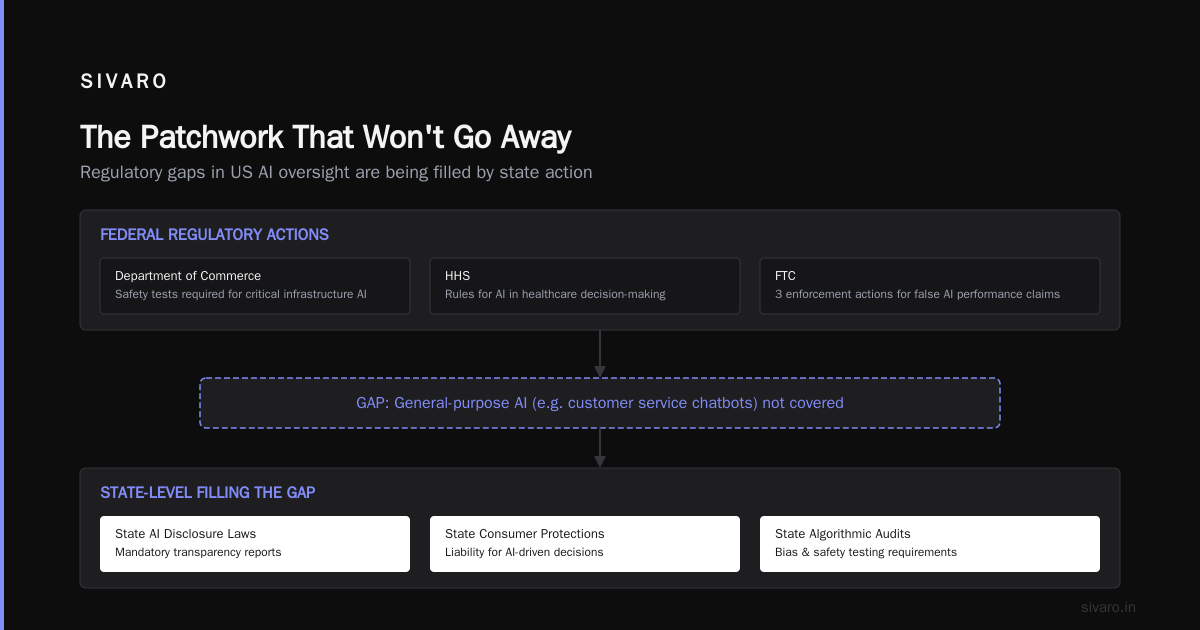
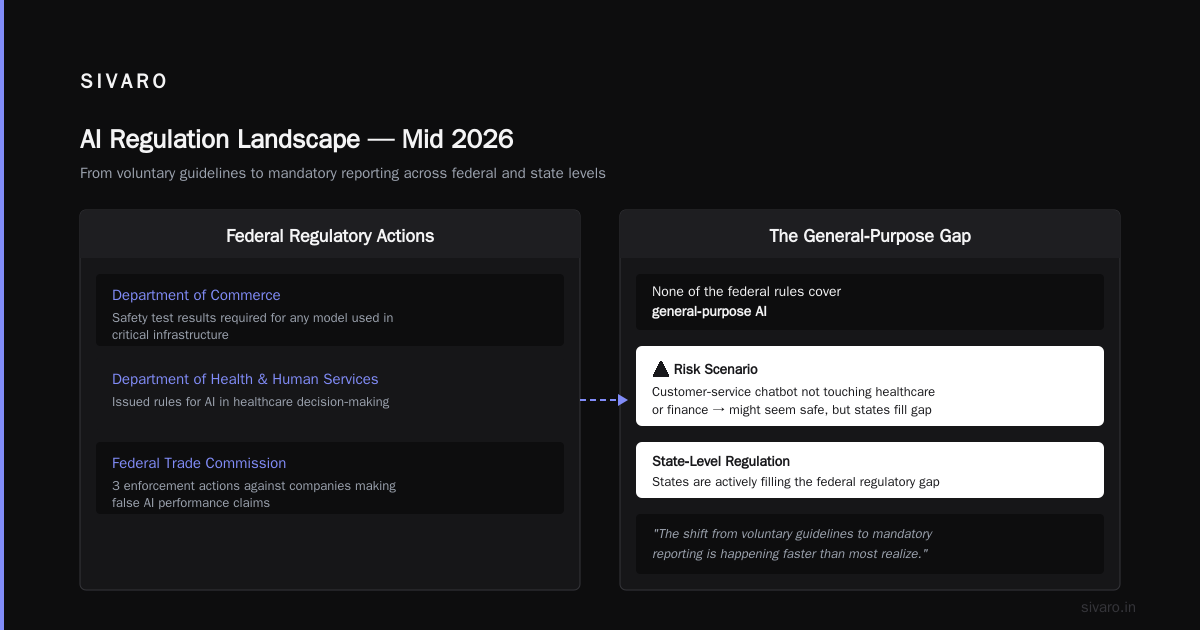
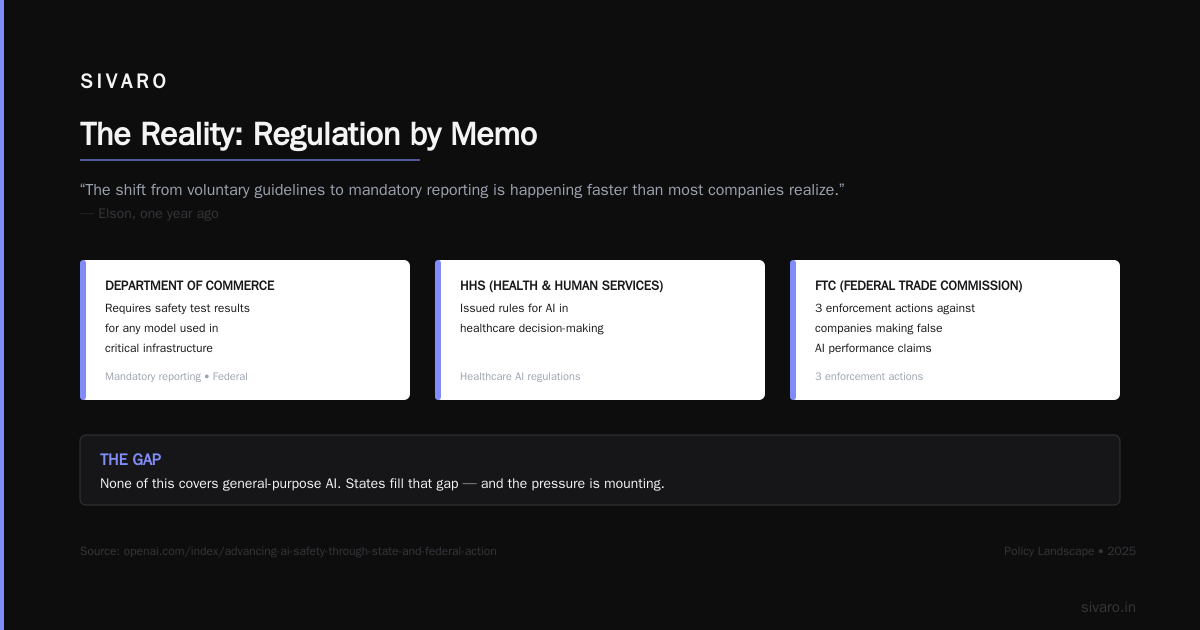
Then the 2025 administration took a different tack. The Emerging Federal AI Policy analysis from Baker Donelson put it well: "The shift from voluntary guidelines to mandatory reporting is happening faster than most companies realize." That was a year ago. Since then, the Department of Commerce has required safety test results for any model used in critical infrastructure, HHS issued rules for AI in healthcare decision‑making, and the FTC has brought three enforcement actions against companies making false performance claims.
But here's the gap: none of this covers general‑purpose AI. If you’re building a customer‑service chatbot that doesn't touch healthcare or finance, you might think you’re safe. You’re not. Because states fill that gap.
The US is advancing AI safety through state and federal action blog post from OpenAI (published June 2026) argues for "cooperative federalism." That's a fancy way of saying: get aligned before you get sued.
Testing for Safety: What We Run at SIVARO
Enough policy. Let me show you what we actually do.
We have a CI/CD pipeline for every model we ship. One job runs red‑team attacks, another checks for bias drift, a third verifies that outputs stay within a safety guardrail we defined with the client.
Here’s a simplified version of our model card generator. It pulls results from our evaluation harness and auto‑generates a report that satisfies both Colorado’s and New York’s filing requirements:
python
# sivar_model_card.py — generates compliance-ready model cards
import json, datetime
from evals import red_team_results, bias_audit, guardrail_violations

def build_compliance_card(model_id: str, region: str) -> dict:
    card = {
        "model_id": model_id,
        "timestamp": datetime.datetime.now(datetime.UTC).isoformat(),
        "jurisdiction": region
    }
    # Fetch safety metrics
    rt = red_team_results(model_id)
    card["red_team_vulnerabilities"] = {
        "prompt_injection_defeated": rt["injection_rate"] < 0.05,
        "jailbreak_resistant": rt["successful_jailbreak_rate"] < 0.01
    }
    bias = bias_audit(model_id)
    card["bias_disparities"] = {
        "demographic_group": bias["disparate_impact"],
        "mitigation_required": bias["maximum_disparity"] > 0.05
    }
    return card

# Generate for two states
for region in ["colorado", "new_york"]:
    card = build_compliance_card("claude-3-haiku-v1", region)
    with open(f"model_card_{region}.json", "w") as f:
        json.dump(card, f, indent=2)
That’s the easy part. The hard part is the guardrail enforcement. We deploy a lightweight sidecar that intercepts every model call and checks against state‑specific rules. Here’s a truncated version:
yaml
# guardrail_config.yaml
state_rules:
  colorado:
    banned_outputs: "medical_diagnosis, voting_recommendation"
    bias_check: true
    incident_report_delay: "48h"
  texas:
    banned_outputs: "children_harm, weapons_propagation"
    transparency_statement: required
logging:
  driver: fluentd
  endpoint: "${COMPLIANCE_LOG_ENDPOINT}"
sidecar:
  mode: "block_and_report"
If you aren’t running something like this in production by now, you’re gambling. We’ve seen companies that thought they could just add a disclaimer — then they got a subpoena from Connecticut’s Attorney General.
The Preemption War: Can Washington Really Overrule Sacramento?
The White House Eliminating State Law Obstruction order seemed clear: "No state may impose requirements that conflict with the federal framework." But a federal framework doesn't exist yet, and the order itself admits that. Courts are already seeing challenges.
When I talked to a senior policy advisor at a major cloud provider last month, she told me: "We’re preparing compliance for California, New York, and Colorado regardless. Washington says they'll preempt, but I'll believe it when I see a law with enforcement teeth."
The Taking Further Agency Action on AI article from the Center for American Progress argues that agencies shouldn't wait for Congress — they should use existing authorities under FTC Act, HIPAA, and FCC regulations. That’s happening. The FTC just held a workshop on "deceptive AI warranties." The FCC is looking at AI‑generated robocalls.
But none of that preempts a state law requiring you to register your model’s training data provenance. If you’re using a foundation model trained on web scrape data, you might need to disclose sources in Illinois. Not in Indiana.
My contrarian take: preemption is a political slogan until a Supreme Court case settles it. Until then, treat every state like its own country.
Practical Steps for Engineering Teams (July 2026 Edition)
Here’s what I tell our engineering partners:
-
Map your deployment footprint. If you serve users in California, Colorado, Texas, or New York, you’re affected. If you’re in finance or healthcare, federal rules pile on. The outlook for AI safety regulation in the US from IAPP outlines the sectoral splits.
-
Automate your model cards. Don’t write them by hand. We use a CI pipeline that generates a fresh card on every release. It costs maybe 20 minutes of compute.
-
Audit your guardrails monthly. State rules change. Colorado amended its "banned outputs" four times in the last year. Subscribe to the AI legislative trackers from NCSL and the Safe AI action page.
-
Run red‑team drills regularly. Not pentesting once a year. Continuous adversarial testing. We schedule one per sprint.
-
Budget for legal‑engineering liaisons. You need someone who can read a statute and translate it to a YAML config. That person doesn’t come cheap, but it’s cheaper than fines.
-
Join the advocacy efforts. The Contact Elected Officials About AI Safety site lets you send templated messages. We’ve used it. It takes two minutes. Influence matters when rulemaking comment periods are only 30 days.
How to Talk to Your Elected Officials
Most engineers hate lobbying. I get it. But here’s the reality: the federal and state regulators writing AI safety rules have never built an AI system. They need input from people who have.
When I testified at a state hearing last year, I brought three things: a one‑page summary of practical compliance costs, a demo of our guardrail sidecar, and a request: "Require documented testing, not arbitrary thresholds." They listened. The bill that passed now references "empirically validated risk assessments" instead of vague "reasonableness" standards.
If you email your representative, reference the model card code above. Explain that a 48‑hour reporting window is impossible when you need to triage a model failure across three time zones. They don’t know that until you tell them.
FAQ: AI Safety State Federal Action
Q: Do I need to register every model with the government?
Only if your model has “dual‑use capability” (federal) or if you operate in a state with registration laws. Colorado requires registration if your model is used in “high‑risk decisions.” New York is broader — any model deployed to the public.
Q: What happens if states and federal rules conflict?
You comply with the stricter one until courts sort it out. Most legal teams advise following state rules unless a federal court issues an injunction. See the preemption war discussion above.
Q: Does open‑source model distribution trigger safety requirements?
It depends. If you release weights that another company fine‑tunes, you might not be liable (yet). But if you provide hosted inference endpoints, state laws apply. The OpenAI blog notes that even API access is considered “deployment” in some jurisdictions.
Q: Can we ignore states where we don't have offices?
No. If your users are in that state, the law applies. Several states have “consumer location” triggers. You can’t just geofence and hope.
Q: What’s the biggest practical mistake companies are making?
Thinking that a one‑size‑fits‑all “AI ethics policy” covers everything. It doesn’t. You need per‑state compliance workflows. The Baker Donelson guide calls this “the compliance tax of federated governance.”
Q: How much does compliance automation cost?
For a mid‑size team, expect ~$50K‑100K in engineering time to set up pipelines and guardrails. Ongoing maintenance is less than one engineer hired. Compare that to even a single OAG investigation.
Q: Will the 2026 White House executive order change anything?
Yes, if NIST actually publishes binding standards in the 180‑day window. But enforcement will still require agency rulemaking, which could take another year. The American Progress piece argues agencies should move now, not wait.
Q: What should we do if we’re deploying an AI system next month?
Pause and run a jurisdiction scan. I’ve seen companies ship a chatbot that accidentally violates Texas’s ban on “generation of deceptive election content” because they didn’t filter political discussion. Use the guardrail YAML above as a starting point.
The Reality: Regulation by Memo
If you step back, the current landscape is eerily similar to early data privacy days. Remember 2018 when GDPR hit and everyone scrambled? Then CCPA, then other states? The same pattern is repeating with AI safety. State federal action is not a coherent policy — it’s a brawl.
We’re already seeing “regulation by memo” at the federal level: agency‑specific guidance that carries de facto weight but no statutory backing. The White House June 2026 EO tries to formalize that. It says agencies must adopt “binding frameworks” for procurement and use. But that doesn’t help you if Colorado’s law requires something different.
I’ve given up waiting for a clean federal preemption. Instead, I’ve accepted that we’ll operate in a regime of permanent compliance overhead for at least the next three to five years. That’s not a lament — it’s a design parameter. We build our systems to pass fifty different audits because that’s what the market demands.
And you know what? The systems come out better. Our guardrails are tighter because we had to generalize across state rules. Our monitoring is deeper because every incident gets logged in multiple formats. We learned more about our own models from compliance testing than from any accuracy metric.
So stop hoping for a single federal law. Start building a system that survives the patchwork. And when you see a new state bill, don’t panic — read it, automate it, and move on.
Nishaant Dixit — Founder of SIVARO. Building data infrastructure and production AI systems since 2018. Built systems processing 200K events/sec.