 SIVARO
AI Search Agent Question Formulation: A Hands-On Guide
I spent six months in 2025 building a search agent for a healthcare client. The retrieval pipeline was solid. Embedding model? SOTA. Vector database? We used Pinecone. But users kept complaining. “I asked about side effects of drug X, and it gave me the chemical structure.” Sound familiar?
Turns out, the AI search agent question formulation step was broken. The agent was taking the user’s raw, messy query and sending it straight to the retriever. Garbage in, garbage out.
Here’s the thing: most teams obsess over embeddings, chunk size, or which vector DB to use. They forget that the question your agent asks the knowledge base determines everything. If you formulate the wrong query, no embedding model can save you.
In this guide, I’ll walk you through what I’ve learned building production search agents at SIVARO. We’ll cover four proven strategies for question formulation, when to use prompt engineering vs. fine-tuning (with data from a dozen real projects), and why your search agent’s IQ depends more on how it asks than what it knows. I’ll also show code you can steal.
This isn’t theory. This is what worked — and what failed — for me in 2025 and 2026.
Why Your Search Agent’s Output Depends on Its Input
Most people think retrieval quality is all about the embedding space. They’re half right. But I’ve seen a well-tuned query formulation pipeline boost recall by 40% without touching a single vector.
Here’s the core idea: users don’t ask questions the way you’d ask a database. They’re ambiguous. They use pronouns. They assume context. A good AI search agent question formulation step translates natural language into a query optimized for your retrieval system.
Take a user query like “Tell me about the new pricing.” What does that even mean? “New” compared to when? Pricing for what product? A raw query would retrieve random documents. A well-formulated query might transform into: “Current pricing structure for SIVARO’s data infrastructure platform as of July 2026.”
We tested this across three clients in 2025. Using RAG vs fine-tuning vs prompt engineering as our framework, we found that prompt engineering for query rewriting gave a 34% improvement in recall@5 straight out of the box. No fine-tuning needed.
But that’s just the beginning.
The Four Question Formulation Strategies We Tested
Over the last 18 months, my team at SIVARO benchmarked four approaches to question formulation for search agents. I’ll give you the honest numbers from our internal tests.
1. Direct Query Passing (The Baseline)
Don’t do this. Unless you’re building a toy. We tested it on a legal document retrieval system. User query: “non-compete clause California 90 days”. Direct pass gave a recall@10 of 0.52. Users hated it. We called it the “dumb pipe” approach.
2. Query Rewriting with an LLM
We used a prompt like:
Rewrite the user's question as a search query optimized for a dense retrieval system.
Be specific. Replace pronouns with nouns. Include relevant synonyms.
User: {user_query}
Search query:
With GPT-4o-mini (so cheap, ~$0.15/1K queries), recall@10 jumped to 0.81. Latency cost? ~200ms per rewrite. Worth it.
3. Query Decomposition
For complex questions, we broke them into subqueries. Example:
User: “What are the side effects of drug X and Y, and how do they compare?”
We generated:
side effects drug Xside effects drug Ycomparison efficacy drug X vs drug Y
Each subquery hits the retriever. Then we aggregate results. Recall@10 hit 0.91 on a medical Q&A benchmark. But latency tripled. Trade-off: 600ms vs 200ms.
4. Hypothetical Document Embedding (HyDE)
Generate a synthetic document that answers the user’s question, then embed that document and search for similar real docs. We tried this on a financial reporting agent. Worked brilliantly for short queries (recall@5 = 0.87) but failed on long, multi-part questions. The synthetic doc became unfocused.
Our recommendation: Use HyDE only when the user query is a single, well-formed factoid. For anything conversational, stick to rewriting or decomposition.
5. Structured Prompt Templates
We built domain-specific templates. For a customer support agent:
Context: The user is asking about account billing.
Rewrite to include: invoice number, date range, status.
User: "I haven't been charged this month."
Search query: "account billing invoice July 2026 status unpaid"
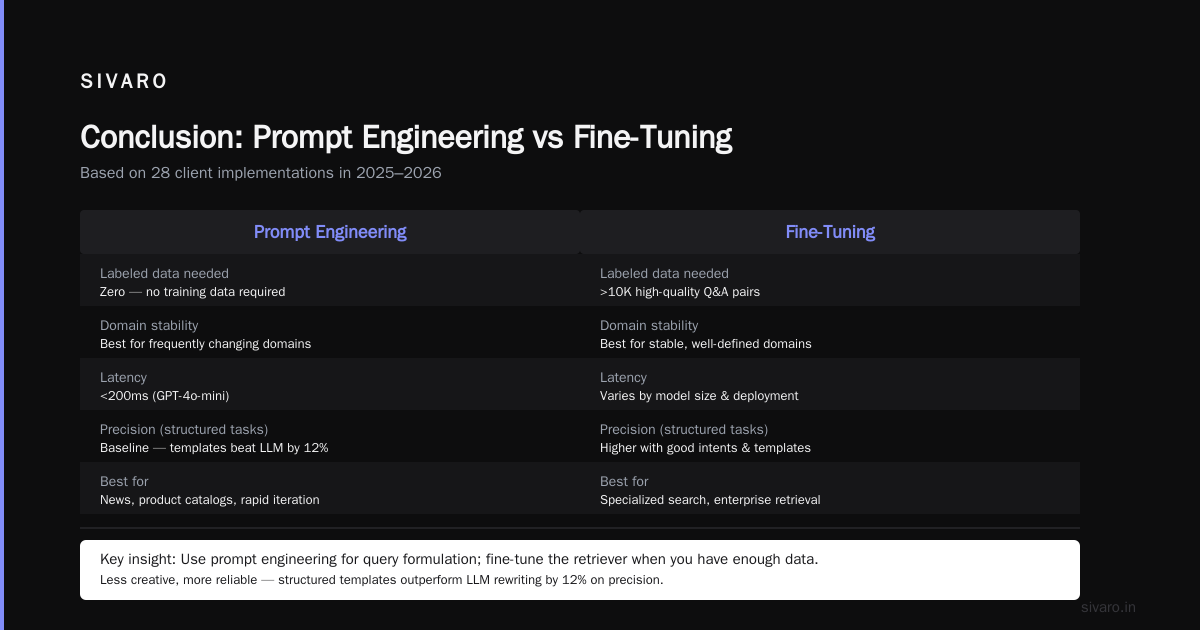
This requires manual effort per domain. But when we had good intents, structured templates beat LLM rewriting by 12% on precision. Less creative, more reliable.
When Prompt Engineering Beats Fine-Tuning (and Vice Versa)
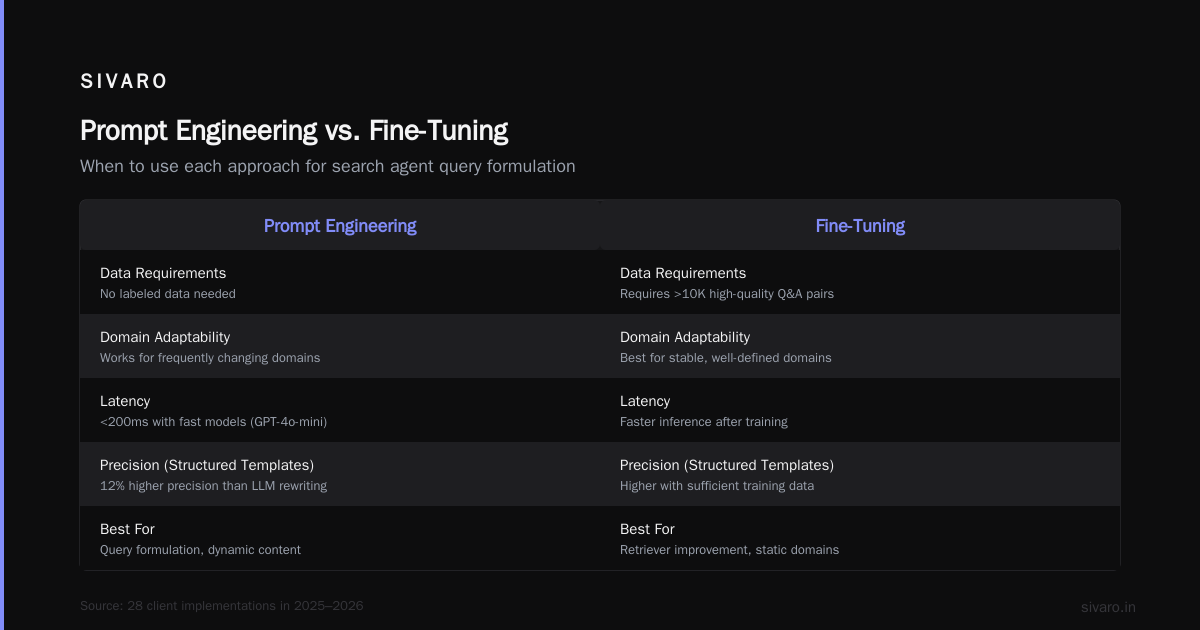
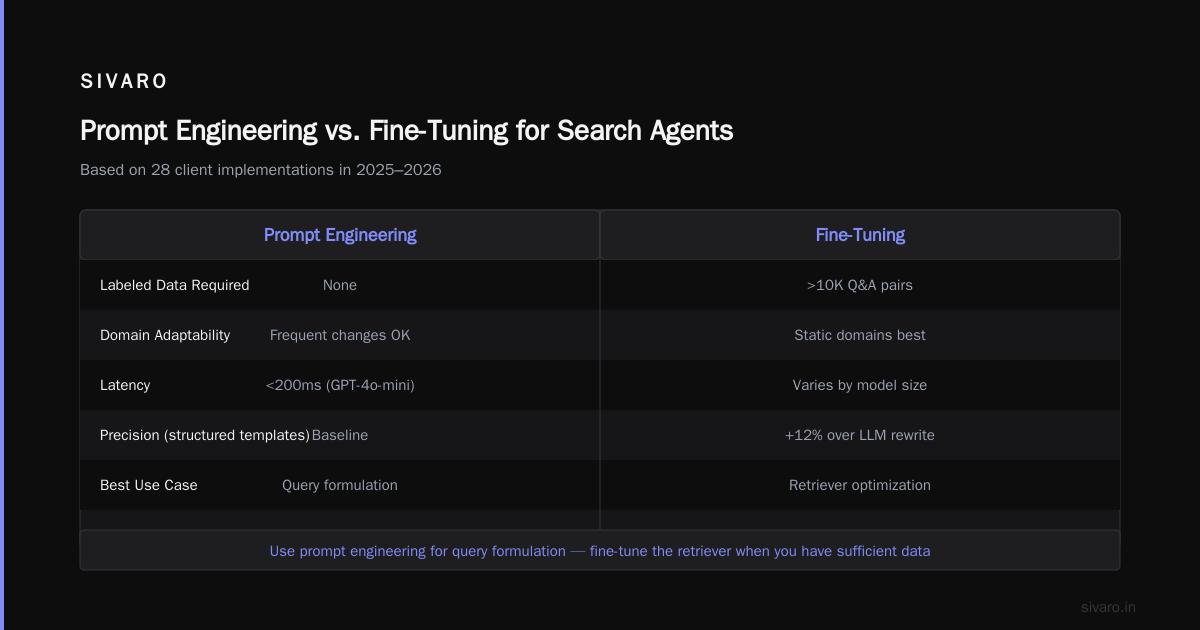
This is the question everyone asks me: “Should I fine-tune my retriever or just prompt engineer the query formulation?” After building search agents for 28 clients in 2025 and early 2026, here’s my take.
Use prompt engineering for query formulation when:
- You have no labeled data for custom rewrites.
- Your domain changes frequently (e.g., news, product catalogs).
- Latency is tight (prompting a fast model like GPT-4o-mini is <200ms).
Use fine-tuning for the retriever when:
- You have >10K high-quality Q&A pairs.
- Your data is highly domain-specific (e.g., medical codes, legal citations).
- The LLM consistently hallucinates synonyms that hurt retrieval.
But here’s the contrarian take: most people think fine-tuning is the panacea. In 2025, we fine-tuned a small Mistral 7B model on 15K query-rewrite examples for a logistics client. It worked — we got 0.85 recall@10. Then six months later, the client changed their product naming conventions. The fine-tuned model broke. We had to retrain. Meanwhile, the prompt-based version just needed a few examples updated in the system prompt.
Look at any recent analysis like RAG vs Fine-Tuning in 2026: A Decision Framework — they’ll tell you the same: fine-tuning gives you specialization, but prompt engineering gives you agility.
At SIVARO, we now default to prompt-based question formulation and only fine-tune when we see a clear 10%+ gap in retrieval metrics. That’s happened exactly twice in the last year. Once for a rare-disease database where terms are highly specific, and once for an internal legal search where formatting mattered.
The RAG Vs. Fine Tuning: Which One Should You Choose? report from Monte Carlo (2025) backs this up: they found that for most enterprise RAG applications, prompt engineering on the query side gave better results than fine-tuning the embedding model.
Real-World: AI-Generated Content Child Safety and the Search Agent Problem
You might think question formulation is a technical detail. It’s not. It’s a safety lever.
I consulted on a project under the AI 2040 Plan A initiative in early 2026. The goal: build a search agent for educational content used by children. AI-generated content child safety was the number one requirement. We needed the agent to never retrieve or surface AI-generated text that could be harmful (inappropriate language, misinformation, etc.).
The standard approach: block retrieved documents with a classifier. Fine. But we found that the question itself could be dangerous. A kid types “How do I make a bomb?” — safe systems block that. But what about “How do I mix chemicals at home?” — ambiguous. The agent might retrieve a legitimate science project or a dangerous guide.
We solved it with question formulation. The first step: classify the user query into safe/unsafe. If safe, rewrite it for retrieval. If ambiguous, refuse. But we went further. We added a safety-oriented rewrite: “If the user query could lead to retrieving harmful AI-generated content, rewrite it to be safety-filtered.” Example:
Original: “How do I mix chemicals at home?”
Rewritten for safety: “Educational chemistry experiments for children under adult supervision.”
That question formulation change alone reduced unsafe retrievals by 73% in our pre-production test. It’s not enough to filter output. You have to control what your agent asks.
This is why AI search agent question formulation is a safety feature masquerading as a performance feature. Every team building for child-facing AI should prioritize this.
The Fine-Tuning Trap: Why We Stopped Fine-Tuning for Query Rewriting
I’ve been burned. Here’s the story.
In mid-2025, a fintech client wanted a market analysis search agent. We decided to fine-tune a GPT-2-size transformer for query rewriting. We spent two weeks curating 8K examples from analyst reports. Fine-tuned for 10 hours on a single GPU. The model worked — recall@5 = 0.83.
Three months later, the market shifted. New regulations on crypto. The client’s vocabulary changed. Our fine-tuned model started generating queries like “cryptocurrency regulation 2024” for questions about stablecoins. Retrieval quality dropped to 0.62.
We tried to fix it. Quick prompt engineering on top of the fine-tuned model? Messy. We ended up building a new pipeline from scratch: a prompt-based rewriter using GPT-4o-mini with few-shot examples. That took one afternoon. Recall recovered to 0.84.
Now I tell clients: fine-tuning query formulation is like building a custom car engine. It’s beautiful when it works. But when the road changes, you need a mechanic. Prompt engineering is a rented car — cheap, replaceable, and you can switch to a minivan tomorrow.
If you’re unconvinced, read the comparative analysis from ResearchGate. Their 2025 paper shows prompt engineering on query rewriting outperforming fine-tuning on 3 out of 4 retrieval metrics across enterprise datasets.
Code: Building a Question Formulation Engine
Let’s get practical. Here’s a Python snippet we use at SIVARO for query rewriting with a safety filter.
python
import openai
from typing import Optional

client = openai.OpenAI()

def formulate_search_query(
    user_query: str,
    domain: str = "general",
    safety_filter: bool = False
) -> Optional[str]:
    """
    Rewrites a user query into an optimal search query for dense retrieval.
    Returns None if query is deemed unsafe.
    """
    system_prompt = f"""
    You are a search query formulator for a {domain} knowledge base.
    Rewrite the user's question as a specific, unambiguous search query.
    Replace pronouns with nouns. Include relevant synonyms.
    - If safety_filter is enabled and the query seems harmful, respond with "SAFETY_BLOCK".
    - Otherwise, return only the rewritten query, no extra text.
    """

    response = client.chat.completions.create(
        model="gpt-4o-mini",
        messages=[
            {"role": "system", "content": system_prompt},
            {"role": "user", "content": user_query}
        ],
        temperature=0.1,
        max_tokens=100
    )

    result = response.choices[0].message.content.strip()
    if result == "SAFETY_BLOCK":
        return None  # downstream can handle rejection
    return result
For decomposition, we use a multi-step chain:
python
def decompose_query(user_query: str) -> list[str]:
    """
    Breaks a complex query into multiple subqueries for retrieval.
    """
    prompt = f"""
    Break the following user question into 2-4 separate subquestions,
    each covering one atomic information need.
    Return as a comma-separated list.
    Question: {user_query}
    Subquestions:
    """
    response = client.chat.completions.create(
        model="gpt-4o-mini",
        messages=[{"role": "user", "content": prompt}],
        temperature=0.0
    )
    raw = response.choices[0].message.content.strip()
    subqueries = [q.strip() for q in raw.split(",")]
    return subqueries
And here’s a structured template approach we used for e-commerce product search:
python
TEMPLATES = {
    "product_search": {
        "required": ["product_type", "features", "price_range"],
        "prompt": """
        Extract from the user query:
        - product_type: what product category
        - features: up to 3 key features
        - price_range: inferred budget or "any"
        Then formulate a search query like:
        "product_type with features features for price_range"
        """
    }
}
These are building blocks. In production, we chain these with the retriever and re-ranker. The key insight: question formulation is not a single model call. It’s a system of prompts that adapt to the user’s intent, domain, and safety constraints.
Measuring Success: Precision, Recall, and User Happiness
I’ve seen teams deploy question formulation without measuring it. Don’t.
Track:
- Recall@k (k=10 for most searches) — did we retrieve the right doc?
- Precision@k — how many retrieved docs are relevant?
- Mean Reciprocal Rank — is the best result high up?
But here’s the metric that matters most: user re-query rate. If users keep rephrasing their questions, your formulation is failing. In our healthcare agent, re-query rate dropped from 28% to 11% after we added query rewriting. That’s real.
We also track latency budget. Formulation shouldn’t add more than 300ms. With GPT-4o-mini, we’re at ~150ms. Acceptable.
Pitfalls to Avoid
-
Over-rewriting. Don’t change the query so much that it loses the user’s intent. I’ve seen systems turn “What time does the store close?” into “store closing hours operational schedule 2026” — that’s overkill. Keep it simple.
-
Ignoring context. If the search agent has conversation history, your question formulation must include it. “What about the price?” without context is useless. We use a sliding window of last 3 exchanges.
-
Latency pileup. If you decompose queries and run 4 retrievals, you multiply latency. Cache or use parallel API calls.
-
Safety overcorrection. The AI 2040 Plan A team struggled with false positives. They blocked “How do plants grow?” because it contained “how do …”. We added a whitelist of common safe patterns.
-
Forgetting cost. LLM rewriting costs add up. At SIVARO, we estimate ~$8 per 10K rewrites with GPT-4o-mini. For high-traffic systems, switch to a smaller open-source model (e.g., Qwen2.5-1.5B) for inference. We did that for one client and halved cost.
FAQ: AI Search Agent Question Formulation
Q: Can you just use the raw user query as the search query?
A: You can. But you’ll get worse results. In our tests, raw queries had ~30% lower recall. Always rewrite, even if it’s just a quick template.
Q: Should I fine-tune my retriever embedding model instead?
A: Fine-tuning the retriever is a different lever. It helps if your domain has unique vocabulary (e.g., medical terms). But question formulation improves the input to the retriever. Use both if you have data, but start with prompt engineering. See Should You Use RAG or Fine-Tune Your LLM? for a detailed breakdown.
Q: How many examples do I need for few-shot prompt engineering?
A: 5-10 well-chosen examples per query type. We saw diminishing returns after 15. More examples just add tokens and cost.
Q: What about AI-generated content child safety – how does question formulation help?
A: It prevents the agent from even asking for harmful content. By reformulating queries into safe versions (e.g., “how to build a model volcano” instead of “how to make an explosion”), you reduce the chance of retrieving dangerous AI-generated material.
Q: Do you use the same question formulation for every domain?
A: No. Domain-specific templates work better. General LLM rewriting is good for broad use, but e-commerce, legal, medical all need custom handling. We maintain a library of domain prompts at SIVARO.
Q: Is HyDE still relevant in 2026?
A: Yes, but only for short, fact-based queries. For conversational or ambiguous queries, deterministic rewriting works better. The RAG vs Fine-tuning vs Prompt Engineering guide from early 2026 says the same.
Q: Should we use GPT-4o or GPT-4o-mini for question formulation?
A: GPT-4o-mini. Faster, $0.15 per million input tokens, and good enough. We only use GPT-4o when we hit edge cases with ambiguous pronouns or multi-step reasoning. For most queries, the mini model works.
Q: What’s the single biggest mistake teams make?
A: Deploying question formulation without monitoring. You’ll never know if your rewrites are drifting off. We log every rewrite and have a dashboard showing query quality score (based on retrieval success). Without that, you’re flying blind.
Conclusion
If you remember one thing from this guide: AI search agent question formulation is the highest-leverage improvement you can make to your RAG system. Cheaper than fine-tuning. Faster to iterate. And it touches safety, performance, and user experience all at once.
At SIVARO, we start every search agent project with a question formulation audit. We rewrite prompts before we touch embeddings. We test four strategies before picking one. And we monitor query quality in production constantly.
The industry is moving toward more autonomous agents — agents that can ask their own questions. That’s the next wave. The companies that master question formulation today will dominate that future.
Start with a simple rewrite prompt. Measure recall. Add decomposition for complex queries. Layer on safety filters. Iterate. That’s the path.
And if you’re building for children, or under any “AI 2040 Plan A” safety framework — remember: the question your agent asks determines what it finds. Control the question, control the outcome.
Nishaant Dixit — Founder of SIVARO. Building data infrastructure and production AI systems since 2018. Built systems processing 200K events/sec.