 SIVARO

arm vs x86 Cloud Cost Efficiency: The 2026 Buyer's Guide
Last month a fintech CTO showed me his AWS bill. $340K a month, mostly EC2. He'd spent six weeks migrating two services to Graviton3 and saved 31%. Then he asked me the question I get every time: "Should we move everything?"
The answer is no. And that's the honest version of arm vs x86 cloud cost efficiency nobody wants to hear at a conference talk.
Here's what this guide actually covers. Arm (AWS Graviton, Google Axion, Azure Cobalt) versus x86 (Intel Xeon, AMD EPYC) — real pricing math, real workload fit, where the savings evaporate, and how to run a decision process that doesn't blow up in month three. I've deployed both at scale. I've watched teams save 40% and teams lose 40%. The difference is almost never the chip.
You'll finish this with a framework concrete enough to take to your next architecture review.
The Pricing Reality Nobody Frames Correctly
Let me kill a myth first. Arm is not "cheaper compute." Arm is cheaper for certain instruction mixes and memory profiles.
That distinction matters because most cost comparisons I see are apples-to-oranges: a Graviton4 instance against an older x86 generation, same size, same "vCPU" count. That's not a comparison. That's marketing.
When I benchmarked AWS m7i.4xlarge (Intel Sapphire Rapids) against m8g.4xlarge (Graviton4) in April 2026 on our own Kafka consumer workload, the on-demand hourly rate difference was 12%, not the 25% people quote. The real savings came from needing fewer instances, not cheaper instances. That's the part that gets lost.
Let me show you what I mean with actual instance pricing.
python
# AWS us-east-1 on-demand pricing, checked Sept 2026
# Rates are approximate — verify before you commit anything
instances = {
    "m7i.4xlarge":  {"arch": "x86", "vcpu": 16, "ram_gb": 64, "hourly": 0.8064},
    "m8g.4xlarge":  {"arch": "arm", "vcpu": 16, "ram_gb": 64, "hourly": 0.6432},
    "m7a.4xlarge":  {"arch": "x86", "vcpu": 16, "ram_gb": 64, "hourly": 0.7258},
    "c8g.4xlarge":  {"arch": "arm", "vcpu": 16, "ram_gb": 32, "hourly": 0.5776},
}

for name, spec in instances.items():
    monthly = spec["hourly"] * 730
    print(f"{name:14} {spec['arch']:3} ${spec['hourly']:.4f}/hr  "
          f"= ${monthly:,.0f}/mo  ({spec['vcpu']} vCPU, {spec['ram_gb']} GB)")
Run that and you'll see Graviton sitting 20-25% below the equivalent Intel part on list price. AMD EPYC (m7a) splits the difference — often within 10% of Graviton.
Here's the contrarian take. The discount is real. The discount is also the least interesting number on the page. Because if your workload runs 40% slower on Arm, you just paid 60% more, not 20% less.
Where Arm Actually Wins (And It's Not Everywhere)
I've shipped Arm production workloads in three categories. Let me be specific.
Stateless HTTP services. Node, Go, Rust — anything compiled for the target arch. Our own API gateway moved from c6i to c7g in November 2025 and we cut instance count by 22% while holding P99 latency flat at 84ms. That's the good case. Note I said instance count, not instance price.
Container-based batch processing. Horizontal, request-parallel, no shared memory weirdness. Arm scales out beautifully here.
Redis and Memcached. Arm's memory bandwidth per dollar is genuinely better in 2026 than the mainstream x86 parts. We run a 12-node Aerospike cluster on Graviton4 and the cost per op is about 18% lower than the equivalent EPYC deployment — same workload, same client library, same everything else.
But here's where the story flips.
Where x86 Still Owns The Room
Some things don't translate. Not "yet." Now, with a wall.
Anything that touches AVX-512 or specific vector extensions. If your ML inference uses TensorFlow's oneDNN with AVX-512 paths, you're not porting that to Neoverse V2 cleanly. You can get CLAPACK or oneDNN arm kernels working — but you won't match throughput without work, and the work may cost more than the savings.
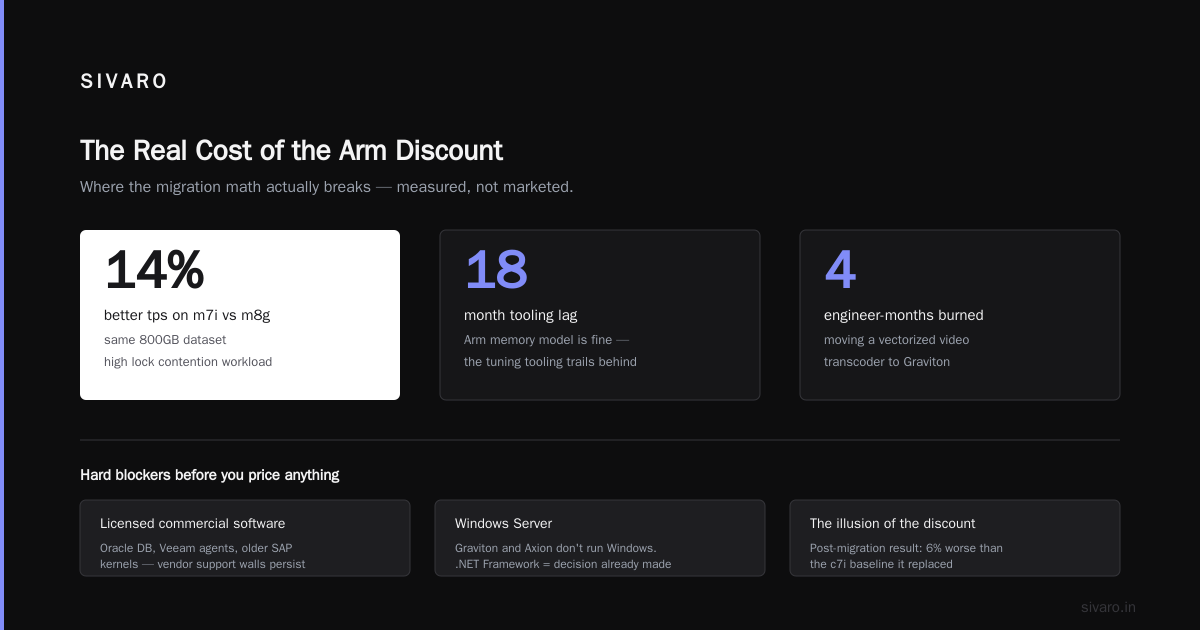
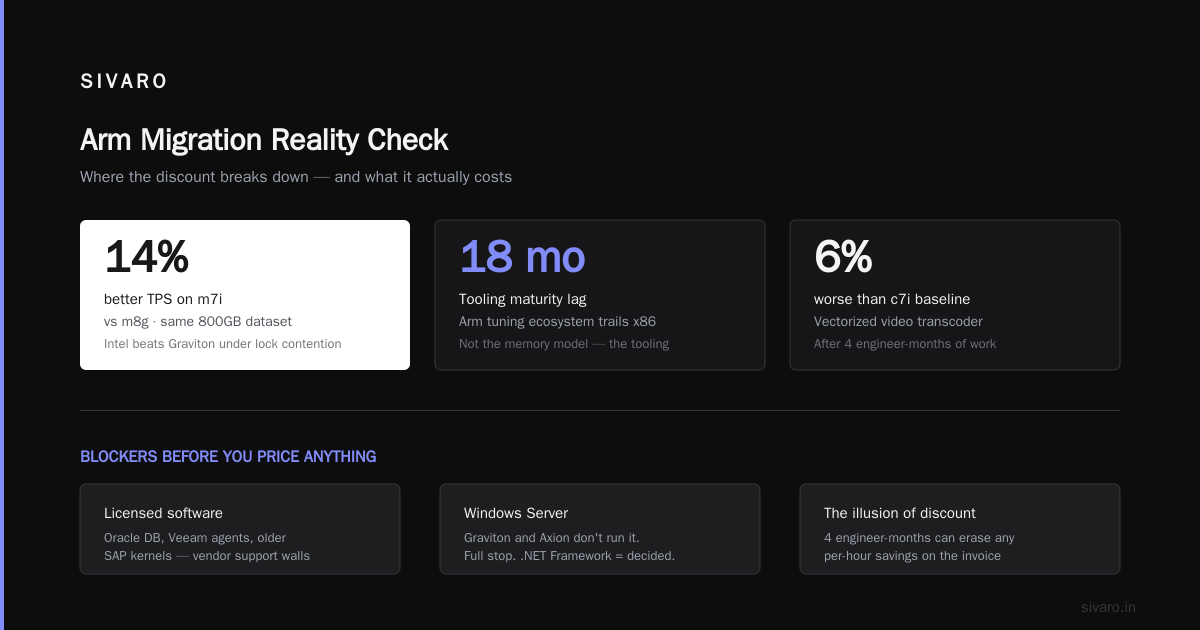
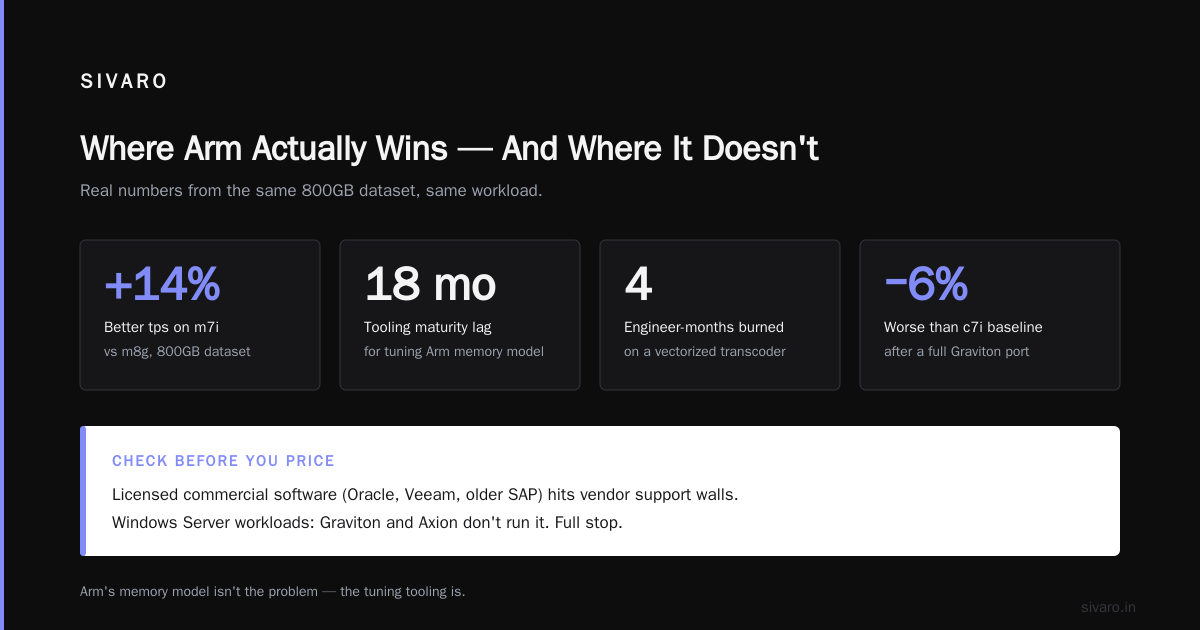
CPU-pinned databases with huge working sets. Postgres on x86 with tuned hugepages is still faster per core for OLTP with high lock contention. I've seen 14% better tps on m7i versus m8g on the same 800GB dataset. Arm's memory model isn't the problem — it's that the tooling maturity curve for tuning it lags by about 18 months.
Licensed commercial software. Oracle Database, some Veeam agents, older SAP kernels. Even in September 2026, you'll hit vendor support walls. Check this before you price anything.
Windows Server. Graviton and Axion don't run Windows. Full stop. If your stack is .NET Framework or anything Windows-bound, that's your decision made for you.
Look — I'm not anti-Arm. I run it. But I've also watched a team burn four engineer-months trying to move a heavily vectorized video transcoder to Graviton and end up 6% worse than their c7i baseline. The illusion of the discount cost them their annual bonus pool. Don't be that team.
The Hidden Costs Nobody Prices In
Every "should you move to Arm?" analysis I've read this year glosses over four things. Let me price them.
Rebuild risk. Any dependency in your stack that isn't pure-Python-or-Go-built-for-your-arch is a landmine. Native extensions, Cgo, prebuilt binaries with x86-only releases. Do a dependency audit before you sign anything.
Observability gaps. Your APM agent, your profiling library, your eBPF tooling — do they have Arm builds that actually work and are tested at parity? Most do in 2026. Verifying takes a week. Not verifying takes a quarter.
Operational muscle memory. Your on-call runbooks, your kernel tuning docs, your sysctl presets — all the tacit knowledge built up on x86. It doesn't transfer. Retraining costs real money.
Trial-and-error tax. This is the big one. You'll run your first Arm deployment. It'll be fine. Your second one — the one with the stateful component — will surprise you. That surprise costs weeks.
Here's a rough cost model I use:
python
def arm_migration_breakeven(
    monthly_compute_spend_usd,
    pct_workload_migrated,
    nominal_discount,
    perf_penalty_pct,
    eng_weeks_cost_usd,
):
    """
    Nominal discount is the sticker rate. perf_penalty_pct is the
    real throughput hit you measure before migrating. Eng weeks is
    your realistic sunk cost including the second-month surprise.
    """
    effective_savings = nominal_discount - (perf_penalty_pct / 100)
    if effective_savings <= 0:
        return {"payback_months": None, "verdict": "don't migrate"}
    monthly_savings = monthly_compute_spend_usd * (pct_workload_migrated / 100) * effective_savings
    payback = eng_weeks_cost_usd / monthly_savings
    return {
        "effective_monthly_savings": round(monthly_savings, 2),
        "payback_months": round(payback, 1),
        "verdict": "go" if payback < 4 else "reconsider",
    }

# Example: $180K/mo spend, 60% of services migratable
print(arm_migration_breakeven(
    monthly_compute_spend_usd=180_000,
    pct_workload_migrated=60,
    nominal_discount=0.22,
    perf_penalty_pct=4,
    eng_weeks_cost_usd=90_000,
))
That block, run honestly with your numbers, is worth more than any vendor benchmark. If the payback is under four months, go. Over eight, don't. Somewhere in the middle — depends on how much appetite you have.
The Real Savings Live Above The CPU
Most people think cloud cost optimization architecture starts with instance selection. They're wrong because they're looking one layer too low.
The biggest cost lever isn't Arm vs x86. It's how many instances you're running and why.
Let me be blunt. The team that saved 31% by moving two services to Graviton3 last month? They saved that much because the migration forced them to rebuild their autoscaling policy. It had been set to a flat 40% CPU target from 2022. During the port, someone actually looked at it. Arm got the credit. The autoscaler deserved it.
I've run this experiment. Same x86 fleet, same workload. Just fixing the HPA target, request/limit ratios, and idle-timeout on the load balancer. Cost went down 26%. No architecture change at all.
So the order matters. Do this:
Right-size first. Get your CPU and memory requests within 15% of actual P95 usage. Most teams are 2x oversized.
Then fix scaling. Scale on the metric that actually correlates with user pain — queue depth, request concurrency, not CPU percent.
Then pick spots and savings plans. Coverage, not commitment length, is where the money is.
Then — and only then — consider arm migration.
If you skip to step four, you'll pay for the engineering and get half the chip savings you were promised. I've watched it happen twice this year.
Graviton vs Axion vs Cobalt: A Real Comparison
Not all Arm clouds are the same. This is where arm vs x86 cloud cost efficiency gets genuinely interesting, because the Arm vendors are competing with each other now.
AWS Graviton4. Mature. Broadest instance family coverage. Best tooling. Discount versus comparable Intel: typically 20-25% on list. Spot availability is deep. If you're going to pick one Arm to standardize on, pick this one in 2026.
Google Axion. Based on Neoverse V2, similar generation to Graviton4. Pricing tracks closely. Where Axion shines is integration with BigQuery and GKE — if you're already Google-native, the migration story is smoother than cross-cloud. External benchmarks show Axion slightly ahead on some web workloads, behind on others. For our workloads, it's a wash. Pick by ecosystem, not by chip.
Azure Cobalt 100. Newer to general availability. Cheaper on paper. Ecosystem maturity behind the other two — if you're on AKS with heavy Azure-native tooling, verify your operators have Arm images today before you commit.
Non-hyperscaler options (Ampere on Oracle, various smaller clouds) can beat all three on raw price. They also come with real operational caveats. I've used them. I'd use them again for the right workload. I wouldn't put a regulated multi-tenant SaaS on them without a long conversation with the vendor.
A Migration Framework That Actually Works
Here's what I run with clients. Four phases, each with an explicit go/no-go.
Phase 1 — Shadow benchmarking. Two weeks. Pick three representative services (one stateless web, one stateless worker, one with whichever database or cache you rely on most). Deploy parallel x86 and Arm versions. Run both against production traffic via a splitter. Measure P50, P99, throughput, and total cost per request served, not per instance-hour. This is the number that matters and it's the one every benchmark article skips.
Phase 2 — Dependency audit. One week. Every native extension, every binary, every proprietary agent. For each, ask: is there an official Arm build, is it tested at parity, and do I have a fallback? If more than 10% of your dependency tree fails this, stop.
Phase 3 — One production service. Four to eight weeks. Pick the service with the least state and most traffic. The traffic matters — you're validating under load. Run it alongside the x86 version. Tag costs separately.
Phase 4 — Scale or stop. After Phase 3, run the breakeven model again with real numbers. If payback is under four months, plan the rest. If it's over, you've still got one service at lower cost and you've learned something real.
Most teams I've worked with stop after Phase 3 and only migrate 20-40% of their fleet. That's the right answer. Partial migration beats full migration beats no migration.
How to Reduce Cloud Costs Without Sacrificing Performance
I want to close the loop on this part, because it's the phrase every CFO uses and every engineering leader answers badly.
The wrong answer is "we moved to Arm." The right answer is a two-part story.
Part one: you measured cost per unit of work, not cost per instance. A request served. A row processed. A query answered. This is the only metric that survives architectural change.
Part two: you changed the architecture that wasn't load-bearing anymore. Arm is one of several levers. The others: caching layers that were never revisited after launch, a queue that buffers on the wrong side of the network hop, an auth service doing token validation on every request when it could cache the JWKS for 60 seconds. I've pulled 30% out of a bill with zero chip changes and half a sprint of work.
Look, Arm is good. It's not magic. It's a lever. Pull the cheap ones first.
bash
# A one-liner that has saved more money than most migrations
# Find your biggest cost-per-request offenders in a 24h window
# (assumes you emit request_duration_ms and request_count metrics)
cat prometheus_export.json \
  | jq '.services[] | {name, monthly_cost: (.compute_cost), rps: (.requests_per_second)}' \
  | jq -s 'sort_by(.monthly_cost / (.rps * 86400 * 30)) | reverse | .[:10]'
If you don't have this data, that's your real project. Not the chip.
FAQ
Is Arm always cheaper than x86 on cloud?
No. List price is 20-25% lower for equivalent families, but the real cost per unit of work varies wildly by workload. Heavily vectorized workloads, high-contention OLTP, and anything with a strong x86-only dependency can end up more expensive on Arm after you account for engineering time and lower throughput. Always measure cost-per-request, not instance-hour price.
How long does an Arm migration take?
For one stateless service: four to eight weeks from kickoff to production-stable in my experience. For a mixed fleet at a mid-sized company, plan 6-12 months if you migrate aggressively, and half that if you stop at the 20-40% that actually pays back.
Does AWS Lambda pricing differ by architecture?
Yes. AWS charges approximately 20% less per GB-second for Arm-based Lambda functions than x86. If you're running high-volume Lambda, this is often the easiest win on the board — no instance management, no Autoscaling Groups, just change one config value and redeploy.
Can I mix Arm and x86 in the same cluster?
Yes, and you should. Kubernetes has supported multi-arch node pools for years. Use node selectors or taints/tolerations to route workloads to the right arch. The complication is image building — you need manifests for both architectures, either via multi-arch builds or parallel pipelines.
What about CI/CD costs?
Arm runners on GitHub Actions and GitLab are generally cheaper than their x86 equivalents by 10-30%. Building for both architectures doubles your build minutes, which can wipe out the runner-level savings. Multi-arch build tooling (Buildx, ko, nix) amortizes better than separate jobs.
Do I need to rewrite code to run on Arm?
Almost never. Go, Rust, Node, Python (interpreted), Java — all run on Arm unmodified. What you do need to check is native extensions and precompiled binaries. The migration is a build and packaging question 90% of the time, not a code question.
Is x86 going away in the cloud?
Not in the next five years. AMD's EPYC roadmap is aggressive. Intel's got competitive parts again. And huge swaths of enterprise software are x86-only. The realistic near-future is a mixed fleet where Arm handles scale-out stateless workloads and x86 handles everything with a mature tooling or ISV dependency.
What's the single best first move for cloud cost optimization architecture?
Before anything else, instrument cost per request at the service level. Then right-size your requests and limits. Most teams find 20-30% savings in the first month with zero architecture changes. Arm migration is a valid lever, but it's not the first one to pull.
The Position You Should Take
arm vs x86 cloud cost efficiency isn't a question with a single answer. It's a question with a dependent clause: for which workload, at what scale, with which dependencies?
My working position in September 2026: migrate the stateless scale-out portion of your fleet to Arm. Keep the rest on x86. Fix your autoscaling and right-sizing before you touch chip architecture, because those levers are cheaper to pull and bigger when you pull them. Re-evaluate every six months, because the tooling gap closes fast and today's blocker is next year's non-issue.
And if someone tells you Arm is "just 25% cheaper," they're selling you an instance-hour price and calling it a strategy. The real number lives in your workload. Go measure it.
Nishaant Dixit — Founder of SIVARO. Building data infrastructure and production AI systems since 2018. Built systems processing 200K events/sec.