 SIVARO

AWS Abbreviation Meaning Cloud Computing: What It Actually Stands For
Let me tell you a quick story. In 2019, I was sitting in a client meeting in Pune, and the CTO — a sharp guy who'd been running mainframes since the 90s — looked at me and asked, "So what does AWS actually stand for? And why does everyone keep telling me to move to it?"
I gave him the textbook answer. Amazon Web Services. Launched in 2006. Now the market leader in cloud infrastructure.
He nodded. Then he asked the question that mattered: "But what does that mean for my business?"
That conversation changed how I explain cloud computing to everyone now. Because the AWS abbreviation meaning cloud computing isn't about the letters. It's about what those letters represent — a fundamental shift in how you buy, build, and operate technology. Today, September 3, 2026, that shift is even more pronounced. AI workloads, data gravity, and the sheer cost of running your own hardware have made the decision less optional and more existential.
In this article, I'm going to break down the AWS acronym meaning explained in practical terms. Not just the history, but how you actually use it, where it hurts, and — critically — how it compares to the other big acronym you keep hearing: Azure. I'll also show you real code and real architecture decisions from projects I've shipped.
Let's start with the basics, then get into the weeds.
What Does AWS Actually Stand For?
AWS stands for Amazon Web Services. That's the literal aws abbreviation meaning cloud computing folks search for. But the "Web Services" part is doing a lot of heavy lifting. It's not about serving web pages. It's about delivering compute, storage, databases, machine learning, and hundreds of other services over the internet, on demand, with pay-as-you-go pricing.
Amazon launched this in March 2006 with S3 (Simple Storage Service) and EC2 (Elastic Compute Cloud). That was 20 years ago. I was still in college. The idea was radical — rent someone else's servers instead of buying your own.
Most people think AWS is just "Amazon's cloud." They're wrong. It's a catalog of over 200 fully featured services. S3 alone stores over 100 trillion objects as of recent public statements. That's not a product. That's a utility, like electricity.
Here's the part most explainers miss:
AWS is not one thing. It's a portfolio. And understanding that portfolio is the difference between paying $500 a month and $50,000 a month.
The AWS Acronym Meaning Explained: It's a Business Model, Not Just Technology
When people ask me about the aws acronym meaning explained in technical terms, I tell them to forget the tech for one second. AWS is a business model.
Amazon figured out something in the early 2000s. They had massive overcapacity in their data centers to handle holiday shopping spikes. Instead of letting that compute sit idle, they decided to rent it out. That spare capacity became a $100 billion run-rate business. Now, it's Amazon's primary profit engine.
The implications for you are huge:
- You stop buying hardware. No more 3-year depreciation cycles.
- You stop forecasting capacity. EC2 scales in minutes, not months.
- You shift from CAPEX to OPEX. Capital expenditure becomes operating expenditure. Your CFO will love this.
- You get access to things you could never build. I'm talking about custom silicon like the Graviton processors, or managed AI services that would take a team of 50 engineers to replicate.
In 2026, this model has matured. AWS just announced more AI-focused instances using their Trainium2 chips. The pace hasn't slowed. But the complexity has grown. That's the trade-off.
What Are the Core Services You Actually Need?
I've built data infrastructure for logistics companies, fintech startups, and healthcare platforms. The pattern is always the same. You start with five services.
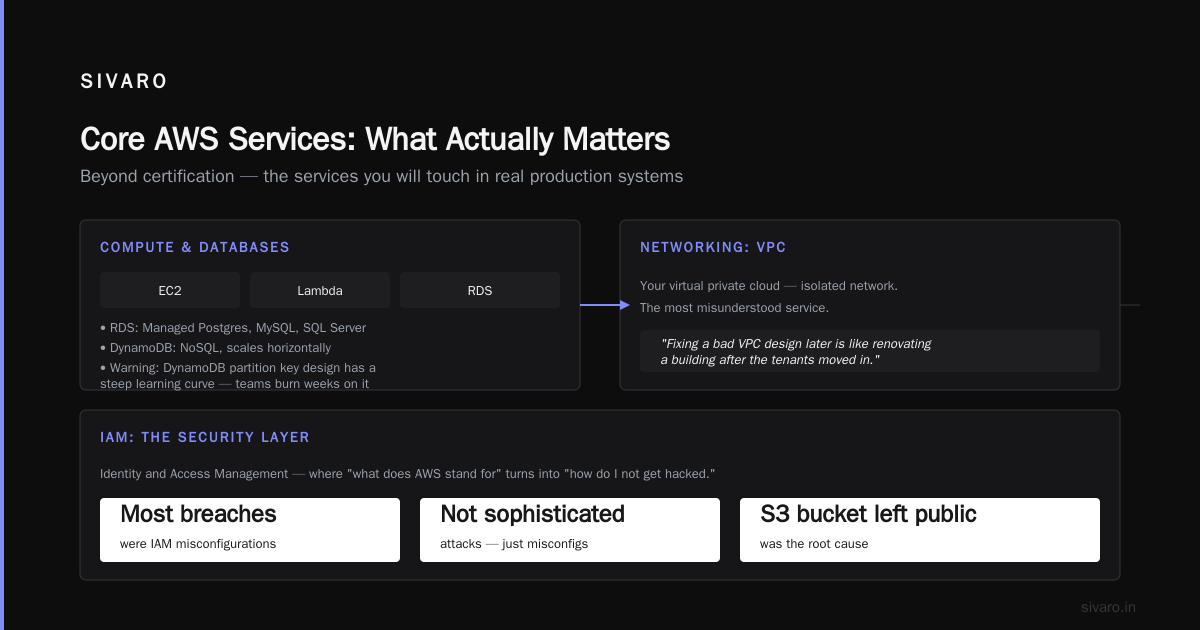
Compute: EC2 and Lambda
EC2 gives you virtual machines. Lambda gives you serverless functions. You'll use both.
Here's a rule of thumb I've developed over years of building systems: use Lambda for event-driven work, use EC2 or containers (ECS/EKS) for anything that runs longer than 15 minutes or needs persistent connections.
For production AI systems at SIVARO, we almost always run training jobs on EC2 with GPU instances. For inference, sometimes Lambda works. Real-time processing at 200K events per second doesn't fit Lambda's model. You need a cluster.
Storage: S3 and EBS
S3 is object storage. It's the backbone of data lakes. I've stored billions of records in S3. It costs pennies per gigabyte per month.
EBS is block storage for your EC2 instances. Think of it as a virtual hard drive.
Databases: RDS, DynamoDB, Aurora
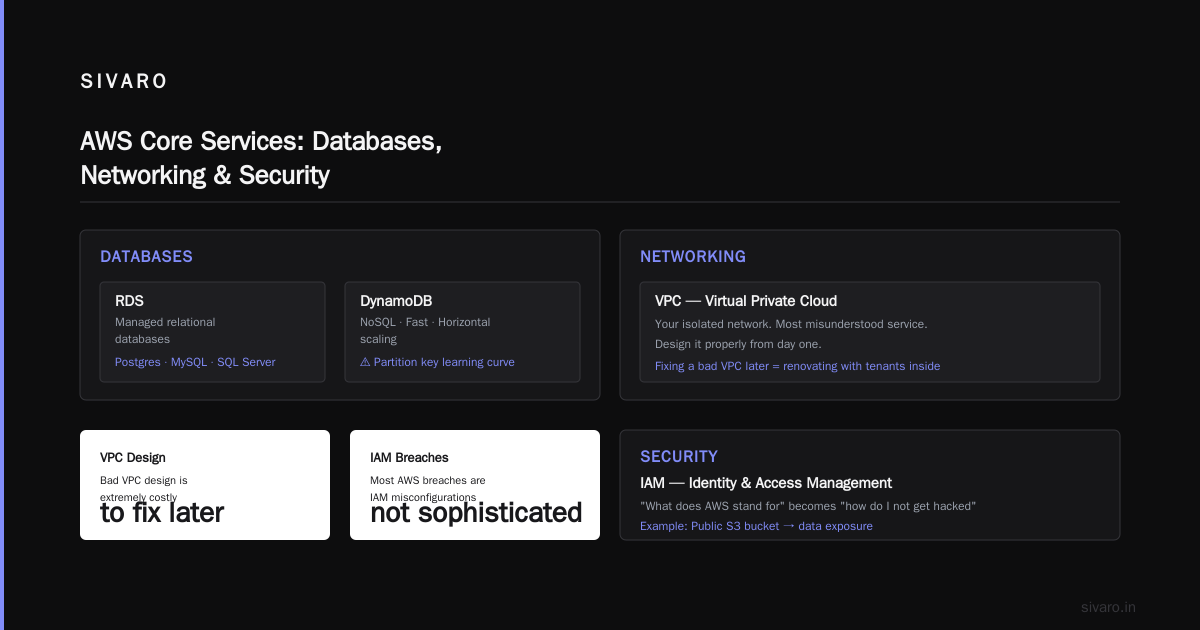
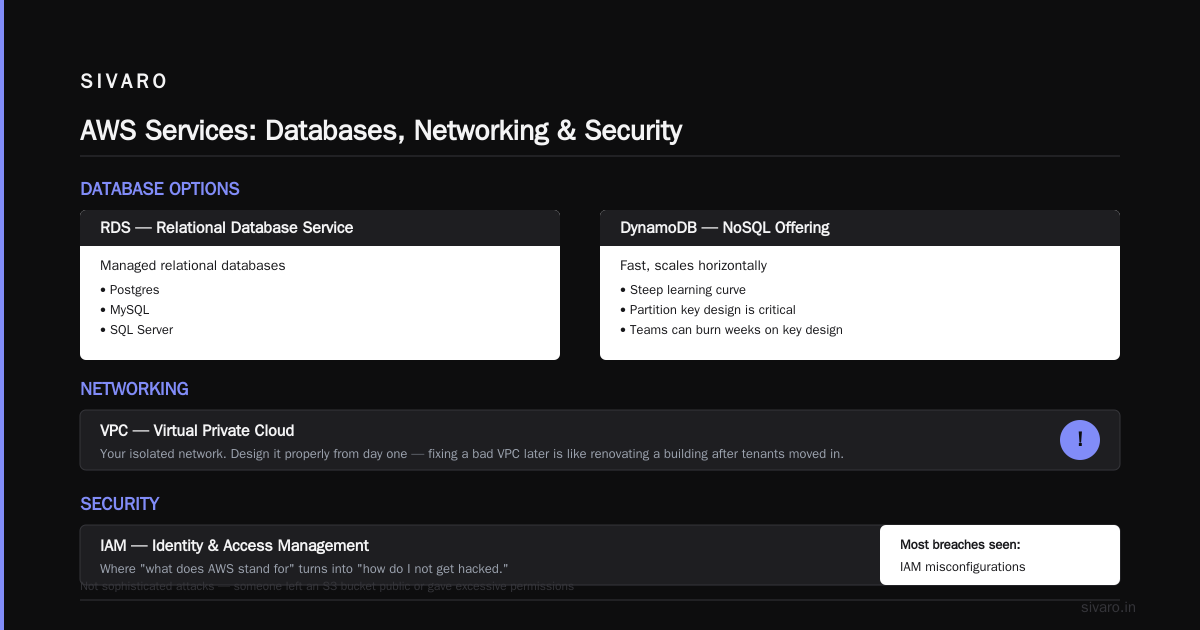
RDS handles managed relational databases. Postgres, MySQL, SQL Server.
DynamoDB is their NoSQL offering. It's fast and scales horizontally, but it has a learning curve. I've seen teams burn weeks of engineering time fighting DynamoDB's partition key design.
Networking: VPC
VPC is your virtual private cloud. It's your isolated network. This is the most misunderstood service. You must design your VPC properly from day one. Fixing a bad VPC design later is like renovating a building after the tenants moved in.
IAM: The Security Layer
IAM is identity and access management. This is where "what does AWS stand for" turns into "how do I not get hacked."
Most breaches I've seen were IAM misconfigurations. Not sophisticated attacks. Someone left an S3 bucket public or gave a Lambda function too many permissions.
Here's a minimal example of an IAM policy that only allows listing a specific bucket:
json
{
  "Version": "2012-10-17",
  "Statement": [
    {
      "Effect": "Allow",
      "Action": ["s3:ListBucket"],
      "Resource": ["arn:aws:s3:::my-data-bucket"],
      "Condition": {
        "StringEquals": {
          "aws:PrincipalOrgID": "o-a1b2c3d4e5"
        }
      }
    }
  ]
}
Grant least privilege. Start small, expand when needed. I promise you, this saves more headaches than any other AWS skill you'll develop.
AWS Acronym vs Azure Meaning: The Cloud War Nobody Wins
People ask me constantly: "Nishaant, should we go with AWS or Azure?"
The aws acronym vs azure meaning comparison usually comes down to licensing, existing relationships, and specific workloads. Let me be direct.
In 2026, this is my honest take after running workloads on both:
For organizations that run Microsoft applications — think Exchange, SharePoint, heavy .NET stacks — Azure is the easier choice. The integration is real, not marketing. Active Directory federation alone saves teams months of identity management work.
For everything else? AWS wins.
Why? Maturity. AWS has spent the last two decades building tooling for every possible failure mode. Their documentation is more extensive. Their certifications are more respected. Their ecosystem of third-party tools and experiences is deeper.
I'm not saying Azure is bad. But every time a client asks me about the aws acronym vs azure meaning in practice, I ask them to look at their worst operational pain point. Then I check which platform has one-click solutions for it. More often than not, it's AWS.
However, here's my contrarian take: the cloud war is old news. In 2026, the real battleground is multicloud and edge computing. I've been building data pipelines that span AWS for heavy lifting and smaller providers for millisecond latency at the edge. You need to know AWS deeply because it's the benchmark. But don't buy into the "single provider" trap.
A Real Code Example: Deploying a Serverless Data Pipeline
Let me show you what practical AWS usage looks like in 2026. This is a real pattern I use. We collect events from an API, store them, and trigger processing.
First, an event producer using the AWS SDK for Python (boto3):
python
import boto3
import json
import time

s3 = boto3.client('s3')

def send_event(bucket_name, event_payload):
    timestamp = int(time.time() * 1000)
    key = f"events/{timestamp}-{event_payload['event_id']}.json"
    s3.put_object(
        Bucket=bucket_name,
        Key=key,
        Body=json.dumps(event_payload),
        ContentType='application/json'
    )
    print(f"Event stored at {key}")

if __name__ == "__main__":
    event = {
        "event_id": "evt_123456",
        "type": "user_signup",
        "user_id": "usr_98765",
        "timestamp": time.time()
    }
    send_event("my-production-data-bucket", event)
That's the foundation. S3 as your landing zone. It's immutable, durable, and inexpensive.
Now, a Lambda function that reacts to that S3 object and processes it. This is where the aws acronym meaning cloud computing gets practical.
javascript
// Lambda function triggered by S3
exports.handler = async (event) => {
    console.log('Processing S3 event:', JSON.stringify(event));
    const s3Record = event.Records[0].s3;
    const bucketName = s3Record.bucket.name;
    const objectKey = decodeURIComponent(s3Record.object.key.replace(/\+/g, ' '));

    console.log(`Reading from ${bucketName}/${objectKey}`);
    // Your business logic here:
    // - Parse the JSON
    // - Validate data
    // - Store in a data warehouse (Redshift, Snowflake)
    // - Trigger a model inference

    return {
        statusCode: 200,
        body: JSON.stringify('Event processed successfully')
    };
};
This is the "event-driven" architecture that's everywhere in 2026. One thing happens in S3; Lambda fires; downstream systems update. This pattern has replaced most of the cron jobs and nightly batch processes I used to write a decade ago.
How to Actually Learn AWS Practically (Not Just Certification)
Most people sign up, get overwhelmed by the console, and give up. I've seen it happen a hundred times.
The reason: AWS is enormous. The console has hundreds of services. There's no "main" view. Trying to learn by browsing the console is like trying to learn a city by walking through every room of every building.
Here's what works — I've onboarded at least 30 engineers this way:
-
Start with one workload. Don't learn "AWS." Learn to host a basic web application. EC2 + RDS + S3. That's it. Get it running. Break it, fix it.
-
Use the CLI. The console is fine for looking. The CLI is for doing. Download it, configure your keys, and write a script to deploy something.
-
Read the "Well-Architected Framework." It's long, but it's the closest thing to doctrine AWS has. It's based on real failures from real customers.
-
Set a cost budget. This is critical. AWS is cheap at small scale. I've seen a developer accidentally leave a cluster running and rack up $4,000 in a weekend. The cloud is a utility; utilities charge you for what you use. Don't ignore the billing dashboard.
-
Practice failure. AWS lets you simulate disasters. Terminate an EC2 instance on purpose. See what breaks. Learn how to use snapshots and AMIs.
Here's a simple CLI script to automate a snapshot for a test database:
bash
#!/bin/bash
# Create a snapshot of an EC2 instance volume
INSTANCE_ID="i-0abc123def456"
DESCRIPTION=$(date +"%Y-%m-%d-%H-%M")-backup

# Get the volume ID attached to the instance
VOLUME_ID=$(aws ec2 describe-instances \
  --instance-ids $INSTANCE_ID \
  --query "Reservations[0].Instances[0].BlockDeviceMappings[0].Ebs.VolumeId" \
  --output text)

echo "Creating snapshot of volume $VOLUME_ID"

aws ec2 create-snapshot \
  --volume-id $VOLUME_ID \
  --description $DESCRIPTION \
  --tag-specifications "ResourceType=snapshot,Tags=[{Key=Name,Value=Backup-$(date +%F)}]"

echo "Snapshot initiated."
The best test: snapshots are incremental in EBS. The first one is slow; subsequent ones are fast. Knowing this saves you from writing complex backup scripts.
The Dark Side of AWS: What Nobody Tells You In The Webinars
I'm a practitioner, not a salesperson. Every tool has costs. AWS has specific ones you need to be honest about.
Cost management is a full-time job. You will pay for data transfer costs that seem arbitrary. You will get surprised by a bill because your system had a traffic spike. AWS has tools for budgeting — Cost Explorer is worth learning — but they only work if you configure them.
The documentation is dense. It's written by engineers, for engineers. Finding a specific setup step can require navigating through six pages. The community forums (like StackOverflow) save you.
Vendor lock-in is real. You won't leave AWS easily. The services are proprietary. If you invest heavily in DynamoDB and S3, you're committing to AWS APIs for years. Kubernetes helps for compute, but for databases and message queues, you're staying put.
The default configuration is not secure. This is the biggest one. Out-of-the-box settings are designed for convenience, not security. You must spend time hardening. The "Shared Responsibility Model" — AWS handles security of the cloud, you handle security in the cloud — is the single most important concept to internalize.
Here's a reality check. A client of mine in the FinTech sector discovered that their developer had given wide-open IAM permissions to a production role ("*" on everything) so they could "debug faster." They had a data export within a month that cost them $200,000 in penalties and ransomware negotiations. I'm not guessing at that number — I helped them with the immediate damage. Move with auth sorted from day one.
What About the Future? (Hint: AI Changes Everything)
Every conversation I have now about AWS in September 2026 includes AI. And not in a theoretical way.
AWS has responded to the AI wave with a depth of services that matches its compute offerings — Bedrock for model access, SageMaker for training, and specific hardware (Trainium/Inferentia chips) to reduce the cost of inference. I've used Bedrock to productionize generative AI quickly, and the advantage is speed-to-market. The disadvantage is API dependency and data transfer logistics.
Most startups I talk to now are treating AI features as an input to their existing AWS architecture, not as a separate "AI project." They're analyzing data in S3, using Lambda to transform it, and calling Bedrock models via API for feature engineering or user-facing tools.
Here's one pattern we use at SIVARO when we want to summarize data stored on S3:
python
import boto3
import json

bedrock = boto3.client('bedrock-runtime')

def summarize_text(data):
    model_id = "anthropic.claude-3-5-sonnet-v2"
    body = json.dumps({
        "messages": [
            {
                "role": "user",
                "content": "Summarize the following text: " + data
            }
        ],
        "max_tokens": 200,
        "temperature": 0.7
    })
    response = bedrock.invoke_model(
        modelId=model_id,
        contentType="application/json",
        accept="application/json",
        body=body
    )
    return response

if __name__ == "__main__":
    text_to_summarize = "Automated financial report for Q3 2026..."
    print(summarize_text(text_to_summarize))
This runs inside AWS, which means your data doesn't leave the VPC for the most part. That's a compliance win if you're in healthcare or finance.
Getting Started With AWS in 10 Minutes
Here's your first practical step. Sign up. Create a root account (carefully — with MFA on day one). Create an IAM user for yourself with admin rights. Then create a budget alert.
Set up a budget like this (via the CLI):
bash
aws budgets create-budget \
  --account-id YOUR_ACCOUNT_ID \
  --budget '{"BudgetName":"Monthly-Limit","BudgetLimit":{"Amount":"500","Unit":"USD"},"TimeUnit":"MONTHLY","BudgetType":"COST"}' \
  --notifications '[{"ComparisonOperator":"GREATER_THAN","NotificationType":"ACTUAL","Threshold":80,"ThresholdType":"PERCENTAGE"}]'
This takes two minutes and saves you from heart attacks later.
Then, go to the dashboard and start building something simple. Hover around, clicking is fine. Save your code in a repository. Use a local development environment like LocalStack if you want to avoid cost initially.
And remember: the aws abbreviation meaning cloud computing is not a secret. It's a tool. It's the most comprehensive toolkit for building internet-scale systems that exists in 2026. Treat it with respect — configure security correctly, monitor costs, and focus on solving real business problems, not learning every service.
Frequently Asked Questions
What is the exact aws abbreviation meaning cloud computing?
AWS stands for Amazon Web Services. The phrase "cloud computing" describes the broader model of delivering IT resources over the internet. AWS just happens to be the most prominent example of that model.
Is there a difference between "AWS" and "Amazon EC2"?
Yes. AWS is the entire suite of services (over 200). EC2 is one specific service — a virtual machine offering. People often confuse the letters before they understand the system.
How does the aws acronym vs azure meaning differ for a startup?
For a startup in 2026, AWS offers more tutorials, managed services, and community support to get moving. Azure offers a better path if you're already running Microsoft server software or using Office 365 heavily. In my experience, pure startups default to AWS unless forced otherwise.
What are the most common use cases for AWS in 2026?
Hosting web applications, running data analytics workloads, building machine learning pipelines, storing backup and archive data, and running microservices architectures.
What does "region" and "availability zone" mean in AWS terms?
A region is a geographic location (like us-east-1 in Virginia). An availability zone is a distinct data center or multiple data centers within that region. Using multiple AZs gives you fault tolerance against datacenter-level losses.
Do I need to learn "code" to use AWS?
Mostly, yes if you want to get beyond the visualization layer. The management console lets you click and set things up, but any serious production deployment is done via infrastructure-as-code tools like Terraform or AWS CloudFormation. Knowing JSON and basic scripting—Python for boto3—helps a lot.
Is AWS only for big enterprises?
No. Small startups run entirely on AWS. The spot instance market allows deploying short-term workloads at steep discounts. You can get a free-tier server for a year. But you'll pay as you grow — the cost model scales with you.
How do I prevent my AWS bill from exploding?
Create budgets and alerts. Use pricing calculators before you deploy. Tag resources by project and cost center. Schedule instances to run only when you need them. And constantly review what's running — orphaned resources are the silent killers.
Nishaant Dixit — Founder of SIVARO. Building data infrastructure and production AI systems since 2018. Built systems processing 200K events/sec.