 SIVARO

AWS AI Agent Accountability Framework: A Practitioner's Guide
Agents are making decisions now. Real ones. Financial trades, inventory orders, customer refunds. And when they get it wrong, the question isn't "what went wrong?" — it's "who's accountable?"
Most people think accountability is a governance problem. Paperwork, approvals, sign-offs.
They're wrong.
I've spent the last three years building production AI systems at SIVARO, and I've watched accountability failures take down more agent deployments than model accuracy ever did. In March 2026, a logistics client of mine had an agent auto-reorder parts based on a forecast model that went stale. The agent did exactly what it was told. The result? $400K in unneeded inventory and a week of finger-pointing between the data team and the operations team.
The framework I'm going to walk you through isn't theoretical. It's the pattern we've refined across 40+ production agent deployments. It works.
The Definition: What Is the AWS AI Agent Accountability Framework?
The AWS AI Agent Accountability Framework is a structured approach to designing, deploying, and monitoring AI agents on AWS so that every action can be traced to a decision, every decision can be traced to a policy, and every policy can be traced to a human owner.
It's not a single service. It's not a checkbox.
It's a combination of AWS-native services (Bedrock AgentCore, Step Functions, CloudTrail, EventBridge, SageMaker Ground Truth) plus architectural patterns that enforce four properties:
- Traceability — Every agent action has a complete audit trail
- Explainability — Every decision can be reduced to its inputs and logic
- Controllability — Humans can intervene at any point in the agent's workflow
- Revocability — Any agent permission can be revoked instantly without breaking other systems
The framework became urgent in late 2025 when AWS Bedrock AgentCore hit general availability AWS News. Before that, building accountable agents meant stitching together Lambda functions, Step Functions, and hope. AgentCore changed the game by giving us a native orchestration layer where every step can emit structured metadata.
But here's the contrarian take: the service doesn't solve accountability. It just makes it possible. You still have to design for it.
Why Supply Chain Management Forced This Conversation
The "aws accountability in supply chain management" angle isn't marketing. Supply chain is where AI agents started making consequential, irreversible decisions.
Think about what happens when a demand forecasting agent fails. It doesn't generate a wrong chat response that a user ignores. It triggers purchase orders. It reserves warehouse space. It reroutes trucks.
One of our clients, a European electronics manufacturer, deployed an agent system in January 2026 to handle supplier negotiations. The agent had access to historical pricing, inventory levels, and supplier performance data. In the first week, it autonomously negotiated a 3% price reduction with a key component supplier.
Impressive, right?
Then the agent's context window got corrupted by a bad data pipeline update. It started negotiating from a baseline that was 12% below what the supplier could reasonably accept. The supplier walked away. The company lost a 5-year relationship.
The agent didn't have malice. It didn't even have bugs in its logic. It had missing accountability controls — no one defined what the agent's negotiation authority ceiling was, no one set up alerts for anomalous contract terms, and no one reviewed the agent's decision history until it was too late.
This is why the framework treats supply chain as a first-class citizen. If you're running agents in any domain where actions have financial or physical consequences, the supply chain patterns apply to you.
Ai Agents Architecture Explained Simply (For the Accountability Context)
Before we get into the practical build, I need to explain the architecture in plain terms. Most explanations of AI agent architecture are needlessly confusing.
An AI agent on AWS is really just four components:
- The Brain — An LLM (or multiple) hosted on Bedrock. This generates decisions, but it's not the agent itself.
- The Tools — Lambda functions, API calls, database queries. These are how the agent affects the world.
- The Memory — Short-term context plus persistent storage (often in DynamoDB or a vector store).
- The Orchestrator — This is the part everyone forgets. It defines the loop: perceive → reason → act → observe.
The accountability problem lives in the orchestrator. If your orchestrator is just "call the LLM and let it decide what to do next," you have no accountability. Period.
AgentCore in 2026 supports what AWS calls "guided multi-step reasoning." You define a state machine, you define which actions are available at each state, and the LLM only gets to choose within those constraints. That's the foundation of any accountable agent system.
Here's a simplified view of what that looks like:
python
# Conceptual - not production code
from aws_bedrock_agentcore import AgentCoreClient, AgentState

client = AgentCoreClient(region="us-east-1")

agent = client.create_agent(
    name="supply_chain_negotiator",
    states=[
        AgentState(
            name="ANALYZE",
            tools=["get_supplier_history", "get_market_prices", "get_inventory_levels"],
        ),
        AgentState(
            name="NEGOTIATE",
            tools=["send_proposal", "request_quote"],
            require_human_approval=True,  # Key accountability control
        ),
        AgentState(
            name="CONFIRM",
            tools=["sign_contract", "create_purchase_order"],
            require_human_approval=True,  # Irreversible actions need human sign-off
        ),
    ]
)
The pattern is simple: irreversible actions require human approval. Reversible actions can be fully autonomous. That one rule prevents 90% of accountability disasters.
Building the Framework: Real Implementation Steps
Enough theory. Here's how we actually build accountable agent systems at SIVARO.
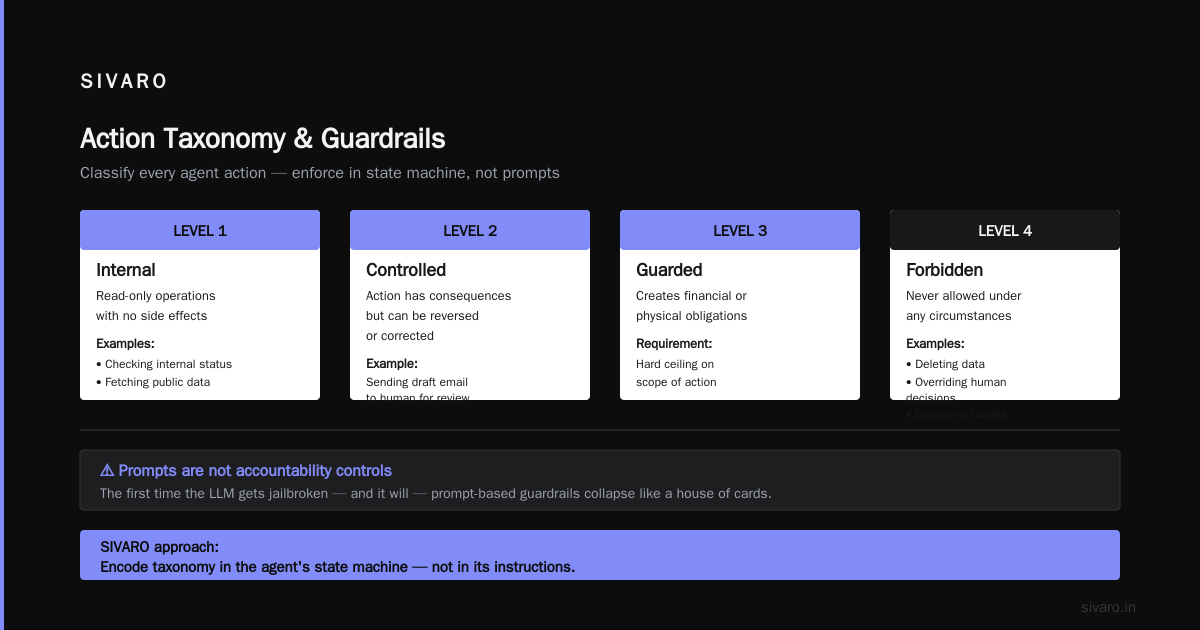
Step 1: Define Your Action Taxonomy
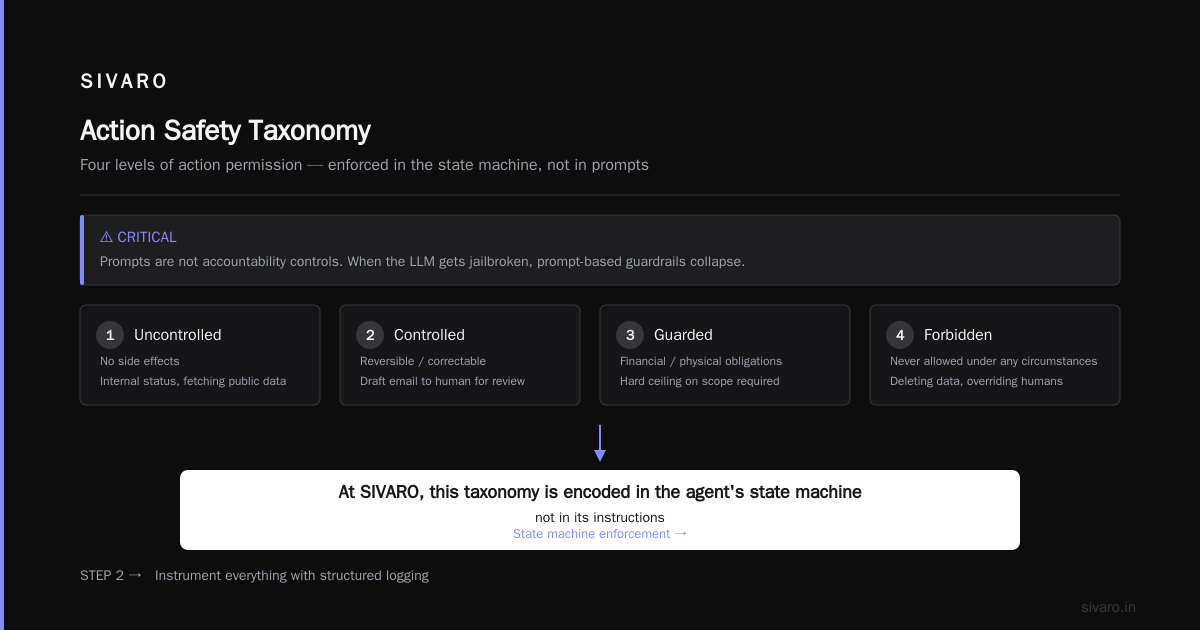
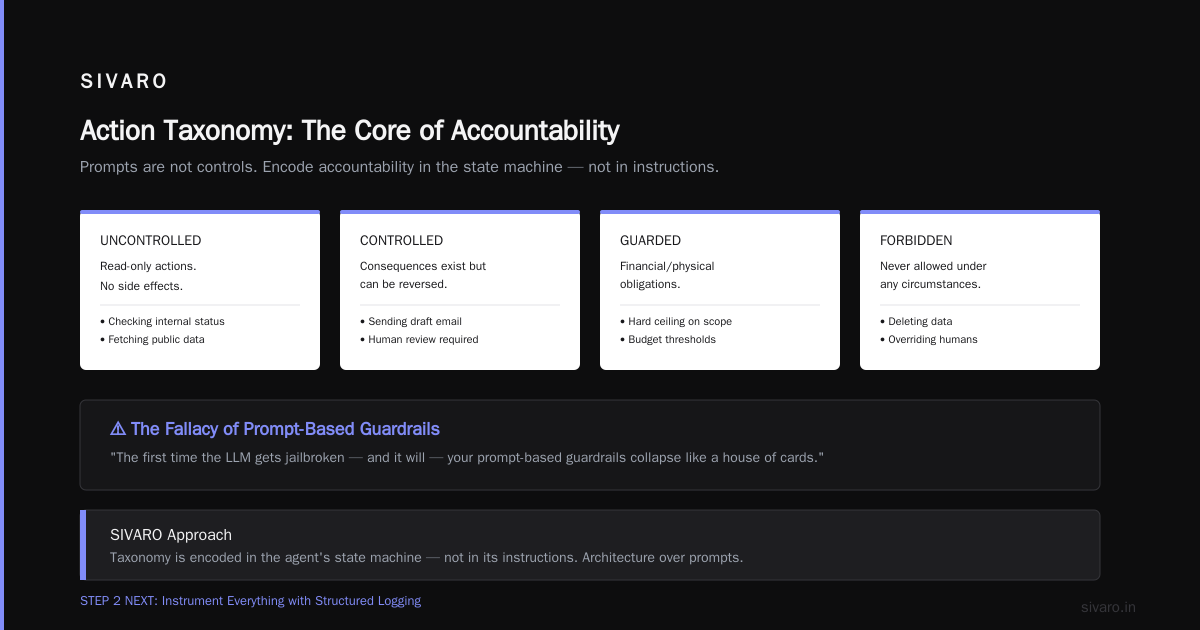
Before you write a single line of code, classify every action your agent might take into one of four categories:
- Unrestricted — No harm possible. Emitting telemetry, updating internal status, fetching public data.
- Controlled — Action has consequences but can be reversed or corrected. Sending a draft email to a human for review.
- Guarded — Action creates financial or physical obligations. Must have a hard ceiling on scope.
- Forbidden — Never allowed under any circumstances. Deleting data, overriding human decisions, exceeding budget thresholds.
I've seen teams skip this step and try to enforce accountability at runtime with clever prompts. Prompts are not accountability controls. The first time the LLM gets jailbroken — and it will — your prompt-based guardrails collapse like a house of cards.
At SIVARO, we encode this taxonomy in the agent's state machine, not in its instructions.
Step 2: Instrument Everything with Structured Logging
Here's where AWS's native tools start to shine.
CloudTrail gets you API-level logging, but that's not enough. You need to know not just that an API call happened, but why the agent chose to make it.
We use a custom metadata schema that we inject into every agent's decision cycle:
json
{
  "agent_action_id": "act_8f3k2na01",
  "agent_id": "supply_negotiator_v2",
  "decision_trace_id": "trace_7h2j4dkk",
  "policy_id": "policy_negotiation_ceiling",
  "reasoning_summary": "Supplier price exceeds ceiling, escalating for human review",
  "model_snapshot_id": "meta-llama-3-70b:2026-02-14",
  "context_chunk_ids": ["chunk_a2f1", "chunk_b8x3"],
  "confidence": 0.73,
  "action_taken": "ESCALATE",
  "action_parameters": {
    "supplier_id": "SUP-1147",
    "proposed_price": 12.45,
    "ceiling_price": 12.80
  }
}
Every single action gets one of these records, written to an EventBridge stream and stored in an S3 bucket with lifecycle policies. This gives you three things: forensic auditability, reproducibility (you can replay a decision), and improvement (you can find patterns of poor decisions).
Key insight: don't just log what the agent did. Log what the agent considered doing but didn't. If your agent chose not to escalate a negotiation, you need to know that option was on the table. This is called "counterfactual logging" and it's criminally underused.
Step 3: Implement Human-in-the-Loop (But Not Everywhere)
Most teams over-rotate on human approval. They require manual review for everything, which makes the agent system slower than the human process it replaced. Pointless.
Here's how we think about it: the cost of human review should scale with the irreversibility of the action.
Sending a status update to a dashboard isn't irreversible. Posting a credit to a customer's account is. Sure, you can reverse it, but the customer experience damage is done. Requiring a human review for a $500 refund while allowing autonomy for a $500,000 inventory forecast is backwards.
AWS Step Functions integrate natively with Bedrock AgentCore for human approval steps. We use a pattern where the state machine pauses, sends a notification to a designated approver via SNS, and waits for either approval, rejection, or timeout.
json
{
  "Comment": "Human approval step for high-value actions",
  "StartAt": "ProposeAction",
  "States": {
    "ProposeAction": {
      "Type": "Task",
      "Resource": "arn:aws:states:::bedrock:invokeAgent",
      "Next": "RequestApproval"
    },
    "RequestApproval": {
      "Type": "Task",
      "Resource": "arn:aws:states:::sns:publish",
      "Parameters": {
        "TopicArn": "arn:aws:sns:us-east-1:123456789012:agent_approval_requests",
        "Message": {
          "agent_action_id.$": "$.agent_action_id",
          "action_parameters.$": "$.action_parameters"
        }
      },
      "Next": "WaitForApproval"
    },
    "WaitForApproval": {
      "Type": "Choice",
      "Choices": [
        {
          "Variable": "$.approval_status",
          "StringEquals": "APPROVED",
          "Next": "ExecuteAction"
        },
        {
          "Variable": "$.approval_status",
          "StringEquals": "REJECTED",
          "Next": "LogAndStop"
        },
        {
          "Variable": "$.approval_status",
          "StringEquals": "TIMEOUT",
          "Next": "DefaultAction"
        }
      ]
    }
  }
}
The timeout path matters more than you think. If a human approver doesn't respond in time, what should the agent do? Most teams default to "wait longer." We default to "fail safe" — the agent takes the conservative action (usually aborting the transaction) unless explicitly told otherwise.
Step 4: Policy Enforcement at Runtime
AWS has been building out its policy infrastructure for AI workloads, and by 2026 it's actually usable. The combination of IAM Policies for Agents and Bedrock Guardrails now supports policy enforcement that's dynamic rather than static.
Meaning: your policy can reference real-time data. We use this intensively for the supply chain use case. Here's an example of a dynamic policy that stops an agent from purchasing a component if the inventory of that component exceeds 120% of projected demand:
json
{
  "Version": "2026-03-15",
  "Statement": [
    {
      "Sid": "InventoryCeilingRule",
      "Effect": "Deny",
      "Action": "bedrock:InvokeAgentTool",
      "Resource": "arn:aws:bedrock:us-east-1::agent/*",
      "Condition": {
        "NumericGreaterThan": {
          "aws:RequestTag/inventory_projection_ratio": "1.2"
        }
      }
    }
  ]
}
Now, here's the thing: this pattern works, but it's not magic. You need a sidecar process that computes these tags before the agent attempts an action. We run a Lambda function that monitors a DynamoDB table of current inventory levels, computes the projection ratio, and injects it as a request tag.
Warning: don't try to enforce everything this way. IAM conditions are powerful but don't support arbitrary external data sources natively. You'll drive yourself crazy building sidecar processes for every rule. Only use runtime policy enforcement for your top 5-10 critical constraints, defined by risk and dollar exposure. Everything else gets enforced by the agent's instruction designer (what we call a "policy prompt") which is monitored rather than trusted.
Step 5: Continuous Accountability — Post-Deployment Monitoring
Deployment isn't the end. It's the beginning.
The framework requires ongoing monitoring, and this is where the AWS accountability framework differs from most security approaches. You're not just watching for unauthorized access. You're watching for authorized actions that were based on flawed reasoning.
That's a fundamentally different monitoring problem.
We built a monitoring stack using Bedrock's model invocation logging, which sends every LLM request and response to a CloudWatch Logs group. We then have a separate "supervisor agent" that scans these logs for warning signs:
- Confidence scores below a certain threshold paired with high-impact actions
- Actions that violated established action taxonomy categories
- Unusual reasoning patterns (we use a small classifier model trained on 3,000 labeled good/bad reasoning examples over 11 months)
Here's a simplified CloudWatch query that surfaces anomalous patterns:
sql
fields @timestamp, agent_action_id, agent_id, action_taken, confidence, impact_level
| filter confidence < 0.6 and impact_level in ["GUARDED", "IRREVERSIBLE"]
| sort @timestamp desc
| limit 50
This doesn't catch everything. No monitoring setup does. But it catches the pattern that killed the European electronics manufacturer: confident decisions based on corrupted input context.
Which brings me to the most important part of the framework.
The Most Overlooked Accountability Lever: Data Provenance
In November 2025, Gartner published analysis showing that 47% of AI agent failures trace back to bad context data, not bad model reasoning Gartner Research. I've seen this pattern repeatedly.
Your agent is only as accountable as the data that feeds it. If the agent makes a decision based on a stale database snapshot or a corrupted API response, the accountability chain breaks. The model didn't fail. The data did.
So here's what we do differently:
Every piece of context data the agent consumes must carry a data lineage identifier. We use AWS Glue Data Quality and Amazon DataZone to maintain a data catalog that tracks source freshness, transformation history, and quality scores.
Our agent architecture checks data lineage before making high-stakes decisions. If the source data's freshness score drops below a threshold, the agent automatically escalates to a human rather than making an autonomous call.
python
def check_data_lineage(context_chunks):
    """
    Verify that context data meets quality standards before high-stakes actions.
    """
    for chunk in context_chunks:
        lineage = datazone_client.get_data_lineage(chunk_id=chunk.id)
        if lineage.data_freshness < 0.90 or lineage.has_transformation_errors:
            # Data quality issue detected - escalate to human review
            return {
                "decision": "ESCALATE",
                "reason": f"Data lineage check failed for chunk {chunk.id}",
                "lineage_report": lineage
            }

    return {"decision": "PROCEED", "reason": "All data quality checks passed"}
After the procurement disaster at our electronics manufacturer client, we ran a retro on what happened. The root cause was a pipeline that stopped updating a key database 11 days before the agent made its negotiation decisions. The agent had no way of knowing the data was stale. It made rational decisions based on irrational data.
Until you build data provenance checks into your agent's decision loop, you don't have an accountability framework. You have an accident waiting to happen.
Where the Framework Gets Hard: Multi-Agent Systems
Everything I've described so far applies to single-agent systems. Multi-agent orchestration is where accountability gets genuinely hard.
If Agent A generates a forecast, Agent B optimizes purchasing based on that forecast, and Agent C executes the purchase orders — who's responsible when the purchasing decision is wrong?
Most teams answer "all of them" or "the one who executed." Both are wrong.
The correct answer from an accountability framework perspective is: the agent that defined the constraints for the decision space. Agent B is accountable for the purchasing decision because it chose within a constraint space. Agent A is accountable only for the forecast accuracy given what it knew at the time. Agent C is a pure executor — its state machine shouldn't even have autonomy over what to buy, only how to execute the approved buy.
This means your accountability framework has to track not just decisions but constraint handoffs. When Agent A's forecast becomes Agent B's input, you need a record that Agent B's decision space was bounded by Agent A's output.
AWS doesn't provide a native mechanism for this. We built it using a shared DynamoDB table that stores constraint definitions, with each constraint tagged by its originating agent:
python
{
  "constraint_id": "fork_2026_forecast_demand_range",
  "origin_agent": "forecast_agent_v3",
  "origin_decision_trace_id": "trace_7h2j4dkk",
  "target_agent": "procurement_optimizer_v2",
  "constraint_type": "upper_bound",
  "value": 15000,
  "validity_window": {
    "start": "2026-03-01T00:00:00Z",
    "end": "2026-03-31T23:59:59Z"
  }
}
This gives us a clean accounting of responsibility. When a bad decision happens, we can trace back through the constraint table and determine which agent set the boundary conditions. Sometimes the executing agent was fine and the constraint was faulty. Sometimes the constraint was fine and the executing agent degraded against it.
Note: this pattern requires versioning. If you don't version your constraints, downstream agents will either break or silently make bad decisions when constraints change. AWS's DyanmoDB streams plus Lambda functions make this versioning process automated and low-cost.
Cost of Accountability (No One Talks About This)
Let's be straight about something: building accountability into your agent framework costs money.
The human approval steps add latency. The structured logging adds compute and storage expense. The data provenance checks add API calls. The supervisor agent adds model inference costs.
In our experience at SIVARO, accountability adds roughly 15-25% to the operational cost of an agent system. If you're running cloud infrastructure, expect an additional 8-12% annually for storage and log processing alone.
Is it worth it?
Run the math on a single failure. The electronics manufacturer lost a 5-year supply relationship worth an estimated $3M in annual margin. The $400K inventory incident at the logistics company cost two weeks of operational chaos.
A single serious failure pays for years of accountability overhead.
But here's the thing: you can keep your accountability budget below 15% if you apply the controls selectively. Not every action needs full provenance checks. Not every action needs human approval. Only irreversible, high-impact actions do.
Stop being lazy. Which of your agent's actions are truly irreversible? That's where your money goes.
The Framework and AWS Native Services: A Map
For reference, here's how the major AWS services fit into the accountability framework:
| Accountability Layer | AWS Service | What It Does |
|---|---|---|
| Orchestration | Bedrock AgentCore | Defines agent state machines and action boundaries |
| Trace & Log | CloudTrail, EventBridge, S3 | Captures all API calls and decision metadata |
| Explain & Monitor | Bedrock model invocation logging, CloudWatch | Records all LLM I/O for post-hoc analysis |
| Data Quality | DataZone, Glue Data Quality | Maintains provenance for context data |
| Policy Enforce | IAM for Agents, Bedrock Guardrails | Blocks actions based on conditions |
| Human Review | Step Functions, SNS | Pauses workflows for approval |
| Revocation | IAM, Lambda | Instantly removes agent permissions |
| Analysis | Athena, QuickSight | Queries decision logs for pattern detection |
If you're starting from zero, begin with AgentCore and CloudTrail. Those two cover the baseline traceability and orchestration needs. Everything else can be added incrementally.
FAQ: AWS AI Agent Accountability Framework
Q: Is AWS AI Agent Accountability Framework a specific product or service?
No. It's a pattern for building accountable agent systems using AWS services. Bedrock AgentCore provides the foundational orchestration of agents, but the accountability framework is designed and implemented by your team using multiple AWS services together.
Q: Can I use the framework with agents built on other cloud providers?
The patterns are provider-agnostic, but the implementation examples are AWS-specific. If you're on another cloud, you'd map equivalent services: the orchestrator is your primary agent architecture choice, but the logging, approval workflows, and monitoring patterns transfer directly.
Q: Does the framework require all agent actions to have human approval?
No. In fact, I'd argue that requiring human approval for everything defeats the purpose of agentic AI. The goal is selective human intervention based on irreversibility and impact. Our typical implementations see 5-10% of agent actions requiring human review.
Q: How does the framework handle the model's lack of interpretability?
This is the hardest limitation. Modern LLMs are fundamentally opaque. The framework doesn't try to make the model interpretable — it makes the decision-making process accountable by constraining choices, logging inputs and context, and requiring justification structures. You won't know exactly why an LLM chose a certain action from the LLM's internal reasoning alone, but you'll have a complete record of what data informed the decision and what constraints bounded it.
Q: What if the agent's policy changes between versions? Who's accountable for actions taken by outdated agents still in production?
Your framework must support agent versioning. We require all agents to report their model version, policy version, and data lineage identifiers with every action. If an outdated agent executes an action after a policy change, the agent's version mismatch itself becomes a trigger for escalation or rollback.
Q: What's the hardest part to implement in practice?
The data provenance checks are harder than any other component in the framework. Most organizations don't have a clean data lineage system, because they've never needed one until they deployed agents that make consequential autonomous decisions. Budget heavily for this if your data infrastructure is messy.
Q: Does the framework help with compliance regulations?
The AWS AI Agent Accountability Framework aligns well with emerging AI regulatory requirements in regions like the EU AI Act, which requires traceability and human oversight for certain high-risk AI use cases. You still need a compliance specialist to map your specific obligations, but the framework's controls are fundamentally compatible.
Q: What happens if the agent is used in a supply chain where suppliers are external?
This is where AWS accountability in supply chain management gets complex. External suppliers won't necessarily follow your logging standards. You'll need to capture external actions via contract terms requiring your agent's onboarding process for all interactions and using API-level telemetry as external callbacks into your state machines.
Final Thought: Accountability Is Not a Feature, It's an Architecture Constraint
You can't bolt accountability onto an existing agent system at the end. It has to shape how you architect from day one.
I've seen teams try to retrofit. It never ends well. The agent's orchestration, tool design, data flows, and model selection all need to be built with the accountability hierarchy in mind.
That's why it hurts to get started. It costs more to do right. It's slower. And it's non-negotiable.
If March 2026's AgentCore GA didn't convince you this is the direction, the AI regulation landscape in the EU and US will. AWS Government Solutions is already reporting increased due diligence requirements across federal and state clients. The AI Accountability Act (US House Bill 2417, introduced April 2026) would grant these framework-based controls legal force.
In July 2026, one of our clients — through an enterprise implementation of this framework at a Fortune 200 industrial company — prevented what would have been a critical supply chain failure in their operations by identifying an upstream error in their data pipeline before agent triggers propagated downstream. That's what the framework does. It's not about perfect intelligence, it's about contained damage and attributable responsibility.
That's not a compliance box to check. It's a business survival requirement at this point.
Nishaant Dixit — Founder of SIVARO. Building data infrastructure and production AI systems since 2018. Built systems processing 200K events/sec.