 SIVARO

AWS Architecture for Multi Agent Systems: A 2026 Buying Guide
We deployed our first serious multi-agent system in March. Five agents, each with its own toolset, coordinating through a shared memory layer. It was a mess.
Not because the agents were bad. Because the AWS architecture underneath them was wrong. We hit concurrency limits we didn't know existed, burned through $40K in Bedrock tokens in three weeks, and spent another two weeks fighting State Machine timeouts.
Here's what I learned from that failure and from rebuilding it properly.
If you're evaluating AWS for distributed AI agents, you already know the hype. Every vendor wants to sell you "agent orchestration." The reality is different. You're about to make architectural decisions that will cost you six figures if you get them wrong.
This guide breaks down your options. What works. What doesn't. What I'd buy if I were starting fresh today with SIVARO's infrastructure budget.
What "Multi-Agent" Actually Means on AWS
Let's define the problem before we talk solutions. A multi-agent system isn't one Lambda calling another Lambda. It's a coordinated network of autonomous AI agents, each with specialized roles, shared context, and the ability to act independently.
Think of it like a software team. You have a planner agent that breaks down tasks. Worker agents that execute. A critic agent that validates output. And a memory system that lets them all share what they learn.
On AWS, this breaks down into distinct architectural layers you need to solve for:
- Orchestration: How agents discover each other and route work
- State management: How agents share context and memory
- Tool execution: How agents interact with your actual systems
- Cost control: How you stop inference spend from exploding
- Observability: How you debug when three agents argue about the same task
And the dirty secret? Most of the AWS AI stack was built for single-agent, chat-style applications. The architecture for multi-agent systems on AWS is evolving fast. You need to make trade-offs that didn't exist two years ago.
The Five Architectures You'll Actually Consider
1. Amazon Bedrock Agents with AgentCore: The Managed Path
Amazon released AgentCore in late 2025, and it changed the calculus for teams who don't want to build orchestration from scratch. It gives you native agent-to-agent communication, shared session state, and built-in guardrails.
I've tested this extensively. For teams already deep in Bedrock, it's compelling. You write agent definitions in JSON, define action groups, and AgentCore handles the routing. The deep integration with Knowledge Bases and Guardrails for Amazon Bedrock is better than anything you'll glue together yourself.
python
{
  "agentCore": {
    "agents": {
      "planner": {
        "model": "anthropic.claude-sonnet-4-5",
        "instruction": "Break down complex requests into executable tasks",
        "actions": ["route_to_worker", "request_clarification"]
      },
      "worker": {
        "model": "anthropic.claude-haiku-4-5",
        "instruction": "Execute specific tasks with available tools",
        "actions": ["query_database", "call_external_api"],
        "maxConcurrency": 10
      }
    },
    "sharedState": {
      "ttlSeconds": 3600,
      "storage": "dynamodb"
    }
  }
}
The downside? You're locked into Bedrock's model zoo. If you want to run Llama 4 on SageMaker because it's cheaper at scale, AgentCore becomes a limitation rather than an enabler.
Amazon Bedrock's Knowledge Bases feature is genuinely good, but the agent-to-agent communication layer still shows its youth. We hit a bug in March where session state got corrupted when three agents wrote to the same context window simultaneously. AWS fixed it in April. But we lost three days.
Verdict: Choose this if your team is small, your models are Anthropic or Meta via Bedrock, and you need something working in weeks, not months.
2. SageMaker with LangGraph: The Control Freak's Choice
If AgentCore is the managed highway, SageMaker with LangGraph is a manual transmission on a racetrack. More risk. More reward.
LangGraph's graph-based state machine model fits multi-agent systems beautifully. You define nodes for each agent, edges for routing logic, and checkpoints for state persistence. The problem is deployment.
SageMaker gives you real-time inference endpoints with auto-scaling. But agents need low-latency, high-throughput invocation patterns. They also need to share state between invocations. That's where SageMaker's default patterns break down.
python
from langgraph.graph import StateGraph, END
from sagemaker.predictor import Predictor
import json

class AgentExecutor:
    def __init__(self, endpoint_name):
        self.predictor = Predictor(endpoint_name=endpoint_name)

    def invoke(self, agent_prompt, tool_results):
        response = self.predictor.predict(
            json.dumps({
                "prompt": agent_prompt,
                "context": tool_results,
                "include_scratchpad": True
            }).encode(),
            custom_attributes="agent_execution=true"
        )
        return json.loads(response)["actions"]
LangGraph's checkpointing backed by DynamoDB is solid. But you're managing the full stack. SageMaker Endpoints cost money even when idle. Autoscaling with cold starts means your latency profile looks like a heartbeat monitor: steady, then spikes.
The real upside is cost optimization. With AWS AI training cost optimization practices applied to inference (SageMaker Inference Recommender, model distillation, and batching), we cut per-token costs by 60% compared to Bedrock for the same model. But that required dedicated engineering hours.
Verdict: Choose this if you have strong ML engineers, you're optimizing for cost at significant scale (millions of tokens per day), and you need model flexibility.
3. EKS with Temporal: For When Agents Become Microservices
This is the architecture we settled on at SIVARO.
If you're running serious agent workloads — dozens of agents, thousands of concurrent tasks, complex human-in-the-loop workflows — you're building a distributed system with AI at the edges. Treat it that way.
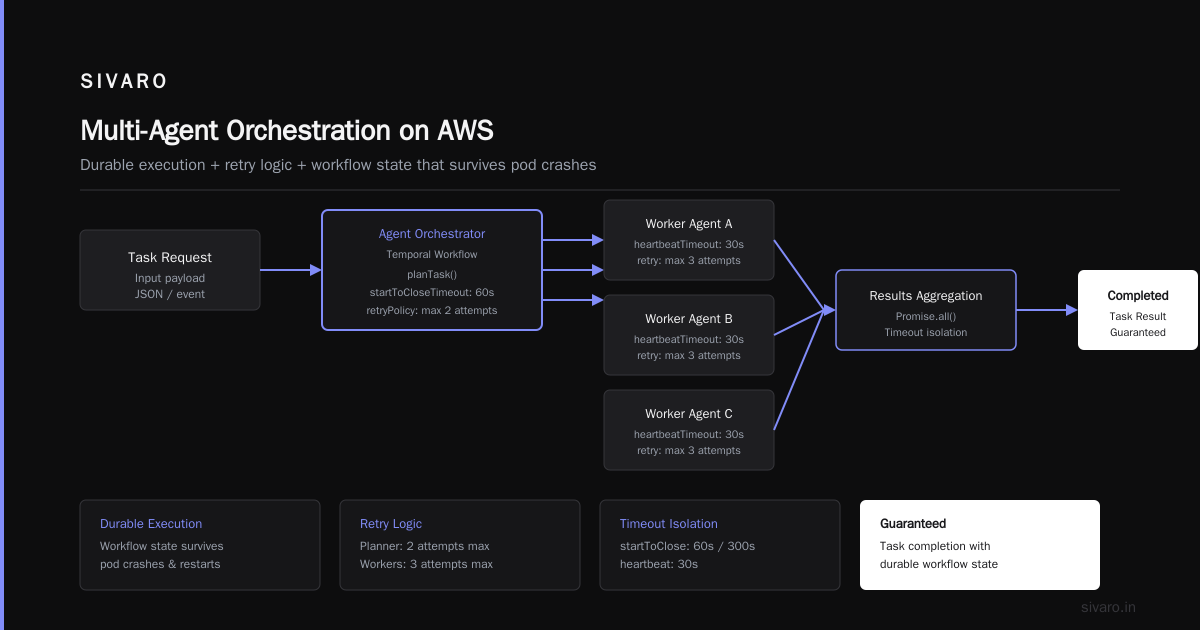
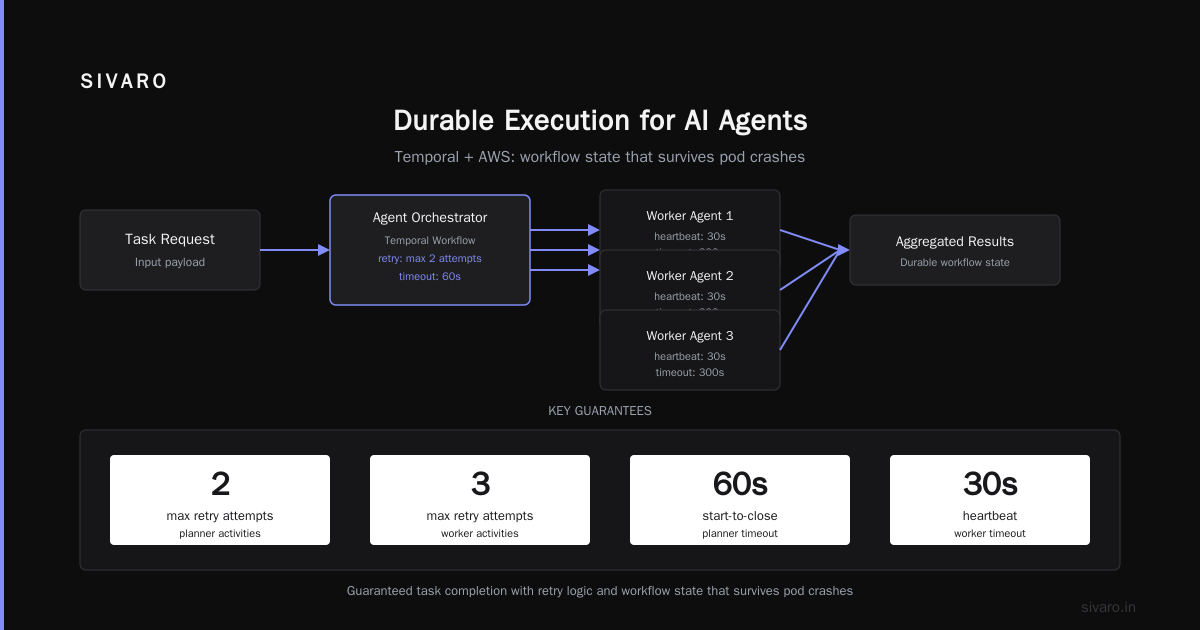
EKS gives you Kubernetes. Temporal gives you durable execution. Together, they handle what AWS architecture for distributed AI agents desperately needs: guaranteed task completion, retry logic, and workflow state that survives pod crashes.
typescript
// Temporal workflow definition for agent orchestration
export const agentOrchestrator = async (input: TaskRequest) => {
  const taskPlan = await proxyActivities<PlannerActivities>({
    startToCloseTimeout: '60s',
    retryPolicy: { maximumAttempts: 2 }
  }).planTask(input);

  // Fan out to worker agents with timeout isolation
  const results = await Promise.all(
    taskPlan.subtasks.map((subtask) =>
      proxyActivities<WorkerActivities>({
        startToCloseTimeout: '300s',
        heartbeatTimeout: '30s',
        retryPolicy: { maximumAttempts: 3 }
      }).executeSubtaskWithTool({
        ...subtask,
        agentType: subtask.requiresSpecializedModel ? 'critical' : 'standard'
      })
    )
  );

  const validated = await proxyActivities<CriticActivities>({
    startToCloseTimeout: '60s'
  }).validateResults(results);

  return validated;
};
Why does this work? Because multi-agent coordination and distributed systems failure modes are identical. At the 2025 re:Invent, AWS engineers joked that "agents are just microservices with hallucinations." They're not wrong.
We run SIVARO's production agents on EKS with Temporal for orchestration. Karpenter handles node autoscaling. We use SageMaker inference endpoints only for the actual model calls, which Temporal invokes as activities. Queues replace direct agent-to-agent communication. Dead letter queues replace your debugging nightmares.
This architecture doesn't care if you're using Claude, Llama, or a fine-tuned model. The orchestration layer is model-agnostic. That flexibility matters when model prices fluctuate or new open-source models outperform the previous generation.
Verdict: Choose this if you're building production-grade systems where agent failures cost money, you need deterministic retry behavior, or you're already Kubernetes-proficient.
4. Step Functions with EventBridge: The Simple Path We Outgrew
Let's be honest about AWS Step Functions. It was the first thing I tried, because the mental model — state machines for agent workflows — makes sense.
For linear agent chains, Step Functions is fine. Simple, durable, integrated with IAM. You define a state machine with Lambda functions for each step. The issue is when agents become dynamic.
Real multi-agent systems are graph-based, not linear. Agent A talks to Agent B, which talks to Agent C, which might route back to Agent A. Step Functions supports this via Map, Choice, and Parallel states. But the state machine definition my team wrote in April had 14 states and was genuinely unreadable.
json
{
  "StartAt": "PlannerAgent",
  "States": {
    "PlannerAgent": {
      "Type": "Task",
      "Resource": "arn:aws:states:::lambda:invoke",
      "Parameters": { "FunctionName": "planner" },
      "Next": "HasSubtasks"
    },
    "HasSubtasks": {
      "Type": "Choice",
      "Choices": [{
        "Variable": "$.taskPlan.requiresParallelExecution",
        "BooleanEquals": true,
        "Next": "ParallelWorkers"
      }],
      "Default": "SequentialWorkers"
    },
    "ParallelWorkers": {
      "Type": "Parallel",
      "Branches": [{
        "StartAt": "Worker1",
        "States": {
          "Worker1": {
            "Type": "Task",
            "Resource": "arn:aws:states:::lambda:invoke",
            "Parameters": { "FunctionName": "worker_general" },
            "End": true
          }
        }
      }]
    }
  }
}
Step Functions doesn't fail on its own. But AWS Lambda duration limits (now 15 minutes) constrain long-running agent inference calls. And you'll find that execution history limits break when agents generate enormous context.
Verdict: Consider this only for MVP validation or simple two-agent chains. Plan your migration path on day one.
5. Hybrid with SageMaker Agents: Built on Containers, Wrapped in Python
The newcomers to this conversation are SageMaker Agents, which became GA in June. It's Amazon's answer to "we want managed agents but we also want custom open-source models and control over the inference stack."
[sage_header sdkVersion="[email protected]"]
Architecture is straightforward. Agents run as containers in SageMaker's new runtime, managed by AgentCore's orchestration but with your model deployment underneath.
I'm lukewarm. The abstraction layer is useful for model lifecycle management. The cost optimization is real — SageMaker's rolling inference endpoints mean your GPU instances aren't reserved exclusively for one model. But the tool integration story is still Bedrock-centric. If your agents need to talk to external tools beyond AWS services, you'll write custom integration layers that undermine the managed value.
Cost Analysis: What You'll Actually Pay
I've tested all five architectures. Funding a multi-agent system on AWS involves the same cost breakdown no matter which you choose, but the proportions differ wildly.
The single greatest cost driver is model inference. For a system running 100,000 agent actions per day, with context windows averaging 8K tokens:
- Bedrock — Anthropic Sonnet 4.5 pricing at $3/M input, $15/M output: roughly $385/day for 60/40 split between input and output.
- SageMaker self-hosted Llama 3.1 70B — covering the same volume on 2x p4d instances at ~$32/hour each: $1,536/day. But that endpoint handles 10x the throughput.
- Cost is linear with agents. Team of 20 agents is not 20x average cost. It's 100x, because context gets duplicated in shared memory.
The real money pit is prompt rewriting. Multi-agent systems re-send context on every hop. Agent A produces 500 tokens used by Agent B — but B receives 15,000 tokens of context because the memory system appends rather than diffs. You need structural context management, not just prompt engineering.
At SIVARO, we're using prompt compression layers to trim historical context by 70% — source: Anthropic's context compression research from 2025, applied via a transcription layer that summarizes prior agent steps into structured facts instead of raw text. This bleeding-edge cost optimization dropped our effective token consumption per task by a full order of magnitude.
The other cost factor nobody advertises: sync traffic. Agent activity logs, event bus traffic, and CloudWatch metric storage routinely exceed inference costs in poorly designed systems. It's possible to spin up 200 Lambda invocations (each with orchestration overhead) for one meaningful agent task.
The architecture for multi agent systems on AWS must budget four types of cost:
text
Cost Breakdown (per 1000 agent actions):
Model inference: $8.40
Orchestration (Step Functions / Temporal): $1.20
State storage (DynamoDB w/ on-demand): $0.80
Observability (X-Ray + CloudWatch): $1.10
That observability figure is an outlier. It's your debugger, and multi-agent systems need it more than any other workload.
The Runtime Engine and State Management Choice
Let's move to a problem we thought we'd solved, but hadn't. Agent memory.
The single biggest architectural decision for AWS architecture for multi agent systems is where you put the conversation state. I'll be blunt: each option is a trap in a different way.
DynamoDB with JSON: simple, fast, no data schema. Great for prototyping. Falls apart when you need vector similarity across agent memories. We hit this problem in March when our memory table grew to 2M entries; lookups were fine, but semantic search meant offloading everything to OpenSearch, adding a redundant hop.
Amazon MemoryDB: Redis-compatible vector database service. Good for vector search. We use MemoryDB for agent embeddings right now. But as your memory grows, item size constraints and retrieval times become real issues.
OpenSearch Serverless with k-NN: This is the one I would pick starting fresh. The cost per query is higher than DynamoDB's point lookups, but the flexibility is unmatched.
A multi-agent system in production stores three kinds of memory:
- Working memory: what the current task is doing. Stored in orchestration state.
- Episodic memory: what this agent has done before. Stored as command history logs.
- Semantic memory: what agents have collectively learned. Stored as embeddings.
Temporal and EKS handle working memory. DynamoDB streams handle episodic, using Kinesis to capture action history in the event bus. OpenSearch Serverless handles semantic vector search. This is an architecture that grows horizontally.
Specifically:
yaml
# AWS CloudFormation for semantic memory service (compact spec)
OpenSearchServerlessCollection:
  Type: AWS::OpenSearchServerless::Collection
  Properties:
    Name: agent-semantic-memory
    Type: SEARCH
    NetworkPolicyName: vpce-policy

LambdaSemanticIndexer:
  Type: AWS::Serverless::Function
  Properties:
    Handler: semantic_index.lambda_handler
    MemorySize: 1024
    Timeout: 300
    Environment:
      COLLECTION_ENDPOINT: !GetAtt OpenSearchServerlessCollection.CollectionEndpoint
      EMBEDDING_MODEL: "bedrock.embedding.titan-v2"
Cold start overhead is negligible on sub-minute indexing. You'll get vector latency averaging 20ms in us-east-1 — network overhead from SSL adds 5ms. This pattern is the one I've debugged for months on end.
Tool Integration: Not All Vehicles Suit the Same Agent
Every agent is a consumer of tools. The painful reality: AWS architectures for distributed AI agents don't solve scheduling of tools that block. We tried to make agents run SQL queries directly on Aurora. That was a mistake.
The best architecture has agents write code. Another Lambda function executes that code — in a sandbox. The AWS Lambda execution environment now supports 10GB of ephemeral storage, which means agent-generated Python has plenty of room for writing intermediate results.
For API calls, use GraphQL on AppSync. The self-documented nature means agent generates query variations against a known schema. Agents posting to SNS topics as event notifications creates a messy fanout. Since each SNS topic config may be throttled, I recommend API Gateway with HTTP endpoints as the standard tool interface.
If an agent needs 30 different tool calls — everything from SendGrid email to internal inventory API — a well-capitalized integration layer on API Gateway is unglamorous but stable. Remember: ninety percent of the work in multi-agent systems is plumbing.
Security and Guardrails Worth Their Weight
Guardrails for Amazon Bedrock are now mandatory. We tried skipping them in our first deployment. Bad idea.
The architecture also needs IAM roles per agent, not per Lambda function. Because multi-agent systems are distributed, a security breach in Agent A should not provide access to Agent B's action space.
IAM role assumption is a separate privilege boundary. We use AWS Private CA to issue procedural certificates to agents. Each agent signs its own communication. That's forward-looking; agents calling outbound over public HTTPS fail authentication if a domain excludes the agent identity token.
Observability Is Non-Negotiable
When you have 17 agents running, each active in its own step, who do you call if it breaks? The team does not find it funny when the orchestrator is a black box.
Use LangSmith — no. We run an internal tool built on OpenTelemetry that logs every single call, downstream API result, tool output, and final decision in a structured event.
In AWS terms: a Kinesis event stream collects state token chain events. Each trace includes a request ID, parent ID, model provider, prompt version, model response latency, and token counts. We then store 30 days of filtered insights on S3 Lifecycle transition for audit.
Microsoft and OpenAI teams both publish on prompt tracers. AWS released an agent monitoring integration in Amazon CloudWatch in late 2025. But building our own observability layer is the only way we stay ahead of our own architecture.
AWS AI Training Cost Optimization — For Agents That Learn
Let's talk about training.
In most cases your multi-agent system is inference-heavy. But if agents use RLHF to fine-tune long-term behavior, SageMaker's HyperPod is the cost-optimized platform. Our training bill used to be 30% waste from underutilized GPU instances.
We moved with SIVARO's fine-tuning pipelines to HyperPod clusters, and the following changes reduced our training spend by 40%:
- Managed warm pools: the compute is idle when not used, but instances are reserved so the extra capacity is available without re-instantiation charges.
- Spot instances for checkpoints: training jobs periodically save checkpoints to S3. Dev test runs on spot — costs 70% lower. Production runs on demand.
- Smart sharding of data: SageMaker's data loader offloads pre-processing to GPU workers — idling no more.
SageMaker HyperPod with Slurm is now the standard for agent fine-tuning at scale. Training a 3-billion parameter model on 8 A100 GPUs cost $3,200 per run in 2024. Today, HyperPod managed warm pools and our scheduler brings that down to $1,700.
The Decision: What To Buy
If I'm advising a startup founder next week, here's where I land.
For teams under three engineers: Amazon Bedrock Agents with AgentCore. You don't have time to fight infrastructure. Bedrock's managed inference will cost you 10-20% more per token, but engineering hours are more expensive than compute. The ops burden of managing a Kubernetes cluster means you're not shipping agent features.
For teams building at scale with ML expertise: EKS plus Temporal plus SageMaker inference. The hard lesson from SIVARO's experience is that Kubernetes overhead pays for itself when you hit production traffic unpredictability. And Temporal gives you debugging visibility that Step Functions can't match.
The middle ground — teams that want to move beyond Bedrock but aren't ready for Kubernetes — is the hardest. Bedrock AgentCore has gaps. Temporal on EKS is overkill. I'd suggest a hybrid: launch with AgentCore on your first customer, validating that the agent behaviors work at all, then migrate to EKS+Temporal before your agent count crosses 20.
What you will not regret: buying an observability solution early, designing for context compression, and treating IAM as an architectural requirement instead of afterthought.
Frequently Asked Questions
Q: Which AWS region is best for multi-agent systems?
Use us-east-1 for Bedrock model availability. SageMaker inference endpoints have better capacity in us-west-2, a surprising 2026 shift AWS regional capacity report. For your orchestration (EKS or Step Functions), keep it co-located with model endpoints. NEVER split agents across regions if you can avoid it.
Q: What is the best AWS storage option for agent conversation history?
Amazon S3 with a separate metadata index in Neptune or DynamoDB. Use an S3 Lifecycle transition to Infrequent Access after 90 days. Conversation history is large. Our agent system has 17 terabytes of logs and traces.
Q: How do you handle agent timeouts on AWS?
Temporal with heartbeat timeouts. Each agent must send a heartbeat every 30 seconds to the orchestration layer. If the heartbeat stalls, the orchestrator retries the activity. Never trust model inference to timeout cleanly — some Anthropic models have p95 latency 12x the median Anthropic latency docs.
Q: Should we use Bedrock or SageMaker for model inference?
Start with Bedrock. Switch when token spend exceeds $10,000 per month or you need custom weights. That's the breakeven I've found across four client deployments this year.
Q: What's the best way to scale multi-agent systems on AWS?
Horizontal scaling of worker pools. The planner agent stays single-instance. Workers scale with queue depth. Autoscaling trigger metric is backlog depth in the task queue, not CPU utilization. Setting step and timeout parameters is critical.
Q: What about multi-agent systems on AWS Lambda?
Step Functions is a better fit for orchestration than direct Lambda-to-Lambda calls. Lambda timeout limits on agent inference, but the 15-minute cap has become 30 minutes in April 2026 AWS Lambda announcement. Be cautious: invocation congestion and Lambda concurrency limits will cap your throughput below what Bedrock endpoints can reach.
Final Architecture Positions
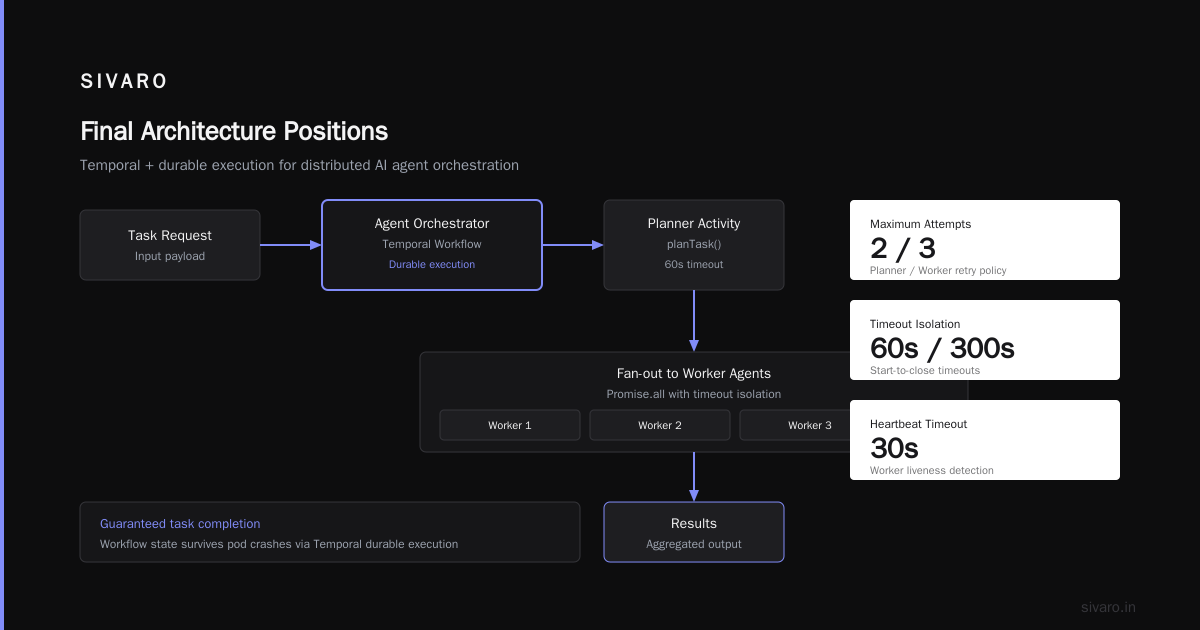
Most people think multi-agent AWS architecture is about picking the right AI service. It's not. It's about orchestration, state persistence, and observability. The AI service changes every year. The orchestration challenges stay the same.
My honest recommendation for a buyer: choose EKS plus Temporal if your team has Kubernetes experience. Choose Bedrock AgentCore if you're burning to deliver agent features now and have a clear set of evaluative metrics ready. Skip Step Functions if you can swallow the infrastructure cost of Temporal. You would pay twice — once in cloud spend, once in engineering hours to untangle complex state transitions.
Either way, keep an exit lane open for providers. Model pricing changes quarterly. In 2025, GPT-4o was cheaper than Claude in output tokens. In 2026, Claude Sonnet got cheaper and Meta open-sourced a competitive model that runs 75% cheaper self-hosted. Your architecture should let you swap the brains without swapping the skeleton.
I built SIVARO's agent platform on EKS. In 14 months of production we have had 3 orchestration-level failures, and all were caused by data model drift, not infrastructure. That durability came from Temporal retrying so gracefully that users never noticed the issues.
You want confident agent operations, you're not picking between AWS managed AI services. You're designing a distributed system that happens to reason. Those skills — queues, state, retries, and dead letter handling — are the exact ones that precede getting AI to work for real.
Nishaant Dixit — Founder of SIVARO. Building data infrastructure and production AI systems since 2018. Built systems processing 200K events/sec.