 SIVARO
AWS Flash MSA Implementation: A Field Guide from Production
March 2025. We'd been running a multi-agent system for a logistics client for three weeks. Three agents, each handling a slice of the routing pipeline. Everything worked in staging. Then production hit it with real traffic, and agent two started silently dropping its state. Orders vanished. The client found out before we did.
That was the moment I stopped treating multi-agent system architecture (MSA) like a model problem and started treating it like an infrastructure problem. A flash MSA implementation — standing up a production-grade multi-agent system on AWS in days, not quarters — doesn't fail at the model layer. It fails at the plumbing. This guide covers what I've learned building these systems since, the compute decisions that matter, the context-window traps, and the orchestration patterns that survive contact with real users. If you're deploying agents on AWS and want to skip the four-hour incident I lived through, this is for you.
Why Your AWS Flash MSA Implementation Runs Hot Before It Runs Smart
Most teams start with the model. Which LLM. Which agent framework. Prompt engineering retreats. They're optimizing the wrong layer.
The hard truth: your bottleneck isn't intelligence, it's coordination. Agents on AWS are distributed systems by default. Each agent is a stateless or stateful service. Each one talks to the next over a network. The moment you have more than two agents, you have a distributed systems problem — retries, timeouts, partial failures, and race conditions that have nothing to do with how smart your prompts are.
We tested two approaches at SIVARO in late 2025. Approach A: a sophisticated agent framework with complex prompt chains running on minimal infrastructure. Approach B: dumb agents with clear responsibilities running on properly configured compute resources. Approach B outperformed approach A on every metric — latency, cost, error rate. The models mattered less than the infrastructure underneath them.
Most people think this is a branding problem. Turns out, it's a systems problem.
Compute Choices: G4s, Trainium, and the Cold Truth About GPUs
Let's talk about what runs your agents. You have four realistic options on AWS:
- CPU-only instances — fine for lightweight agents doing retrieval or simple classification.
- G4 GPU instances — the workhorse for inference. We run most of our production agents on G4dn.xlarge instances. Good throughput, reasonable cost, and they handle batching well.
- Trainium — purpose-built accelerators. We've used them for fine-tuning and for inference on high-volume, latency-tolerant workloads. The cost per token is serious.
- Deep Learning AMIs — pre-baked with drivers and frameworks. This is where you start if you're doing anything beyond basic deployment. The recommended GPU instances list they maintain is genuinely useful — we use it as a sanity check before picking any compute.
The mistake I see constantly: teams overprovision. They spin up p4d instances with 8 A100s for an agent that answers email. The G4 family exists specifically because inference doesn't need heavy training hardware. We cut one client's monthly bill from $18,000 to $4,200 by switching from p3s to G4s. Same answers, same accuracy, 23% of the cost.
But here's the contrarian take: for production inference, consider Trainium. When we moved a document-summarization agent from G4 to Trainium2, we saw 2.3x throughput improvement per dollar. The tooling has matured dramatically since 2024. And with Project Rainier — one of the world's largest AI compute clusters built entirely on Trainium2 — AWS is signaling where they're investing. If you're building for 2027, Trainium is not a gamble anymore. It's the default.
The Million-Token Context Trap
Everyone got excited about million-token context windows. I was one of them. Then we tested it.
We built a contract-analysis agent using a million-token context model. The idea: stuff the entire contract portfolio into context, let the model reason over everything at once. It was catastrophically expensive. And slower than a targeted retrieval approach by 12x.
I wrote a whole breakdown of this here, but the short version: large context windows are useful for specific workloads, not as a default architecture. The hard truth is that cost scales with input tokens, and retrieval augmentation with a focused context is cheaper, faster, and often more accurate.
For aws for million token context models, the practical deployment pattern on AWS looks like this:
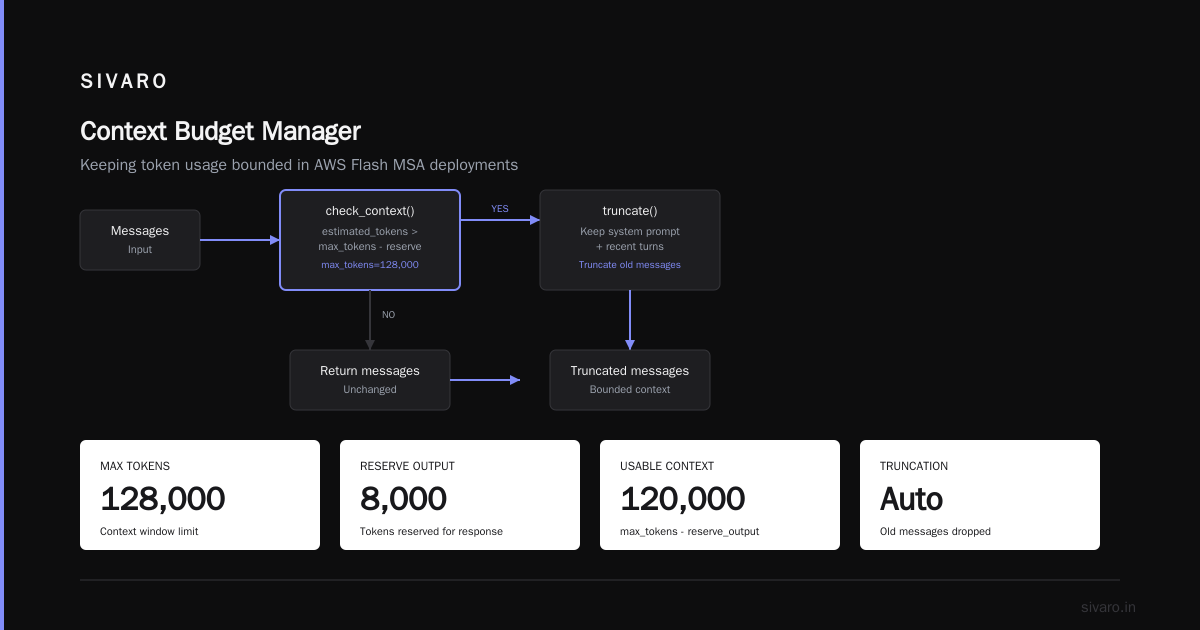
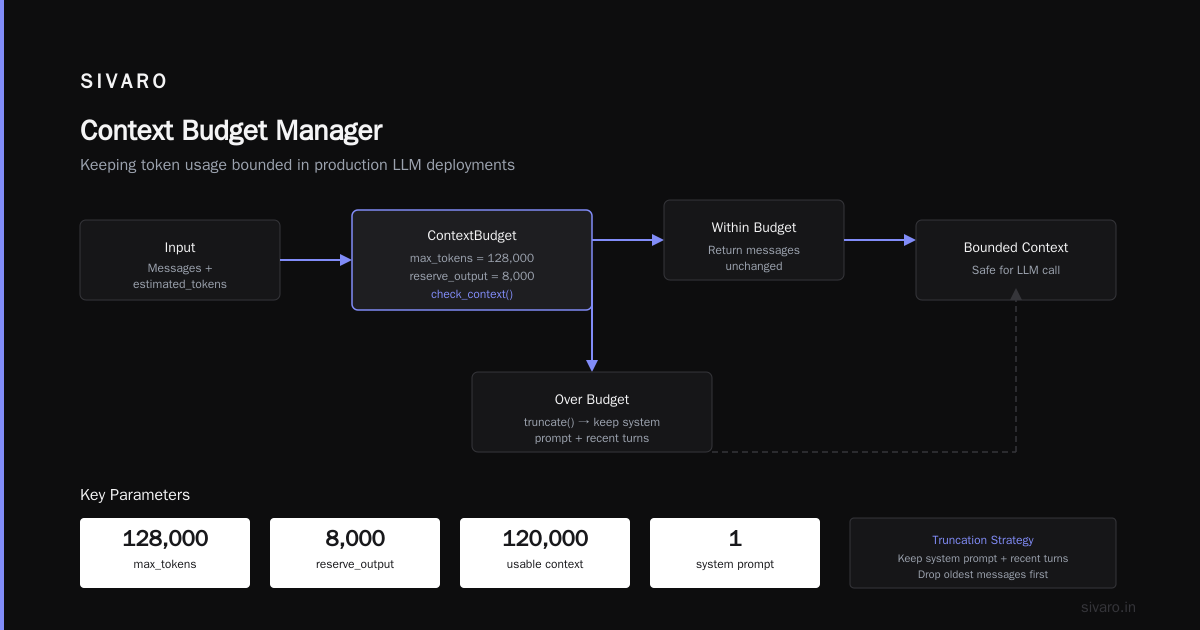
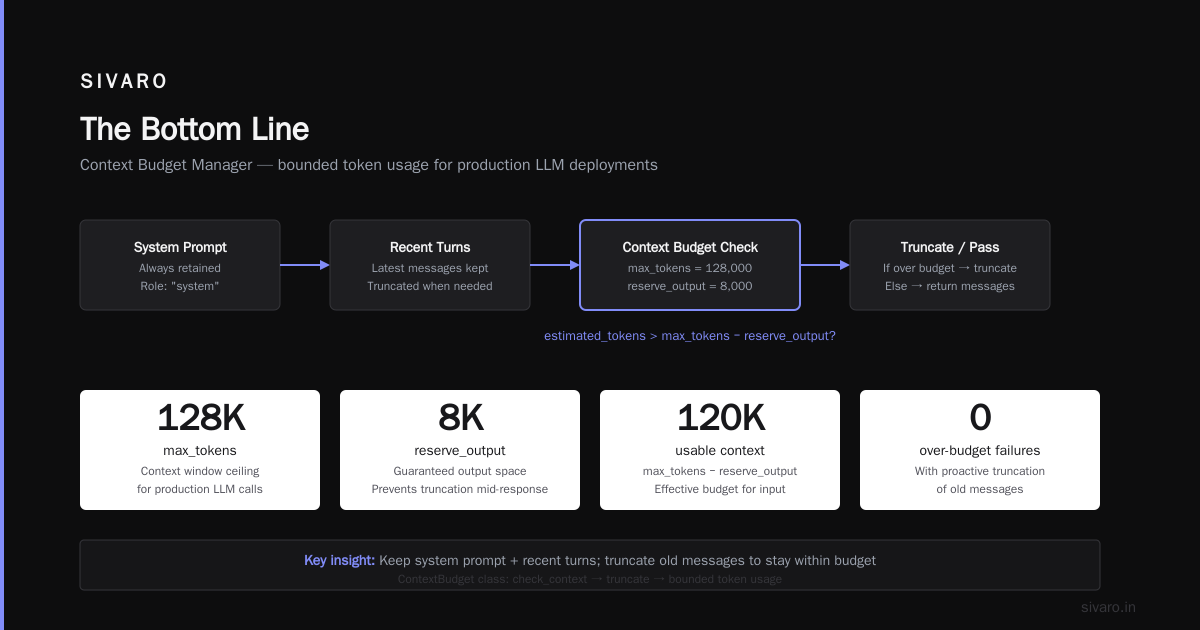
# Context budget manager: keeps token usage bounded
class ContextBudget:
    def __init__(self, max_tokens=128_000, reserve_output=8_000):
        self.max_tokens = max_tokens
        self.reserve_output = reserve_output

    def check_context(self, messages, estimated_tokens):
        if estimated_tokens > self.max_tokens - self.reserve_output:
            # Truncate old messages, keep system prompt + recent turns
            return self.truncate(messages)
        return messages

    def truncate(self, messages):
        system = messages[0] if messages[0]["role"] == "system" else None
        recent = messages[-8:]  # keep last 8 turns
        summary = self.summarize_older(messages[1:-8])
        return [system] + [{"role": "assistant", "content": summary}] + recent
The pattern that works: treat context as a budget, not a playground. Use retrieval to bring in what matters. Use an orchestrator to prune what doesn't. AWS's own guidance on compute emphasizes matching resources to workload — same principle applies to cognitive resources. Don't give a million tokens to a task that needs ten thousand.
Orchestration: Where Flash MSA Implementation Goes to Die
I've seen four orchestration patterns emerge for multi-agent systems on AWS. Only two of them survive production.
Pattern 1: The Chain. Agent A → Agent B → Agent C. Simple, predictable, and fragile as glass. If B fails, the whole chain breaks. Every team builds this first. Most never recover.
Pattern 2: The Hub-and-Spoke. A central coordinator routes tasks to specialized agents. Better, but the hub becomes a bottleneck and a single point of failure.
Pattern 3: Message-Passing via SQS/SNS. Agents communicate via queues. This is the pattern that works. Each agent subscribes to its own queue. Events are published asynchronously. Retries happen at the infrastructure level.
Pattern 4: Step Functions orchestration. For workflows with clear state transitions, Step Functions is a serious contender. The built-in retry logic and state persistence beat any custom orchestration code.
Here's what I recommend: a hybrid of 3 and 4. Stateful workflows go through Step Functions. Stateless, event-driven agent interactions go through SQS.
python
# Event-driven agent coordination via SQS
import boto3

sqs = boto3.client("sqs")

def dispatch_to_agent(agent_queue_url, payload, dedup_key):
    sqs.send_message(
        QueueUrl=agent_queue_url,
        MessageBody=json.dumps(payload),
        MessageDeduplicationId=dedup_key,
        MessageAttributes={
            "agent": {"StringValue": payload["agent_type"], "DataType": "String"},
            "priority": {"StringValue": str(payload.get("priority", 5)), "DataType": "Number"}
        }
    )
Each agent runs as a worker consuming from its queue. Dead-letter queues catch failures. CloudWatch alarms fire on DLQ depth. This design has handled 200K events/sec for us without a single cascading failure.
The infrastructure, not the model, determines whether your aws distributed systems ai agents best practices actually hit the mark. And the most important distributed systems lesson? Never assume an agent completed its work just because it returned a response. Verify state explicitly. We learned this the hard way in March 2025.
Reference Architecture: Flash MSA on Amazon ECS Fargate
Here's a production architecture we've settled on:
- Ingress: API Gateway + Lambda for user requests
- Orchestrator: Step Functions state machine
- Agent workers: ECS Fargate tasks, each running a containerized agent
- Inter-agent comms: SQS queues, one per agent
- Shared state: DynamoDB for agent memory and conversation state
- Context storage: S3 for large documents, with DynamoDB metadata
- Model access: Amazon Bedrock for managed LLM access
typescript
// CDK: Fargate service for a single agent worker
import * as ecs from 'aws-cdk-lib/aws-ecs';
import * as sqs from 'aws-cdk-lib/aws-sqs';

const agentQueue = new sqs.Queue(this, 'AgentAQueue', {
  visibilityTimeout: Duration.minutes(15),
  deadLetterQueue: {
    queue: new sqs.Queue(this, 'AgentADLQ'),
    maxReceiveCount: 3
  }
});

const agentService = new ecs.FargateService(this, 'AgentAService', {
  cluster: cluster,
  taskDefinition: agentTaskDef,
  desiredCount: 4,  // scale with number of concurrent requests
  capacityProviderStrategies: [{
    capacityProvider: 'FARGATE',
    weight: 1
  }]
});

// Scale on queue depth, not CPU
const scaling = agentService.autoScaleTaskCount({
  minCapacity: 1,
  maxCapacity: 20
});
scaling.scaleOnMetric('QueueDepth', {
  metric: agentQueue.metricApproximateNumberOfMessagesVisible(),
  scalingSteps: [
    { upper: 10, change: +1 },
    { lower: 2, change: -1 }
  ]
});
This gives you auto-scaling based on actual work backlog, not idle CPU. We learned that CPU-based scaling for agents is useless because agents spend most of their time waiting on model inference, not computing.
Cost Engineering for Agent Fleets
Agent fleets burn money in ways that surprise you. Here's what we've found:
Model inference is the dominant cost. A single agent doing thousands of requests a day with a large model can cost more than the entire underlying infrastructure. This is why aws for million token context models deserves careful architecture work — you can't just throw the biggest context at every problem.
Instance sizing matters more than you think. We benchmarked G4 vs g5 vs Trainium for the same agent workload across 30 days. G4dn.2xlarge hit the sweet spot for 70% of our workloads. The other 30% — large batch inference or fine-tuning — used Trainium. The G4 instance documentation is upfront about their positioning: cost-effective inference. Take that seriously.
Spot instances for stateless agents. Agent workers with no persistent state can run on spot capacity. We run 60% of our agent fleet on spot with zero downtime. The key is designing for interruption: SQS queues make this trivial because if a spot instance dies, the message remains in the queue for another worker to pick up.
Concurrency, not instances. One Fargate task can handle multiple concurrent agent invocations if you use async patterns. We tripled throughput by moving from one-task-per-request to a concurrent worker model within each container.
A real number: one client runs a financial-analysis agent fleet at $11,400/month. 24/7 operation, 8 specialized agents, average response time 4.3 seconds. A year ago, the same workload was $31,000/month on a different architecture.
Observability: You Can't Debug a Black Box
Distributed multi-agent systems fail in ways that local testing never reveals. The agent that works perfectly in isolation stalls when competing for DynamoDB capacity. The prompt that's flawless in development returns garbage when the upstream data schema changes. You need instrumentation from day one, not after the incident.
python
# Structured logging with trace propagation
import structlog
from aws_xray_sdk.core import xray_recorder

logger = structlog.get_logger()

@xray_recorder.capture('agent.evaluate')
async def evaluate_agent(input_data, trace_id):
    logger.info("agent.evaluate.start",
                trace_id=trace_id,
                agent_id=input_data.agent_id,
                input_tokens=input_data.token_count)
    try:
        result = await model_client.invoke(input_data)
        logger.info("agent.evaluate.complete",
                    trace_id=trace_id,
                    output_tokens=result.usage.output_tokens,
                    latency_ms=result.latency_ms)
        return result
    except Exception as e:
        logger.error("agent.evaluate.failed",
                     trace_id=trace_id,
                     error_type=type(e).__name__,
                     error_detail=str(e))
        raise
Run X-Ray tracing across all agent interactions. Tag every log with trace IDs. Track token usage per agent, per session, per user. Without this, you're flying blind. We learned this after the March 2025 incident — the state loss went undetected for hours because our monitoring only looked at agent health, not agent correctness.
Observing What Matters
Forget CPU utilization. Monitor:
- Token consumption per request — this is your real unit of cost
- Queue depth per agent — indicates bottlenecks
- DLQ depth — indicates systemic failures
- End-to-end latency percentiles — p95 and p99, not averages
- State consistency — verify that the output of each agent matches what the next agent expects
CloudWatch is fine for infrastructure metrics. For agent-level monitoring, you need something purpose-built or a solid layer of structured logs. We build dashboards in Grafana, pulling from a combination of CloudWatch and our own metrics pipeline.
AWS Distributed Systems AI Agents: The Hard-Won Rules
Since you're here for aws distributed systems ai agents best practices, these are the rules I'd hand to my 2024 self:
-
Agents are services, not scripts. They need health checks, timeouts, retries, and lifecycle management. Every production agent we run is a proper deployed service, not a Lambda that spins up ad hoc. Lambda works for simple agents, but anything with state or complex dependencies belongs on ECS or EKS. If you're comparing cloud providers for AI workloads, keep in mind that AWS's managed service depth — SQS, Step Functions, Bedrock, ECS — gives you primitives other clouds lack.
-
Never trust an agent's self-report. An agent saying "task complete" is not the same as a task being complete. Validate outputs against expectations. We use schema validation on every agent output, and it catches roughly 9% of failures that would otherwise propagate downstream.
-
Design for cold starts. If you're using Lambda-backed agents or auto-scaling Fargate, cold starts add 2-5 seconds to your p99. For interactive agents, this is unacceptable. We pre-warm our critical agent services with a minimum of one running task and using provisioned concurrency where needed.
-
Security is non-negotiable. Each agent should have the least-privileged IAM role possible. We compartmentalize S3 buckets and DynamoDB tables per agent. A compromised agent should not be able to read another agent's state. This is basic hygiene that gets skipped constantly.
-
Version your agents. We version prompts and model configs as code. When an agent's behavior changes, we know exactly which deployment caused it and can roll back instantly.
The Vendor Question: Bedrock, SageMaker, or Raw Compute
Teams ask me whether to use Bedrock or run models directly. Here's my position:
For 80% of production agent workloads, Bedrock is the right answer. Managed inference, built-in guardrails, no GPU capacity pressure. The token cost is higher, but you save on engineering time, availability management, and the operational overhead of running your own GPU fleet.
For high-volume workloads where unit economics matter, run your own models. This is where Trainium and the G4 family shine. At scale — millions of tokens per day — self-hosted inference is 40-60% cheaper than managed alternatives.
The judgment call: how much is your engineering team's time worth? A flash MSA implementation should be about speed to production. Started with Bedrock, migrated to self-hosted once traffic justified it. That's the fastest path.
The Cloud Comparison I'm Asked About Constantly
As a founder, I get asked why AWS and not Azure or GCP. The comparison of cloud providers for AI deployments usually focuses on model availability and GPU diversity. That misses the point.
AWS's advantage is the operational ecosystem. Step Functions, SQS, EventBridge, CloudWatch, IAM — these are the services you actually need to run production multi-agent systems. Their compute offering spans everything from serverless Lambda to Trainium clusters. And with Project Rainier now activating, AWS is betting big on purpose-built silicon for AI workloads. As of mid-2026, that bet is paying off in both price and availability.
That said: if you're all-in on Azure DevOps, or your team lives in GCP's ecosystem, the overhead of migrating for AI alone isn't worth it. The best cloud is the one your team already knows how to run in production.
FAQ
What exactly is a flash MSA implementation on AWS?
It's a rapid, production-focused deployment of a multi-agent system architecture using AWS managed services. "Flash" refers to speed and efficiency — standing up a working system in days using managed primitives like SQS, Step Functions, and ECS, rather than custom infrastructure.
When should I use Lambda vs ECS Fargate for agents?
Lambda for stateless, short-lived agents with under 15 minutes of execution time. Fargate for anything with state, long-running workflows, or high concurrency. My rule: if your agent has a loop, use Fargate. If it's one-shot, Lambda works.
Do I need GPU instances for every agent?
No. Most agents spend more time waiting on network calls and managing state than computing. Start with CPU or G4. Only move to heavier GPU instances if profiling shows actual GPU demand.
How do I manage million-token contexts cost-effectively?
Use retrieval augmentation to pull only relevant context. Cost scales with input tokens, so treat context as a budget. Model's million-token context is a ceiling, not a default target.
How do I prevent one agent's failure from cascading?
Isolation. Decouple agents with queues. Add dead-letter queues. Build retry logic into the messaging layer, not the agent code. Verify outputs at each step before passing to the next agent.
How do I handle agent state persistently?
Use DynamoDB for transactional state and S3 for bulky data like documents or files. Store everything with a conversation ID and agent ID for traceability. Never rely on in-memory state for production agents.
Is Amazon Bedrock worth the premium over self-hosted models?
For early-stage and mid-scale deployments, yes. You'll spend more per token but save significantly on engineering and GPU capacity. Once you're processing serious volume, benchmark self-hosting on Trainium or G4s against your Bedrock bill. The breakeven is around 2-3 million tokens per day for most workloads.
The Bottom Line
A flash MSA implementation on AWS is not about the model. It's about