 SIVARO
aws full form meaning: What Nobody Tells You About the Cloud Giant (A Practitioner’s Guide)
Look, I’ve been running production systems on AWS since 2018. Built SIVARO on it. Processed 200K events per second through it. Watched bills explode, watched architectures collapse, and rebuilt them. So when someone asks me about aws full form meaning, I don’t just say “Amazon Web Services” and move on.
I tell them the real story.
AWS launched in 2006. Internal Amazon infrastructure, spun out as a product. Simple idea: rent compute by the hour. Changed everything. But seventeen years later? The aws full form meaning has shifted. It’s not just web services anymore. It’s a distributed operating system for the planet. It’s the substrate that runs Netflix, Airbnb, and half the startups you’ve never heard of.
This article isn’t a glossary. It’s a field guide. Written by someone who’s been burned by AWS, saved by AWS, and learned exactly where the landmines are buried. By the end, you’ll understand not just what AWS is, but how to actually use it without getting destroyed by complexity or cost.
So What Does AWS Actually Stand For?
AWS full form meaning is Amazon Web Services. That’s the literal expansion. But the functional definition? It’s a collection of over 200 cloud services spanning compute, storage, databases, machine learning, analytics, networking, security, and more.
Here’s what most people miss: Amazon launched AWS because they needed to. Their internal teams were building the same infrastructure over and over. So they abstracted it, productized it, and accidentally created the dominant cloud computing platform on earth.
Today, AWS owns roughly 32% of the cloud market. Microsoft Azure sits at 23%. Google Cloud trails at 11%. The gap matters — more on that in the comparison section.
But understanding aws full form meaning requires knowing what makes it different from running your own servers. Three things:
- Pay-as-you-go pricing — no upfront capital
- Elasticity — scale up, scale down, instantly
- Managed services — let AWS handle the undifferentiated heavy lifting
Sounds perfect. It’s not. Every convenience comes with a cost. Literally. I’ve seen startups burn $50K/month on services they didn’t need because they thought “managed” meant “cheap.”
The Core Services You Actually Need
AWS offers 200+ services. You’ll use maybe 15. Don’t let the catalog intimidate you.
Compute
EC2 is the original. Virtual machines on demand. You pick the instance type, storage, OS, and go. Simple. Expensive if you’re careless.
Lambda changed everything. No servers at all. Upload code, set a trigger, pay per execution. We run most of SIVARO’s event processing on Lambda. Cold starts are the enemy — more on that later.
ECS and EKS handle containers. ECS is AWS-native. EKS runs Kubernetes. I prefer EKS for portability. You can move workloads to on-prem or another cloud without rewriting everything.
Storage
S3 is the undisputed king. Object storage that scales infinitely. We store petabytes of training data there. Eleven 9s of durability. It just works.
EBS attaches to EC2 instances. Block storage. Fast. Persistent. Expensive for what you get.
Databases
RDS manages relational databases — PostgreSQL, MySQL, Oracle, SQL Server. Good enough for most applications.
DynamoDB is their NoSQL offering. Key-value and document. Sub-millisecond latency at scale. Hard to design for, but when it works, it’s magic. We migrated one system from MongoDB to DynamoDB and cut latency by 80%.
Redshift is data warehousing. Columnar storage. Fast analytics on massive datasets. If you’re doing OLAP, Redshift is your friend. But don’t use it for OLTP — learned that the hard way.
The Hard Truth About the “Elastic” Promise
Most people think AWS auto-scales magically. They’re wrong.
Elasticity works if you design for it. That means stateless applications, distributed databases, and careful capacity planning. Slap a traditional monolithic app on EC2 and expect it to scale? You’ll hit bottlenecks immediately.
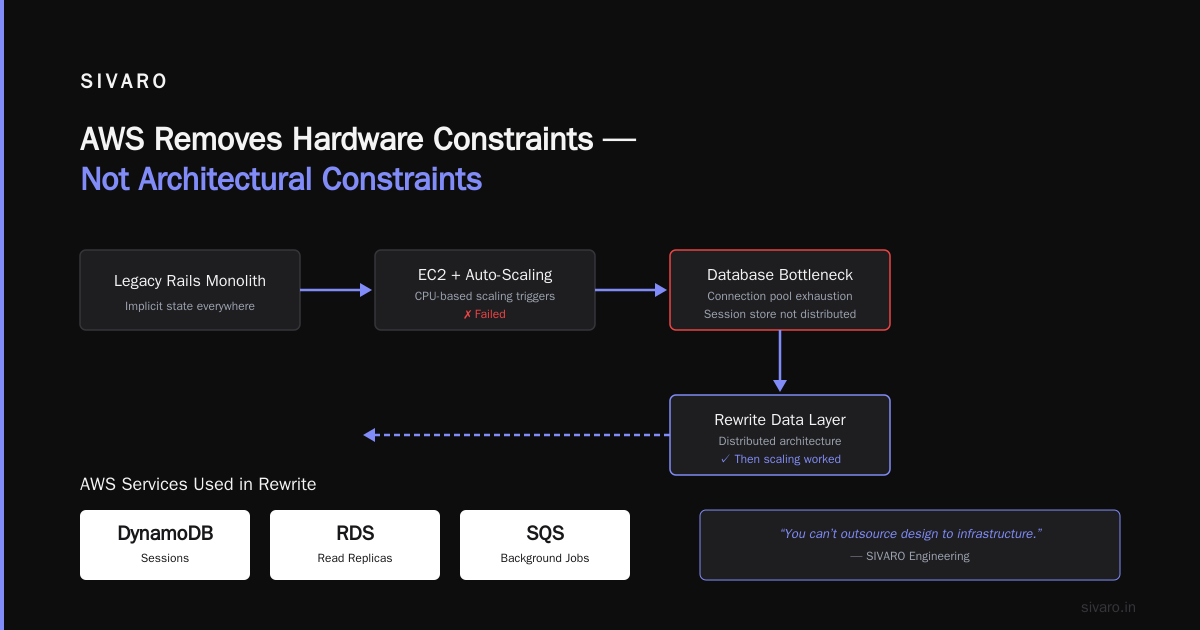
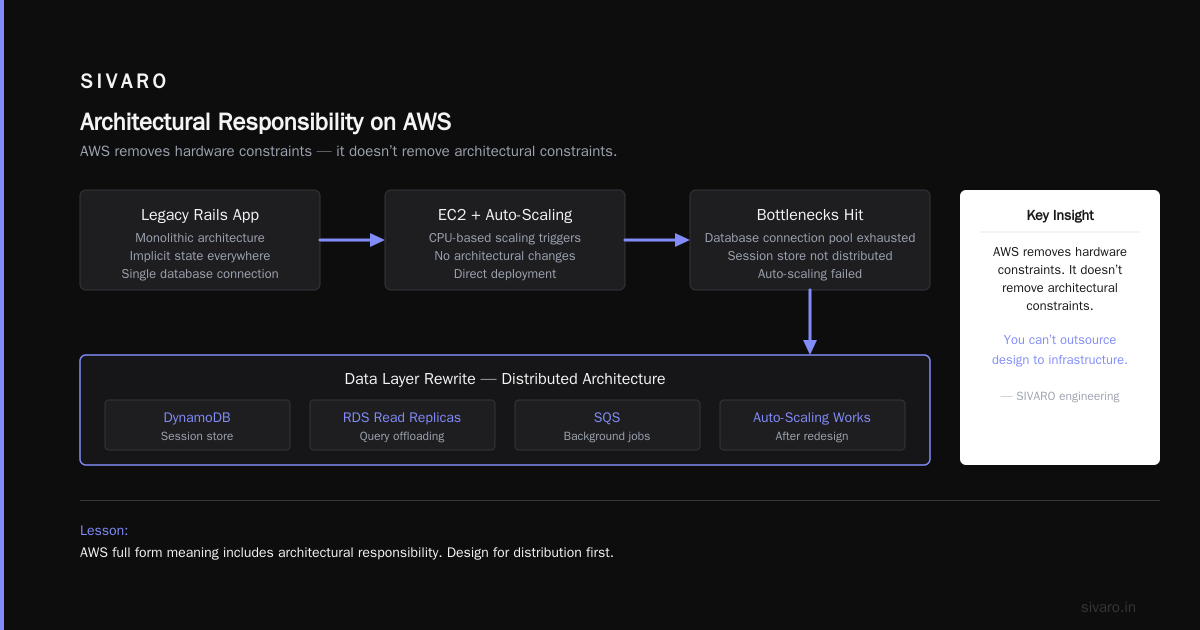
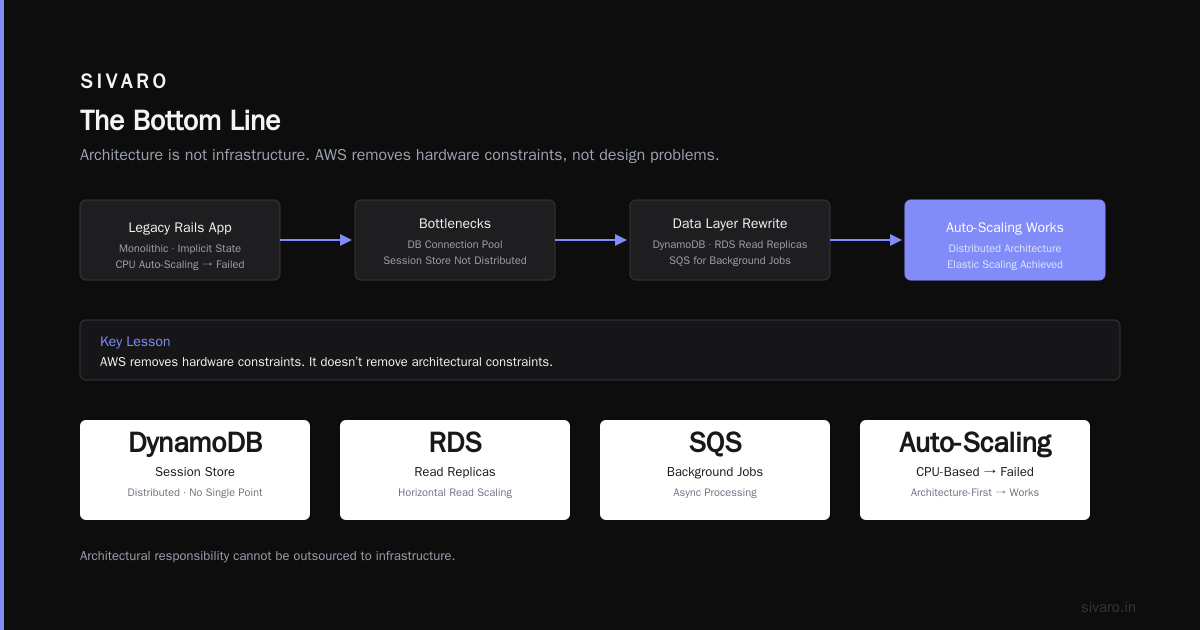
Here’s what I tell clients: AWS removes hardware constraints. It doesn’t remove architectural constraints.
We tested this at SIVARO. Took a legacy Rails app, deployed it on EC2 with auto-scaling based on CPU. It failed. The database couldn’t handle the connection pool. The session store wasn’t distributed. The app had implicit state everywhere.
Had to rewrite the data layer. Moved to DynamoDB for sessions, RDS read replicas for queries, SQS for background jobs. Then auto-scaling worked.
The lesson? aws full form meaning includes architectural responsibility. You can’t outsource design to infrastructure.
Distributed Training: Where AWS Gets Interesting
If you’re doing machine learning at scale, AWS has serious capability. SageMaker supports distributed training across multiple nodes. This isn’t academic — we use it for production models.
The challenge is orchestrating the work. Distributed machine learning requires splitting data, synchronizing gradients, and handling node failures. SageMaker handles the plumbing. You bring the model and data.
But don’t assume it’s automatic. We ran a training job with default settings on 16 p3.16xlarge instances. It took 3 hours and cost $1,200. Switched to the distributed training library — 45 minutes, $300. The configuration matters.
For really large-scale work, you’ll need cloud-native and distributed systems thinking. AWS provides the primitives, but you design the architecture.
The Cold Start Problem Nobody Warns You About
Lambda’s cold starts killed our API once. Surface-level explanation: function hasn’t been invoked recently, so AWS spins up a new container. Takes 500ms-2s. That’s an eternity for latency-sensitive applications.
We were running a real-time inference pipeline on Lambda. First request of the day? 1.2 seconds. User-facing. Unacceptable.
Solutions:
- Provisioned Concurrency — keep N instances warm always. Costs money but eliminates cold starts.
- VPC optimization — cold starts get worse with VPCs. Use AWS Lambda SnapStart if your runtime supports it.
- Don’t use Lambda — sometimes a small EC2 instance is simpler than fighting cold starts.
We went with provisioned concurrency. Added 20% to our compute bill. Worth it for the latency SLA.
Understanding this pattern is crucial for any serious agentic systems that are distributed systems. Agents calling functions with unpredictable latency? Bad experience.
AWS vs Azure vs GCP Comparison (The Real One)
Everyone wants a simple answer. There isn’t one. But here’s my experience after running production workloads on all three.
AWS — widest service catalog, best documentation, most community resources. The default. But also the most complex. IAM policies alone consume entire careers. You’ll spend more time configuring than building.
Azure — better integration with Microsoft products. If you’re a .NET shop, Azure feels natural. Active Directory integration is superb. But the portal is slower. Some services feel half-baked compared to AWS equivalents.
GCP — best pricing for sustained workloads. Committed use discounts are brutal against AWS Reserved Instances. Kubernetes runs natively (GKE is superior to EKS). But fewer services overall. If you need something AWS has and GCP doesn’t, you’re writing your own.
I chose AWS for SIVARO because of the ecosystem. More third-party tools integrate with AWS. Easier to hire engineers who know AWS. But I acknowledge: it’s not the cheapest, and it’s not the simplest.
For the aws vs azure vs gcp comparison, the real differentiator is your team’s operational maturity. AWS rewards experience. Azure rewards Microsoft stack familiarity. GCP rewards Kubernetes expertise.
Don’t pick based on which has the coolest AI service. Pick based on where your team is strongest.
Certification Path for Beginners (The Efficient Way)
The aws certification path for beginners is a minefield. AWS offers 11 certifications across 4 tiers. Most people pick a random path and waste months.
If you’re new, ignore everything except the Cloud Practitioner and Solutions Architect Associate.
Cloud Practitioner teaches the basics. You’ll learn service categories, pricing models, security concepts. It’s foundational. Don’t skip it.
Solutions Architect Associate is the real start. You design fault-tolerant, scalable, cost-effective architectures. This exam is hard. Expect 2-3 months of study.
After that, choose your direction:
- Developer — if you’re writing code that runs on AWS
- SysOps Administrator — if you’re managing infrastructure
- Specialty — data analytics, machine learning, security (only after Associate)
I recommend this sequence because it matches how you’ll actually use AWS. Learn the concepts, then design architectures, then specialize.
Don’t attempt Professional certifications until you have at least 2 years of hands-on experience. The Professional exams test judgment, not memorization.
Cost Control: The Silent Career Killer
AWS bills can spiral. I’ve seen a startup with $200K/month bill. They were using unoptimized RDS instances with 10x the needed capacity.
Here’s what works:
- Tag everything — resource tags let you track costs by project, team, environment. Mandatory.
- Use Savings Plans or Reserved Instances — save 30-60% on compute. Commit to 1 or 3 years.
- Monitor with Cost Explorer — set budgets. Get alerts. Act on anomalies.
- Delete unused resources — EBS volumes, Elastic IPs, load balancers. They cost money sitting idle.
- Right-size instances — most workloads don’t need the instance type you chose. Monitor utilization. Downsize.
We reduced SIVARO’s AWS bill by 40% in the first quarter of implementing these. It wasn’t clever. It was disciplined.
The Hardest Lesson: Managed ≠ Hands-Off
Here’s the contrarian take: managed services require more expertise, not less.
Running RDS means you don’t manage PostgreSQL patches. But you do manage parameter groups, backup windows, read replicas, failover policies. You need to understand replication lag, connection pooling, query performance.
Running Lambda means you don’t manage servers. But you do manage function configuration, memory allocation, timeout settings, concurrency limits, VPC configuration. You need to understand cold starts, event sources, IAM roles.
aws full form meaning includes abdication and responsibility. AWS takes the hardware. You take the configuration.
That’s not a bad trade. But don’t think moving to AWS reduces your operations burden. It shifts it.
Real Production Examples from SIVARO
Let me be specific about what we run.
Event processing pipeline: 200K events/second through Kinesis Data Streams → Lambda → DynamoDB → Redshift. Cost is about $0.05 per million events in the processing layer. Storage is additional.
ML training: SageMaker with distributed training across 8* p4d instances. Each instance has 8 A100 GPUs. We use the distributed training library for gradient synchronization. Training runs average 4 hours. Cost per run: about $1,200.
Inference serving: We use SageMaker endpoints with auto-scaling. Two instance types: ml.g4dn.xlarge for latency-sensitive workloads, ml.inf1.xlarge for batch inference. Inference latency averages 35ms.
Data lake: S3 with Glue catalog, Athena for ad-hoc queries, EMR for Spark workloads. Storing about 50TB of historical data. Monthly S3 cost: around $600.
None of this was set up in a day. Each service required tuning, testing, and incident response planning.
The Future of AWS (July 2026 Perspective)
As of July 2026, AWS is investing heavily in AI infrastructure. The Trainium2 chips are available. Bedrock for foundation models is mature. Serverless is eating everything.
The trend that matters: distributed systems thinking is no longer optional. Every application is distributed. Every ML model runs across multiple nodes. Every database must handle partial failures.
When you understand cloud-native and distributed systems for efficient scale, AWS becomes an extension of your design philosophy. When you don’t, it becomes a source of frustration.
FAQ
What is AWS full form meaning exactly?
Amazon Web Services. It’s a cloud computing platform providing compute, storage, databases, machine learning, analytics, and networking services on a pay-as-you-go basis. Launched in 2006 by Amazon.
Is AWS hard to learn for beginners?
Yes, but not because the concepts are difficult. Because there are 200+ services and every one has its own configuration surface. Start with the aws certification path for beginners — Cloud Practitioner then Solutions Architect Associate. Expect 3-6 months to reach competence.
How does the AWS vs Azure vs GCP comparison shake out for startups?
AWS has the widest ecosystem and most community support. Azure is best for Microsoft-heavy shops. GCP offers better pricing for sustained workloads. For most startups, AWS is the safe bet. Not always the best choice, but never a bad one.
Can I run distributed training on AWS without deep ML expertise?
You can, but you shouldn’t. The distributed training in Amazon SageMaker AI abstracts some complexity, but you still need to understand data parallelism, model parallelism, and gradient synchronization. Start with small models and scale up.
What’s the biggest AWS mistake you’ve seen?
Not understanding distributed machine learning requirements before architecting. Teams pick instance types based on GPU count without considering networking bandwidth or memory bandwidth. Then training takes 3x longer than expected and costs 3x more.
How do I control AWS costs?
Tag resources, use Savings Plans, monitor with Cost Explorer, delete unused resources, right-size instances. We cut our bill by 40% with these measures. It’s not magic — it’s discipline.
What’s the future of AWS?
More AI-native infrastructure (Trainium, Bedrock), deeper serverless capabilities, and tighter integration between services. Agentic systems that are distributed systems will drive demand for event-driven, scalable architectures.
The Bottom Line
aws full form meaning is Amazon Web Services. But what it means is a platform that lets you build distributed systems without owning hardware. That’s powerful.
It’s also complex, expensive if you’re careless, and requires serious architectural thinking.
I’ve built SIVARO on AWS. I’ve processed 200K events per second through it. I’ve watched bills spike and crashes cascade. And I still choose AWS for most projects.
Not because it’s perfect. Because it’s the most capable platform in existence.
The trick isn’t understanding AWS. It’s understanding distributed systems. AWS just provides the building blocks.
Build wisely.
Nishaant Dixit — Founder of SIVARO. Building data infrastructure and production AI systems since 2018. Built systems processing 200K events/sec.