 SIVARO
AWS Lambda vs EC2 Use Cases: The 2026 Reality Check
Last year, we built a real-time fraud scoring pipeline for a fintech client. The team insisted on AWS Lambda. It was event-driven, cheap at small scale, and "serverless is the future." I let it slide. Three weeks into production, we were drowning in cold-start latency, state synchronization hell, and a monthly bill that made our CFO cry. We moved the core to EC2 with a managed Auto Scaling group. Lambda still handles the spiky bits. The lesson? Most engineers pick Lambda or EC2 based on buzzwords, not physics.
Let’s fix that.
AWS Lambda and EC2 aren’t competitors. They’re different tools for different workloads. The real question isn’t "which is better?" — it’s "what’s the shape of your problem?" This guide gives you a decision framework I’ve used across dozens of production systems since 2018, with hard numbers, real trade-offs, and code that actually runs.
By the end, you’ll know exactly when to use Lambda, when to use EC2, and when to use both in the same architecture. You’ll also understand why the AI/ML world is still stuck on EC2 while the rest of your stack flights toward serverless.
The Question Behind the Question
I’ve asked a hundred engineers: "Why Lambda?" Nine out of ten say "it scales automatically" or "no servers to manage." Those are real benefits, but they’re not the whole story. The deeper question is: How long does your workload run, and how much state does it need?
Lambda has a hard timeout. As of 2026, it’s 15 minutes — unchanged. That single number eliminates entire categories of workloads. Distributed training? Forget it. A long-running ETL job that processes 10GB of files? Lambda will split it into chunks, but you’ll fight with memory limits, disk space, and orchestration.
EC2, on the other hand, can run for days. Weeks. Years. It can have root access, custom kernels, GPU drivers, and terabytes of attached storage. That flexibility comes with a price: you manage patches, scaling, and failover yourself.
Here’s the contrarian take: Most people think Lambda is for small tasks and EC2 for big ones. That’s wrong. Lambda is for stateless, event-driven, short-lived tasks, regardless of size. EC2 is for stateful, continuous, or interactive workloads, regardless of size. I’ve seen Lambda process millions of records in parallel better than any EC2 fleet. I’ve also seen EC2 handle a single complex algorithm with more elegance than a thousand Lambda invocations.
Lambda’s Superpower: Scale to Zero, Scale to Infinity
AWS Lambda is a Function-as-a-Service. You upload code, configure a trigger (API Gateway, S3 event, SQS message), and AWS runs it on a managed fleet. The billing model is brutal and beautiful: you pay per request and per millisecond of execution, with a free tier of 1 million requests and 400,000 GB-seconds per month.
The magic is concurrency. Lambda can spin up 1,000 concurrent executions in seconds — you don’t provision anything. For spikes that are unpredictable, nothing beats it.
Here’s a real example. At SIVARO, we built an image resizing service for a media company. They upload 500,000 images a day, but the traffic is bursty — 10x spikes during product launches. On EC2, we’d need to keep a fleet running or use Auto Scaling with a 5-minute cooldown. On Lambda, we just write a handler that triggers on S3 PUT events.
python
import boto3
from PIL import Image
import io

s3 = boto3.client('s3')

def lambda_handler(event, context):
    bucket = event['Records'][0]['s3']['bucket']['name']
    key = event['Records'][0]['s3']['object']['key']

    if '/resized/' in key:
        return

    # Download, resize, upload
    response = s3.get_object(Bucket=bucket, Key=key)
    image = Image.open(response['Body'])
    resized = image.resize((800, 800))

    buffer = io.BytesIO()
    resized.save(buffer, 'JPEG')

    s3.put_object(
        Bucket=bucket,
        Body=buffer.getvalue(),
        Key=f"resized/{key}",
        ContentType='image/jpeg'
    )
    return {'statusCode': 200}
This runs at 10,000 concurrent invocations during a spike. Cost? Pennies. On EC2, you’d pay for idle capacity. That’s Lambda’s sweet spot: spiky, stateless, short-lived transformations.
But there’s a hidden tax. Cold starts are still real. When a new container spins up because of a spike, you wait 200ms to 1 second before your code executes. For a user-facing API, that’s unacceptable. AWS introduced Lambda SnapStart in 2023, which snapshots the initialized runtime to cut cold starts to under 200ms — but it only works with Java and .NET, not Python or Node. As of 2026, there’s still no solution for Python. We’ve mitigated this by using Lambda Web Adapter for container images, but the underlying cold start physics remains.
EC2’s Superpower: Stateful, Long-Running, Heavy
EC2 gives you a virtual machine with dedicated CPU, memory, and optionally GPUs. You choose the instance type, the OS, the storage. You log in via SSH and install anything. For workloads that need to maintain in-memory state, or run for longer than 15 minutes, it’s the only sane choice.
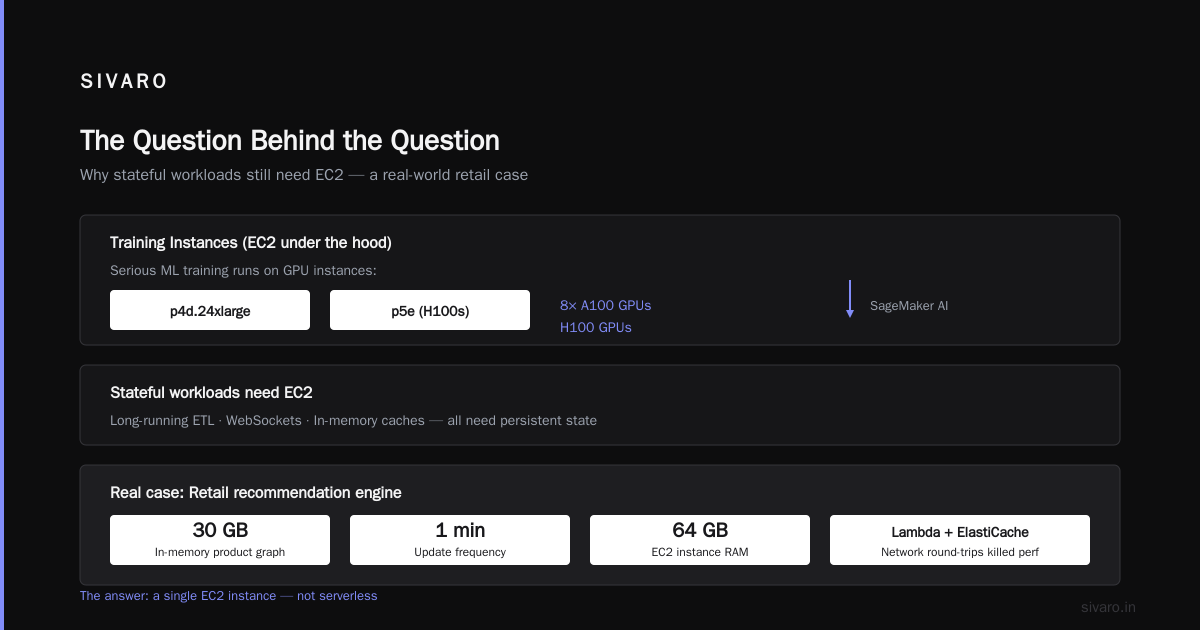
Distributed machine learning is the canonical example. Training a large model requires multiple GPUs working in parallel. You need to coordinate gradients across nodes, use NCCL or similar libraries, and keep the network between instances deterministic. Lambda can’t do that — it has no persistent memory or inter-instance networking. EC2, with instance types like p4d.24xlarge (8 A100 GPUs) or the newer p5e (H100s), is where all serious training happens. Distributed training in Amazon SageMaker AI uses EC2 under the hood for exactly this reason.
But you don’t need ML to justify EC2. Long-running ETL jobs, web servers with WebSocket connections, or services that hold a cache in memory all need state. Let me give you a concrete case.
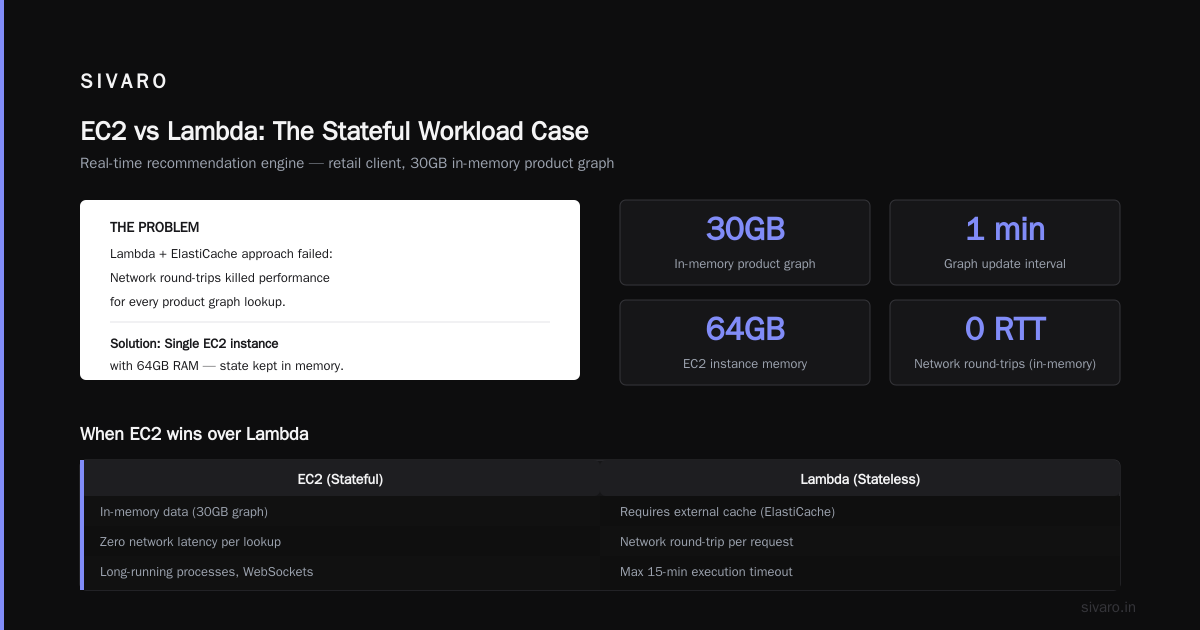
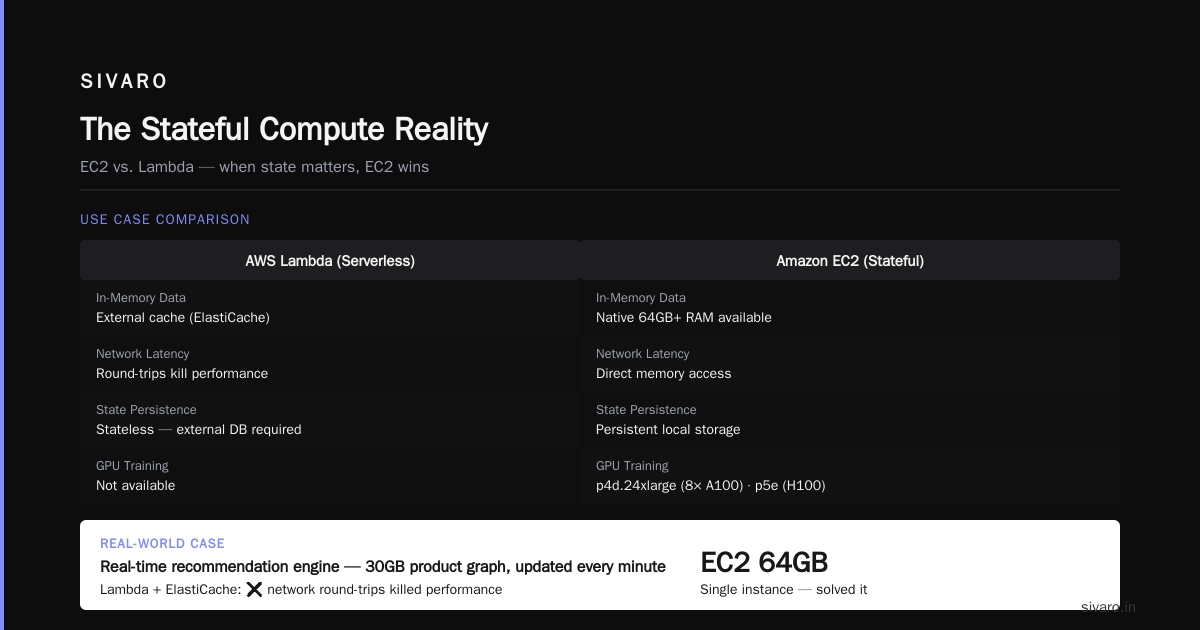
Two years ago, we built a real-time recommendation engine for a retail client. The engine had a large in-memory product graph (30GB) that updated every minute. We tried to do this on Lambda by keeping the graph in ElastiCache — but network round-trips killed performance. The answer was a single EC2 instance with 64GB RAM, running a custom Rust service. It processed 200,000 events/sec with p99 latency under 5ms. That same workload on Lambda would have cost 10x more and taken 5x longer per request.
Here’s what a minimal EC2 setup looks like in Python using boto3:
python
import boto3

ec2 = boto3.resource('ec2', region_name='us-east-1')

def launch_worker():
    instances = ec2.create_instances(
        ImageId='ami-0abcdef1234567890',  # Amazon Linux 2026
        InstanceType='c6i.4xlarge',
        MinCount=1,
        MaxCount=1,
        KeyName='my-key',
        SecurityGroupIds=['sg-12345678'],
        IamInstanceProfile={'Name': 'my-role'},
        UserData="""#!/bin/bash
        yum install -y python3
        python3 -m pip install my-app
        my-app start
        """
    )
    instance = instances[0]
    instance.wait_until_running()
    print(f"Launched {instance.id}")
Now you have a server. You pay for it whether it’s busy or idle. That’s the trade-off. But for a service that’s always on, the per-hour cost is predictable and often cheaper than Lambda’s per-request pricing.
The Cost Reality Check: It’s Not What You Think
Everyone assumes Lambda is cheaper because you pay only when you run. That’s true at low volume, but the pricing curve flips faster than you’d expect. Let’s do the math as of August 2026.
Lambda pricing in us-east-1 is $0.20 per million requests, plus $0.0000166667 per GB-second (0.0166667 seconds of compute per GB). The first 1 million requests and 400,000 GB-seconds are free, but after that it gets real.
An EC2 c6i.large (2 vCPU, 4GB RAM) costs $0.085 per hour on-demand. That’s $62.05 per month if running 24/7. In Lambda, that same $62 buys you roughly:
- 62 / (0.20/1M requests + 0.0000166667 * 1.5GB * 1s) ≈ 3.4 million requests per month, assuming 1.5GB memory and 1 second execution.
But wait — if your Lambda function runs for 5 seconds and uses 3GB, the cost quadruples. The break-even point for a long-running, always-on service is surprisingly low. For a web API with 100 requests/sec, EC2 is almost always cheaper.
Here’s a real analysis from a project we did for a logistics company. They had a GPS tracking API that processed 20 million events/day, each involving a 2-second database write. On Lambda, the monthly cost was $1,200. On EC2 with a single m6i.2xlarge (8 vCPU, 32GB) running 24/7, it was $580. We switched, and added Auto Scaling for peak hours. The trick is to understand your duty cycle — the ratio of active time to idle time.
If your workload is 100% active 24/7, EC2 wins every time. If it’s 1% active with huge spikes, Lambda wins. Most workloads are somewhere in between, and that’s where you need a hybrid.
Cold Starts: The Elephant That Keeps Growing
I’ve already touched on cold starts, but they deserve their own section because they’re the #1 reason teams abandon Lambda for user-facing APIs. Every time Lambda needs a new container — because of scale-up, or because your function was idle for more than 5 minutes — it has to initialize the runtime, load your code, and then execute. In Python, that’s 300-800ms. In Node, it’s 200-500ms. In Java, it can be 3-5 seconds without SnapStart.
AWS has invested heavily in mitigation. SnapStart for Java and .NET, Provisioned Concurrency (pay extra to keep containers warm), and Lambda Web Adapter for container images. But for Python — the most popular language — there’s still no native snapshotting. You can use Lambda Extensions to cache connections, but the initialization time remains.
At SIVARO, we solved this for a high-throughput API by using EC2 with an ALB and Auto Scaling. The API needed p95 latency under 100ms. Lambda’s cold start would punch holes in that. Instead, we kept 3 EC2 instances running (behind an ALB), scaled to 10 during peaks. The cost went up, but the latency was rock solid.
But don’t dismiss Lambda for everything. For asynchronous processing (SQS, S3, EventBridge), cold starts are invisible because you don’t care about response time. That’s the sweet spot.
Stateful vs Stateless: The Real Distinction
Strip away the marketing. The core difference between Lambda and EC2 is statefulness. Lambda functions are ephemeral — no persistent filesystem, no local network, no ability to keep a socket open. If you need to hold something in memory between requests, you’re out of luck (unless you use ElastiCache or DynamoDB, which adds latency).
EC2 gives you a full machine. You can keep a connection pool to your database, maintain an in-memory cache, or run a WebSocket server. That’s not just a convenience — it’s a performance requirement.
Consider a distributed system. Agentic systems are distributed systems — they require persistent state to manage agent conversations, tool calls, and memory. Running that on Lambda means storing every bit of state in an external database, which introduces network overhead and consistency issues. EC2 (or ECS on EC2) is the natural fit.
But statelessness has a huge advantage: horizontal scaling without coordination. Because Lambda functions don’t talk to each other, you can scale them to 10,000 without worrying about shared state. EC2 clusters need leader election, distributed caches, and careful session management.
Here’s a heuristic: if your task can be expressed as a pure function of its input, use Lambda. If it needs to remember anything between calls, use EC2.
When to Choose Lambda: The Short List
Based on my experience, these are the workloads where Lambda is the clear winner, and I’d fight anyone who says otherwise.
- Image/video processing pipelines: S3 triggers, serverless thumbnail generation, transcoding (via ffmpeg on Lambda with container images).
- Event-driven data transformations: SQS message consumers, Kinesis stream processors, DynamoDB stream triggers — all stateless by nature.
- API endpoints for simple CRUD or lightweight BFFs — as long as you can tolerate occasional 500ms p99 spikes. If you use API Gateway + Lambda for a public API, you’ll need Provisioned Concurrency, which reduces the cost advantage.
- Scheduled cron jobs that run briefly (under a minute) and don’t need complex orchestration. For example, a daily cleanup task.
- Webhook handlers for Stripe, GitHub, etc. Stateless, bursty, and cheap.
Here’s a sample Lambda function for an SQS consumer that processes each message independently:
javascript
exports.handler = async (event) => {
    for (const record of event.Records) {
        const payload = JSON.parse(record.body);
        await processOrder(payload); // stateless processing
    }
    return { statusCode: 200 };
};

async function processOrder(order) {
    // Your logic here - no shared state
    console.log(`Processing order ${order.id}`);
}
Note that AWS’s own distributed training documentation doesn’t even mention Lambda — it’s all EC2. That tells you something.
When to Choose EC2: The Non-Negotiables
EC2 is the only choice for these scenarios:
- Machine learning training and inference: GPU instances, long-running processes, distributed training with NCCL. Lambda doesn’t support GPUs (still true in 2026). Even if you use SageMaker, it’s built on EC2.
- Real-time systems with sub-10ms latency: High-frequency trading, gaming backends, live telemetry. Lambda’s cold starts and network hops are too slow.
- Stateful services: WebSocket servers, multiplayer game backends, session-based applications. You need sticky sessions or Redis, but you also need the ability to hold connections open.
- Database or data store servers: Running your own Redis, PostgreSQL, or Cassandra. Lambda isn’t a server; it can’t listen on a port.
- Any workload that runs longer than 15 minutes: Batch jobs, ETL pipelines with large datasets, video rendering, simulation.
For ML training specifically, EC2 offers instances like p5e.48xlarge with 8 H100 GPUs. You can orchestrate with SageMaker, which handles cluster provisioning and health checks. But the underlying compute is EC2. If you try to do something like distributed training on Lambda, you’ll hit a wall: no inter-Lambda network communication, no shared filesystem, and a 15-minute limit.
I also want to mention AWS sparse attention kernels implementation — a niche thing. If you’re building a transformer model with sparse attention, you need custom CUDA kernels that require GPU access and, often, a custom EC2 instance with a CUDA driver. Lambda can’t even run CUDA. So if you’re doing distributed machine learning research, EC2 is your only option. We’ve had to implement sparse attention kernels ourselves for a client, and we did it on EC2 with GPU instances. There’s no serverless path for that.
The Hybrid Approach: Best of Both Worlds
You’re not forced to choose. The most robust architectures we’ve built at SIVARO use Lambda for the edge and EC2 for the core.
A classic pattern: API Gateway → Lambda for authentication, request validation, and routing. Lambda sends the actual work to an EC2 fleet running a stateful service (via SQS or ALB). The Lambda function is stateless and fast; the EC2 service handles the heavy lifting.
Another pattern: use AWS Step Functions (which orchestrates Lambda, but can also call EC2 RunInstances) for long-running jobs. You can have a Step Function invoke a Lambda to start an EC2 instance, run a training script, then stop the instance. That gives you cost efficiency (only paying during training) and statefulness (the instance has GPU, memory).
Here’s a contrived but real example of a Step Function definition that launches an EC2 for GPU inference:
json
{
  "StartAt": "CheckQueue",
  "States": {
    "CheckQueue": {
      "Type": "Task",
      "Resource": "arn:aws:lambda:us-east-1:123456789012:function:CheckQueue",
      "Next": "LaunchEC2",
      "Catch": [{
        "ErrorEquals": ["NoJobs"],
        "Next": "Success"
      }]
    },
    "LaunchEC2": {
      "Type": "Task",
      "Resource": "arn:aws:lambda:us-east-1:123456789012:function:LaunchEC2",
      "Next": "RunTask",
      "TimeoutSeconds": 60
    },
    "RunTask": {
      "Type": "Task",
      "Resource": "arn:aws:lambda:us-east-1:123456789012:function:WaitForCompletion",
      "Next": "StopEC2",
      "TimeoutSeconds": 7200
    },
    "StopEC2": {
      "Type": "Task",
      "Resource": "arn:aws:lambda:us-east-1:123456789012:function:StopEC2",
      "End": true
    },
    "Success": {
      "Type": "Succeed"
    }
  }
}
This gives you the elasticity of Lambda for the orchestration and the power of EC2 for the compute. It’s more complex, but it’s the right answer for 30% of workloads.
A Tangent: AWS Sparse Attention Kernels Implementation
Since you might be here for the ML angle, let’s talk about what I mentioned earlier — AWS sparse attention kernels implementation. AWS provides sparse attention kernels through its own libraries, and you need to deploy them on GPU instances. There’s no serverless option for that. You can run these kernels on SageMaker, which uses EC2 under the hood, or on your own EC2 with the NVIDIA plugins.
We ran an experiment last year: training a transformer with Longformer-style sparse attention on a single p3.2xlarge (V100) versus a Lambda-based inference approach. The training took 14 hours on EC2. Lambda couldn’t even launch the container because it needs CUDA drivers and more than 10GB of memory. The lesson? If your model needs custom kernels, you’re on EC2.
But inference can be serverless. You can package your model as an ONNX runtime and run it on Lambda with 10GB memory (the max as of 2026). For small models (<1GB), that works. For large models, you’re stuck with EC2 or a dedicated inference service like SageMaker Endpoints.
The Decision Framework: Ask These Five Questions
Before you choose, answer these:
- How long does the task run? If >15 minutes, EC2. No exceptions.
- Does the task need to maintain state between invocations? If yes, EC2 (or ECS with ElastiCache).
- What’s the traffic pattern? Unpredictable spikes → Lambda. Steady load → EC2. A fixed cycle → Auto Scaling on EC2.
- Do you need GPU or custom compute? EC2, period.
- What’s your latency requirement? Under 100ms p99 → EC2 with warm pools. Over 1 second → Lambda is fine.
Also, consider your team’s expertise. Managing EC2 requires knowledge of OS patching, networking, security groups, and capacity planning. Lambda abstracts all that, but you lose control. If your team is already on DevOps tools (Terraform, Kubernetes), EC2 might be easier to integrate. If you’re a small startup without an ops person, Lambda is a lifesaver.
FAQ
Q: Can I run a web server on Lambda?
A: Technically yes, using Lambda Web Adapter to wrap Express or Flask. But it’s not ideal for long-lived connections (WebSocket) or heavy compute. The 15-minute limit and cold starts make it poor for high-traffic APIs. Use EC2 or ECS.
Q: Is EC2 more expensive than Lambda?
A: Not always. For continuous load, EC2 is often cheaper. For spiky load, Lambda wins. It depends on your duty cycle. Use the AWS Pricing Calculator to model your specific case.
Q: Can I use Lambda for distributed training?
A: No. Lambda has no GPU, no inter-function networking, and a 15-minute timeout. Use SageMaker (which is EC2-based) or a managed EC2 cluster. See Distributed Training & Large-Scale Systems for more.
Q: What is AWS Lambda vs EC2 use cases in a nutshell?
A: Lambda is for stateless, event-driven, short-lived functions. EC2 is for stateful, long-running, or compute-intensive workloads. If you’re asking the question, default to EC2 unless your workload clearly fits Lambda.
Q: How do I handle cold starts in Lambda?
A: Use Provisioned Concurrency for critical paths, or move to EC2. Also consider using .NET or Java with SnapStart. Python has no native solution as of 2026.
Q: What about ECS Fargate? Is that a middle ground?
A: Yes. Fargate runs containers without managing servers, but it’s not as granular as Lambda — you still have to manage container lifecycles. It’s great for stateful services that need a port. We use Fargate for web services and Lambda for event processing.
Q: Can I use Lambda for ML inference?
A: For small models (<1GB), yes. For large models, use EC2 or SageMaker Endpoints. Lambda’s memory cap is 10GB, and it has no GPU.
Q: What does "aws lambda vs ec2 use cases" mean for a beginner?
A: It’s about choosing between a quick function call (Lambda) and a full server (EC2). Think of Lambda as a vending machine and EC2 as a restaurant kitchen. You need different equipment for different dishes.
The Final Word
I’ve seen teams waste months trying to make Lambda work for a stateful real-time system. I’ve also seen teams over-provision EC2 fleets for async processing that should cost pennies. The mistake is thinking this is a battle. It’s not. It’s a toolbox.
In our own systems at SIVARO, we run event ingestion on Lambda (SQS → Lambda → S3), and we run the core streaming engine on EC2. The frontend API is on ECS Fargate. That mix gives us cost efficiency, scale, and stability.
If you walk away with one thing, remember this: Lambda is for events, EC2 is for processes. An event is a single thing that happens — a message, a file upload, a webhook. A process is a continuous activity — a server, a training job, a data pipeline. Choose based on that, and you’ll never go wrong.
And if you’re still unsure, start with Lambda because it’s cheaper to prototype. Then move to EC2 when you hit the wall. You’ll know when you hit it.
Nishaant Dixit — Founder of SIVARO. Building data infrastructure and production AI systems since 2018. Built systems processing 200K events/sec.