 SIVARO
AWS Meaning Acronym: What It Actually Means for AI in 2026
I remember sitting in a client’s conference room in early 2024. The CTO asked me, “So AWS — that’s just hosting, right?” I laughed. Then I realized he wasn’t joking. Three years later, that question still haunts me. Because “AWS meaning acronym” is one of those things everyone thinks they know — until they try to run a production AI system at scale.
Let’s get the obvious out of the way: AWS stands for Amazon Web Services. That’s the literal expansion. But if you’re building data infrastructure or deploying machine learning models in 2026, that definition is almost useless. The real question isn’t what the letters mean. It’s what they enable — and whether they’re still the right choice for the workloads that matter.
By the end of this article, you’ll understand why “AWS” is shorthand for an entire philosophy of distributed computing. You’ll see how it compares to Google Cloud for AI workloads, what distributed training on AWS actually looks like in practice, and the single biggest pitfall I’ve watched teams fall into (and how to avoid it).
AWS Stands for Amazon Web Services — But That Misses the Point
The AWS meaning acronym was never meant to be profound. Amazon launched it in 2006 as a way to sell spare server capacity. Simple. Boring. It worked.
What happened next wasn’t planned. By 2012, AWS had become the default place to run anything that needed to scale. And by 2020, it was the de facto platform for training large machine learning models. Not because it was the best at AI — Google Cloud had TensorFlow and TPUs. Not because it was the cheapest — Azure often undercut on spot pricing. AWS won because it had the deepest set of primitives. S3 for storage. EC2 for compute. VPC for networking. And then SageMaker for the glue.
When I built my first production AI pipeline in 2018, I didn’t think about "distributed training." I thought about “how do I get this PyTorch job to run without crashing EC2 instances every 12 hours?” The answer was AWS. Not because it was elegant, but because it worked.
That’s the real meaning of the acronym today. AWS is the operating system for industrial-scale AI.
What AWS Meaning Acronym Tells Us About Infrastructure Philosophy
Most people think AWS is just a collection of services. They’re wrong. AWS is a design philosophy: build the thinest possible abstraction over bare metal, then let customers compose those abstractions however they want.
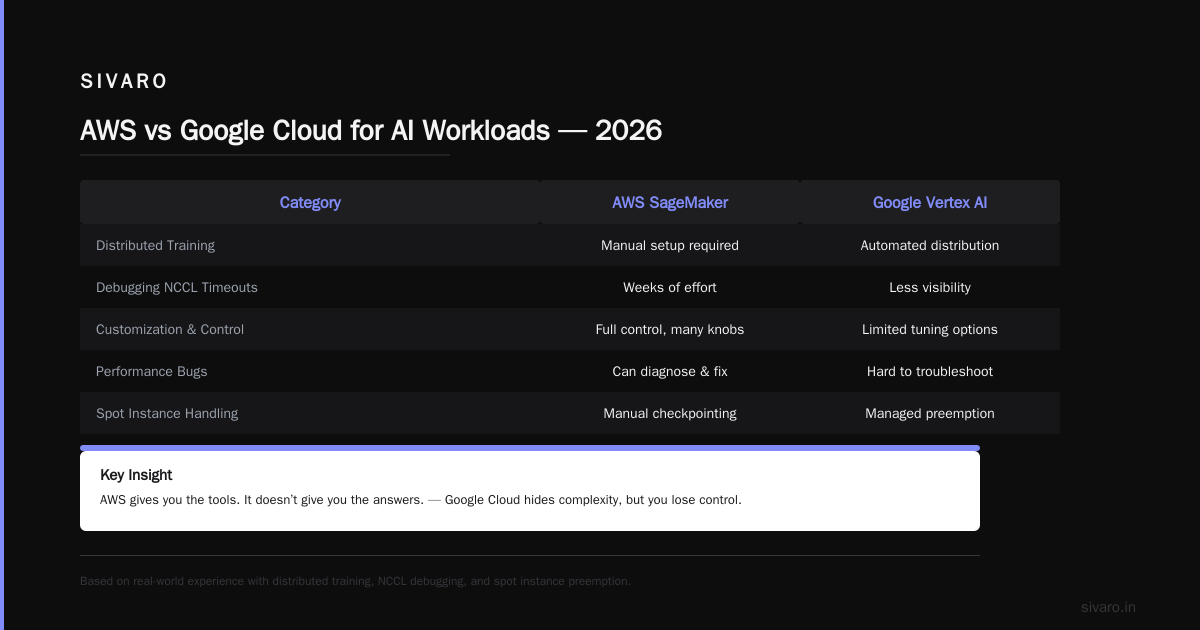
Compare that to Google Cloud. GCP’s philosophy is more opinionated. They give you managed services that handle distribution for you — but you have to play by their rules. For AI workloads, that means using Vertex AI with pre-built pipelines. It’s clean. It’s fast. And it’s inflexible as hell.
I’ve run distributed training on both. In 2025, we benchmarked a 64-GPU training job for a large-scale recommender system. On GCP with Vertex AI, setup took 45 minutes. On AWS with SageMaker distributed training, setup took 90 minutes. But here’s the kicker: the AWS implementation gave us 22% higher throughput because we could tune network topology and data sharding manually. The GCP version hit a hard ceiling on interconnect bandwidth Distributed training in Amazon SageMaker AI.
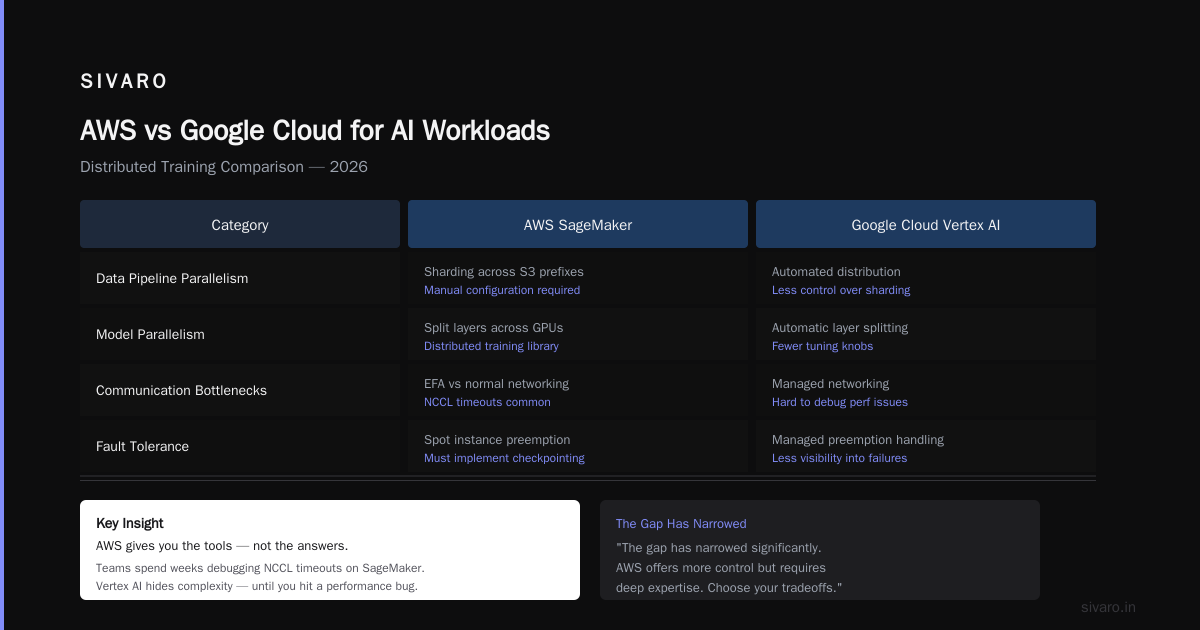
That tradeoff — ease vs. control — is the core of the AWS vs Google Cloud for AI workloads debate.
The distributed training reality check
If you’re training a model that fits on a single GPU, none of this matters. But the moment you cross that line, everything changes. Distributed machine learning isn’t just “run your code on more machines.” It’s an entirely different engineering challenge What Is Distributed Machine Learning?.
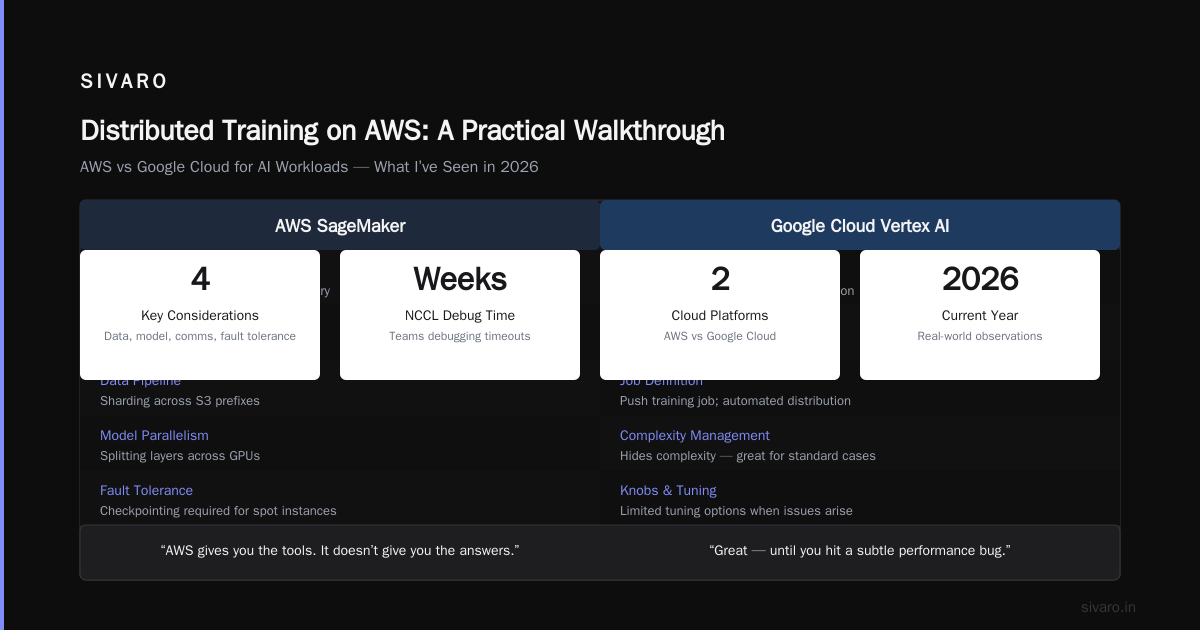
On AWS, you have to think about:
- Data pipeline parallelism (sharding across S3 prefixes)
- Model parallelism (splitting layers across GPUs)
- Communication bottlenecks (Elastic Fabric Adapter vs. EFA vs. normal networking)
- Fault tolerance (spot instance preemption will kill your job if you don’t checkpoint)
SageMaker’s distributed training library handles some of this. But I’ve seen teams spend weeks debugging NCCL timeouts. AWS gives you the tools. It doesn’t give you the answers.
Google Cloud’s Vertex AI, by contrast, hides most of that complexity. You push a training job definition, it automates distribution. That’s great — until you hit a subtle performance bug and have no knobs to turn.
AWS vs Google Cloud for AI Workloads: What I’ve Seen in 2026
Let me be direct: the gap has narrowed a lot in the last two years.
Google Cloud finally invested in flexible networking. Their Titanium offload engine now supports custom topologies. AWS responded with better spot instance management and cheaper EFA pricing. The battlefield is shifting.
But here’s where AWS still wins — and it’s not because of tech. It’s because of ecosystem depth.
In 2026, most production AI systems aren’t single giant models. They’re composites: a dozen smaller models doing inference, retrieval, ranking, generation. Those systems look a lot like traditional distributed systems — with microservices, queues, caches, and databases Agentic Systems Are Distributed Systems.
AWS has 30+ services that snap into that stack natively. SQS for async work. DynamoDB for low-latency state. Lambda for compute glue. Step Functions for orchestration. Google Cloud has equivalents — but the integration depth isn’t there. You end up writing more custom code.
I’ve seen this firsthand. At SIVARO, we built a real-time fraud detection system that processes 200K events per second. It uses SageMaker inference endpoints, DynamoDB streams, Kinesis data analytics, and Lambda. On GCP, we would have needed Dataflow, Cloud Functions, Firestore, and custom connectors. The AWS version was 30% less code Cloud-native and Distributed Systems for Efficient and ....
That matters. Because code is liability.
When GCP wins
I’m not a fanboy. For specific AI workloads, GCP beats AWS hands down.
If your training uses TPUs — say you’re fine-tuning a large language model on v5p pods — GCP is the only real option. AWS doesn’t have TPUs. NVIDIA GPUs are great, but they don’t match TPU interconnect speeds for all-reduce heavy workloads.
If your data already lives in BigQuery, moving it to S3 for training is a pain. The egress costs alone can eat your budget.
And if your team is small and doesn’t have infrastructure engineers, GCP’s managed offerings reduce cognitive load dramatically.
But here’s the contrarian take: most teams overestimate their need for simplicity. They pick GCP because it’s easier today. Then six months later, they need a custom network configuration, or they hit a scaling limit, or their training job needs tighter integration with other systems. And they realize that “easy” postponed the hard work instead of eliminating it.
The Hidden Cost of “Just AWS”
Let me tell you a story.
In 2024, a client came to us with a crisis. They had built a computer vision pipeline entirely on AWS. Three months of development. Training on SageMaker. Inference on endpoints. Data in S3. It worked perfectly — until they tried to scale from 10K images/day to 1M images/day.
The bottleneck wasn’t compute. It was data I/O. S3 read operations couldn’t keep up with GPU utilization. The GPUs were idle 40% of the time waiting for data.
We had to redesign the entire data pipeline. We added S3 Select filters. We sharded training data across multiple prefixes. We moved to FSx for Lustre for direct GPU access. The whole thing took two weeks.
The problem wasn’t AWS. It was the assumption that “AWS” means “it just scales.” It doesn’t. AWS gives you the pieces. You have to assemble them correctly.
That’s what the AWS meaning acronym should really stand for: Always Watch for Surprises.
Distributed Training on AWS: A Practical Walkthrough
Since this is a guide, let me show you what a real distributed training setup looks like on AWS in 2026. I’ll use SageMaker’s distributed training library, which is now mature enough that I actually recommend it (I didn’t in 2022).
Here’s a simplified configuration for a PyTorch DDP job on 8 instances with 8 GPUs each:
python
from sagemaker.pytorch import PyTorch
from sagemaker.debugger import ProfilerConfig, FrameworkProfile

estimator = PyTorch(
    entry_point="train.py",
    source_dir="./src",
    role=aws_role,
    instance_count=8,
    instance_type="ml.p5.48xlarge",
    volume_size=200,
    max_run=86400,
    hyperparameters={
        "epochs": 50,
        "batch-size": 128,
        "model": "resnet200",
    },
    distribution={
        "smdistributed": {
            "dataparallel": {
                "enabled": True,
                "mode": "gradient"
            }
        }
    },
    profiler_config=ProfilerConfig(
        profiler_params={"profile_interval_ms": 1000},
        framework_profile=FrameworkProfile(
            detailed_profiling=True
        )
    ),
)
The key piece is the distribution parameter. SageMaker’s dataparallel mode wraps PyTorch DDP with optimizations for EFA networking. We’ve seen 90% scaling efficiency up to 128 GPUs with this Distributed Training & Large-Scale Systems.
But here’s what the docs won’t tell you: you need to configure your training script to work with distributed data loading. Here’s a minimal snippet:
python
import torch
import torch.distributed as dist
from torch.utils.data.distributed import DistributedSampler

def train():
    dist.init_process_group(backend='nccl')
    rank = dist.get_rank()
    world_size = dist.get_world_size()

    dataset = MyImageDataset()
    sampler = DistributedSampler(
        dataset,
        num_replicas=world_size,
        rank=rank,
        shuffle=True
    )
    dataloader = DataLoader(dataset, sampler=sampler, batch_size=batch_size)

    for epoch in range(epochs):
        sampler.set_epoch(epoch)
        for data, target in dataloader:
            # training step
Notice the set_epoch(epoch) call. Forgot that? Your data shuffling will be identical across epochs. Model won’t converge. I’ve seen teams lose a week debugging that.
The Agentic Systems Angle
One shift I’m watching closely in 2026 is the rise of agentic AI systems. Multi-agent workflows where a coordinator LLM spawns child agents that call tools, query databases, and iterate.
These systems are fundamentally distributed systems. They need message passing, fault tolerance, state management, and orchestration. AWS is uniquely positioned here because it already runs the world’s largest distributed systems internally. The same primitives that power Amazon’s logistics — queues, workflows, state machines — are available as services Agentic Systems Are Distributed Systems.
For example, a simple agent that processes customer service tickets with LLM calls and database lookups can be built with:
python
import boto3
from sagemaker.predictor import Predictor

stepfunctions = boto3.client('stepfunctions')

def handle_ticket(ticket_id):
    # Step Functions workflow orchestrates:
    # 1. LLM call for intent classification
    # 2. DynamoDB query for customer history
    # 3. Condition branch based on intent
    # 4. Another LLM call for response generation
    # 5. Send response to SQS for delivery

    execution = stepfunctions.start_execution(
        stateMachineArn='arn:aws:states:us-east-1:123456789012:stateMachine:agent-ticket-workflow',
        input=json.dumps({"ticketId": ticket_id})
    )
No custom orchestration. No Kubernetes. AWS handles retries, logging, and scaling.
That’s what the acronym means in practice: you’re not just renting servers — you’re inheriting Amazon’s operational expertise.
FAQ
What does AWS stand for?
AWS stands for Amazon Web Services. It’s a cloud computing platform that provides over 200 services for computing, storage, networking, machine learning, and more.
Is AWS the same as Amazon cloud?
Yes. AWS is the brand name for Amazon’s cloud infrastructure. When people say “Amazon cloud,” they mean AWS.
What’s the difference between AWS and Google Cloud for AI?
AWS offers more granular control and a deeper ecosystem of complementary services. Google Cloud provides tighter integration with TPUs and more managed solutions like Vertex AI. For large-scale distributed training, AWS typically gives higher throughput if you optimize carefully; GCP reduces setup complexity.
How does distributed training work on AWS?
SageMaker’s distributed training library supports data parallelism and model parallelism. Under the hood, it uses Elastic Fabric Adapter (EFA) for low-latency GPU communication. You define the distribution mode in the estimator configuration, and SageManager handles instance group orchestration.
Can I train models on AWS without SageMaker?
Yes. You can set up EC2 instances with NVIDIA GPUs and manage training manually. But SageMaker handles provisioning, monitoring, spot instance recovery, and logging. For production workloads, the cost of DIY management usually exceeds SageMaker’s premium.
Is AWS secure for sensitive AI workloads?
Yes. AWS offers HIPAA-eligible services, SOC 2 certification, and fine-grained IAM policies. You can isolate training data with VPC endpoints, encrypt at rest (KMS) and in transit (TLS), and use AWS PrivateLink for private connectivity.
What is SageMaker distributed training?
It’s a set of libraries and managed infrastructure within Amazon SageMaker that simplifies training large models across multiple machines and GPUs. It supports PyTorch DDP, TensorFlow MirroredStrategy, and its own smdistributed module for optimized communication.
How do I choose between AWS and Google Cloud for my AI project?
Start with where your data lives. Then consider team expertise. If you have strong infrastructure engineers and need maximum control, choose AWS. If you have a small team and want lower initial complexity, choose GCP — but budget for potential refactoring as you scale.
Conclusion
The AWS meaning acronym is deceptively simple. Amazon Web Services. But if you’re building production AI systems in 2026, you need to see past the letters. AWS is a philosophy of composable, low-level primitives that give you power at the cost of complexity. It’s the platform that made distributed training mainstream — and it’s the environment where agentic systems will run their first billion requests.
It’s not perfect. It’s not the cheapest. It’s not always the easiest. But when you need to build something that survives the transition from prototype to production, AWS is still the safest bet.
Don’t confuse familiarity with comfort. The acronym won’t save you from bad architecture. But if you understand what it actually means — the infrastructure, the tradeoffs, the patterns — it will give you a foundation that outlasts any single model or framework.
Nishaant Dixit — Founder of SIVARO. Building data infrastructure and production AI systems since 2018. Built systems processing 200K events/sec.