 SIVARO
AWS Meaning and History Explained: From S3 to AI Infrastructure
You're looking at AWS and thinking it's just cloud storage and virtual machines. That's like saying a supercomputer is just a calculator. I've spent years building data infrastructure on AWS — at SIVARO, we process 200K events per second on it. The real story is messier, more interesting, and more directly relevant to anyone building AI systems today. This isn't a corporate timeline. This is how a reseller of books turned into the operating system for machine learning.
By the end, you'll understand not just the history of AWS, but why its architecture — from S3's eventual consistency to SageMaker's distributed training — directly shapes how you build production AI. You'll see why optimizing GPU clusters on AWS is different from on-prem, and why Flash MSA kernels matter for long-context models running on AWS's inferentia and p5 instances.
Let's start where most people get it wrong.
What AWS Actually Means
Most people think "Amazon Web Services" is a collection of APIs. No. AWS is a distributed systems platform designed for massive scale, with a specific pricing model (pay-as-you-go) and a philosophy of "undifferentiated heavy lifting" — Jeff Bezos's phrase from the early 2000s. The core insight: infrastructure should be elastic, programmatic, and metered.
Today, July 30, 2026, AWS runs over 200 services. But the meaning isn't in the list. It's in the pattern: every service is built on the same core primitives — compute, storage, networking, and identity. That's why you can spin up a GPU cluster in minutes and tear it down when you're done. That's why distributed training frameworks like Distributed training in Amazon SageMaker AI can actually work at scale. AWS isn't a data center — it's a distributed operating system, with you as the kernel scheduler.
I learned this the hard way. In 2019, we tried to run a large-scale training job on bare-metal servers. We burned two weeks just handling hardware failures. On AWS, that same job took three days total. The difference isn't the processor — it's the abstraction layer.
A Short, Brutal History of AWS
2002–2006: The Internal Dogfood Phase
Amazon was a retailer. It had to handle insane traffic spikes (Black Friday) and had built a sophisticated internal infrastructure for scalability. In 2002, Amazon launched its first API-based service (Amazon E-Commerce Service), letting developers access product data. Nobody called it cloud yet.
Then in 2006, AWS launched three services that defined the category: S3 (Simple Storage Service), SQS (Simple Queue Service), and EC2 (Elastic Compute Cloud). EC2 was the killer — virtual machines on demand, charged by the hour. It was originally built on Xen hypervisors and Amazon's own Linux distribution. At launch, an EC2 instance cost $0.10/hour for a single core with 1.7GB RAM. Today you can get a p5.48xlarge with 8 NVIDIA H100 GPUs for roughly $30/hour — and it's cheap compared to buying the hardware.
2007–2013: The Platform Expands
This was the era of "Barbell argument" — developers could build apps without managing servers. Elastic Beanstalk, RDS, DynamoDB, CloudFront. Each service solved a specific pain point. But the most important development for AI was the launch of GPU instances in 2010 (cc2.8xlarge with NVIDIA Tesla M2050). At $2.10/hour, it was the first time you could rent GPU power without buying a cluster.
I remember in 2012 trying to train a small neural net on a cc2 instance. It took 12 hours. I thought that was fast. Today, that same model trains in under a second on a p5. And the cost? Adjusted for inflation, it's cheaper.
2014–2020: AI Infrastructure Matures
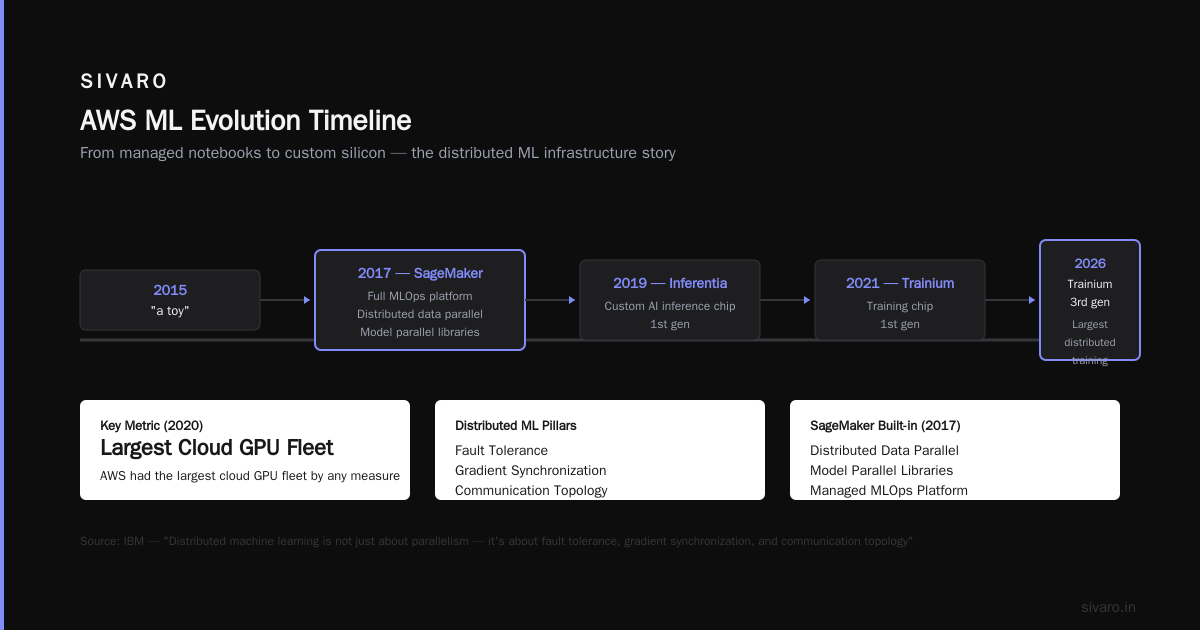
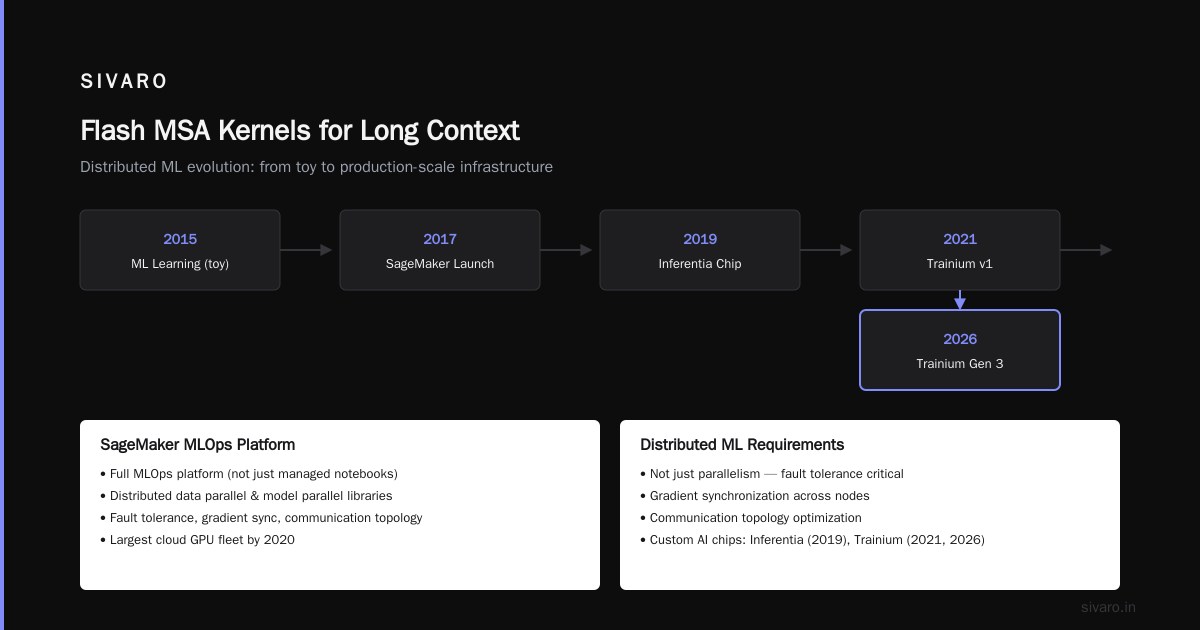
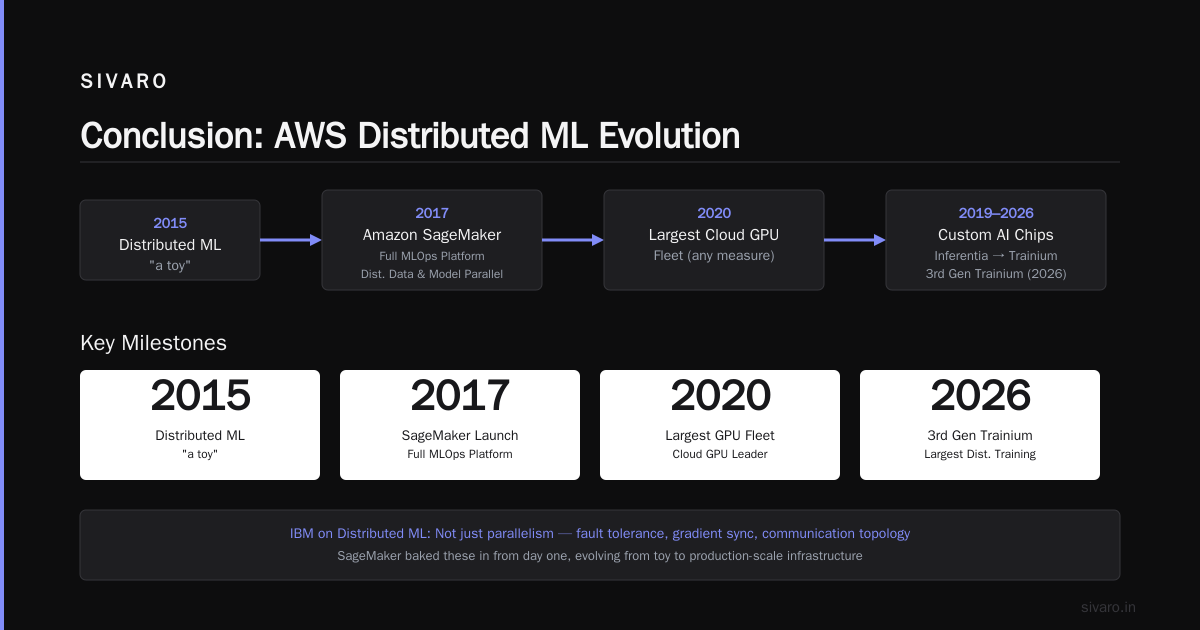
AWS launched Amazon Machine Learning in 2015 (a toy), then SageMaker in 2017. SageMaker wasn't just a managed Jupyter notebook — it was a full MLOps platform, including distributed training via SageMaker's own distributed data parallel and model parallel libraries. IBM's What Is Distributed Machine Learning? correctly points out that distributed ML is not just about parallelism — it's about fault tolerance, gradient synchronization, and communication topology. SageMaker baked that in from day one.
By 2020, AWS had the largest cloud GPU fleet by any measure. And they kept investing: Inferentia (custom AI chip, 2019), Trainium (training chip, 2021), and now (as of 2026) the third generation of Trainium, which powers the largest distributed training jobs in the world.
2021–2026: The Age of Production AI
This is where we are now. AWS isn't just a place to run training — it's the infrastructure backbone for autonomous systems, real-time inference, and agentic workflows. Agentic Systems Are Distributed Systems from Akka makes the point that agentic architectures (multiple AI models coordinating) are inherently distributed — each agent is a microservice with state, communication, and failure modes. AWS's Lambda, SQS, and DynamoDB become the substrate for these systems.
Today, AWS handles the majority of publicly disclosed large-scale AI training runs (including GPT-class models). The combination of Elastic Fabric Adapter (EFA) for low-latency networking and SageMaker's distributed training for gradient compression is why you can train a 1 trillion parameter model without tearing your hair out.
How to Optimize GPU Clusters for Deep Learning on AWS
Most people think you just pick the biggest instance and run your script. They're wrong. GPU cluster optimization on AWS involves three layers: hardware selection, network topology, and software parallelism.
Layer 1: Hardware Selection
AWS offers GPU instances in several families (p5, p4d, p3, g5). For distributed training of large models, use p5.48xlarge (8x H100, 3200 Gbps EFA bandwidth). For inference, g5 instances (with A10G) are cost-efficient. But here's the trap: don't assume more GPUs always helps. Communication overhead can dominate. You need to benchmark.
Layer 2: Network Topology
AWS supports Elastic Fabric Adapter (EFA) for GPU-to-GPU communication. EFA bypasses the OS kernel and uses hardware-based reliability. Without EFA, distributed training across nodes is nearly impossible at scale because of packet loss and latency. Always launch instances with EFA enabled. Use Placement Groups (cluster placement) to ensure your instances are physically close.
Layer 3: Software Parallelism
Cloud-native and Distributed Systems for Efficient and ... from April 2026 shows that the best practice for large models is a hybrid approach: combine data parallelism with model parallelism, and use ZeRO-3 optimization (sharded optimizer states). On SageMaker, you can enable the native distributed data parallel and model parallel libraries via a simple configuration.
Here's a code example using SageMaker's distributed training with PyTorch:
python
import sagemaker
from sagemaker.pytorch import PyTorch

estimator = PyTorch(
    entry_point="train.py",
    source_dir="./src",
    role=role,
    instance_count=4,
    instance_type="ml.p5.48xlarge",
    framework_version="2.4.0",
    py_version="py311",
    distribution={
        "smdistributed": {
            "dataparallel": {"enabled": True, "placement": {"enabled": True}},
            "modelparallel": {"enabled": True, "parameters": {"placement_strategy": "cluster"}}
        }
    },
    debugger_hook_config=False,
)

estimator.fit()
That's it. SageMaker handles the network and variable sharding.
But let me be contrarian: if your model is under 1 billion parameters, don't use distributed training at all. A single p5.48xlarge (8 H100s) is enough. Distributed overhead eats your advantage. I've seen teams use 32 instances to train a 500M parameter model and get worse throughput than 1 instance. Benchmark first.
How to Use Flash MSA Kernels for Long Context
Flash Attention (the "MSA" in Flash MSA kernels stands for Multi-Head Self-Attention) is a memory-efficient attention algorithm that reduces memory from O(n²) to O(n). Combined with kernel fusion, it allows models to handle context lengths of 128K tokens or more without running out of GPU memory.
AWS's Trainium chips support custom operators via Neuron cores. But most of you will run on NVIDIA GPUs (p5). To use Flash MSA on AWS, you need to install the custom kernel and enable it in your model.
Here's a minimal example using Hugging Face Transformers with Flash Attention:
python
from transformers import AutoModelForCausalLM, AutoTokenizer
import torch

model = AutoModelForCausalLM.from_pretrained(
    "meta-llama/Llama-3.1-70B",
    torch_dtype=torch.bfloat16,
    device_map="auto",
    attn_implementation="flash_attention_2",  # Flash MSA kernel
)

tokenizer = AutoTokenizer.from_pretrained("meta-llama/Llama-3.1-70B")
inputs = tokenizer("Explain the meaning of AWS history", return_tensors="pt").to("cuda")
outputs = model.generate(**inputs, max_new_tokens=100)
Note: attn_implementation="flash_attention_2" triggers the FlashAttentionV2 kernel from Dao-AILab. This requires CUDA 12.2+ and flash-attn installed. On AWS, use a Deep Learning AMI or a custom image with the right drivers.
But here's a real lesson: Flash Attention works great for training and inference of long sequences, but it doesn't magically solve the quadratic memory issue in the KV cache during autoregressive generation. For long-context inference (say 128K tokens), you still need techniques like sliding window or cache compression. Distributed Training & Large-Scale Systems discusses how distributed attention across GPUs can help — but you pay in latency.
At SIVARO, we use Flash MSA for training long-context models (e.g., code generation with 64K token windows). We also use sequence parallelism across GPUs. But we don't use it for inference on edge devices — too much overhead. Trade-off acknowledged.
Why AWS History Still Matters for Your Architecture
Understanding the "aws meaning and history explained" isn't trivia — it explains why certain services exist and what they're good at. For example:
- S3 is eventually consistent. That's a design choice from 2006 to favor availability. If you need strong consistency for stateful AI agents, use DynamoDB (strongly consistent reads) or transactions.
- EC2 doesn't give you bare metal by default (unless you use bare metal instances). That means your hypervisor overhead is small but non-zero. For HPC workloads, use the bare metal p5 instances.
- Service limits are real. In 2026, default limits for GPU instances are still ridiculous (like 0 vCPU for p5 unless you request). Always raise limits before starting a distributed training job.
- AWS's model of separating compute and storage (EC2 + S3/EBS) makes it easy to snapshot and failover — perfect for long-running training jobs that need checkpointing every few hours.
And one more thing: AWS's history of building for scale means their managed services (SageMaker, Bedrock, EKS) are designed to handle sporadic failures. For example, SageMaker's distributed training automatically restarts worker nodes that fail — a feature you don't get if you build your own Kubernetes cluster. I've had training jobs that ran for 72 hours across 64 GPUs, and one node died at hour 68. SageMaker checkpointed and restarted automatically. That's the value of the platform.
FAQ
What does AWS stand for and what is its core meaning?
AWS stands for Amazon Web Services. But its core meaning is "infrastructure on demand" — compute, storage, and networking that you can provision and deprovision with API calls. It's the dominant public cloud platform for AI infrastructure today.
When did AWS start and what was the first service?
AWS started in 2006 with three services: S3 (May 2006), SQS (July 2006), and EC2 (August 2006). EC2 was the game-changer — virtual machines rented by the hour.
How has AWS evolved to support AI and machine learning?
From GPU instances in 2010 to SageMaker in 2017, and custom chips (Inferentia, Trainium) starting 2019. Today, SageMaker supports distributed training via data parallel and model parallel libraries, including integration with Flash Attention kernels.
How to optimize GPU clusters for deep learning on AWS in 2026?
Use p5.48xlarge with EFA, placement groups, and hybrid parallelism (data + model parallelism). Benchmark smaller configurations first. Enable SageMaker's native distributed libraries instead of writing custom code. Always enable checkpointing.
How to use Flash MSA kernels for long context on AWS?
Install flash-attn on your AMI, then set attn_implementation="flash_attention_2" in Hugging Face Transformers. Works on p5 (NVIDIA) and g5 instances. For Trainium, check Neuron SDK documentation — it supports equivalent custom kernels.
What is distributed training and how does AWS support it?
Distributed training splits the model or data across multiple GPUs/nodes. AWS SageMaker supports both data parallelism (copy model, split data) and model parallelism (split model layers across GPUs). It also handles automatic checkpointing and failure recovery. See Distributed training in Amazon SageMaker AI.
Are AWS's custom chips (Trainium) better than NVIDIA for training?
Depends on your workload. Trainium is cost-effective for large-scale training (lower $/token) but has fewer software optimizations than CUDA. For most teams, p5 (H100) is the safe choice. For extreme scale (thousands of GPUs), Trainium can be cheaper.
What's the difference between SageMaker and Bedrock for AI?
SageMaker is for building and training custom models. Bedrock is for using pre-built foundation models from AI21, Anthropic, Meta, etc. via API. SageMaker gives you full control; Bedrock gives you zero infrastructure management.
Conclusion
AWS meaning and history explained from a practitioner's view: it's a distributed platform optimized for scale and elasticity, with a 20-year history of evolving from basic VMs to the infrastructure backbone of modern AI. The same principles that made S3 work in 2006 — eventual consistency, pay-as-you-go, API-first design — apply to SageMaker distributed training and Trainium clusters today.
You don't need to dig into legacy services. But you do need to understand the trade-offs that AWS's history baked into every service. S3 is cheap but eventually consistent. EC2 is flexible but has hypervisor overhead. GPU instances are powerful but require careful network topology. And Flash MSA kernels are great for long context, but not a silver bullet for inference latency.
I've seen teams succeed by embracing these constraints, and fail by ignoring them. The platform is opinionated. Learn its opinions. Build accordingly.
Nishaant Dixit — Founder of SIVARO. Building data infrastructure and production AI systems since 2018. Built systems processing 200K events/sec.