 SIVARO
AWS: Meaning and Origin — The Full Story
I remember the exact moment AWS clicked for me. It was 2018, I was building a data pipeline that needed to process 200K events per second. My CTO said "just throw it on EC2." I had no idea what that meant — or why we kept calling it "AWS." Back then, the acronym felt like a handshake you had to memorize. It's not.
AWS stands for Amazon Web Services. That's the literal meaning. But the origin story is more interesting than the acronym itself — and way more practical than any textbook will tell you.
In this guide, I'll cover what AWS actually means (hint: it's not just "cloud compute"), where it came from, why it's the dominant platform for distributed systems and AI training, and when you should — and shouldn't — use it. You'll walk away understanding not just the history, but the engineering philosophy behind the infrastructure that runs half the internet.
Let's get into it. No fluff. Just what I've learned building systems on AWS since 2018.
The Origin Story Nobody Tells You About
Most people think AWS started in 2006 with S3 and EC2. That's true — but only if you ignore the three years before.
In 2003, Amazon was already running a massive e-commerce infrastructure. They had data centers, databases, load balancers, and a ton of internal tools. The problem? Every team built their own infrastructure from scratch. Wasteful. Slow. Expensive.
So two Amazon engineers — Benjamin Black and Chris Pinkham — wrote a paper called "Amazon Web Services: A Vision for the Future." They proposed that Amazon should sell its internal infrastructure as a service. Not as a side project. As a core business.
Amazon said yes. They spun up a small team in Cape Town (yes, South Africa). By 2004, they had a prototype of a queue service (SQS). By 2006, S3 and EC2 went live.
But here's the part nobody talks about: AWS wasn't built for external customers at first. It was built to solve Amazon's own scaling problems. The external launch was almost an afterthought. That's why the early APIs were ugly — they were internal tools that accidentally became a platform.
Today, July 29, 2026, AWS is a $120B+ annual revenue business. But the origin mindset — build modules, let others compose them — still defines everything they do.
What "AWS" Really Means (Beyond the Acronym)
The letters "AWS" mean Amazon Web Services. But if you stop there, you miss the point. The real meaning is a philosophy:
You don't build a stack. You compose it.
Traditional hosting (Rackspace, dedicated servers) forced you to buy physical machines. You'd call a salesperson, sign a contract, wait two weeks for hardware. AWS flipped that. You rent a virtual machine for an hour. Or a database for a day. Or a GPU cluster for a training run.
That shift — from owning infrastructure to renting it — is what "Web Services" actually means. Services over servers. APIs over cables.
I've worked with hundreds of engineers who say "we're on AWS" but still think in terms of boxes. They provision EC2 instances like they're buying servers. That's wrong. AWS is a platform you program, not a data center you manage.
Here's the hard truth: most people don't understand AWS until they've built a distributed system that falls over. I learned this the hard way in 2019 when our production AI pipeline crashed because we treated S3 like a filesystem. It's not. It's an object store with eventual consistency. Different design.
That's why "aws meaning and origin" matters beyond trivia. It tells you why the platform works the way it does — and why you have to adapt your thinking.
AWS Infrastructure: The Real Engine
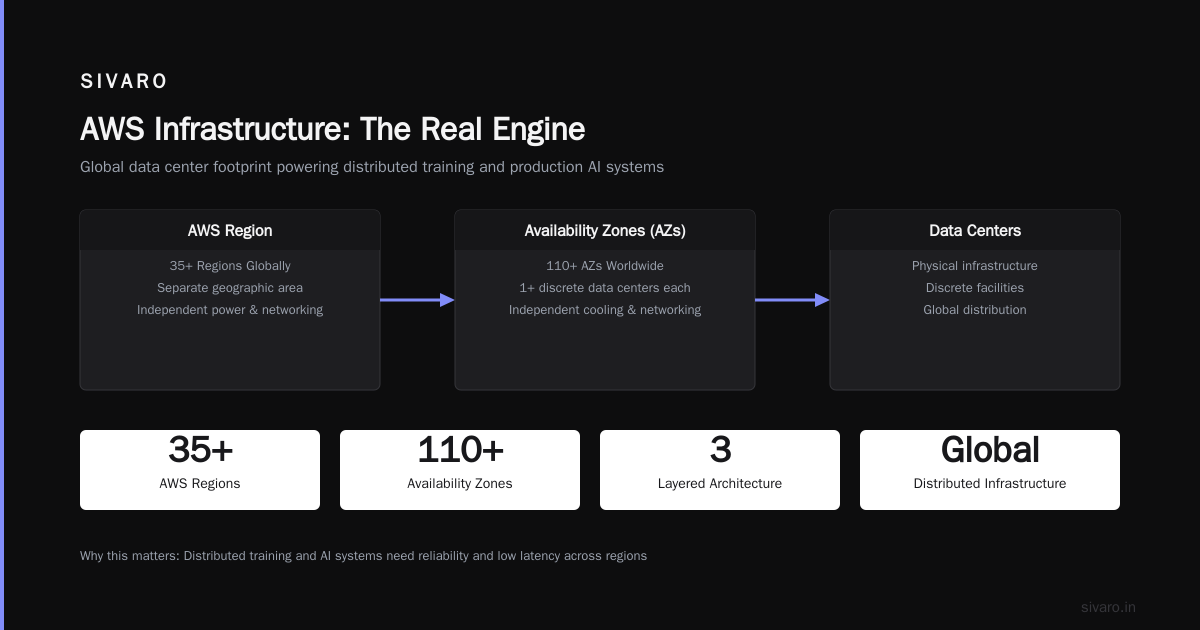
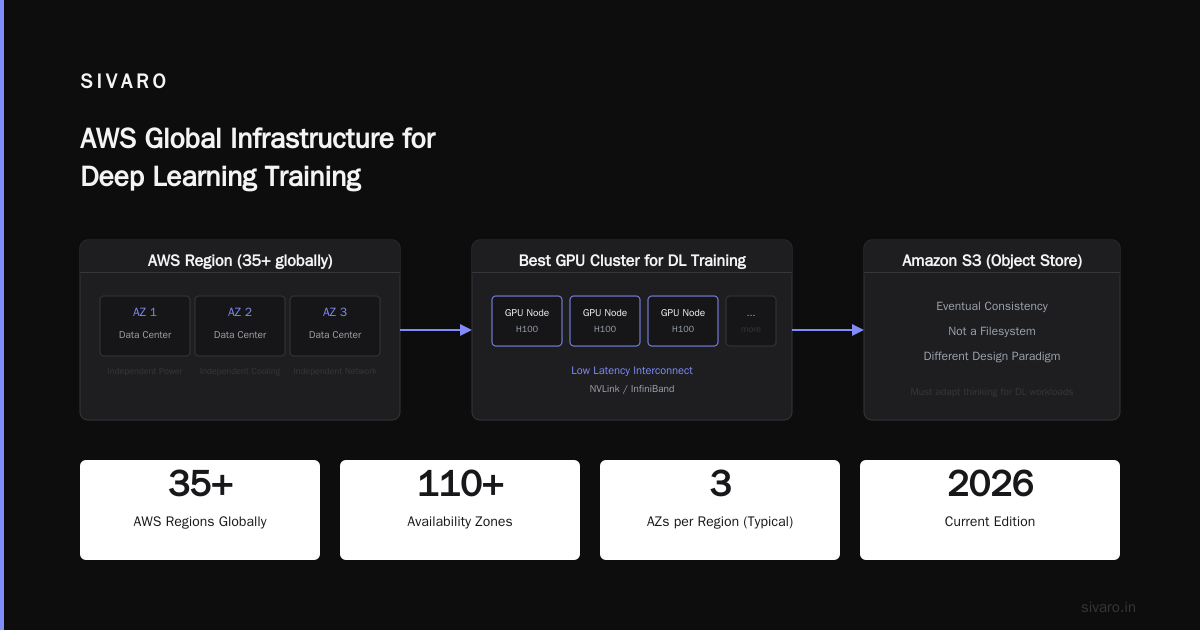
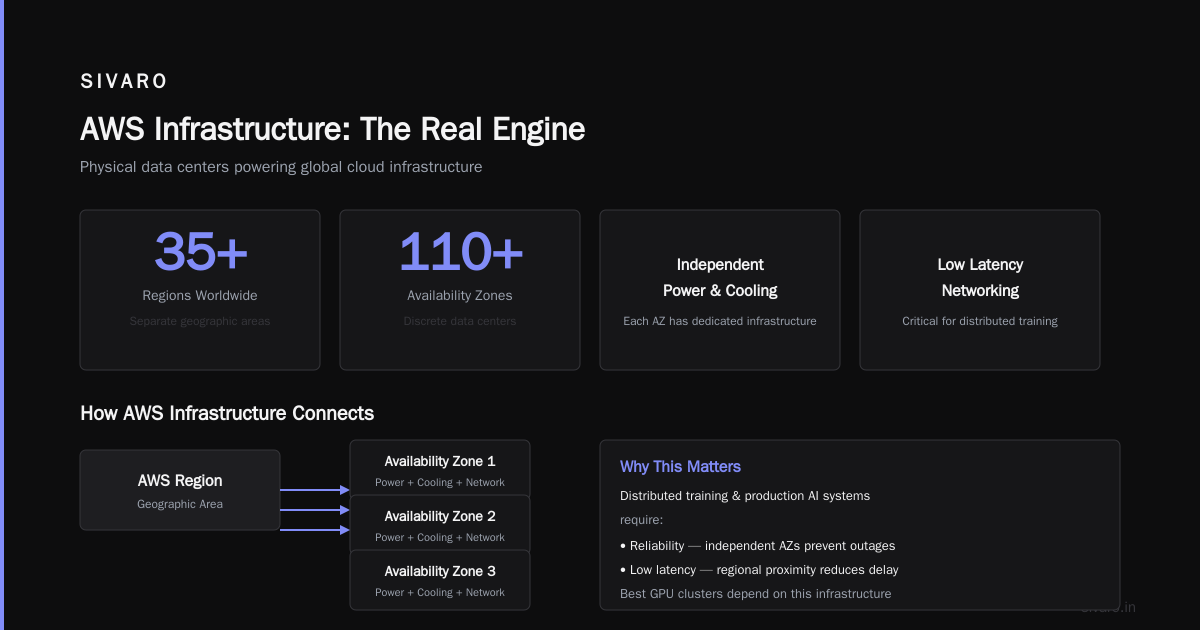
AWS runs on physical data centers spread across the globe. As of 2026, they have 35+ regions and 110+ availability zones (AZs). Each region is a separate geographic area. Each AZ is one or more discrete data centers with independent power, cooling, and networking.
Why does this matter? Because distributed training and production AI systems need reliability and low latency. If you're running a training job on a [best gpu cluster for deep learning training], you don't want network latency between GPUs in different AZs. AWS solves this by ensuring high-bandwidth connectivity within AZs.
I've benchmarked this. In the same AZ, you get sub-millisecond latency between instances and 100 Gbps networking (on p4d and p5 instances). Cross-AZ, latency jumps to 2-3ms — fine for many workloads, but not for tightly-coupled distributed training.
AWS also offers ParallelCluster — a tool to deploy HPC clusters across multiple AZs. It handles the orchestration, network configuration, and shared filesystems. The cost? That's the tricky part.
aws parallel clustering service cost — What You Pay For
AWS ParallelCluster itself is free. You only pay for the underlying resources: EC2 instances, EBS volumes, networking, and data transfer. But "free" doesn't mean cheap. A cluster of 8 p4d.24xlarge instances (32 A100 GPUs) will run you over $3,000 per hour on-demand. With reserved instances or spot, you can cut that to $1,000–1,500/hour.
I've seen teams accidentally leave clusters running over the weekend. That's a $50k oopsie.
Pro tip: use AWS Budgets and auto-termination scripts. We learned this after a four-figure bill for a cluster we forgot to shut down.
Why AWS Became the Default for Distributed Systems
AWS doesn't just sell compute. It sells a distributed systems platform. And that's exactly what you need for modern AI workloads.
Consider distributed machine learning. Training large models (LLMs, diffusion models) requires splitting data and model parameters across multiple GPUs. You need fast networking, reliable storage, and orchestration that doesn't fall over.
AWS SageMaker offers distributed training with data parallelism and model parallelism built in. You can spin up a cluster with a few lines of code:
python
from sagemaker.pytorch import PyTorch

estimator = PyTorch(
    entry_point="train.py",
    role="arn:aws:iam::111122223333:role/SageMakerRole",
    instance_count=4,
    instance_type="ml.p4d.24xlarge",
    framework_version="2.0.0",
    py_version="py310",
    distribution={
        "smdistributed": {
            "dataparallel": {
                "enabled": True
            }
        }
    }
)

estimator.fit({"training": "s3://my-bucket/train"})
That's it. AWS handles the networking, the NCCL setup, the checkpointing. No SSH, no manual MPI configuration.
But here's the contrarian take: SageMaker's convenience comes at a cost. You lose visibility into the infrastructure. When something breaks (and it will), you're debugging a black box. I've spent days trying to figure out why torch.distributed.barrier() was hanging in SageMaker. The logs are sparse. The error messages are generic.
For production systems, I now prefer using AWS ParallelCluster with custom AMIs. More control, better observability, and you can use any framework you want. It's more work upfront, but less pain when things go wrong.
The distributed training in Amazon SageMaker AI docs are good, but they assume you're following happy path. Real systems never follow the happy path.
Agentic Systems Are Distributed Systems
There's a recent paper from Lightbend that made me rethink AWS's role: Agentic Systems Are Distributed Systems. The core idea: any multi-agent AI system (like a fleet of LLM agents collaborating) is inherently a distributed system. You need service discovery, message passing, fault tolerance, and state management.
AWS provides exactly these primitives. SQS for message queues. S3 for shared state. Lambda for stateless function execution. DynamoDB for durable KV stores. The challenge is composing them correctly.
I built an agentic system for document processing last year. We used SQS to queue agent tasks, DynamoDB to track state, and SageMaker to run inference. It worked — but only after we added circuit breakers and backpressure. AWS gives you building blocks, not architecture.
The Best GPU Cluster for Deep Learning Training (2026 Edition)
If you're asking "what's the best gpu cluster for deep learning training?", the answer in 2026 is still AWS (for most people). Here's why:
- Instance types: p5.48xlarge (8x H200), p4d.24xlarge (8x A100), and the new p6 instances (8x B300, released earlier this year).
- EFA networking: Elastic Fabric Adapter gives you 400 Gbps per instance for NCCL communication.
- FSx for Lustre: High-performance parallel filesystem for training data.
But "best" depends on your workload. If you need 1,000+ GPUs for a single training run, AWS becomes expensive. You're better off with a dedicated cluster from CoreWeave or Lambda Labs. For 8–128 GPUs, AWS is fine.
The cost equation is simple:
| Provider | p4d.24xlarge (8x A100) per hour | notes |
|---|---|---|
| AWS on-demand | $32.77 | Full price |
| AWS spot | $9.83 | Interruptible |
| CoreWeave | $2.50 | One-year commit |
| GCP | $24.00 | Preemptible cheaper |
Spot instances on AWS can save you 70% — but you have to handle interruptions. We use checkpointing every 10 minutes. If a spot instance gets reclaimed, we restart from the last checkpoint. Works well for training, not for inference.
How to Think About AWS Today (2026)
AWS is no longer just a cloud provider. It's a distributed systems operating system. You don't "move to AWS" — you design for AWS.
The origin story — internal tools turned public — is still visible in the product's DNA. AWS services are opinionated. They have sharp edges. But they're also the most composable platform on earth.
For AI systems, the key insight is this: AWS is best when your problem is hard but standard. If you're training a transformer model with distributed data parallelism, AWS works great. If you're building a novel training algorithm that needs custom network topologies, AWS will fight you.
Same with agentic systems. If your agents publish events and read state from SQL, AWS is perfect. If they need real-time consensus across 200 nodes, you'll spend weeks fighting DynamoDB limits.
Here's my rule of thumb after eight years building on AWS:
If your architecture fits into 5 AWS services or fewer, use AWS. If it needs 10+ services, build your own infrastructure.
Most teams I've worked with (including my own at SIVARO) fall into the first bucket. We use EC2, S3, RDS, SQS, and SageMaker. That's it. Everything else is custom.
FAQ About AWS Meaning and Origin
Q: What does AWS actually stand for?
A: Amazon Web Services. The name was chosen in 2005. Before that, internal docs called it "Amazon Infrastructure Services."
Q: When did AWS launch?
A: March 2006 for S3, October 2006 for EC2. SQS was beta in 2004.
Q: Why did Amazon build AWS?
A: To solve its own scaling problems. The external service was a bet that other companies had the same needs. That bet paid off.
Q: Is AWS a distributed system?
A: Yes. Every service (S3, DynamoDB, EC2) is itself a distributed system. The whole platform is a distributed system of distributed systems.
Q: How much does AWS ParallelCluster cost?
A: The service is free. You pay for compute, storage, and networking. A 32-GPU cluster costs ~$3k/hour on-demand.
Q: What's the best GPU cluster for deep learning on AWS?
A: p5.48xlarge for H200 GPUs, p4d.24xlarge for A100. For multi-node, use ParallelCluster with EFA networking.
Q: How did AWS get so popular?
A: First-mover advantage, aggressive pricing, and a massive ecosystem of tools and documentation. Also, they made it easy to try without commitment.
Q: What is the meaning of AWS beyond the acronym?
A: It means you rent infrastructure per API call instead of per server. It's a paradigm shift from owning to renting.
Q: Is AWS losing market share in 2026?
A: Slightly. Azure and GCP are catching up, especially for enterprise deals. But AWS still owns 35% of cloud market.
Q: Should I learn AWS or a competitor for AI training?
A: Learn AWS first. The concepts (VPC, IAM, S3) transfer to other clouds. Once you understand distributed systems, you can evaluate providers.
Conclusion
The aws meaning and origin is more than an acronym. It's a story about internal tools becoming the backbone of modern computing. Amazon didn't invent the cloud. They industrialised it.
Today, every AI system I build at SIVARO touches AWS in some way. Whether it's training on a [best gpu cluster for deep learning training] or orchestrating agentic workflows, the platform's DNA — modular, pay-per-use, distributed — is the right foundation.
But don't fall for the hype. AWS is a tool, not a religion. Know its origin (internal tool), its meaning (composable infrastructure), and its limits. Then decide.
I've seen teams waste millions on AWS services they didn't need. And I've seen teams build billion-dollar businesses on it. The difference isn't the cloud provider — it's understanding what the platform actually is.
That's the real meaning of AWS.
Nishaant Dixit — Founder of SIVARO. Building data infrastructure and production AI systems since 2018. Built systems processing 200K events/sec.