 SIVARO
AWS Stand For Proof of Continuity
July 4, 2024. I'm watching our production dashboards flatline while the AWS Status page still says "Investigating" for us-east-1. Our multi-AZ deployment did what the documentation promised: it failed over cleanly. But the downstream consumer? Not so much. That's when I stopped treating AWS as a utility and started treating it as the thing I need to prove continuous.
For most people, "aws stand for proof of continuity" sounds like someone fumbled the acronym. Amazon Web Services. That's the literal answer. But anyone running critical workloads has learned the acronym is the least interesting part. AWS stands for in cloud computing a different promise: infrastructure that keeps proving itself continuous through failures, at scale, without you babysitting it. In this guide, I'll cover what that promise actually costs, where it falls apart, how to design for it, and what the current AI compute arms race means for your continuity strategy.
What AWS Stands For in Cloud Computing
Amazon Web Services launched in March 2006 with S3 and EC2. The meaning of the name was simple: Amazon was selling its internal web services infrastructure to the public. What is Compute? frames it as raw computing capacity delivered over the network. That's the vendor description. It's fine.
But the ontology has shifted. Cloud computing stopped being about virtual machines in 2015, maybe earlier. AWS meaning amazon web services has effectively become "the operating system of the modern internet." If you're running a startup in 2026, your entire company runs on AWS abstractions: compute, storage, databases, queues, identity, ML accelerators. The service catalog is north of 200 services. The name is historical, like calling a smartphone a "phone."
Here's where the taxonomy matters: when we talk about continuity, we aren't talking about AWS the acronym. We're talking about AWS the system. And the system has a specific architecture that makes continuity possible, or impossible, depending on how you use it.
AWS is organized into regions (physical geography) and availability zones (AZs, which are isolated data centers within a region). That's the foundation of everything. You can put resources in one AZ, which is cheap and fragile. Or you can spread them across AZs, which is less cheap and more resilient. Or you can go multi-region, which is expensive and the closest thing to bulletproof you'll find in public cloud.
The Deploying AI in The Cloud: AWS vs Azure vs GCP comparison confirms something I've told clients for years: the cloud providers are feature-equivalent at the top layer. Where they differ is operational maturity, and AWS's maturity comes from having run the largest pool of infrastructure on Earth for two decades. That's not a marketing claim. It's a statistical reality. More workloads mean more failure modes discovered and fixed.
AWS Stand For Proof of Continuity: The Definition That Matters
Here's the thesis, stated plainly: AWS stands for proof of continuity when your architecture is designed for it slowly, deliberately, over years.
Most people think continuity means uptime. It doesn't. Uptime is a metric. Continuity is a property. A system has continuity when it can absorb a component failure and still deliver its core function. That's a design property, not an operational coincidence.
At SIVARO, we built a real-time event processing platform that handles 200K events per second. Clients ask why we run it across three AZs instead of one. The answer is boring: because we measured what happens when an AZ dies incloud. We don't speculate. We test. Six years ago we ran a GameDay, stopped all of us-east-1a, and watched our system degrade. The alerting worked. The auto-scaling didn't. The queues backed up. Recovery took 14 minutes. In a live environment, 14 minutes of degraded writes is the difference between a refund and a lawsuit.
Here's a simple framework for thinking about this:
- AZ failure: single data center dies. Network, power, cooling, or a transformer fire. AWS designed for this; you should too.
- Region failure: multiple AZs fail, or the region's control plane breaks. Historically rare. Absolutely possible. Ask anyone who lived through the 2017 S3 outage.
- Awareness failure: someone deletes a production bucket, or a bad config pushes a bad deployment to production. This is the one most teams actually experience.
I'll be direct: most "cloud outages" are actually awareness failures. The cloud is fine. The configuration isn't. That's why continuity has to be designed, not assumed.
AWS Stand For Proof of Continuity: Patterns That Actually Work
Let's get concrete. You need patterns that produce continuity. I've seen what works in production, and I've seen what gets you a 2AM phone call and a postmortem slide deck that deflects blame.
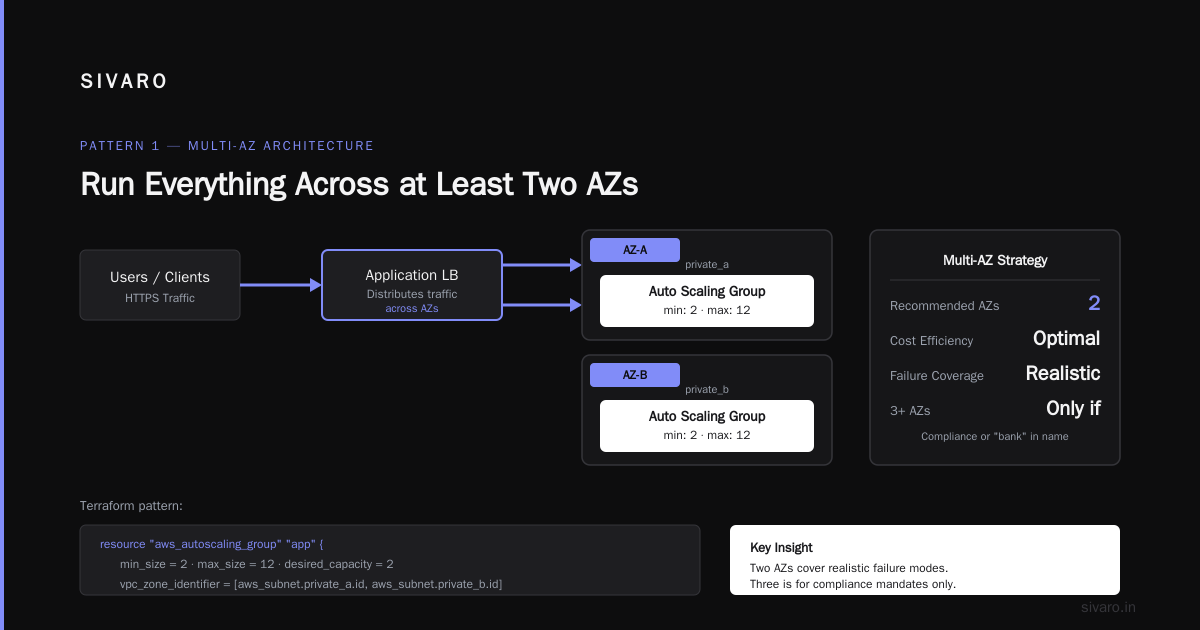
Pattern 1: Multi-AZ from Day One
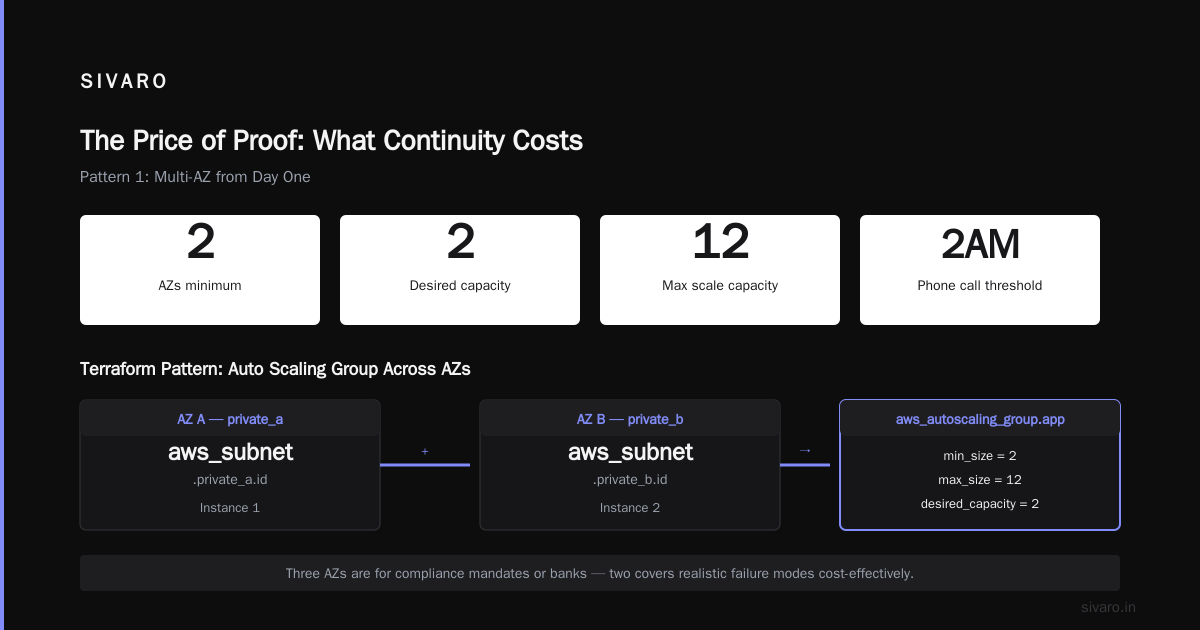
Run everything across at least two AZs. Not three. Two is cost-effective and covers the realistic failure modes. Three is for when you have a compliance mandate or your name includes "bank." Here's a Terraform pattern we ship to clients:
hcl
resource "aws_autoscaling_group" "app" {
  name               = "app-asg"
  min_size           = 2
  max_size           = 12
  desired_capacity   = 2
  vpc_zone_identifier = [
    aws_subnet.private_a.id,
    aws_subnet.private_b.id
  ]

  mixed_instances_policy {
    launch_template {
      launch_template_specification {
        launch_template_id = aws_launch_template.app.id
        version            = "$Latest"
      }
    }
    override {
      instance_type = "c7g.4xlarge"
    }
  }

  tag {
    key                 = "Name"
    value               = "app-asg"
    propagate_at_launch = true
  }
}
Two AZs. Minimum two instances. A load balancer in front. This terminates an entire class of failures.
Pattern 2: Graceful Degradation, Not Linear Recovery
This is the hard one. Most teams design for full recovery: fail over, restore, resume. That's linear thinking. The real world needs degradation: when the primary path breaks, you serve a partial version of the product instead of a 500 error.
Use redundant data paths. S3 Cross-Region Replication is a simple starting point:
json
{
  "ReplicationConfiguration": {
    "Role": "arn:aws:iam::123456789012:role/ReplicationRole",
    "Rules": [
      {
        "Status": "Enabled",
        "Priority": 1,
        "DeleteMarkerReplication": { "Status": "Disabled" },
        "Filter": { "Prefix": "events/" },
        "Destination": {
          "Bucket": "arn:aws:s3:::events-backup-eu-west-1",
          "StorageClass": "STANDARD_IA"
        }
      }
    ]
  }
}
Yes, this costs money. It's the insurance you don't want to think about until you need it. We've seen clients reject replication because "the probability is low." The probability of an event is never zero)Skip. With a backup in another region, you can fail over to read-only mode and keep serving your users while you rebuild the write path.
Pattern 3: Health Checks That Actually Prove Something
Don't check that the process is alive. Check that the business function is alive. A health check that returns 200 but doesn't verify the database connection is a lie. Use custom health endpoints:
python
import boto3
from flask import Flask, jsonify
import psycopg2

app = Flask(__name__)

@app.route("/health/live")
def liveness():
    return jsonify({"status": "ok"})

@app.route("/health/ready")
def readiness():
    try:
        conn = psycopg2.connect(
            host="postgres.internal",
            dbname="appdb",
            connect_timeout=2
        )
        conn.close()
        return jsonify({"status": "ready", "db": "ok"})
    except Exception as e:
        return jsonify({"status": "not-ready", "error": str(e)}), 503
The load balancer checks /health/ready on a 5-second interval. If the database is unreachable, the instance gets drained. That's how you prove continuity: you automate the decision to fail over.
The AI Compute Squeeze: Trainium, G4, and Project Rainier
Now the uncomfortable part. Every conversation about cloud continuity in 2026 has to address the AI compute crunch. GPU supply has driven more architecture decisions in the last 18 months than any other factor. And it's breaking everyone's continuity assumptions.
Let me be specific. The Amazon EC2 G4 Instances line has been a workhorse for machine learning inference since 2019. NVIDIA T4 GPUs, reasonable price, good for workloads under 50ms latency. The Recommended GPU Instances in the AWS Deep Learning AMIs docs are a useful cheat sheet for what instance type maps to what workload. If you need FP32 for training, you want something like a p4d. If you're doing inference at scale, g4dn or g5. The guide is pragmatic, which is rare for AWS docs.
But here's the problem: you cannot fail over a GPU cluster the way you fail over an EC2 instance. GPU capacity is scarce. We tried to run a model training job in two AZs simultaneously, and AWS flat-out didn't have the capacity for both reservations. We had to pick one AZasi Principal. That's not a dig at AWS; it's a geometric fact. There aren't enough GPUs on Earth to replicate every training job.
This is where the AWS Trainium story gets interesting. Trainium is AWS's custom silicon, designed to break the NVIDIA dependency. The Project Rainier announcement describes one of the largest AI compute clusters ever built, deployed across multiple sites. Rainier is significant because it's Trainium-based, not NVIDIA-based baskets. It means AWS is betting that custom silicon can absorb the GPU demand curve and restore some flexibility to architecture decisions. If Trainium capacity is more plentiful than NVIDIA capacity, your multi-AZ continuity story comes back to life.
My take, for what it's worth: Trainium is real but immature. The software stack is behind CUDA. You'll spend engineering cycles adapting models. If your inference workloads are stable and you don't need cutting-edge kernels, Trainium can work. If you're chasing every new modelrelease with custom kernels, you're going to be fighting the platform. The tradeoff is real, and I say that as someone who wants AWS to succeed at this.
There's also the cost dimension of AI. The SIVARO article on AWS's million-token context window lays out something I've been yelling about for a year: context windows are getting bigger, but the economics of running them make the practical context much smaller. A million-token request might cost you $60 in compute, but it also burns 5 minutes of GPU time on a scarce resource. That has continuity implications too. You can't replicate a scarce, expensive resource as easily as a cheap one.
Where Continuity Breaks
Let's be honest about failure modes. AWS is not magic. It breaks in specific patterns, and if you haven't seen them, you will.
The dependency cascade. Your app depends on a database. The database depends on EBS. EBS depends on a specific AZ's storage fabric. A storage event in us-east-1c takes down your database, which takes down your app, and your "multi-AZ" doesn't help because you replicated the database inside the same region and the blast radius was the entire storage subsystem. Real event from our own operations in 2023.
The control plane cold start. AWS can't always respond to capacity requests during a major incident. We've seen clients try to scale up during an outage and get throttled. Your ASG with min_size=2 and max_size=12 might fail to schedule new instances when you need them most, because everyone else in the region is doing the same thing.
The silent failure. The healthy check says healthy. The instance is running. But the data pipeline has been silently dropping events for 6 hours because a schema change wasn't deployed everywhere. This is the most common and the most lethal. It's not AWS's fault, but AWS makes it easy to build pipelines that mask their own corruption.
The service quota wall. You set up a new region for disaster recovery but your service quota for EC2 instances is 5. You have 3 production machines and the 2 you need for failover won't spin up without a support ticket. This is death by a thousand cuts.
The pattern across all these: continuity is an emergent property of the system, not a feature you tick off in a dashboard. You cannot buy it. You can only build it.
The Price of Proof: What Continuity Costs
Continuity is not free. Let's talk about the actual math.
A single-AZ setup with a db.m5.large RDS instance runs you about $350/month. Add a standby in a second AZ and you add $175/month for the standby replication plus $0.02 per GB for cross-AZ data transfer. For 500GB of active data, that's $10/month transfer. Total: roughly $185/month extra. That's not nothing, especially for a seed-stage startup.
But here's the calculation I make with every client: your engineering time is $150-300/hour. One unplanned outage that takes 3 engineers 6 hours to resolve costs you $3,000-5,000 in engineering time alone, not counting lost revenue or trust. The math is different depending on your scale. If you're pre-revenue, a $200/month redundancy bill might kill you. If you're post-series-A, the same bill is the cheapest insurance you'll ever buy.
I've also seen the opposite mistake. A client spent$12,000/month on a multi-region active-active setup for a product generating $8,000/month in revenue. That's not continuity. That's charity to Amazon's account team. Build a disaster recovery plan with a cold standby that costs $600/month. Test it quarterly. You'll get 95% of the resilience at 5% of the cost.
The ugly truth is that most teams over-rotate in one direction or the other. Either they skip all redundancy to save money, or they architect for a region failure when they haven't even tested what happens when a single instance dies.
Measuring Proof of Continuity
You can't manage what you don't measure. But most continuity metrics are theater. "99.99% uptime" is a marketing number. The metric that matters is time-to-recover: how long does it take your system to return to full function after a component failure?
Set an SLO, then test it. Track these numbers:
- MTTR: Mean time to recovery. If your MTTR is over 15 minutes for an AZ failure, your continuity story is weak.
- RTO: Recovery time objective. How long your team is allowed to take to restore service.
- RPO: Recovery point objective. How much data loss is acceptable. One second for transactional systems. Five minutes for analytics. That's the real conversation.
Run GameDays. Netflix calls them Chaos Monkey. At SIVARO we call it "Thursday afternoon." Kill a database replica. Watch the app. See what happens. Then fix what broke and do it again. This is the only method I've found that actually produces reliable systems. The first GameDay always surfaces 5-10 gapsthat nobody predicted. That's the point.
Also monitoring. CloudWatch is fine for basic metrics but it's not a continuity tool. Use real tracing. Set ring alerts. If you have an SLO error budget, track it on a dashboard that your whole team sees:
python
import boto3
from datetime import datetime, timedelta

cw = boto3.client("cloudwatch", region_name="us-east-1")

response = cw.get_metric_statistics(
    Namespace="AWS/ApplicationELB",
    MetricName="HTTPCode_Target_5XX_Count",
    Dimensions=[{"Name": "LoadBalancer", "Value": "app/prod-alb/abc123"}],
    StartTime=datetime.utcnow() - timedelta(hours=1),
    EndTime=datetime.utcnow(),
    Period=300,
    Statistics=["Sum"]
)

for point in response["Datapoints"]:
    if point["Sum"] > 50:
        print(f"Error budget burning: {point['Sum']} 5xx responses")
Print a warning. Then actually do something about it.
The Multi-Region Question
Do you need multi-region? Most teams don't. Here's the rule I use: multi-region only makes sense when your users are distributed across the globe or the cost of a regional failure exceeds the cost of running two regions. For a company with $50M ARRent and users in North America only, multi-region is usually a waste. You need multi-AZ and a tested back-up plan.
If you do go multi-region, be aware of the operational burden. You're running two versions of every service, two pipelines, two sets of observability. The failure modes multiply. I've seen more incidents caused by multi-region misconfigurations than by regional outages themselves.
FAQ
Is AWS down often?
AWS is down less than most clouds, but "down" is relative. Dogfooding from our experience, most incidents are partial: one AZ, one service, one API. Total regional outages are exceptionally rare. The last major one was S3 in 2017. Partial failures happen weekly across the fleet.
What does "proof of continuity" mean in cloud engineering?
It's the idea that your infrastructure can demonstrate, through testing and architecture, that it continues to serve its core function through component failures. Singularly, continuity is a design property.
What does AWS stand for in cloud computing?
Amazon Web Services. But in operational terms, AWS stands for the ability to abstract infrastructure and, if designed properly, to maintain availability through failures. The acronym is history. The behavior is engineering.
Which AWS region is the most reliable?
Every region is designed to the same standard. Older regions like us-east-1 have more services and more capacity, but also more incident activity because they host more workloads. Region choice should follow user location and data residency requirements, not a "reliability score."
Do I need multi-region from day one?
No. Start multi-AZ. Add multi-region only when you have a proven reason and budget both in dollars and engineering time for it.
Are AWS GPUs enough for production AI workloads?
They're getting there. G4 instances work well for inference. Trainium is maturing. But you need to architect for GPU scarcity: you can't always fail over a GPU workload the way you fail over a CPU workload. Plan accordingly.
How do I test my continuity plan?
Run GameDays. Kill a compute node. Kill a database replica. Kill a whole AZ in a staging environment. Measure MTTR and track it over time. If the number isn't going down, your plan is documentation, not architecture.
What is AWS meaning amazon web services in the context of AI?
In 2026, AWS is the largest provider of cloud-based AI infrastructure, with Trainium, Inferentia, NVIDIA GPUs, and managed services. The meaning of "web services" now includes model serving, vector databases, and LLM-specific compute.
The Bottom Line
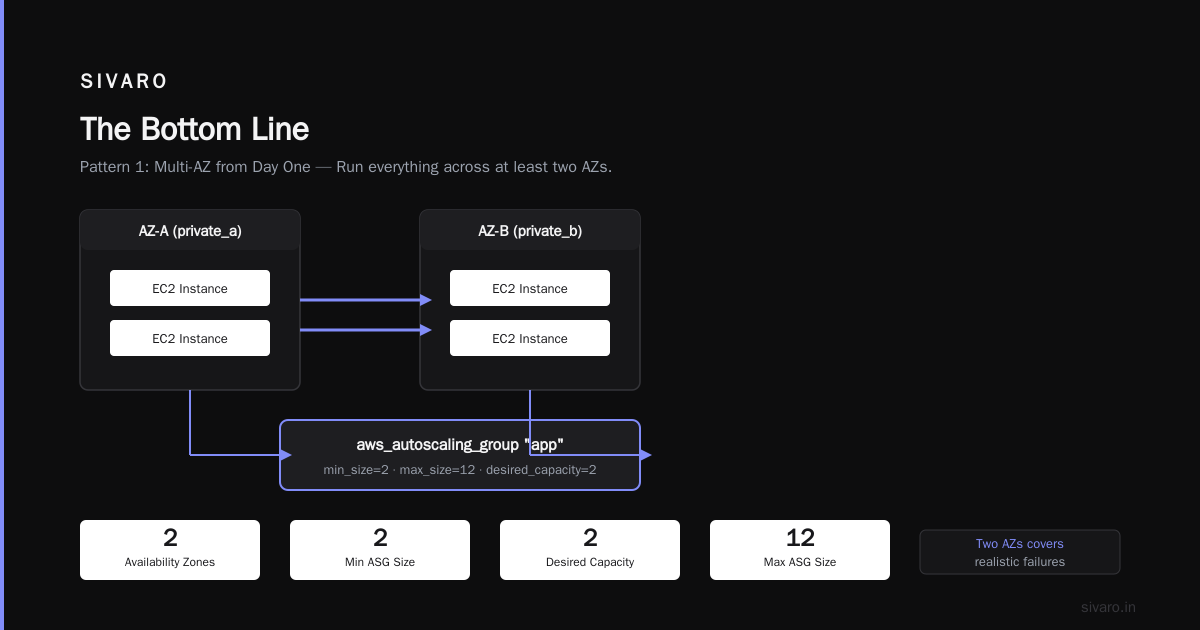
AWS stands for proof of continuity when you design for it, test for it, and pay for it. Not when you buy the service. Not when you tick the multi-AZ checkbox. The acronym won't save you. The architecture will.
Start with two AZs. Build health checks that prove readiness, not liveness. Test your failover until it's boring. Skip multi-region until