 SIVARO
AWS vs Cloud Computing: The Mental Model That Actually Matters
If you asked me in 2017 what the difference was between AWS and cloud computing, I would've said it's a branding problem. AWS is a brand. Cloud computing is a concept. Amazon just named their product line after the category.
Turns out, I was wrong.
I realized this while sitting in SIVARO's war room in early 2025, staring at a $48,000 monthly bill from a client who thought they were "doing cloud computing right." They had Kubernetes clusters running in six regions, three different database engines, and a data pipeline so tangled it took two engineers two weeks to trace a single event through it.
That wasn't cloud computing. That was just AWS with a mess on top.
Here's what I've learned after years of building data infrastructure on Amazon's platform: the question "aws vs cloud computing" isn't about semantics. It's about understanding what you're actually paying for, what you're actually building, and what you're actually on the hook for.
In this guide, I'm going to break down the real differences, the practical implications, and how to think about both without getting lost in vendor marketing.
The Confusion Starts With Naming
Let's clear up the history first because it explains a lot of the confusion.
AWS originally stood for "Amazon Web Services." That's the answer to "aws what did stand for" — and it's been that since 2006 when they launched S3 and EC2 to the public.
But here's the thing about that name: it implies AWS is just a collection of services. A catalog. A menu.
That's cute. That's also misleading.
Distributed training in Amazon SageMaker AI is a perfect example. On the surface, it's just "a service" — you click, you train, you pay. But underneath, it's a massive distributed system designed to coordinate hundreds of GPUs across multiple machines, handle data sharding, manage model parallelism, and checkpoint everything so a single failure doesn't destroy three days of training.
That's not a service. That's an operating system for distributed computing.
And that's the core distinction I want to make:
Cloud computing is the abstract idea of using remote infrastructure.
AWS is a specific implementation of that idea — and it's a much bigger commitment than the term "service" suggests.
What Cloud Computing Actually Means (Practically)
When I talk to engineering teams, I tell them cloud computing isn't one thing. It's a stack of promises:
- Abstracted infrastructure — someone else owns the metal
- Elastic scaling — resources grow and shrink on demand
- Pay-per-use economics — you pay for what you consume
- Managed operations — someone else handles the undifferentiated heavy lifting
If you're looking at cloud providers in 2026 — AWS, Azure, GCP, even the smaller players like DigitalOcean — they all make these promises. But they deliver on them very differently.
Here's what the abstract concept doesn't tell you:
The abstraction always leaks.
That's not cynicism. It's engineering reality. Cloud-native and Distributed Systems for Efficient and Reliable AI makes this case well — the authors point out that cloud-native systems promise "seamless scalability" but the reality is that every layer of abstraction adds latency, failure modes, and operational complexity.
I've seen this play out dozens of times. A team moves to the cloud thinking they'll never touch a server again. Then they discover:
- Network timeouts between availability zones
- IAM permission rabbit holes
- Cold starts on Lambda functions
- Data transfer costs they never budgeted for
That's not cloud computing failing. That's cloud computing being real.
AWS Is a Business Model More Than a Technology
Let me get contrarian for a second.
Most people think about AWS as a technology platform. I think about it as a pricing engine with a really good technical moat.
The proof is in how Agentic Systems Are Distributed Systems describes modern infrastructure: these systems are "inherently distributed, asynchronous, and failure-prone." AWS doesn't solve those problems — it just sells you the raw materials to build solutions, then charges you at every layer where you could possibly buy a shortcut.
Consider the economics:
- Each service is priced to maximize revenue per unit of compute
- Data transfer charges create sticky architecture (once your data is in S3, moving it costs money)
- Managed services charge a premium for operational convenience
- The marketplace ecosystem creates switching costs through integration
This isn't a criticism. It's a feature of how they run the business.
In 2024, AWS revenue was over $100 billion annually. In 2025, with AI workloads exploding, their growth accelerated further. By 2026, the company has effectively doubled down on AI infrastructure — they announced new GPU instance types, expanded SageMaker capabilities, and made their sparse attention kernels implementation available to anyone who wants to optimize transformer inference costs.
But here's what you need to internalize: AWS's incentives are not your incentives.
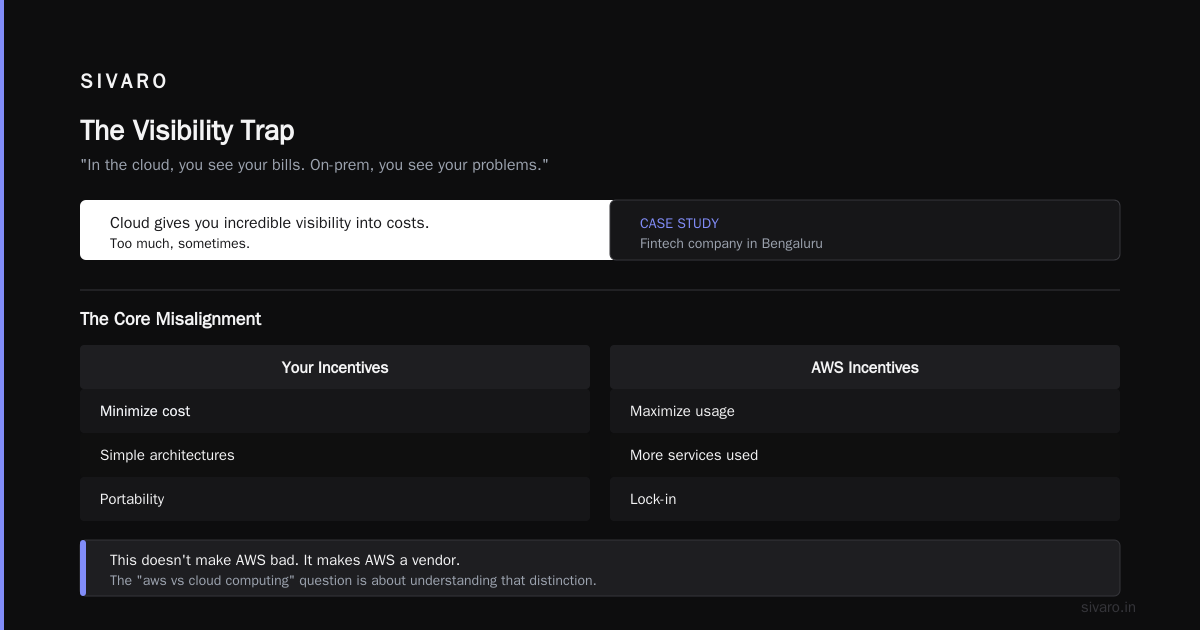
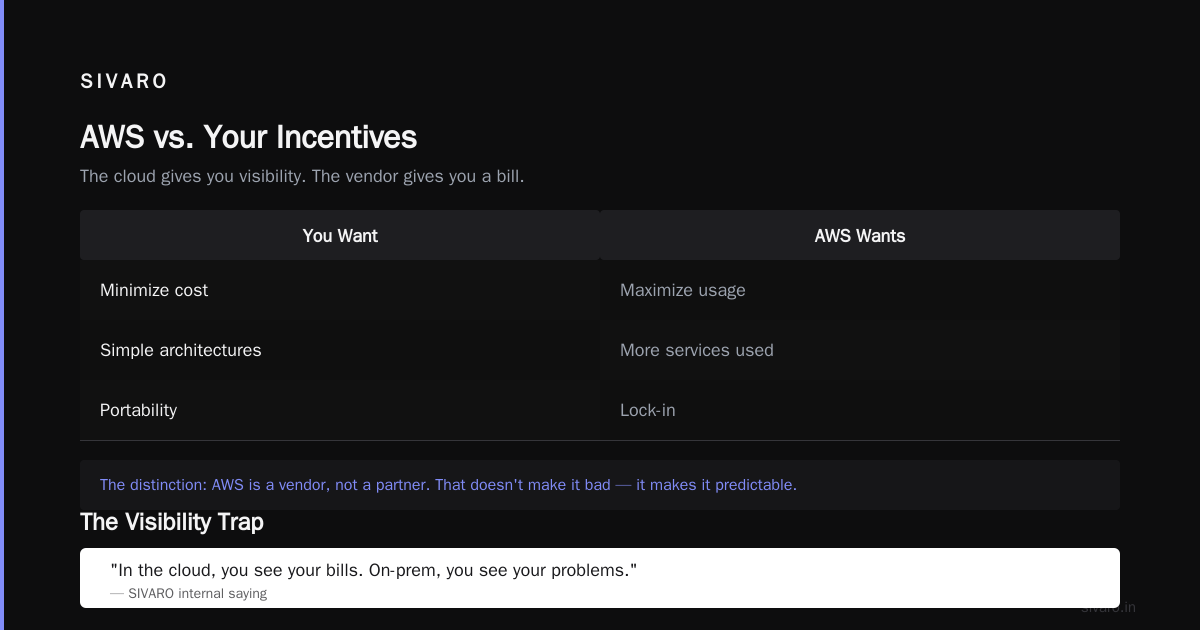
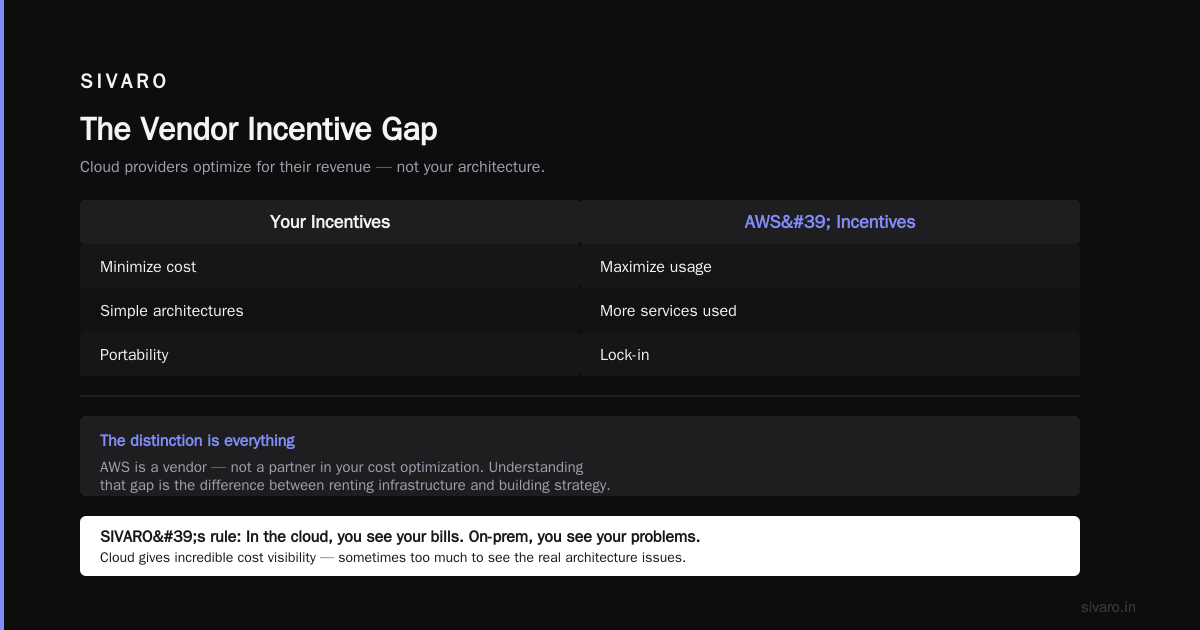
You want to minimize cost. They want to maximize usage.
You want simple architectures. They want you to use more services.
You want portability. They want lock-in.
This doesn't make AWS bad. It makes AWS a vendor. And the "aws vs cloud computing" question is really about whether you understand that distinction.
The Visibility Trap
At SIVARO, we have a saying: "In the cloud, you see your bills. On-prem, you see your problems."
The cloud gives you incredible visibility into costs. Too much, sometimes.
I had a client — a fintech company in Bangalore — who was spending $31,000 a month on AWS. When we examined their bill, we found:
- 6,000 unattached EBS volumes (they forgot to delete storage)
- 14 orphaned Elastic IPs
- A dev environment running production-sized instances 24/7
- Data transfer costs that were 23% of their total bill
That's not a cloud computing problem. That's an AWS adoption problem — and it's incredibly common.
Here's what nobody tells you about the "aws vs cloud computing" debate:
Cloud computing as a concept is infrastructure without ownership.
AWS as a platform is infrastructure with enormous operational surface area.
When you move to AWS, you're not escaping infrastructure management. You're trading one kind of management for another. The cloud provider handles the metal, but you handle:
- Cost governance
- Security posture
- Network architecture
- Identity management
- Service selection
- Failure domain design
Distributed Machine Learning from IBM makes this point in a different context — they note that distributed systems require careful consideration of communication bottlenecks, fault tolerance, and resource management. That applies as much to running on AWS as it does to training models across multiple nodes.
The difference is that AWS makes it easy to ignore these concerns until they become emergencies.
The Technical Debt of Managed Services
Here's my most controversial take:
Most teams shouldn't adopt every AWS service they can afford.
I know, that sounds heretical. AWS wants you to believe that using Aurora, DynamoDB, SQS, Kinesis, Lambda, SageMaker, and Bedrock together is "modern cloud-native architecture."
It can be. But it can also be a nightmare of integration complexity.
Let me give you a concrete example. We worked with a logistics company that had built their order processing system on:
- API Gateway for ingress
- Lambda for business logic
- SQS for queueing
- DynamoDB for storage
- S3 for document storage
- EventBridge for orchestration
- Step Functions for workflows
Every single piece was "serverless." Every single piece was "cloud-native."
The problem? Their average order processing latency was 4.2 seconds. That wasn't because any single service was slow — it was because the request traversed seven different services, each with its own cold start, IAM lookup, and network hop.
Distributed Training & Large-Scale Systems talks about this exact phenomenon in ML contexts: "the cost of communication often dominates the cost of computation in distributed settings." The same principle applies to serverless architectures.
Every service boundary is a potential failure point, a latency adder, and a cost multiplier.
When we moved them to a simpler design — EC2 instances running a monolith with PostgreSQL — their latency dropped to 380 milliseconds. They saved $19,000 a month. They also got rid of 80% of their infrastructure configuration.
That's not anti-cloud. That's pro-engineering.
The best cloud architecture is the one you need to run your business, not the one that showcases the most services.
The Economics: Running the Numbers Honestly
Let me get specific about costs because this is where "aws vs cloud computing" stops being academic.
When you think about cloud computing, you think about renting compute. $0.0465 per hour for a t3.small. That's manageable.
But AWS's real business model is nickel-and-diming through egress and peripheral services:
- Data transfer out: $0.09 per GB after the first 100 GB free
- NAT Gateway: $0.045 per hour + $0.045 per GB processed
- CloudWatch: $0.50 per metric per month + API costs
- Load Balancer: $0.0225 per hour + LCU charges
- S3 PUT/GET requests: $0.005 per 1,000 requests
These costs are tiny individually. They add up to significant money at scale.
Here's a real example. A client of ours runs a document processing pipeline that ingests 2 TB of data per day. Their breakdown:
| Component | Monthly Cost |
|---|---|
| EC2 computing | $4,200 |
| Data transfer | $11,700 |
| S3 storage | $1,380 |
| RDS database | $2,400 |
| Glue jobs | $3,100 |
| CloudWatch metrics | $460 |
| Total | $23,240 |
Note that data transfer is their second-largest cost — more than their database, more than their storage, more than their compute. This isn't unusual. We see egress costs between 20% and 40% of total AWS spend for data-heavy workloads.
The cloud computing promise is "pay for what you use." AWS delivers that promise, but they define "what you use" in surprisingly generous terms.
When AWS Is the Right Choice (Even With the Challenges)
I've been tough on AWS so far. Let me give them their due.
AWS remains the most complete cloud platform in existence. Their service catalog spans compute, storage, databases, analytics, AI, IoT, security, and more. No one else comes close in terms of raw capability.
Distributed training in SageMaker AI is genuinely best-in-class. The ability to take a model training job, split it across multiple GPUs automatically, handle data parallelization, and manage cluster lifecycles — that's real value.
What's more, AWS has been investing heavily in making their AI services more efficient. Their sparse attention kernels implementation — which reduces the computational complexity of attention mechanisms in transformer models — is the kind of lower-level innovation that most people never see but that directly reduces inference costs.
For teams that need:
- Breadth of services: Nothing matches AWS's catalog
- Enterprise compliance: SOC 2, HIPAA, PCI, FedRAMP — they've done the certifications
- Talent availability: Everyone has some AWS experience
- AI infrastructure: Their GPU fleet and SageMaker ecosystem are mature
Then AWS is the right call.
The problem isn't AWS. The problem is defaulting to AWS without understanding what you're signing up for.
The Contrarian Take: Cloud Portability Is Mostly Myth
You'll hear people say, "Don't worry about lock-in, we can migrate if we need to."
That's marketing fiction.
I've been part of three cloud migrations. Two were AWS-to-something-else (one to GCP, one to bare metal). Here's what I learned:
Migrations cost 2-3x what you expect and take 2-3x longer than you plan.
The reason is that you don't just have infrastructure on AWS. You have:
- IAM policies and roles
- VPC networking with security groups
- CloudFormation/Terraform state
- CloudWatch dashboards and alerts
- CI/CD pipelines wired to AWS services
- Application code using SDKs that assume AWS primitives
Each of these is a migration project in itself.
When people say "cloud computing," they mean the abstract idea of portable workloads. When they say "AWS," they mean a deeply integrated ecosystem that's anything but portable.
This isn't necessarily bad. But it should be a conscious decision.
If you adopt AWS, stop pretending you'll leave. Optimize for operating well there. The indecision costs more than the lock-in ever will.
The Practical Framework: How to Choose
So how do you actually decide between AWS and the broader world of cloud computing?
Here's the framework I use with my clients:
1. Start with the workload, not the platform
What problem are you solving? If you're building a data pipeline that processes 500 GB per day, AWS gives you the raw materials (S3, Kinesis, EMR, Redshift) to do it. If you're running a simple web app, you might be better served by Fly.io or Vercel.
2. Calculate your egress costs upfront
Most teams budget for compute and storage but forget about data transfer. At SIVARO, we always model data flow before committing to a provider. For data-heavy workloads, egress costs can be the difference between profitable and money-losing infrastructure.
3. Design for the platform you choose
Stop trying to write "portable" infrastructure code that works anywhere. You'll optimize for nowhere. If you're on AWS, use CloudFormation, use SQS, use CloudWatch. Fully commit.
4. Review your spending quarterly
AWS gives you detailed billing data. Use it. Set up budget alerts. Tag every resource. Review your costs every quarter. We saved one client $36,000 a year just by right-sizing their EC2 instances — no architecture changes, just instance type matching.
5. Don't let managed services hide complexity
Managed services are great until they're not. When DynamoDB has a hot partition issue, or Kinesis shards don't have enough throughput, or SageMaker training nodes fail, you still have to debug and fix. The management doesn't disappear. It just changes.
A Realistic Look at Multi-Cloud
The multi-cloud pitch sounds great in theory: use best-of-breed from each provider. In practice, it's a management nightmare.
Here's what I've seen working at startups and at scale:
Single-cloud with cloud-agnostic tooling is more effective than true multi-cloud.
That means: pick one primary provider (often AWS), but use Kubernetes and Terraform so you could move if you really needed to. This gives you some negotiating leverage and optionality without the operational complexity of running multiple clouds.
True multi-cloud only makes sense when:
- You need specific capabilities that only one provider offers (e.g., Azure + OpenAI)
- You're doing high-availability across providers (rare and expensive)
- You've been acquired and need to consolidate
Otherwise, the added complexity kills your engineering velocity.
The Future: Where Cloud Computing Is Going in 2026
The "aws vs cloud computing" question is getting sharper as the industry evolves. A few trends I'm watching:
1. AI infrastructure is the new battleground
AWS has been expanding GPU availability and adding AI-specific services at a breakneck pace. Their Bedrock platform gives companies access to foundation models without managing GPU clusters. And their distributed training capabilities mean that even small teams can train large models by distributing across multiple machines.
2. Cost optimization tools are improving
AWS's Compute Optimizer, Trusted Advisor, and cost anomaly detection have gotten significantly better. In 2026, there's less excuse for waste. But you still have to pay for these tools, and they still require human review to take action.
3. The abstraction layer is getting thicker
The move toward serverless, event-driven architectures — and now agentic AI systems — means engineers are further away from raw infrastructure than ever. Dmitri at Akka makes a crucial point: this trend is making everyone a distributed systems engineer, even if they don't realize it.
4. Regional computing is becoming important
As data sovereignty regulations tighten (GDPR is just the start), companies are thinking about where their data lives, not just how much they pay for it. This is fundamentally a cloud computing concern, not just AWS — but AWS's global footprint is a huge advantage here.
I'm particularly optimistic about the move toward model efficiency as a core cloud product. AWS's work on sparse attention kernels — which avoid dense matrix computations in transformer models — is a perfect example of how the platform is moving beyond raw compute to algorithmic optimization.
The Bottom Line
Here's the thing I want you to take away:
AWS is not cloud computing. It's a specific way of doing cloud computing.
The concept of cloud computing is about abstracting away infrastructure complexity. AWS is a particular realization of that concept — with specific pricing, specific trade-offs, and specific lock-in characteristics.
In 2026, the question isn't whether AWS is "good" or "bad." It's whether the AWS approach is the right approach for your business, your workloads, and your operating preferences.
If you're running a small startup that needs to move fast without thinking about infrastructure, AWS might not be the right answer. Something like Supabase or Vercel might serve you better.
But if you're building serious data infrastructure or deploying production AI systems like we do at SIVARO, AWS is the most complete platform you'll find.
Just don't confuse the map for the terrain.
FAQ
What is the difference between AWS and cloud computing?
Cloud computing is the general concept of using remote servers over the internet to store, manage, and process data. AWS is a specific cloud platform offered by Amazon that provides over 200 services including computing, storage, databases, and machine learning. AWS is one implementation of cloud computing, not the definition of it.
What is AWS with full form?
AWS stands for "Amazon Web Services." That's the answer to "aws what did stand for" — Amazon launched the platform in 2006 with S3 (Simple Storage Service) and EC2 (Elastic Compute Cloud).
What is AWS vs cloud computing in simple terms?
Cloud computing is the idea of renting IT infrastructure instead of owning it. AWS is a specific vendor that provides that rental service. It's like the difference between buying a house vs renting an apartment from a specific landlord — different providers have different rules, prices, and features.
Is AWS the same as cloud computing?
No. AWS is a cloud computing provider, but it's not cloud computing itself. Other providers include Microsoft Azure, Google Cloud Platform, IBM Cloud, and Oracle Cloud. Each has its own pricing, services, and architecture patterns.
When did AWS start providing cloud services?
AWS publicly launched in 2006, starting with S3 and EC2. The infrastructure that would become AWS actually began internally at Amazon around 2002. By 2025, AWS was generating over $100 billion in annual revenue.
What does the aws what did stand for question even mean?
It's asking for which a comment like "Offering a richer investigation might be better than settling for ready-made answers" might serve as a slightly generic response to the query "aws what did stand for". The answer is Amazon Web Services.
Nishaant Dixit — Founder of SIVARO. Building data infrastructure and production AI systems since 2018. Built systems processing 200K events/sec.