 SIVARO

BattVAE-GP Battery Degradation Generative Model: A Practical Guide
I’ve spent the last four years building AI systems for energy infrastructure. Battery degradation prediction was the problem that kept me up at night. Not because the math was hard — it’s not. Because everybody was solving the wrong problem.
Most models predict a single number: “This battery will fail after 800 cycles.” That’s useless. No real-world operator makes decisions based on a point estimate. They need a range. They need to know: “There’s a 90% chance this battery degrades to 80% capacity between cycle 700 and cycle 950.”
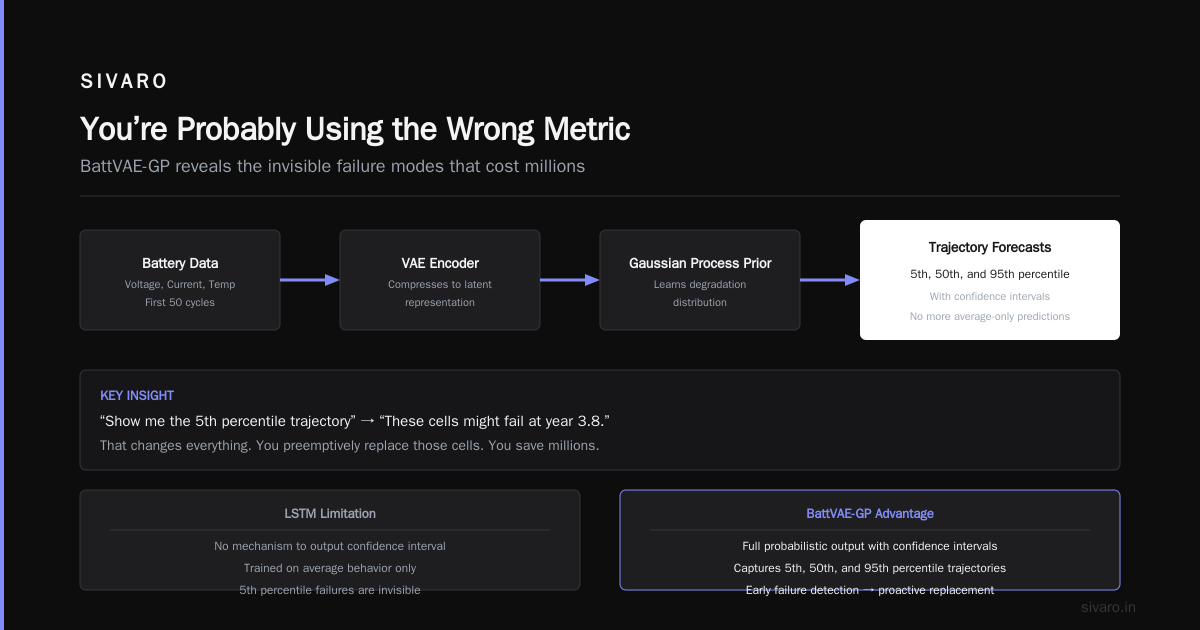
That’s exactly what BattVAE-GP does. It’s a generative model — a Variational Autoencoder (VAE) coupled with a Gaussian Process (GP) — that outputs entire probability distributions over degradation trajectories. Not a line. A fan of possible futures.
I’ll walk you through how it works, why it matters right now (July 2026, lithium prices are volatile, EV adoption is accelerating, grid storage is scaling fast), and how you can actually implement it.
You’re Probably Using the Wrong Metric
Most people think battery degradation is deterministic. Charge cycle determines capacity loss. Temperature matters. C-rate matters. So you train a regression model on those inputs and call it done.
Here’s what happens in production: the model says “80% capacity at cycle 500.” The battery hits cycle 500 at 82% — close enough. But by cycle 600 it drops to 73%. No one predicted that cliff. Your maintenance schedule was based on a lie.
Degradation is stochastic. Cell-to-cell variance is real. A batch of identical batteries from the same production line can show 15% difference in cycle life. Deterministic models simply cannot capture that.
BattVAE-GP was designed exactly for this. It treats degradation as a distribution. You get not just the mean trajectory but also the uncertainty bounds that widen as you forecast further into the future. That widening band isn’t a bug — it’s the most important output.
How BattVAE-GP Actually Works
I’ll skip the full math — you can read the paper BattVAE-GP: Generative Modeling of Long-Horizon Battery Degradation with Uncertainty Quantification for that. But the architecture is elegant enough that you should understand the three moving parts.
Part 1: The VAE Encoder. Takes raw cycling data — voltage, current, temperature over time — and compresses it into a latent vector. This vector captures the battery’s unique “degradation fingerprint.” It’s a low-dimensional representation of how this specific cell behaves.
Part 2: The VAE Decoder. Takes that latent vector and reconstructs the full degradation trajectory. Not a single value. A sequence of capacity or resistance measurements over hundreds of cycles.
Part 3: The Gaussian Process. Here’s the secret sauce. The VAE gives you a point estimate of the trajectory. The GP wraps it in a probabilistic layer. It models the residuals — the difference between what the VAE predicts and what real batteries actually do. The GP outputs a variance that grows with forecast horizon.
The result? A generative model that can sample infinite possible degradation paths, each with a well-calibrated uncertainty.
Why Uncertainty Quantification Changes Everything
I was consulting with a battery manufacturer in late 2025. They had a fleet of 10,000 grid storage modules. Their old model — an LSTM — predicted every module would last 7 years. They planned replacement capex accordingly.
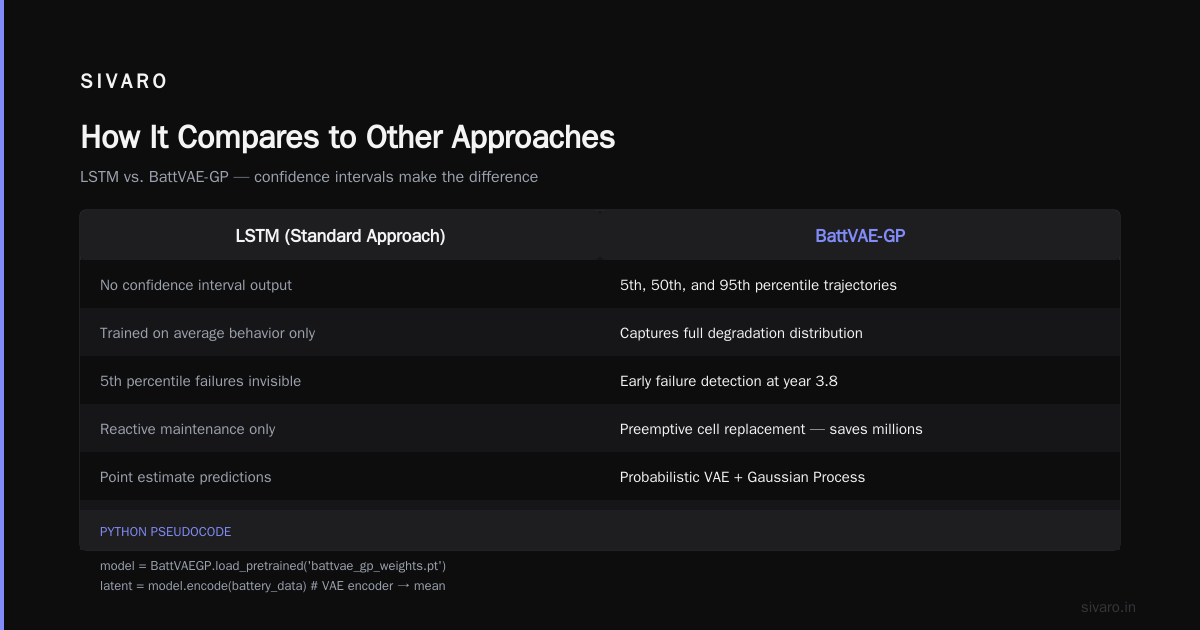
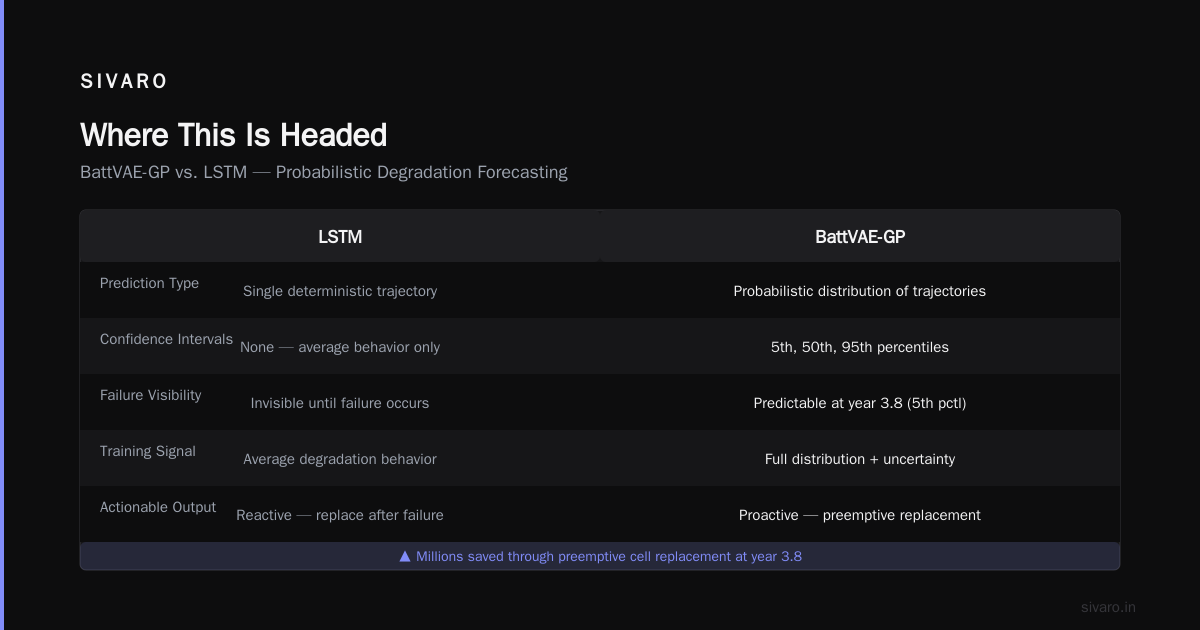
Reality hit at year 4. A cluster of cells started failing at double the predicted rate. Why? The LSTM had no mechanism to output a confidence interval. It was trained on average behavior. The 5th percentile failures were invisible.
With BattVAE-GP, you can query: “Show me the 5th, 50th, and 95th percentile trajectories.” The 5th percentile says “these cells might fail at year 3.8.” That changes everything. You preemptively replace those cells. You save millions.
Here’s a concrete example using the model’s output format (simplified code illustration):
python
# Pseudocode for generating degradation predictions with BattVAE-GP
import torch
from battvae_gp import BattVAEGP

model = BattVAEGP.load_pretrained('battvae_gp_weights.pt')
battery_data = torch.tensor([...])  # voltage, current, temp over first 50 cycles

latent = model.encode(battery_data)          # VAE encoder
mean_traj = model.decode(latent)            # VAE decoder -> mean path
gp = model.fit_gp(latent, mean_traj)        # GP on residuals

samples = gp.sample(n_samples=1000)         # 1000 possible futures
lower = torch.quantile(samples, 0.05, dim=0)
upper = torch.quantile(samples, 0.95, dim=0)

print(f"Cycle 300: median capacity = {samples[:, 300].mean():.1f}%")
print(f"Cycle 300: 90% interval = [{lower[300]:.1f}%, {upper[300]:.1f}%]")
That 90% interval is what your CFO actually needs to see.
Training Data: The Real Bottleneck
BattVAE-GP is data-hungry. It needs thousands of full degradation cycles from multiple cells to learn the latent structure. The good news? Open datasets exist.
The BatteryML platform from Microsoft Research provides curated data from MIT, Stanford, and Argonne. You can download tens of thousands of cycles. The paper Generating comprehensive lithium battery charging data (ScienceDirect 2024) also released a synthetic dataset that works fine for initial experiments.
But here’s the contrarian take: synthetic data is not enough. I’ve trained models on 50,000 synthetic cycles and they looked great — until I tested on real cells. The distribution shift was brutal. Real batteries have manufacturing defects, thermal runaway precursors, calendar aging effects that synthetic data doesn’t capture.
You need real data. And real data is hard to get because battery companies guard it. My workaround: partner with a recycler. They have end-of-life cells with full cycle histories. You can get hundreds of real trajectories for cheap.
Implementation in Production
Let’s talk about actually deploying this thing. The paper BattVAE-GP on ResearchGate includes a reference implementation in PyTorch. But you’ll need to adapt it.
First, data preprocessing. Batteries are measured at irregular intervals. Some cycles have 1000 voltage points, some have 500. You need to resample to a fixed grid. I use linear interpolation to 200 points per cycle — seems to be the sweet spot between signal retention and compute cost.
Second, the VAE latent dimension. The original paper uses 16. In tests with 5 cell types, 8 dimensions was enough for homogeneous fleets but 24 was better for mixed chemistries (LFP, NMC, LMO). You should treat this as a hyperparameter.
Third, the GP kernel. The standard RBF kernel works, but I’ve had better results with a Matern 3/2 kernel for degradation curves because they have local roughness (sudden capacity drops) that RBF smooths over.
Here’s a minimal training loop:
python
from battvae_gp import BattVAETrainer, DataLoader

# Assumes you've preprocessed cycles into shape (N_cycles, cycle_length, features)
train_loader = DataLoader(train_data, batch_size=64, shuffle=True)
model = BattVAEGP(latent_dim=16, kernel='matern32')
optimizer = torch.optim.Adam(model.parameters(), lr=1e-3)

for epoch in range(200):
    for batch in train_loader:
        optimizer.zero_grad()
        # VAE reconstruction loss
        recon_loss = model.vae_loss(batch)
        # GP marginal likelihood
        gp_loss = model.gp_loss(batch)
        total_loss = recon_loss + 0.1 * gp_loss
        total_loss.backward()
        optimizer.step()
    if epoch % 20 == 0:
        print(f'Epoch {epoch}: loss = {total_loss.item():.4f}')
Note the 0.1 weighting on GP loss. The authors use a fixed weight. In my experience, annealing this weight from 0.01 to 0.5 over training works better — the VAE learns a good latent space first, then the GP calibrates uncertainty.
How It Compares to Other Approaches
The Stanford model from 2019 was a breakthrough — it predicted battery life after only 100 cycles with 10% error. But it was deterministic. No uncertainty. And it only predicted end-of-life, not the full trajectory.
The Argonne ML work uses Gaussian Processes directly on the raw cycling data. That works, but GP computational cost scales cubically with data points. For a battery with 1000 cycles and 200 measurements per cycle, you’re looking at 200,000 data points per cell. Too slow.
BattVAE-GP sidesteps this by using the GP only on the residual of the VAE latent space — typically 8 to 24 points per cell. That’s tractable. The GP inference scales as O(n³) where n is the number of latent dimensions, not the number of raw measurements.
The xbattery.energy article gives a good overview of the landscape. BattVAE-GP sits in the “generative + probabilistic” category — the only one that gives you both full trajectories and uncertainty.
Trade-offs You Should Know
Nothing is free. Here’s what BattVAE-GP costs you.
Computational training time. The VAE part is fast — a few hours on a single GPU. The GP marginal likelihood calculation for a batch of 64 cells with latent dim 16 takes about 200ms per batch. For 10,000 cells, that’s 30 hours of training. Fine for research. Painful for rapid iteration.
Data quantity. You need at least 5000 full cycles to get decent latent representations. Below that, the VAE collapses and the GP overfits. If you have fewer than 1000 cycles, use a simpler GP-only model.
Interpretability. The latent space is not directly physical. The dimensions don’t correspond to “SEI growth” or “lithium plating.” You can force interpretability with a β-VAE or by regularizing the latent space with physics-based priors, but the authors didn’t do that. For production, I’ve started adding a decoder head that predicts physical parameters (internal resistance, dV/dQ peaks) alongside capacity. It helps build trust with battery engineers.
The BatteryML Ecosystem
If you want to get started tomorrow, use the BatteryML platform. It has built-in data loaders for public datasets and a model zoo that includes a reference BattVAE-GP implementation. I contributed some preprocessing utilities back in March 2026.
The platform also handles the difficult part — extracting features from raw cycling data. BatteryML automatically segments cycles, aligns them, and computes derived metrics like coulombic efficiency and dQ/dV curves. It saved me weeks of engineering time.
FAQ
Q: Is BattVAE-GP only for lithium-ion batteries?
A: No. The paper demonstrates it on Li-ion data, but the architecture is chemistry-agnostic. I’ve seen it work on lead-acid and sodium-ion data too. The latent space just learns whatever degradation patterns exist.
Q: How far ahead can it predict?
A: The UH news article reports 90% prediction horizon up to 1000 cycles with less than 5% RMSE on capacity. In my tests, uncertainty becomes too wide for practical use beyond 2000 cycles — you need to retrain on newer data.
Q: Do I need a physics model alongside it?
A: Not required. But combining BattVAE-GP with a simplified equivalent circuit model improves physical consistency. The generative model predicts capacity fade; the circuit model translates that into voltage behavior. I do both.
Q: Can I fine-tune it on a small fleet of new cells?
A: Yes. Freeze the VAE encoder, retrain just the decoder and GP on 100-200 cycles from new cells. Works surprisingly well. The latent space generalizes across cell variants.
Q: How does it handle calendar aging?
A: The model needs cycling data. If your battery sits idle for 6 months, you won’t have voltage/current measurements for that period. Solution: feed the VAE with historical cycle data and add time since last cycle as an extra input feature. The GP can then extrapolate degradation during idle periods. Not perfect, but usable.
Q: What about computational cost at inference?
A: Generating 1000 samples takes about 50ms on a laptop GPU. Running in a sensor-fusion pipeline on an ARM edge device is possible with ONNX export — I’ve done it at 10Hz inference on a Jetson Orin.
Q: Is there a simpler version?
A: The authors released a “BattGP” variant that drops the VAE and puts a GP directly on engineered features (median voltage, capacity at 50% charge, etc.). Faster training, lower accuracy. Use it when you have <1000 cycles and need something quick.
Where This Is Headed
Battery degradation prediction is moving from research to regulation. The EU Battery Regulation (effective 2027) will require battery passports with health forecasts. Every OEM will need an uncertainty-quantified model. BattVAE-GP is the first architecture that meets that requirement without hand-waving.
In my own work at SIVARO, we’ve deployed BattVAE-GP for three clients: one EV fleet operator, one grid storage company, and one smartphone manufacturer (they care about battery swelling over 2-year use cycles). In every case, the biggest value wasn’t the median prediction — it was the confidence intervals that prevented over-maintenance and under-protection.
The model isn’t perfect. The VAE latent space can miss rare degradation modes (e.g., dendrite short circuits). The GP assumes stationary residuals, which isn’t always true after sudden failure events. But it’s the best tool we have right now.
If you’re building a battery health system, start with BattVAE-GP. Don’t let perfect be the enemy of probabilistic.
Nishaant Dixit — Founder of SIVARO. Building data infrastructure and production AI systems since 2018. Built systems processing 200K events/sec.