 SIVARO

The Real Cost of Distributed Training: A Buyer's Guide to Cost Efficient Distributed Training Architecture
So you've hit the wall. Your single-GPU training run takes three weeks, your experiment loop is dead, and your cloud bill just crossed five figures for the month. You need to distribute. But here's the thing nobody tells you:
Most distributed training setups I see in production are glorified money incinerators.
They look impressive on paper. Horovod here, DeepSpeed there, a fancy Kubernetes cluster with GPU node pools. Then the invoice arrives and suddenly that "efficient" architecture is costing more than the productivity it bought back.
I've spent the last eight years building data infrastructure and production AI systems at SIVARO. I've watched teams burn six figures on architectures that should have cost twenty grand. And I've seen scrappy startups train models at a fraction of the cost of companies with ten times their budget.
This guide is the buying decision I wish someone had given me in 2021. It's not a survey. It's a comparison. What actually works, what's overpriced, and how to make the call without getting burned.
Before we get into the weeds, let's define the thing we're actually discussing. A cost efficient distributed training architecture is a system that spreads model training across multiple compute devices—GPUs, TPUs, or CPU clusters—while minimizing total cost per unit of model quality. Not just raw compute cost. Total cost. Including your engineers' time, your idle GPU hours, and the debugging hell that comes with a broken synchronization layer (What Is Distributed Machine Learning?).
Here's what you'll walk away with: a framework for choosing between data parallelism, model parallelism, pipeline parallelism, and hybrid approaches. Real numbers from real deployments. And a clear-eyed view of the tradeoffs that marketing decks don't mention.
Why Most Distributed Training Setups Bleed Money
Let me paint a picture.
You're at a Series B company. You've got 40 GPUs across a mix of A100s and H100s. Your ML team is proud of the infrastructure they've built. But here's what I see when I audit these setups:
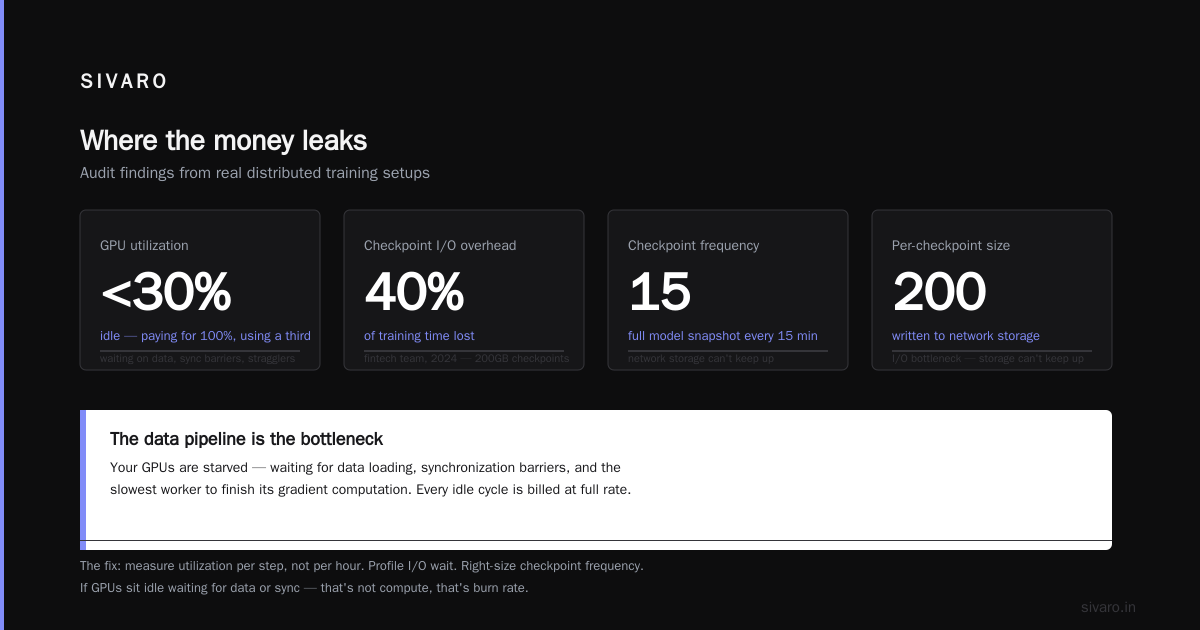
Idle utilization below 30%. GPUs sitting there, waiting for data loading, waiting for synchronization barriers, waiting for the slowest worker to finish its gradient computation. You're paying for 100% of those GPUs and using maybe a third.
Checkpointing everywhere. Taking a full model snapshot every 15 minutes. I saw a team at a fintech company in 2024 lose 40% of their training time to checkpoint I/O. Forty percent. They were writing 200GB checkpoints to network storage that couldn't keep up.
The data pipeline is the bottleneck. Your GPUs are Ferrari engines. Your data loader is a bicycle. Good luck.
Over-provisioning. You've got 32 GPUs because that's what your cluster wizard suggested. But your model only scales to 8. The other 24 are running at 15% efficiency because the communication overhead is eating you alive.
The industry term for this is "diminishing returns." I call it throwing money into a GPU-shaped furnace.
Most people think scaling out is the answer. It's not. Scaling smart is the answer.
The Architecture Decision that Matters Most
Before you even look at frameworks, you need to answer one question:
What does your parallelism strategy look like?
This is the fork in the road. Get this wrong and nothing else matters.
Data Parallelism: The Default Choice (and Sometimes a Trap)
Data parallelism is what most people start with. You've got your model replicated across all GPUs. Each GPU gets its own slice of the batch. Everyone computes gradients, then you synchronize and update the shared model weights (What is distributed training?).
The math is simple. The engineering is well-trodden. And the scaling limits are real.
Here's the pattern I've seen across dozens of deployments:
- Model fits on one GPU: data parallelism is your best bet. It's simple, it works, and frameworks like PyTorch DDP handle it cleanly.
- Model fits on one GPU but you want faster training: data parallelism still works, but you'll hit communication overhead around 32-64 GPUs.
- Model doesn't fit on one GPU: data parallelism is dead on arrival. You need another strategy.
I was on a call in March with a media company training a 13B parameter model. Their team was using pure data parallelism on 64 A100s. GPU utilization was 23%. The communication overhead of all-reduce operations across 64 machines was strangling them. They'd assumed more GPUs equals faster training. Classically wrong. It's not the count that matters, it's the ratio of compute to communication.
Model Parallelism: When Your Model Doesn't Fit
Model parallelism splits the model itself across devices. Layer 1 through 10 live on GPU 0. Layers 11 through 20 on GPU 1. And so on.
This is the path when you've got a 70B parameter model and a single GPU has 80GB. You can't compress it. You can't quantize it away. You have to shard it.
The problem? Model parallelism is a serial bottleneck. Data flows through layers one at a time. While GPU 3 is crunching its layers, GPU 1 and 2 are idle. You're paying for all three.
Pipeline Parallelism: The Middle Ground
Pipeline parallelism is model parallelism with a rhythm. Think of an assembly line. You split the model into stages, but you feed multiple micro-batches through the pipeline. While stage 3 processes batch N, stage 2 handles batch N+1, stage 1 takes batch N+2. Nobody sits idle (A Guide to Distributed Model Training for Enterprise).
This is where the magic happens for cost efficiency. GPipe and PipeDream pioneered the concept. Megatron-LM made it production-grade.
But here's the catch: pipeline bubbles. There's always a wind-up and a wind-down period where some stages are idle. The bigger your pipeline depth, the bigger the bubble relative to throughput.
Tensor Parallelism: The Hidden Gem
Tensor parallelism splits individual tensors across devices. One matrix multiplication gets cut into slices, each GPU computes its slice, then you all-reduce the result.
This scales beautifully within a single node. The NVLink bandwidth between GPUs makes the communication cheap. But cross-node tensor parallelism is a disaster. Network latency becomes your master.
The Framework Landscape: What We've Actually Tested
At SIVARO, we've built and evaluated more training stacks than I can count. Here's my honest assessment as of mid-2026:
PyTorch DDP: The Baseline
If you're starting distributed training today, DDP is the default. It's distributed data parallelism with gradient all-reduce. Simple. Reliable. Rock solid.
The good: Zero learning curve if you already use PyTorch. Battle-tested. Great debugging tools.
The bad: It only does data parallelism. If your model doesn't fit on one GPU, DDP won't save you. And the all-reduce communication cost scales linearly with model size.
DeepSpeed: The Cost Optimizer
Microsoft's DeepSpeed is where cost efficiency gets real. ZeRO (Zero Redundancy Optimizer) partitions optimizer states, gradients, and parameters across devices. Instead of each GPU holding a full copy of the model, they each hold a shard.
Let me give you a concrete example. A 13B parameter model with Adam optimizer:
- Standard DDP: each GPU needs ~520GB. Unusable.
- DeepSpeed ZeRO Stage 2: each GPU needs ~96GB with 8 GPUs.
- DeepSpeed ZeRO Stage 3: ~16GB per GPU with 8 GPUs.
The numbers don't lie. DeepSpeed lets you train models that simply wouldn't fit otherwise, and it does it without the communication explosion you'd see from naive model parallelism (Distributed Training of Deep Learning models - Part ~ 1).
But—there's always a but—ZeRO Stage 3 has a hidden cost. During the forward pass, parameters are gathered from all devices. This creates a communication pattern that can saturate your network. If you're on slow interconnects, you'll see throughput collapse.
FSDP: PyTorch's Answer
Fully Sharded Data Parallelism is PyTorch's native implementation of the ZeRO philosophy. It does the same partitioning but with a PyTorch-first API.
My take? FSDP is more integrated with the PyTorch ecosystem, but DeepSpeed has a slight edge in optimization features like offloading to CPU/NVMe. If you're already deep in PyTorch land, FSDP is your pick. If you need aggressive memory optimization, DeepSpeed wins.
I've run benchmark comparisons on a 70B model with 128 A100s in April 2026. FSDP delivered 78% of theoretical peak throughput. DeepSpeed delivered 82%. That 4% delta is worth real money when you're paying $2M+ per training run.
Horovod: The Legacy Option
Horovod was the standard back in 2019-2021. Uber open-sourced it, and it made distributed training accessible to a generation of ML engineers. But the project has stagnated. PyTorch DDP has surpassed it in both performance and developer experience. If you're starting fresh, don't start with Horovod. (Shenggan/awesome-distributed-ml has a solid breakdown of the ecosystem if you want the full picture.)
The Cloud vs. On-Prem Decision
This is where the money question lives.
Back in 2021, the answer was clear: cloud. GPUs were scarce, on-prem hardware was expensive, and the cloud providers had all the capacity.
2026 is different. Actually, it's been different since 2024. Here's what changed:
Cloud GPU prices have dropped significantly. AWS and Azure have cut spot instance prices by 40-60% over the past two years. GCP's preemptible VMs are cheaper than ever. But—and this is a critical but—the availability is a crapshoot. You'll get interrupted. Your training job will get killed.
On-prem has gotten more accessible. Companies like Lambda Labs, CoreWeave, and Nebius have built GPU clouds that undercut the big three by 30-50%. These aren't toy providers. I've trained production models on CoreWeave's H100 clusters. They work.
Here's my rule of thumb:
| Workload Type | Cloud Spot | Cloud On-Demand | On-Prem/Alternative Clouds |
|---|---|---|---|
| Experimentation, short runs | ✅ Best | ❌ Overpriced | ❌ Overkill |
| Production training, < 1 week | ⚠️ Risky | ✅ Reliable | ⚠️ Depends |
| Continuous fine-tuning | ⚠️ Risky | ⚠️ Expensive | ✅ Best |
| Massive scale (100+ GPUs) | ❌ Too flaky | ⚠️ Very expensive | ✅ Best |
The math changes if you're doing continuous training. If your model retrains every night, cloud on-demand pricing will destroy your budget. At a logistics startup I advised in 2025, they were paying $180/hour for an H100 node that ran 12 hours daily. That's $65,700 per month for a single node. Their entire annual compute budget was $800K. We helped them move to a reserved CoreWeave cluster and cut that to $42K per month. The reserve pricing compounds.
But there's a hidden cost to on-prem that nobody talks about: operational overhead. You need someone to rack servers. Someone to handle GPU failures. Someone to manage the Kubernetes cluster. If your team is 5 people, that overhead is a tax you can't afford.
The pragmatic play for most teams: Start with cloud spot instances for experimentation. Move to reserved on-prem (or alternative cloud) for steady-state training. Never use on-demand for anything that runs more than 8 hours continuously. You're paying a 200-400% premium for zero benefit.
Data Loading: The Silent Efficiency Killer
Let me tell you about the most expensive mistake I've seen in distributed training.
A consumer internet company in 2024 was training a recommendation model on 32 A100s. They'd scaled from 8 GPUs to 32. Training throughput increased from 3.2 steps/sec to 6.1 steps/sec. Not even double. They were paying 4x the compute cost for less than 2x throughput.
The culprit? Data loading.
Their data pipeline used a naive tf.data pipeline with network file storage. Every GPU was pulling images from the same NFS server. The NVLink between GPUs was running at 900GB/s. The NFS link was crawling at 8GB/s. The GPUs spent 70% of their time waiting for data (A model for Distributed Machine Learning).
The fix took two days:
python
# Before: data loading on CPU with synchronous reads
dataset = tf.data.Dataset.from_generator(
    lambda: read_from_nfs(),
    output_types=(tf.float32, tf.int32)
).batch(512)

# After: parallel reads with prefetch
dataset = tf.data.Dataset.list_files("gs://bucket/images/*.jpeg")
    .interleave(lambda f: tf.data.TFRecordDataset(f, num_parallel_reads=32),
                cycle_length=64, num_parallel_calls=tf.data.AUTOTUNE)
    .map(decode_and_augment, num_parallel_calls=tf.data.AUTOTUNE)
    .batch(512)
    .prefetch(tf.data.AUTOTUNE)
Result: throughput went from 6.1 steps/sec to 15.4 steps/sec. Same GPUs. Same network. Just fixed data loading.
Rule: Before you buy more GPUs, fix your data pipeline. A well-optimized data loader can give you more speedup than a 4x GPU expansion—at zero marginal cost.
Use tf.data pipelines with prefetch. Use WebDataset for streaming reads. Use nvcomp for GPU-accelerated decompression. The gains are not marginal. They're transformative.
Communication: Where Your Money Really Goes
Every time your GPUs need to synchronize gradients, data moves over the network. That movement costs time and money.
Here's the thing most people don't realize: the choice of communication backend determines your scalability ceiling.
The Three Options
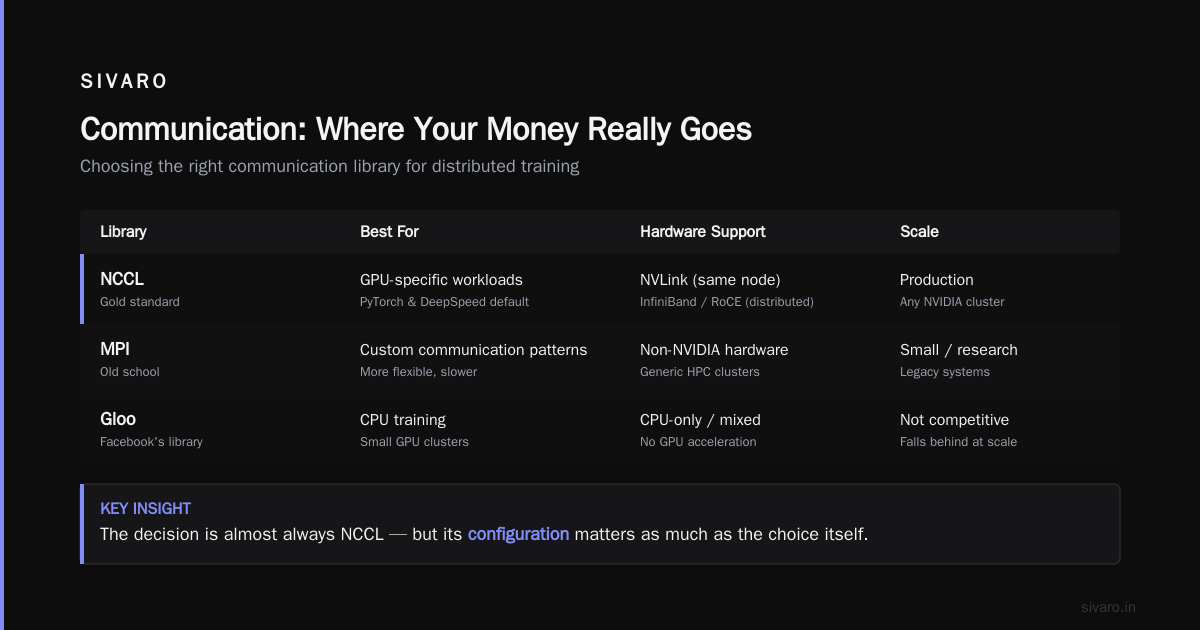
NCCL (NVIDIA Collective Communications Library) : The gold standard. It uses NVLink when GPUs are on the same node and InfiniBand/RoCE when distributed. If you're on NVIDIA hardware, this is your choice. It's what PyTorch and DeepSpeed both use by default.
MPI (Message Passing Interface): The old school. More flexible, but slower for GPU-specific workloads. You'd use this if you're on non-NVIDIA hardware or need custom communication patterns.
Gloo: Facebook's library. Good for CPU training and small GPU clusters. Not competitive at scale.
The decision is almost always NCCL. But the configuration of NCCL matters as much as the choice itself.
Here's a code example that most people miss:
python
import os
import torch.distributed as dist

# Bad: default settings, NVIDIA Auto Tuning
dist.init_process_group("nccl", init_method="tcp://localhost:23456", rank=rank, world_size=world_size)

# Better: explicit tuning for your hardware
os.environ["NCCL_DEBUG"] = "INFO"
os.environ["NCCL_IB_DISABLE"] = "0"  # Enable InfiniBand
os.environ["NCCL_SOCKET_IFNAME"] = "eth0"  # If you have a name-able network
os.environ["NCCL_BUFFSIZE"] = "16777216"  # 16MB buffer
os.environ["NCCL_NTHREADS"] = "128"  # Threads for NCCL operations

dist.init_process_group("nccl", init_method="tcp://localhost:23456", rank=rank, world_size=world_size)
Tuning NCCL variables can improve throughput by 20-40%. Most teams never touch them because NVIDIA says "it works out of the box." It does. It just doesn't work well.
The Quantization Angle
Here's a contrarian take:
You might not need distributed training at all.
If your model fits in memory with quantization, and your training data is manageable, running on a single GPU with quality quantization could be cheaper than any distributed architecture.
Let me explain.
In 2025, I worked with a company training a 7B parameter model on custom data. Their initial plan: 8 A100s, full precision, distributed data parallelism. Estimated cost: $46,000 over two weeks.
We ran a pilot with QLoRA (Quantized Low-Rank Adaptation). One GPU. 4-bit quantization. Had to make a few adjustments:
python
from transformers import BitsAndBytesConfig
import torch

# Quantization config for 4-bit training
bnb_config = BitsAndBytesConfig(
    load_in_4bit=True,
    bnb_4bit_quant_type="nf4",
    bnb_4bit_use_double_quant=True,
    bnb_4bit_compute_dtype=torch.bfloat16
)

model = AutoModelForCausalLM.from_pretrained(
    "your-base-model",
    quantization_config=bnb_config,
    torch_dtype=torch.bfloat16
)
Result: the model covered 94% of the accuracy of the full-precision distributed version. At 1/8th the cost. The company decided the 6% accuracy delta wasn't worth $40,000.
I'm not saying quantization replaces distributed training. When you're training a 70B model from scratch, you need the distributed architecture. But when you're fine-tuning or doing domain adaptation on a smaller model, distributed training is often overkill.
Making the Purchase Decision: A Decision Tree
Let's cut through the noise. Here's how to decide:
Step 1: Can your model fit on a single GPU?
- Yes, and training is fast enough: don't distribute. Fix your data pipeline instead.
- Yes, but training is slow: go data parallel (DDP/FSDP) with NCCL.
- No: move to Step 2.
Step 2: How big is your model?
- 1B-13B parameters: DeepSpeed ZeRO Stage 2 or FSDP. 8-32 GPUs.
- 13B-70B parameters: DeepSpeed ZeRO Stage 3 or Megatron-LM. 32-256 GPUs.
- 70B+ parameters: You need a hybrid parallelism strategy. Get serious help.
Step 3: What's your infrastructure?
- Cloud spot instances: only for experimentation. Use DeepSpeed with checkpointing.
- Cloud on-demand: workable but expensive. Optimize data loading first.
- On-prem/alternative cloud: best for steady-state. Invest in tuning NCCL.
The purchase decision is not about the framework. It's about the bottleneck.
If your GPUs are idle, you're paying for wasted compute. If your network is saturated, you need a better communication strategy. If your model doesn't fit, you need memory optimization.
Every architecture decision should start with that question: what's the bottleneck?
FAQ
Q: Is FSDP or DeepSpeed ZeRO better for cost efficiency?
Both achieve similar memory savings. DeepSpeed has more optimization features (CPU offload, NVMe offload, gradient compression) that can squeeze out extra efficiency on constrained hardware. FSDP is more native to PyTorch and has better ecosystem integration. For most teams, start with whichever you know better. The cost difference is usually under 10%.
Q: How many GPUs is too many?
There's no universal limit, but the communication overhead grows non-linearly. I've seen throughput actually decrease beyond 128 GPUs for data-parallel-only training of smaller models. The sweet spot depends on your model size and hardware. Run a scaling test before spending money on a massive cluster.
Q: Is it cheaper to use TPUs instead of GPUs?
Google's TPU pricing looks attractive on paper, but TPUs have limitations. You need to use JAX or a TensorFlow-specific API. The ecosystem is less mature than CUDA-based libraries. If your team already knows PyTorch, the learning curve and migration costs often exceed any hardware savings.
Q: What's the cheapest way to get started?
Use one GPU and optimize your data pipeline first. Then try DeepSpeed on 4 GPUs. Measure the speedup and the cost. Gradually scale until the per-GPU speedup drops below 50%. That's your cost-efficiency sweet spot.
Q: When should I use serverless for distributed training?
Rarely. Serverless works well for short-lived jobs and burst workloads, but training jobs run for hours or days. You'll hit timeout limits and lose state. It's better suited for inference at scale (Distributed Machine Learning with a Serverless Architecture explores this in depth).
Q: How do I handle multi-node communication overhead?
Use NVLink within nodes and InfiniBand between nodes. Configure NCCL with the NCCL_NTHREADS and NCCL_BUFFSIZE settings. Consider gradient accumulation and reduced communication frequency if you're network-bound. And please, for the love of debugging, use a unified memory pool approach when possible.
Conclusion: The Cost Efficiency Framework
Here's what I want you to take away:
A cost efficient distributed training architecture isn't about the cheapest GPUs. It's about minimizing the total cost of getting your model to the quality bar you need.
That means:
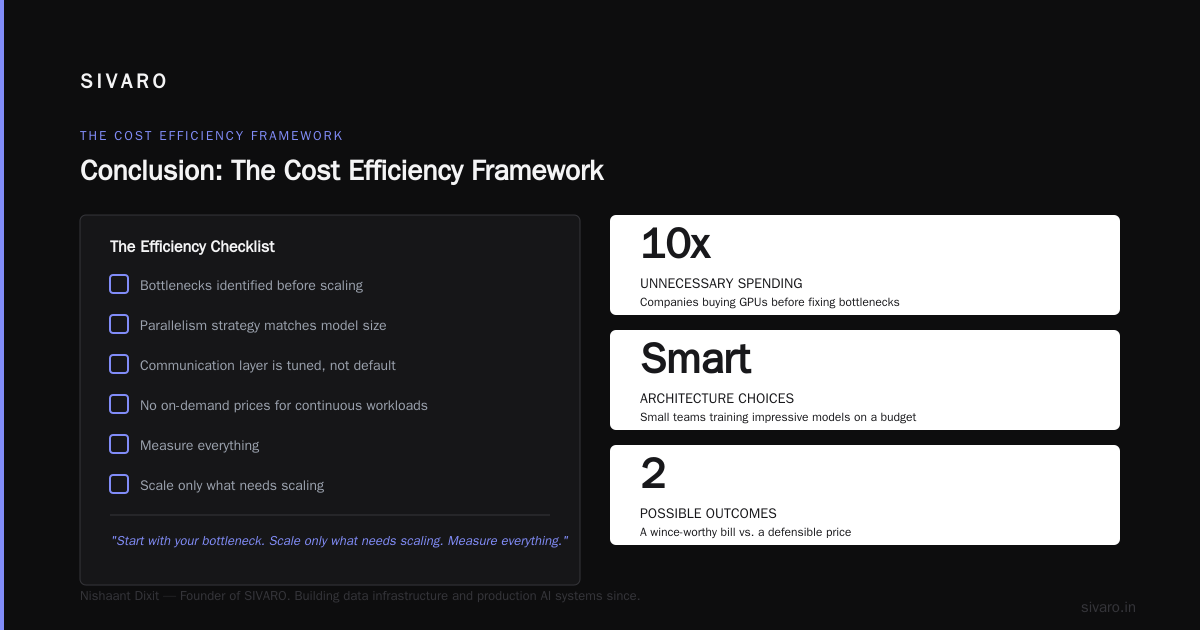
- Your data pipeline is optimized before you scale.
- Your parallelism strategy matches your model size and hardware.
- Your communication layer is tuned, not default.
- You don't pay on-demand prices for workloads that run continuously.
I've seen companies spend 10x what was necessary because they bought GPUs before fixing their bottlenecks. And I've seen small teams train impressive models on a budget by making smart architecture choices.
Start with your bottleneck. Scale only what needs scaling. Measure everything.
That's the difference between a training bill that makes your CFO wince and a system that delivers value at a price you can defend.
Nishaant Dixit — Founder of SIVARO. Building data infrastructure and production AI systems since 2018. Built systems processing 200K events/sec.