best datasets for llm fine-tuning: A Practitioner’s Guide (2026)
The best datasets for llm fine-tuning aren’t the biggest. They’re the boldest. The most aligned with your deployment reality. And often, the smallest.
In this guide, I’ll walk you through what actually works in 2026 – the datasets and the trade-offs. You’ll learn how to pick, build, and QA datasets for instruction fine-tuning, preference alignment, and domain specialization. I’ll show you code and when to ignore the hype.
What Makes a Dataset Good for Fine-Tuning?
Most people think a good dataset is “high quality”. That’s like saying a good engine is “powerful”. Vague. Unhelpful.
Here are the three properties I care about:
1. Distribution match with inference-time inputs.
If your chatbot handles customer complaints but you fine-tune on Wikipedia summaries, you’ll get a polite, factually dense model that can’t handle “my order didn’t arrive, you’re useless.” Fine-tuning shifts the model’s output distribution. Shift it in the wrong direction and you’re done.
2. Signal density.
A dataset where every example teaches something new. If 80% of your examples are trivial variations of “What’s the capital of France?”, you’re burning compute. Signal-to-noise ratio matters more than row count (Google Cloud guide makes the same point).
3. No latent contradictions.
This is the silent killer. Two experts write the same policy – one says “always refund within 30 days”, the other says “except for electronics”. Fine-tune on both without resolving the conflict, and the model learns a confused middle ground. You need a single source of truth, or explicit conflict resolution in the dataset.
The Best Datasets for LLM Fine-Tuning: Start Here
Not all datasets are created equal. Here’s my ranking.
1. Dolly (Databricks) – still king for instruction following
Released in 2023, but don’t let the age fool you. Dolly is 15,000 high-quality human-written instruction-response pairs spanning brainstorming, classification, closed QA, generation, and more. Why does it hold up? Because every example was written by a Databricks employee following strict guidelines. No noise. No hallucinations.
Code snippet: loading Dolly with HuggingFace datasets
python
from datasets import load_dataset

dolly = load_dataset("databricks/databricks-dolly-15k", split="train")
print(dolly[0])
# {'instruction': 'What are the three primary colors?',
#  'context': '',
#  'response': 'The three primary colors are red, blue, and yellow.',
#  'category': 'closed_qa'}
2. OpenAssistant Conversations (OASST1) – breadth over polish
OASST1 is a mess. 161k messages in 35 languages, collected from volunteers. Some responses are brilliant. Some are gibberish. But that mess is exactly why it works for general-purpose assistants. It exposes the model to real-world user phrasing – typos, incomplete sentences, cultural references, emotional tones.
If you’re building a customer-facing chatbot (not a domain expert), OASST1 is your best bet for initial fine-tuning. The key is to filter out low-confidence responses.
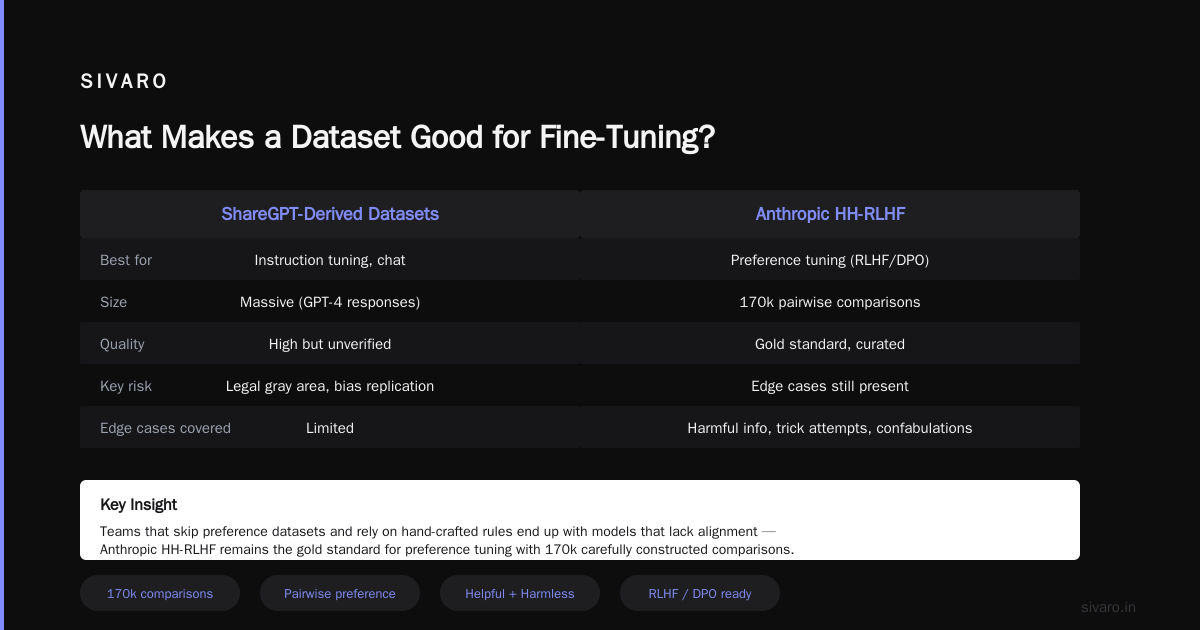
3. ShareGPT – the pragmatic data mine
Yes, it’s technically violating OpenAI’s terms. I’m not recommending you use it. The collected conversations between users and GPT-3.5/4 are phenomenally rich. They show multi-turn dialogues, refusal strategies, chain-of-thought reasoning, and creative writing.
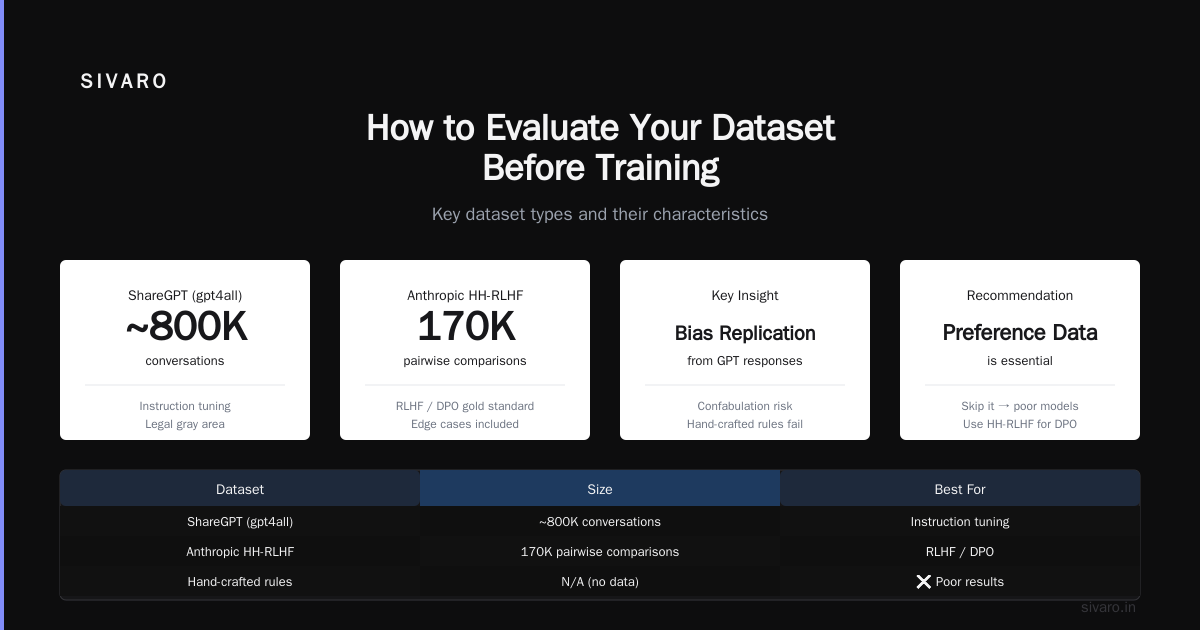
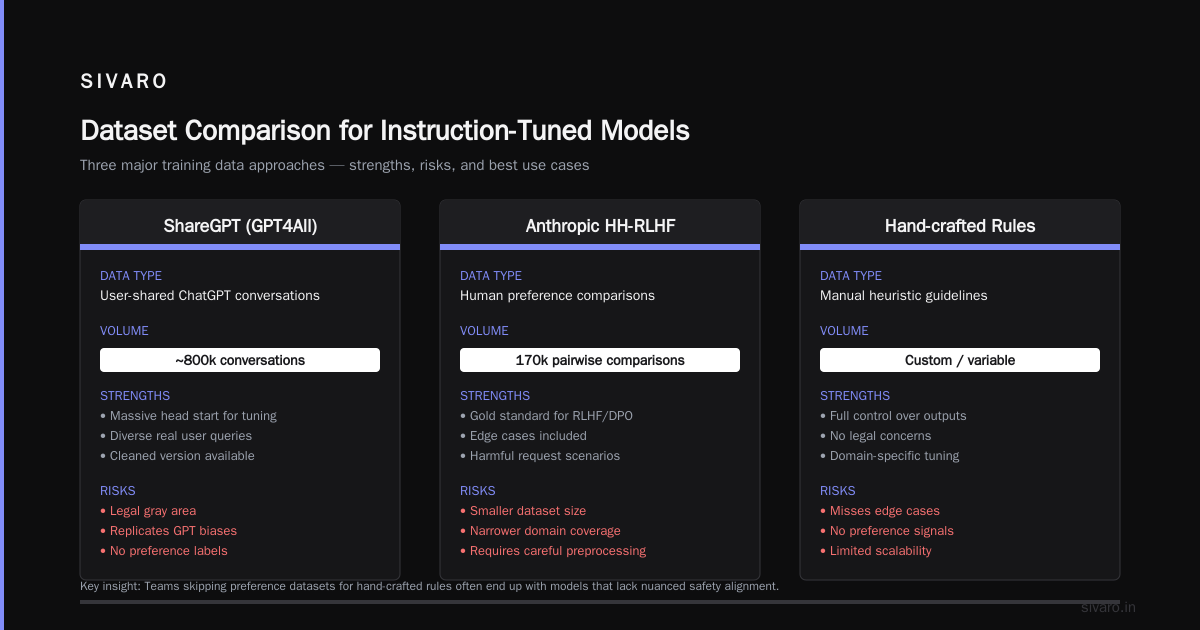
For those building instruction-tuned models, ShareGPT-derived datasets (like the “gpt4all” cleaned version) provide a massive head start. Just be aware of the legal gray area and the fact that the model might replicate biases present in the original GPT responses.
4. Anthropic’s Helpful + Harmless (HH-RLHF) – gold for preference tuning
If you’re doing RLHF or DPO, this is the closest thing to a gold standard. 170k pairwise comparisons where annotators chose the “helpful” and “harmless” response. The dataset is carefully constructed to include edge cases: requests for harmful information, attempts to trick the model, confabulations.
Teams that skip preference datasets and just use hand-crafted rules end up with models that sound good but occasionally go rogue. HH-RLHF isn’t perfect (it’s US-centric and overly polite), but it’s a solid base. Add your own domain-specific preference pairs on top.
Instruction Datasets: The Foundation of Fine-Tuning
For most use cases, your fine-tuning journey starts with instruction data. But not all instruction datasets are the same.
The two camps:
- Human-written: Dolly, OpenAssistant, Alpaca (original) – expensive but reliable.
- Synthetic: Self-Instruct, Evol-Instruct, WizardLM derived – cheap but prone to hallucination cascades.
The synthetic vs. human debate is mostly settled by 2026: use synthetic for breadth, human for depth. Start with a synthetic seed to cover common patterns, then manually curate 1-2k high-value examples that define your unique behavior.
Example: an instruction dataset for a children’s tutor – helping kids aged 6-12 with homework – needs to:
- Never do the child’s homework for them (that’s cheating).
- Always explain step-by-step.
- Use age-appropriate language (no “facilitate” or “parameter”).
- Celebrate mistakes as learning opportunities.
Preference Datasets for RLHF and DPO
Pure instruction fine-tuning makes a model obedient. Preference tuning makes it aligned.
The canonical format: (prompt, chosen response, rejected response). The model learns to maximize the probability of the chosen one relative to the rejected one.
Where do you get preference data?
- Human annotation – expensive ($2-5 per comparison), but gold. Use for your core domain.
- Model-based – use a stronger model (e.g., GPT-4o) to rank responses from your weaker model. Cheap but noisy.
- Implicit from logs – if you have a live system with user feedback (thumbs up/down, follow-up questions, retention), you can mine preference pairs. This is the holy grail because it reflects real user preferences, not abstract “helpfulness”.
Domain-Specific Datasets: When General Just Won’t Cut It
Generic datasets are fine for a generic assistant. But if you’re building a medical triage bot, a legal document reviewer, or a financial advisor, you need domain-specific data.
Best sources for domain data:
- Your own logs – nothing beats real production queries. Anonymize and deduplicate.
- Public benchmarks – MMLU, PubMedQA, MedMCQA, LegalBENCH. These are usually multiple-choice, which requires conversion to instruction format.
- Expert-written corpora – textbooks, manuals, peer-reviewed papers. Chunk them and create QA pairs using a prompt like “Given the following text, ask a question that a domain expert might answer from this text, and provide the answer.”
Warning: Fine-tuning on domain data without grounding can cause catastrophic forgetting of general capabilities. Mitigate by mixing 10-20% general instruction data in each batch.
Synthetic Data: The Double-Edged Sword
Everyone in 2026 is generating synthetic data. It’s cheap, fast, and infinitely customizable. But it has a dark side.
Problem: The model you’re using to generate synthetic data has its own biases. If you use GPT-4o to generate medical QA pairs, the resulting dataset will reflect GPT-4o’s knowledge cutoffs, reasoning patterns, and halluncination tendencies. Fine-tuning a weaker model on that data essentially distills the strengths and weaknesses of the teacher.
Teams that create entire fine-tuning datasets from a single powerful model end up with a fine-tuned model that has the same blind spots as GPT-4o. It’s self-referential overfitting.
My rule of thumb: use synthetic data for data augmentation (paraphrasing, rephrasing, changing difficulty), not for creating examples from scratch. And always validate a random sample with human review.
Code snippet: generating instruction pairs from a document
python
import openai

def generate_qa_pairs(text_chunk, n=3):
    prompt = f"""Given the following text, generate {n} question-answer pairs that test understanding.
Format each pair as "Q: ...A: ...".
Text: {text_chunk}"""
    response = openai.ChatCompletion.create(
        model="gpt-4o",
        messages=[{"role": "user", "content": prompt}],
        temperature=0.7
    )
    raw = response.choices[0].message.content
    # parse pairs
    pairs = []
    for line in raw.split("

"):
        if line.startswith("Q:"):
            q, a = line.split("A:")
            pairs.append({"question": q.replace("Q:", "").strip(),
                          "answer": a.strip()})
    return pairs
How to Evaluate Your Dataset Before Training
Don’t throw data into fine-tuning blindly. Here’s a four-step sanity check:
-
Sample 100 examples and manually grade them. Are the instructions clear? Are the responses correct? If more than 10% are wrong, stop and rework.
-
Measure entropy of responses. If every response is roughly the same length, same structure, same tone, your dataset lacks diversity. Run a simple entropy calculation on token-length distribution. Low entropy means you’ll get a monotone model.
-
Check for label leakage. If your instruction says “Based on the patient’s symptoms, what disease?” and the response mentions the disease directly, but the context doesn’t contain it – that’s leakage. The model will hallucinate facts it didn’t see.
-
Run a quick fine-tune on 1% of the data, one epoch. Compare loss curves on held-out validation set. If loss doesn’t go down meaningfully, the data might be too noisy or contradictory.
Fine Tune Open Source LLM vs Closed Source: The Dataset Implications
The fine tune open source llm vs closed source debate is not just about cost or privacy. It’s about data control.
With closed source (OpenAI, Anthropic), you can only fine-tune via their API. They own the fine-tuned model weights. You can’t inspect what’s inside. You can’t go back and fix a data error without resubmitting the whole job.
More importantly, closed source fine-tuning is dataset size constrained by pricing. OpenAI charges $0.008 per 1k tokens for training (as of May 2026). Fine-tuning a 70B-equivalent model on 10k examples costs about $1,200. For a children’s tutor startup on a bootstrap budget, that’s painful.
Open source gives you unlimited (within your compute) control over dataset curation. You can do 50 epochs on 200 perfect examples. You can augment on the fly. You can blend datasets in interesting ratios.
But open source also means you’re responsible for the dataset itself. No safety filters from the API provider. If your dataset is biased, your fine-tuned model will be biased.
I’ve made a chart in my head:
- Choose closed source when: you have a standard task, need quick deployment, and can afford the API fees.
- Choose open source when: you need fine-grained control, domain specialization, or cost efficiency at scale.
The dataset question doesn’t change between them – you still need good data. But open source lets you fail faster and cheaper on the data side.
Practical Steps to Build Your Fine-Tuning Dataset
Here’s a checklist:
-
Define your output format first. Is it a single response? Multi-turn? Function call? JSON object? Your dataset must match the inference-time format exactly.
-
Gather existing data. Look for public datasets (I listed the top ones). Check Hugging Face dataset viewer. Filter by language, license, domain.
-
Augment with synthetic data using a strong model. Use techniques like:
- Paraphrasing to increase diversity.
- Back-translation for multi-lingual support.
- Difficulty scaling (easy, medium, hard).
-
Add edge cases. What happens when the user asks something impossible? When they use profanity? When they contradict themselves? Your dataset needs those examples.
-
Validate with a holdout set. Don’t use all data for training. Keep 10-20% aside for evaluation. Run a small fine-tuning and check if your holdout loss decreases.
-
Watch for over-tuning. If your holdout loss goes up after epoch 1, stop. You’ve exhausted the data. More epochs won’t help.
FAQ
Q: How many examples do I need for fine-tuning?
A: Between 500 and 5,000 is typical, depending on the task and model size. Narrow tasks can need fewer, if they are well chosen.
Q: Should I use GPT-4 to generate my dataset?
A: Yes, for initial synthetic data. But validate every example. And be aware that the student model will inherit GPT-4’s style and biases.
Q: What’s the best dataset for domain-specific fine-tuning (legal)?
A: Start with CaseHOLD (legal holdings) and LegalBENCH. Then augment with 200 manually written examples by lawyers in your jurisdiction. No public dataset can replace expert curation.
Q: Can I mix multiple datasets?
A: Yes, but balance them. If you mix 100k general examples with 1k domain-specific, the model will ignore the domain. Aim for at least 20% domain data.
Q: How do I handle multi-turn conversations?
A: Format each (history, response) pair. Include the full history. Some datasets (like ShareGPT) already include multi-turn. For others, you may need to concatenate consecutive turns.
Q: What’s the cheapest way to get started with fine-tuning?
A: Use QLoRA on a single GPU (e.g., RunPod A6000 for $0.79/hr). Pick a small model like Llama 4 7B. Start with 500 examples from Dolly. That’ll cost you under $10.
Q: How do I know if my dataset is too noisy?
A: Train for one epoch on a small sample. Look at the loss curve. If it’s jagged (oscillating), you have contradictions in the data. If it plateaus quickly, you don’t have enough signal.
Conclusion
The best datasets for llm fine-tuning aren’t found in a repository – they’re built. They’re a reflection of your product’s actual usage, your users’ actual words, and your domain’s actual edge cases.
Start small. Iterate. Measure. And always, always validate with real humans before shipping.
Fine-tuning isn’t magic. It’s data engineering with a decoder. Get the data right, and the model follows.
Nishaant Dixit — Founder of SIVARO.