 SIVARO
Best Fine Tuning Framework for Production LLMs: A 2026 Field Guide
I remember the day in 2024 when my team almost destroyed a perfectly good search product. We had a RAG pipeline that worked. Precision was solid. Then some blog post convinced us we needed to fine-tune. Three weeks later, we had a model that wrote beautiful prose and couldn't find a single document. We rolled it back in a day. That failure taught me more than any success.
Here's the reality: fine-tuning is the most overhyped and underused tool in the modern AI stack. Most teams don't need it. The ones who do need a rigorous framework.
This guide walks you through the best fine tuning framework for production llms in 2026 — what to use, when to use it, and how to evaluate it. You'll learn the decision framework we use at SIVARO, the actual tools that survived production, and the mistakes that will cost you months.
Let's get into it.
The False Choice: Fine-Tuning vs. Prompt Engineering
Most people think this is an either/or decision. It's not.
Fine Tuning vs. Prompt Engineering Large Language Models frames it well — these are complementary tools, not competing ones. Prompt engineering gets you 80% of the way there with zero training cost. Fine-tuning gets you the remaining 20% that prompt engineering can't touch.
But here's the contrarian take: most teams should start with prompt engineering and stay there. Google's LLMs: Fine-tuning, distillation, and prompt engineering makes the point that prompt engineering is faster, cheaper, and easier to iterate. You can change a prompt in minutes. A fine-tune takes days.
I've seen teams burn six weeks fine-tuning a model when a better prompt would have solved it in six hours. Prompt Engineering vs Fine Tuning: When to Use Each nails the core distinction: fine-tuning changes the model's behavior, prompt engineering changes the model's instructions.
So when do you actually need to fine-tune?
When to Fine-Tune: A Decision Framework
Here's the framework we use at SIVARO. It's brutal and it's honest.
Fine-tune when:
- Your task has a specific format the base model can't consistently produce
- You need to compress domain knowledge into the model weights
- Latency and cost constraints demand a smaller model
- You've exhausted prompt engineering and RAG, and you have data
Don't fine-tune when:
- You haven't measured your baseline failure rate
- Your data is under 1,000 examples
- You're trying to fix a retrieval problem (that's a RAG problem)
- You're bored and want to see the training logs
The Fine-Tune an SLM or Prompt an LLM? The Case of ... paper makes an interesting point — smaller models fine-tuned well can outperform larger models with perfect prompts. But "well" is doing a lot of heavy lifting there.
The Fine-Tuning vs Prompt Engineering: A 2026 decision framework breaks it down by cost per query. Their math shows that if you're serving 1M queries per month, a fine-tuned 7B model beats a prompted 70B model on cost by 10x. That's real money.
The Best Fine Tuning Framework for Production LLMs in 2026
Now we get to the meat. You've decided you need to fine-tune. What's the best fine tuning framework for production llms?
My answer: PEFT with LoRA, served through vLLM, orchestrated with a proper evaluation harness.
That's the stack. It's boring. It works.
Why LoRA Wins
Full fine-tuning is dead for most production use cases. It's expensive, slow, and produces a model you can't easily serve.
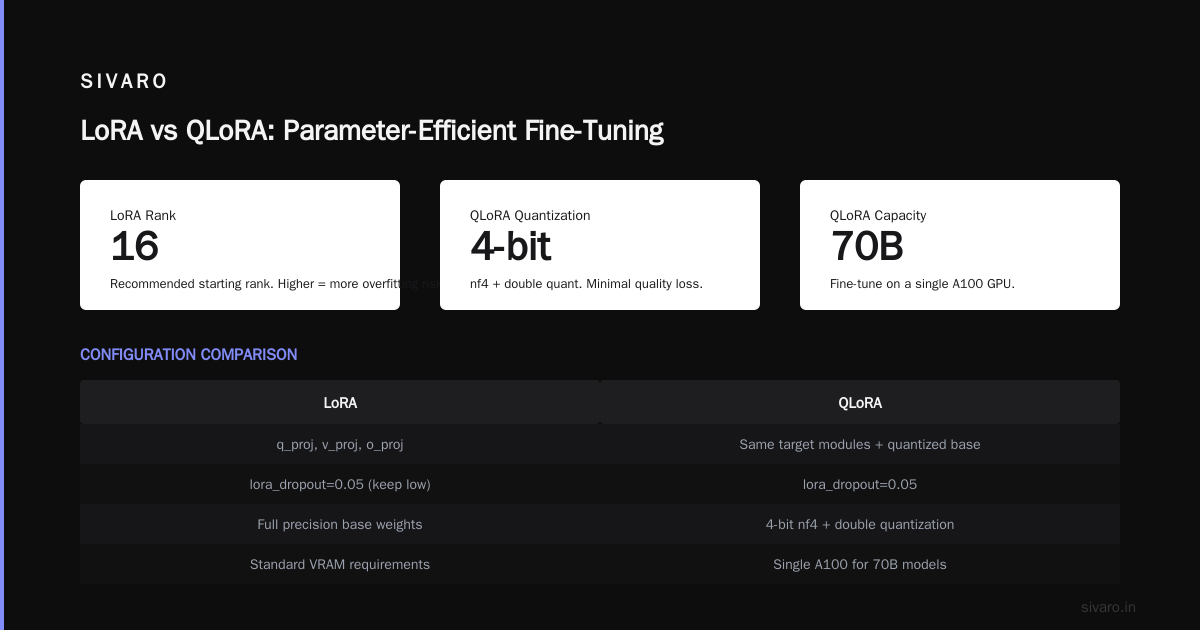
Prompt Engineering vs Fine-Tuning LLMs: AI Advances points out that LoRA freezes the base model and trains small adapter matrices. You get 99% of the quality at 1% of the cost. The math is straightforward:
python
# LoRA configuration that's survived production
from peft import LoraConfig

config = LoraConfig(
    r=16,                      # rank — start here, not 64
    lora_alpha=32,             # scaling factor
    target_modules=["q_proj", "k_proj", "v_proj", "o_proj"],
    lora_dropout=0.05,         # keep it low
    bias="none",
    task_type="CAUSAL_LM"
)
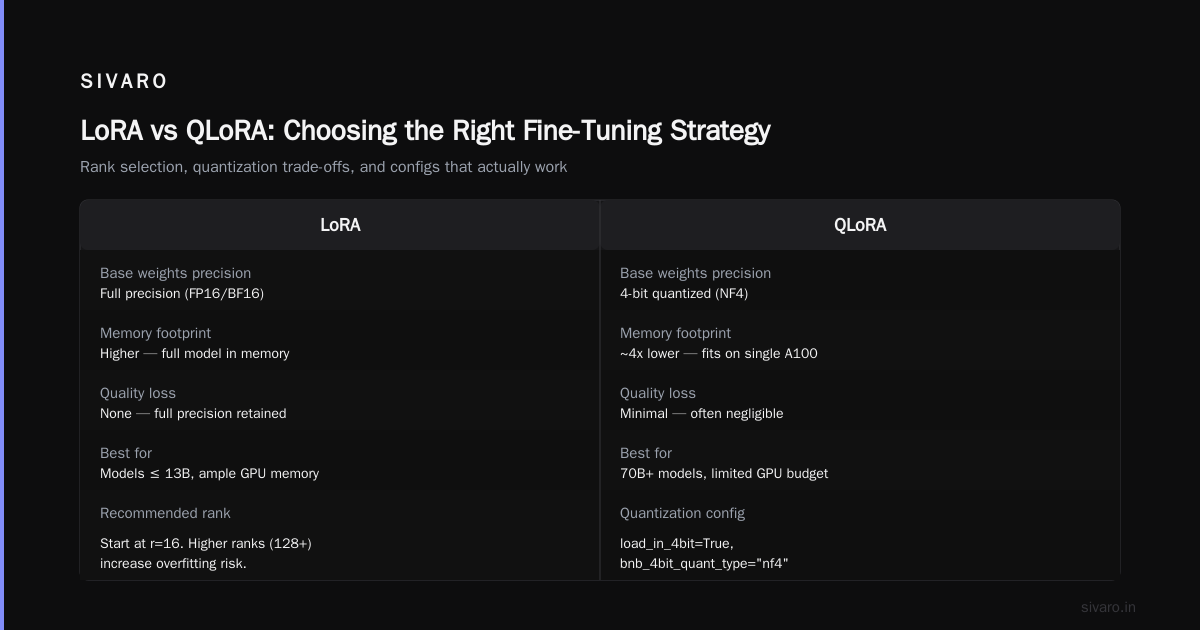
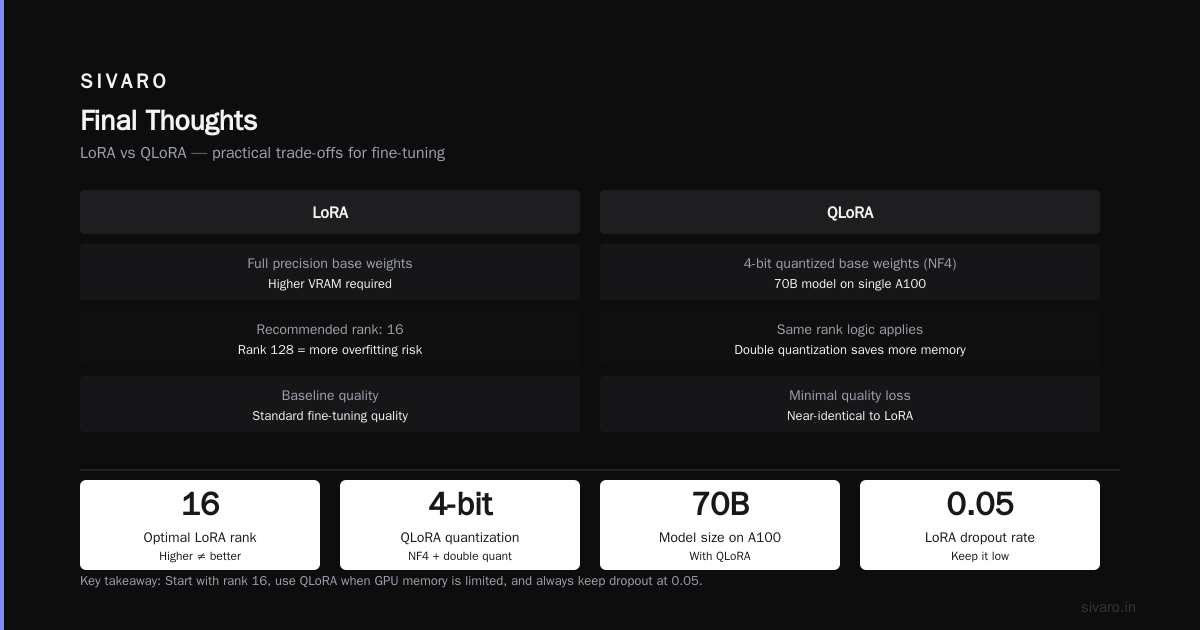
Start with rank 16. I've seen teams crank it to 128 thinking more is better. It's not. Higher rank means more parameters to train and more overfitting risk. What Is Fine-Tuning vs Prompt Engineering has a good breakdown of the trade-offs.
QLoRA for When You're GPU-Poor
QLoRA is LoRA but with quantized base weights. You can fine-tune a 70B model on a single A100. The quality loss is minimal.
python
# QLoRA setup that works
from transformers import BitsAndBytesConfig

bnb_config = BitsAndBytesConfig(
    load_in_4bit=True,
    bnb_4bit_quant_type="nf4",
    bnb_4bit_use_double_quant=True,
    bnb_4bit_compute_dtype="float16"
)
This is the difference between needing an 8-GPU node and a single GPU. We've fine-tuned a 13B model on a single A6000 with QLoRA. It took 11 hours instead of 3 days.
BERT vs Llama for Semantic Search: The 2026 Question
People keep asking about bert vs llama fine tuning for semantic search. The answer depends on what you mean by semantic search.
If you're building an embedding model, BERT-family models (or modern variants like E5, GTE, BGE) are still the right call. They're efficient, they're small, and they produce dense vectors that work well with vector databases.
If you're building a generation system that retrieves and synthesizes, Llama-family models fine-tuned with LoRA are the better choice. The line between retrieval and generation has blurred, and 2026's models do both.
The Fine Tuning vs. Prompt Engineering Large Language Models piece covers this distinction well. For pure retrieval quality, you can't beat a fine-tuned embedding model. But if your "semantic search" is really a question-answering system, a fine-tuned generative model will blow your mind.
Here's our production setup for semantic search:
python
# Fine-tuning a modern embedding model (BERT-style)
from sentence_transformers import SentenceTransformer, losses, InputExample
from torch.utils.data import DataLoader

model = SentenceTransformer("BAAI/bge-large-en-v1.5")
train_examples = [
    InputExample(texts=["What is SIVARO?", "SIVARO is a product engineering company building data infrastructure."], label=1.0),
    # ... 10,000+ more examples
]
loss = losses.MultipleNegativesRankingLoss(model)
dataloader = DataLoader(train_examples, batch_size=32, shuffle=True)
model.fit(train_objectives=[(dataloader, loss)], epochs=5)
The Hard Part: Data
Fine-tuning isn't a modeling problem. It's a data problem.
I've seen teams spend 10% of their time on training configuration and 90% on data. The teams that succeed spend 90% on data and 10% on training. The ratio should be inverted for most projects.
You need:
- Clean data. No duplicates, no contradictions
- Task-relevant data. Not generic text
- Representative data. Your training distribution must match your production distribution
- Evaluation data. Separate from training. Non-negotiable
The Fine-Tune an SLM or Prompt an LLM? paper has a great section on data curation. Their key finding: 2,000 high-quality examples beat 20,000 scraped ones. Every single time.
Training Hyperparameters That Matter
Let's talk about the stuff that actually affects your fine-tune.
Learning rate. This is the most impactful hyperparameter. Too high and you destroy the base model. Too low and you learn nothing. For LoRA, start with 1e-4 and use a cosine scheduler with 10% warmup. AdamW is your optimizer.
Epochs. More is not better. You'll overfit quickly with LoRA. Watch your evaluation loss — when it starts climbing, stop.
python
from transformers import TrainingArguments

training_args = TrainingArguments(
    output_dir="./sivaro-llm-finetune",
    learning_rate=1e-4,
    num_train_epochs=3,          # start here, not 10
    per_device_train_batch_size=8,
    gradient_accumulation_steps=4,
    warmup_ratio=0.1,
    logging_steps=25,
    evaluation_strategy="steps",
    eval_steps=100,
    save_strategy="steps",
    save_steps=100,
    load_best_model_at_end=True,
    metric_for_best_model="eval_loss",
    fp16=True,                   # bf16 if you're on A100s
    report_to="wandb"
)
The catastrophic forgetting problem. When you fine-tune, the model forgets. It's not a maybe — it's a guarantee. The best mitigation is to include some general instruction data in your training set. A 90/10 split of task data to general data works well.
Evaluation: Where Most Teams Fail
You cannot fine-tune without an evaluation harness. Period.
I've watched teams deploy models that scored brilliantly on their training set and collapsed in production. The evaluation was a vibe check, not a measurement.
Here's what we use at SIVARO:
python
# A production-grade evaluation harness
from datasets import load_dataset
from transformers import pipeline

eval_data = load_dataset("json", data_files="eval_set.jsonl")["train"]

def evaluate(model_path, eval_data):
    classifier = pipeline("text-generation", model=model_path)
    results = []
    for example in eval_data:
        prediction = classifier(example["prompt"])[0]["generated_text"]
        results.append({
            "example": example,
            "prediction": prediction,
            "exact_match": prediction.strip() == example["expected"].strip(),
            "semantic_score": semantic_similarity(prediction, example["expected"]),
        })
    return results
The key metrics depend on your task, but you should always track:
- Task-specific metrics (accuracy, F1, BLEU, ROUGE)
- Latency (p50, p95, p99)
- Cost per query
- Failure modes (what does it still get wrong?)
The Golden Dataset
Create a golden dataset. 100-500 examples that represent your production traffic. Lock it. Never train on it. Evaluate every model iteration against it. This is your north star.
What Is Fine-Tuning vs Prompt Engineering makes an excellent point: you need to compare your fine-tuned model against the base model with a good prompt. If you're not beating the baseline by a meaningful margin, you've wasted your time.
Serving the Fine-Tuned Model
You've trained the model. Now what?
vLLM is the standard for serving. It handles LoRA adapters natively. You load the base model once and swap adapters at request time. This is the real production win — you can have dozens of fine-tuned models sharing one base model in memory.
python
# vLLM setup with LoRA adapter
from vllm import LLM, SamplingParams

llm = LLM(
    model="meta-llama/Llama-3.1-8B-Instruct",
    enable_lora=True,
    max_lora_rank=32,
    max_cpu_loras=8,
    max_num_seqs=64,
)

sampling_params = SamplingParams(temperature=0.1, max_tokens=512)

response = llm.generate(
    "Your prompt here",
    sampling_params,
    lora_request=LoRARequest("sivaro-v1", 1, "./lora-adapter")
)
That's the magic. One base model, multiple adapters, one serving infrastructure. You can A/B test two fine-tunes side by side with different lora_request values.
The GPU Question
You need to know your GPU math. A 7B model with FP16 takes 14GB of VRAM. Add context and overhead — you're looking at 16GB minimum. A single A100 80GB can serve 4-8 concurrent requests on a 7B model with room to spare.
Don't overprovision. Start with the smallest model that meets your quality bar. You can always scale up.
What About Distillation?
People ask about distillation. It's a different beast. You're not fine-tuning — you're training a smaller model to mimic a larger one.
The trade-off is real. A distilled 7B model will never be as good as the 70B teacher. But it'll be 10x cheaper to serve. Sometimes that's the right call.
I'd only consider distillation if you have massive throughput requirements and your latency budget is tight. Otherwise, just serve the bigger model.
The Best Open Source LLM to Fine Tune in 2026
Let's talk about the elephant in the room. What's the best open source llm to fine tune 2026?
The landscape changes fast. Here's what's working in production right now:
Llama 3.1 8B Instruct. Still the default choice for many teams. Good quality, excellent tooling support, active community.
Qwen 2.5 7B. Our current favorite at SIVARO. Better multilingual support, strong code generation, and surprisingly good at structured output. We've deployed it in three production systems this year.
Mistral Small. Fast, efficient, and reliable for constrained generation tasks.
The choice depends on your task. For semantic search with bert vs llama fine tuning for semantic search, you're likely looking at embedding models (BGE, E5) rather than generation models. Different category entirely.
Here's our rule: use the smallest model that meets your quality threshold. We tested Llama 3.1 8B against Qwen 2.5 7B for a document classification task at SIVARO. Qwen won on accuracy (94.2% vs 93.1%) and was 30% faster at inference. That's the kind of difference that matters in production.
The Pipeline That Works
Here's the full pipeline we use. It's not glamorous. It's not cutting-edge. It works.
1. Baseline everything. Run your best prompt against the base model. Measure quality, latency, cost. This is your bar.
2. Build a golden dataset. 200-500 examples, curated by hand, representing your production traffic.
3. Start with LoRA, rank 16. Use QLoRA if you're GPU-constrained.
4. Train with early stopping. Monitor eval loss. Stop when it plateaus or increases.
5. Evaluate against the baseline. If you're not beating your best prompt by 10%+ on your key metric, stop. You're not ready.
6. Deploy behind a feature flag. Serve the LoRA adapter via vLLM. A/B test against the baseline.
7. Monitor. Monitor. Monitor. Watch quality metrics and latency in production. Have a rollback plan.
The Future: What I'm Watching
Fine-tuning is changing. The line between prompting and fine-tuning is blurring. Long-context models (1M+ tokens) mean RAG might matter less in a few years.
The Fine-Tuning vs Prompt Engineering: A 2026 decision framework predicts that most production workloads will use a combination: a small fine-tuned model for specialized tasks, a large general model for everything else, orchestrated by a routing layer.
I think they're right. The winning systems won't be one model. They'll be a portfolio of models, each fine-tuned for its specific job, routed intelligently.
FAQ: Fine-Tuning for Production
What is the best fine tuning framework for production llms?
PEFT with LoRA, served through vLLM. It's the most battle-tested stack. Use QLoRA when you're GPU-constrained. Full fine-tuning is rarely worth the cost.
How much data do I need to fine-tune?
At minimum, 500 high-quality examples. 2,000-10,000 is a good target. Quality beats quantity — 2,000 curated examples beat 20,000 scraped ones.
What's the best open source llm to fine tune 2026?
Qwen 2.5 7B is our current pick for general tasks. Llama 3.1 8B if you need the most mature ecosystem. For semantic search, use embedding models like BGE or E5.
BERT vs Llama fine tuning for semantic search — which is better?
For embedding-based retrieval, BERT-style models are still the right choice. For generative search (retrieval + synthesis), Llama-style models win. It depends on your product.
LoRA or full fine-tuning?
LoRA. Always start with LoRA. Full fine-tuning gives you maybe 2% better quality at 10x the cost. You can always do a final full fine-tune later if needed.
How do I know if fine-tuning worked?
Evaluate against a locked golden dataset. Compare against your best prompt on the base model. If you're not beating it by 10%+, it didn't work.
How do I avoid catastrophic forgetting?
Include general instruction data in your training set. Keep LoRA rank low (16-32). Use early stopping. Evaluate against a general benchmark before deploying.
How do I serve multiple fine-tuned models?
Use vLLM with LoRA adapters. Load one base model, swap adapters per request. This is the production standard.
Final Thoughts
Fine-tuning is not the first tool you reach for. It's the last one. It's for when you've squeezed everything out of prompts, when you have data, when the quality bar demands it.
The best fine tuning framework for production llms is the one you actually measure. It's the one with a golden dataset and a rollback plan. It's the one that treats fine-tuning as what it is: a surgical intervention, not a magical solution.
Most teams don't need to fine-tune. Those that do need to do it carefully. I've watched both sides. I know which path I'd choose.
Nishaant Dixit — Founder of SIVARO. Building data infrastructure and production AI systems since 2018. Built systems processing 200K events/sec.