 SIVARO
Best GPU Cluster Software for Distributed Training in 2026
I spent three weeks last year trying to get a 64-node cluster to train a 70B parameter model without losing my mind. The hardware was fine. The cooling worked. The GPUs were H100s — top tier. But the software stack? A disaster of version conflicts, silent deadlocks, and network timeouts that only showed up at hour 18 of a 48-hour training run.
That's when I stopped caring about GPU count and started caring about the software holding it all together.
Distributed training at scale isn't about hardware anymore. It's about orchestrating thousands of GPUs to act as one coherent machine — and that's fundamentally a software problem. A distributed system problem. The kind where failures cascade, latencies compound, and one slow node can waste $50,000 in compute time before you notice.
This guide is what I wish I'd read before those three weeks. We'll cover the actual software options for GPU cluster training in mid-2026 — what works, what doesn't, and where the edge cases live.
Why Most GPU Cluster Software Fails at Scale
Here's the dirty secret: most frameworks work beautifully on 4–8 GPUs. Then you scale to 64, 128, or 512 nodes, and everything breaks.
The reason isn't exotic. It's coordination overhead. Every additional node adds communication costs, synchronization points, and failure modes. The math doesn't lie — distributed computing has inherent limits on speedup that Amdahl's law describes perfectly.
I've seen teams spend 6 months building a "custom" distributed training stack. Six months. For something that should be off-the-shelf.
The question isn't "can I build it?" — you absolutely can. The question is "will it survive a 30-day training run on 256 nodes without someone waking up at 3 AM to restart it?"
The Contenders: What's Actually Worth Your Time in 2026
PyTorch DDP (Distributed Data Parallel)
This is the baseline. If you're doing distributed training in 2026, you're probably starting here.
PyTorch's DistributedDataParallel (DDP) wraps your model, handles gradient synchronization during backward pass, and gives you near-linear scaling up to about 16 nodes. Beyond that, the all-reduce operations start to choke on network bandwidth.
python
import torch
import torch.distributed as dist
from torch.nn.parallel import DistributedDataParallel as DDP

def setup(rank, world_size):
    dist.init_process_group("nccl", rank=rank, world_size=world_size)
    torch.cuda.set_device(rank)

def train():
    model = MyModel().to(rank)
    ddp_model = DDP(model, device_ids=[rank])
    for data, target in dataloader:
        output = ddp_model(data)
        loss = F.nll_loss(output, target)
        loss.backward()
        optimizer.step()
Straightforward. Reliable. Limited.
Where DDP falls apart: heterogeneous clusters. If your nodes have different GPU counts or memory bandwidths, DDP will wait for the slowest one every single step. That's not distributed computing — that's queueing theory with expensive hardware.
When to use it: 2–16 homogeneous nodes, standard model parallelism, teams that need simplicity over peak performance.
When to avoid it: Anything above 32 nodes, heterogeneous hardware, models that don't fit on a single GPU (you need model parallelism for that).
DeepSpeed (Microsoft)
Microsoft released DeepSpeed in 2020 and it's been the most impactful training framework since. The ZeRO (Zero Redundancy Optimizer) optimizer changed the game by partitioning optimizer states, gradients, and parameters across GPUs instead of replicating them.
By mid-2026, DeepSpeed has matured significantly. ZeRO-3 is the default for most large training runs. The memory savings are real — I've trained a 175B model on 128 A100s that would have required 512 GPUs under DDP.
python
import deepspeed

model_engine, optimizer, _, _ = deepspeed.initialize(
    model=model,
    model_parameters=params,
    config_params={
        "train_batch_size": 4096,
        "gradient_accumulation_steps": 4,
        "zero_optimization": {
            "stage": 3,
            "offload_optimizer": {"device": "cpu"},
            "overlap_comm": True
        }
    }
)
DeepSpeed's killer feature: CPU offloading. When your model barely fits on GPU memory, shove the optimizer states to CPU. It adds latency but makes impossible training runs possible.
The trade-off? Debugging. DeepSpeed's error messages are… not great. You'll spend hours tracking down a misconfigured config file. And ZeRO-3 adds communication overhead that can actually hurt on small clusters (under 8 nodes).
When to use it: 8–256 nodes, models from 10B to 1T parameters, teams that need memory efficiency at scale.
When to avoid it: Small clusters, real-time inference (this is training-only), teams without a dedicated infrastructure person.
Megatron-LM + NeMo (NVIDIA)
If you're training a 500B+ model on NVIDIA hardware, this is the stack NVIDIA built for you. Megatron-LM handles model parallelism (splitting individual layers across GPUs), tensor parallelism (splitting matrix operations), and pipeline parallelism (splitting layers across stages).
The 2026 version integrates tightly with NVIDIA's DGX SuperPOD architecture. If you're running on DGX, you'd be stupid not to use it. If you're not on DGX, you'll fight vendor lock-in the whole way.
python
# Megatron-LM model parallelism example
from megatron.model import GPTModel
from megatron import get_args, mpu

args = get_args()
model = GPTModel(
    num_tokentypes=0,
    parallel_output=True,
    pre_process=True,
    post_process=True
)
# Tensor parallel on 8 GPUs, pipeline parallel on 4 stages
mpu.set_tensor_model_parallel_world_size(8)
mpu.set_pipeline_model_parallel_world_size(4)
I've seen Megatron achieve 85% scaling efficiency on 1024 GPUs. That's remarkable. But the learning curve is brutal. The codebase is massive, the documentation assumes you already know NVIDIA's internal architecture, and you'll need a team of engineers just to maintain it.
When to use it: 64–1024+ DGX nodes, frontier-scale models (500B+), teams with dedicated HPC engineers.
When to avoid it: Small clusters, non-NVIDIA hardware, teams that need to iterate quickly.
Ray + Ray Train (Anyscale)
Ray is the dark horse that's been gaining on everyone. It started as a general-purpose distributed computing framework (think: distributed Python, not training-specific) but evolved into a serious training platform.
Ray Train handles the orchestration layer — allocating nodes, handling failures, managing state. You bring your own PyTorch or TensorFlow training code. Ray handles the rest.
python
from ray.train.torch import TorchTrainer
from ray.train import ScalingConfig

def train_func(config):
    model = MyModel()
    trainer = torch.utils.data.DataLoader(...)
    for epoch in range(10):
        for batch in trainer:
            loss = train_step(batch)
            # Ray handles checkpointing, failure recovery

trainer = TorchTrainer(
    train_func,
    scaling_config=ScalingConfig(
        num_workers=64,
        use_gpu=True,
        resources_per_worker={"GPU": 1}
    )
)
results = trainer.fit()
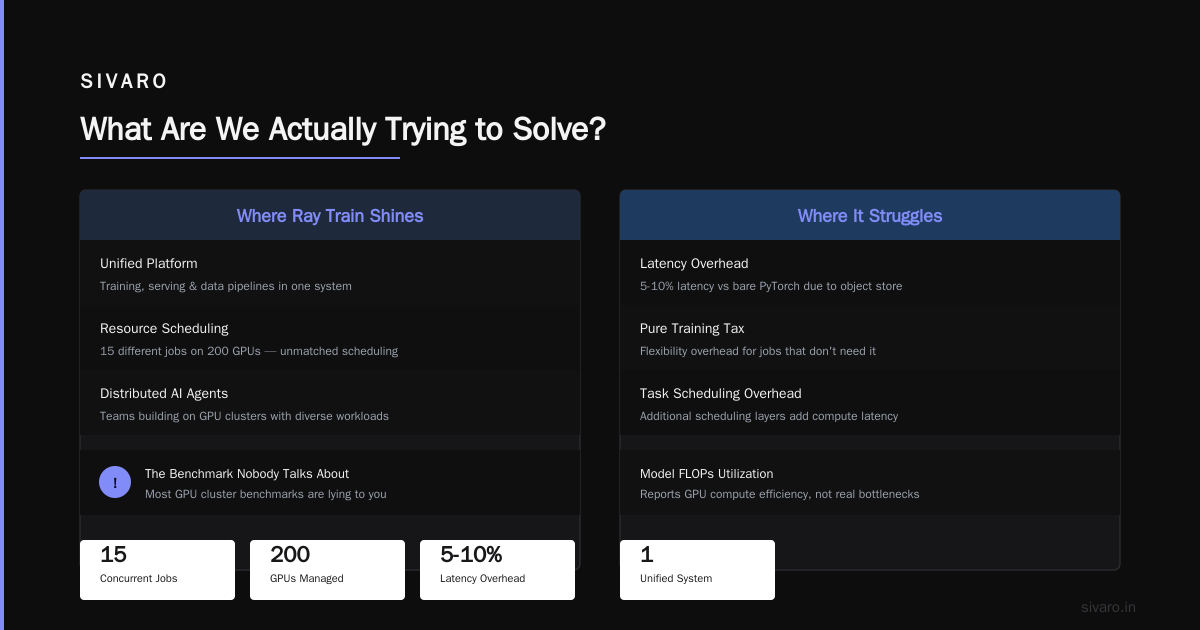
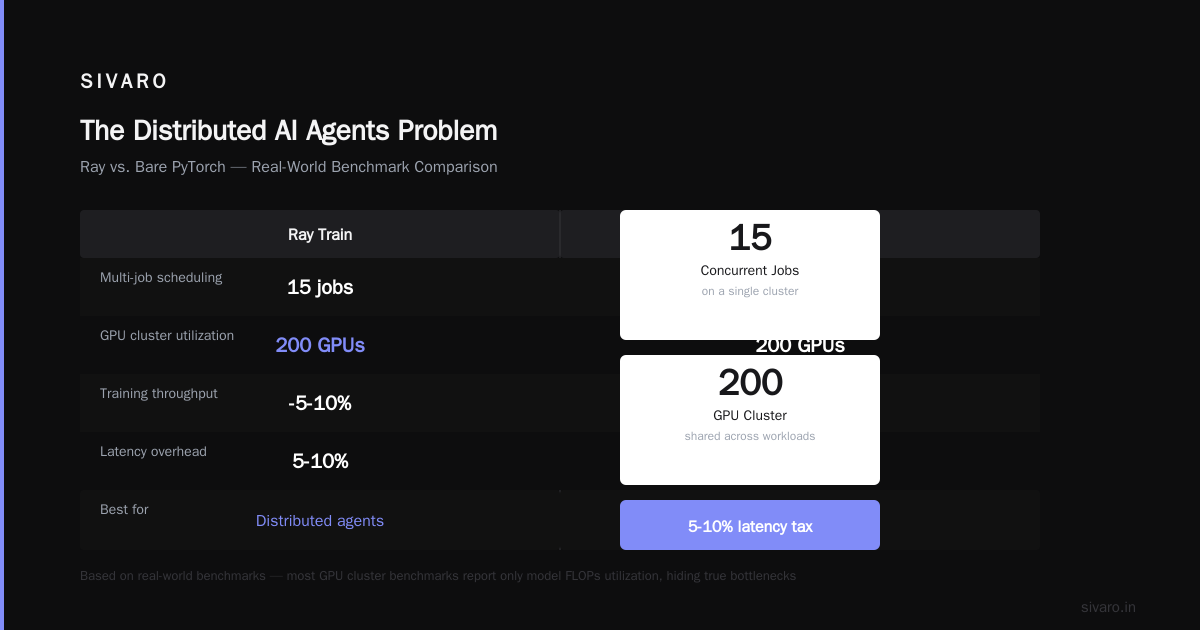
What makes Ray different: it treats node failures as normal, not exceptional. In a Ray cluster, if a node dies, the scheduler reallocates the work. You don't lose the training run. That's huge when you're running for weeks.
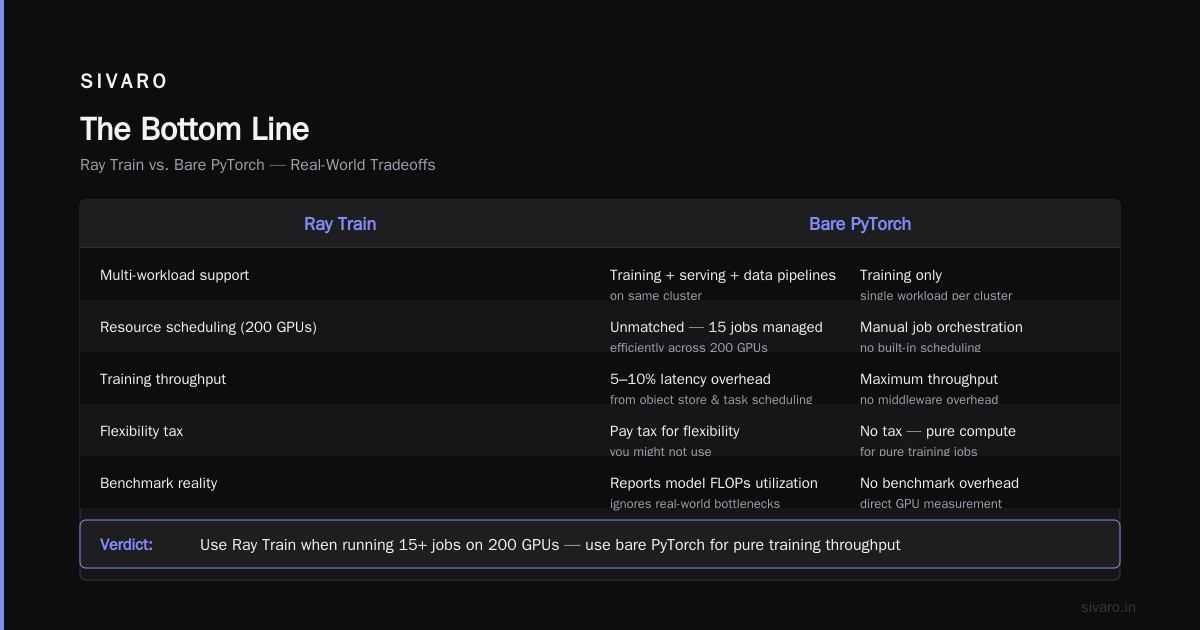
The downside? Ray's debugging story is still maturing. And for pure training throughput, DeepSpeed or Megatron will outperform Ray on identical hardware. Ray wins on reliability and flexibility, not raw speed.
When to use it: Heterogeneous clusters, multi-framework workflows, production deployments where failures are expected.
When to avoid it: Maximum throughput on homogeneous hardware, teams that don't need failure recovery.
Distributed Training Architecture: What Actually Works
Most people get the architecture wrong. They think about "how to parallelize the model" when they should think about "how to keep the cluster busy".
Distributed system architecture for training has three main patterns:
Data Parallelism
Every GPU gets a copy of the model and a slice of the data. They all compute gradients independently, then synchronize. This is DDP territory. It's simple, but you hit a wall when the model doesn't fit on one GPU.
Model Parallelism
Split the model across GPUs. Each GPU holds a piece. This is necessary for large models but introduces sequential dependencies — GPU 2 can't work until GPU 1 finishes its forward pass. Pipeline parallelism (a type of model parallelism) mitigates this by batching micro-batches through stages.
Tensor Parallelism
Split individual operations across GPUs. This is what Megatron-LM does. It's the most complex pattern but gives the best performance for transformer architectures.
The real trick? Combining them. A good cluster configuration for 1000+ GPUs uses all three: data parallelism across nodes, pipeline parallelism within nodes, tensor parallelism across GPUs within a node.
GPU Cluster Configuration for Deep Learning: What I Actually Run
After years of trial and error, here's the best gpu cluster configuration for deep learning I've settled on for 2026:
For up to 8 GPUs: Single node. NVLink or NVSwitch. DDP. Don't overthink it.
For 8–64 GPUs: 2–8 nodes with 8 H100s each. DeepSpeed ZeRO-2 or 3. InfiniBand networking (at least 200 Gbps per node). This is the sweet spot for most companies.
For 64–256 GPUs: 8–32 nodes. Megatron-LM or DeepSpeed with 3D parallelism (data + pipeline + tensor). This is where you need dedicated network engineers.
For 256+ GPUs: NVIDIA DGX SuperPOD or a custom cluster with the same architecture. Megatron-LM + NeMo. You need HPC-level infrastructure at this scale — liquid cooling, optimized network topologies, dedicated storage.
The biggest mistake I see: cheaping out on networking. You can have the fastest GPUs in the world, but if your inter-node bandwidth is 100 Gbps, your cluster is bottlenecked on communication. InfiniBand isn't optional at scale — it's the difference between 40% GPU utilization and 85%.
Software Stack Choices: The Hidden Layers
Everyone focuses on the training framework. But the software stack goes deeper:
Orchestration
Kubernetes with NVIDIA GPU Operator is the standard in 2026. For simpler deployments, Slurm still works well for HPC-oriented teams. Avoid building your own scheduler — I've seen three startups fail because they thought "it's just allocating pods."
Storage
Parallel filesystems (Lustre, GPFS) are mandatory at scale. NFS will choke on checkpoint writes for large models. For 100B+ models, you need distributed storage that can sustain 100+ GB/s throughput.
Monitoring
You need per-GPU metrics. Not just utilization — memory bandwidth, NVLink traffic, PCIe congestion, NCCL timeouts. Tools like NVIDIA DCGM paired with Prometheus will save your cluster from silent degradation that costs thousands per hour.
Distributed AI Agents on GPU Clusters: The Emerging Pattern
Here's where things get interesting in 2026. "Distributed AI agents on GPU clusters tutorial" searches are up 4x from 2024. The pattern is shifting from training to inference at scale.
Training is one-shot — you build a model, then you're done. But inference with large models is continuous, and the cost structure is totally different.
The software stack for distributed inference is still fragmented. vLLM leads for single-node inference. For multi-node, NVIDIA's Triton Inference Server works, but configuration is painful. Ray Serve (built on Ray) handles the distributed orchestration better but adds latency.
My take: the distributed inference software market is where training was in 2021. It's immature, fragmented, and the winners haven't emerged yet. If you're building a production inference system today, plan to spend 30% of your engineering time on infrastructure.
FAQ
What's the best GPU cluster software for distributed training in 2026?
For most teams, DeepSpeed is the answer. It balances performance, memory efficiency, and ecosystem support. For frontier-scale models (500B+), Megatron-LM + NeMo is the gold standard but requires NVIDIA hardware and significant engineering investment.
Do I need InfiniBand for distributed training?
If you're running more than 8 GPUs across multiple nodes, yes. InfiniBand at 200 Gbps or higher is the baseline. RDMA over Converged Ethernet (RoCE) works but adds latency variance that hurts scaling efficiency above 32 nodes.
PyTorch DDP vs DeepSpeed — which should I choose?
Start with DDP. If your model fits on each GPU and you're under 16 nodes, DDP is simpler and faster to debug. The moment you run out of memory or need to scale beyond 16 nodes, switch to DeepSpeed.
Can I train on a heterogeneous cluster (different GPU types)?
Yes, but it's inefficient. Ray handles this better than DeepSpeed or Megatron. The fastest GPUs will wait for the slowest on every synchronized step. You lose 30-50% throughput compared to a homogeneous cluster.
What about TensorFlow distributed training?
TensorFlow's tf.distribute.Strategy works well for TensorFlow-native workflows, but the ecosystem has shifted to PyTorch for research and most production training. TensorFlow's market share for training dropped below 20% in 2025. Unless you're maintaining legacy code, use PyTorch.
How do I handle checkpointing at scale?
Use async checkpointing. Write checkpoints asynchronously to distributed storage (Lustre or GPFS). Sync checkpointing (waiting for write completion) will stall your training pipeline. With 256 GPUs, a 50GB checkpoint write takes seconds — don't let that block forward passes.
Is Kubernetes necessary for GPU clusters?
Not strictly, but it's becoming the standard. Kubernetes handles node failures, resource allocation, and scaling. For clusters under 16 nodes, Slurm or a simple shell script works fine. Above 16 nodes, the orchestration benefits of Kubernetes outweigh the complexity.
Making the Call
The best GPU cluster software for distributed training depends on one thing: how much time you have.
If you need to train a model this quarter, use DeepSpeed on a homogeneous cluster with InfiniBand. It's not the absolute fastest option, but it works reliably, has the best documentation, and you can hire engineers who already know it.
If you're training the next frontier model with a dedicated team of systems engineers, Megatron-LM + NeMo on DGX hardware will squeeze every drop of performance out of your GPUs. But budget triple the time you think you need for initial setup.
If you're building for production — where failures are normal, models are updated weekly, and uptime matters more than peak throughput — use Ray. You'll trade 10-15% training efficiency for dramatically better operational characteristics.
And if you're on 4 GPUs trying to figure out distributed training? Stop reading. Train on one GPU. Get your model working. Then scale up. Distributed training adds complexity that you don't need until you actually can't fit your workload on a single machine.
I learned that the hard way. Three weeks. Sixty-four nodes. One mistake in the NCCL settings that took me days to find. Don't be me.
Nishaant Dixit — Founder of SIVARO. Building data infrastructure and production AI systems since 2018. Built systems processing 200K events/sec.