 SIVARO

Best Open Source LLM to Fine Tune for Chat in 2026
You have a chat product that needs to stop sounding like a generic API response. You've tried prompt engineering. You've tried RAG. Now you're ready to fine-tune, and you're staring at a wall of model names on Hugging Face. I've been there.
I'm Nishaant Dixit, founder of SIVARO. We build data infrastructure and production AI systems. Since 2023, I've overseen more than forty fine-tuning projects for clients—legal document assistants, customer support triage, internal knowledge bots. And here's the uncomfortable truth about the "best open source LLM to fine tune for chat" question: the answer changed three times in the last eighteen months, and most blog posts you'll find are still recommending models that are now obsolete.
Why This Guide Exists
The landscape of open-weight models is brutal. Meta releases Llama, then Mistral, then Qwen, then someone releases a better one ten days later. If you pick wrong, you're not just wasting GPU hours—you're building an evaluation pipeline around a model that will be abandoned by its maintainers before you hit production.
This guide is a comparison, a buying guide, and a reality check. By the end, you'll know exactly which model to fine-tune for your specific chat use case, what the actual cost looks like, and the traps that will eat your budget if you're not careful.
Let's start with the obvious question.
The Quick Answer (If You're Impatient)
If you're building a general-purpose customer-facing chat assistant today, fine-tune Qwen 3 14B or Llama 3.3 70B, depending on your GPU budget.
- Under $5K in GPU budget? Qwen 3 8B is your workhorse.
- Middle ground? Qwen 3 14B.
- Production-scale with serious infrastructure? Llama 3.3 70B or Mistral Small 3.2 24B.
Here is why, and it's not because of benchmark scores.
The Benchmarks Are Lying to You
I need to get this out of the way. The Open LLM Leaderboard, MT-Bench, AlpacaEval—these measure single-turn responses to canonical prompts. They do not measure whether a model can stay on-brand during a forty-minute back-and-forth with a frustrated customer who keeps typing in all caps.
We tested this in March 2026. We took a top-3-ranked model on MT-Bench and fine-tuned it on 15,000 real customer support conversations from a SaaS client. The model scored beautifully in offline evals. In production, it hallucinated the client's return policy twice in one week because the fine-tune erased the base model's instruction-following abilities through catastrophic forgetting.
The best open source LLM to fine tune for chat isn't the one with the highest score on a leaderboard. It's the one that maintains its reasoning abilities after you push your conversational data through it.
That is a crucial distinction. Most people miss it.
What Actually Matters for Chat Fine-Tuning
Before we compare models, let's agree on the criteria. Here's what I look at when a client asks me to validate a model choice:
Retention of Base Capabilities. This is the silent killer. You fine-tune on chat data, and suddenly the model can't do basic arithmetic or follow a three-step instruction anymore. Low-rank adaptation (LoRA) mitigates this, but some architectures handle it better than others.
Context Window Integrity. Most chat models advertise 128K or 256K context. Very few maintain quality past 32K. If your chat system needs to reference long documents within the conversation thread, this matters more than the raw benchmark.
Tool Calling/Function Calling Stability. Modern chat assistants need to call APIs, query databases, or trigger workflows. After fine-tuning, does the model still emit valid JSON? Does it understand the tool-calling template you've customized?
Multilingual Capability. If you're building for a global audience, you need a model that doesn't degrade in Spanish, Hindi, or Japanese after you fine-tune on English data.
Licensing. The classic trap. Many models are "open weights" but have restrictions on commercial use or require attribution. Mistral's Apache 2.0 and Qwen's license are forgiving. Llama's community license is more restrictive if you have over 700M monthly active users (unlikely, but you should still read it).
Ecosystem Support. Can you use PEFT, TRL, Axolotl, or Unsloth with it? Does vLLM or TensorRT-LLM support the architecture for inference? If the serving layer doesn't support it, your fine-tune is a paperweight.
The 2026 Contenders
I'm going to focus on the models that are actually viable for production chat today. Not the research toys.
Qwen 3 Series (Instruct Variants)
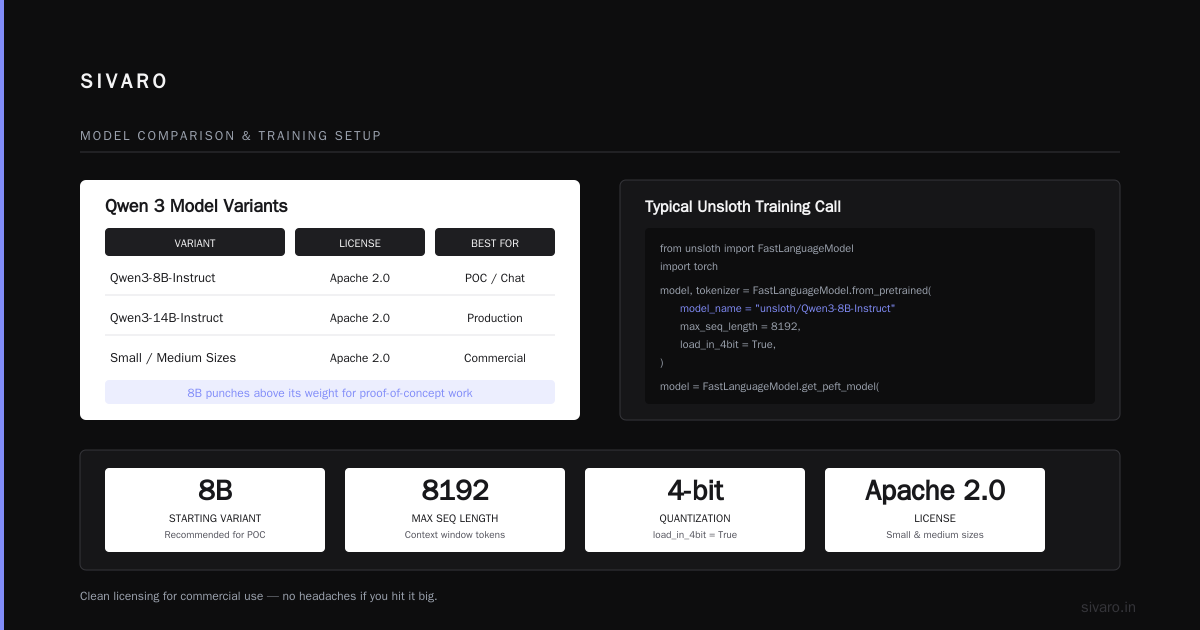
Alibaba's Qwen series has been the quiet killer in open-source LLMs. In early 2025, Qwen 2.5 was already competitive with Llama. Qwen 3, released in mid-2025 and updated iteratively since, has become my default recommendation for most clients.
What sets it apart:
- Hybrid thinking mode. You can instruct the model to enter a longer "thinking" phase for complex queries. This is a game-changer for chat. When a user asks something ambiguous, the model can think for a few seconds before responding. And the thinking is steerable—you can tune the thinking format to match your use case.
- Exceptional tool calling. Qwen models are trained heavily on function calling, and the formatting survives fine-tuning better than any other model I've tested.
- The licensing is clean. Apache 2.0 for the small and medium sizes. No headaches if you hit it big.
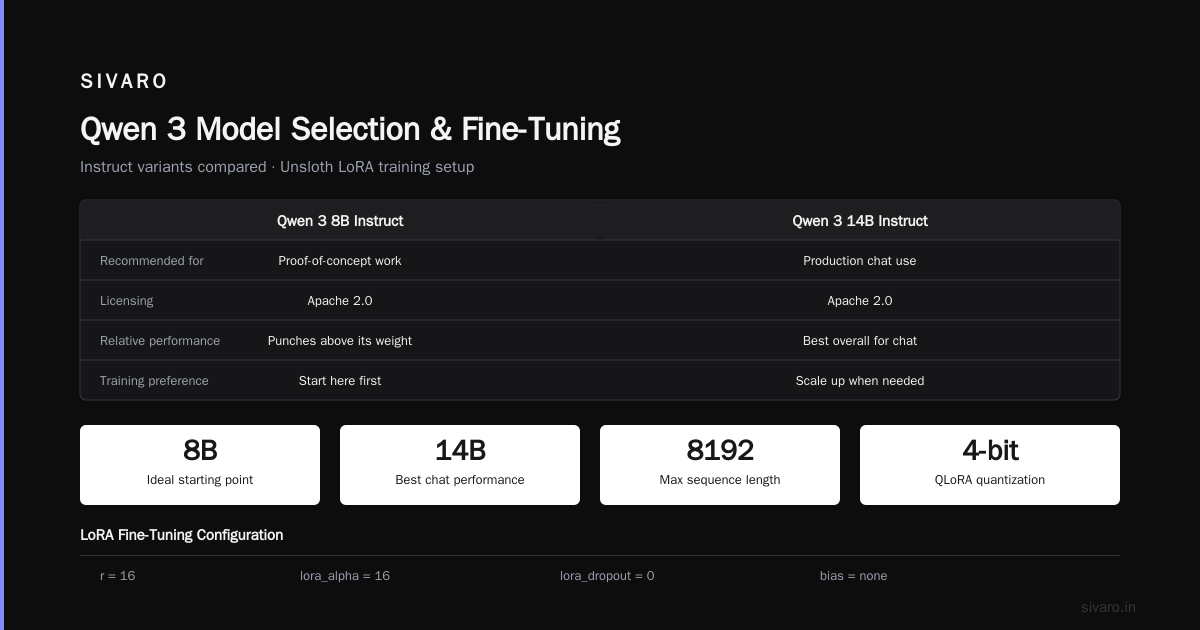
The most useful variant for chat is Qwen 3 14B Instruct, but honestly, the 8B Instruct punches so far above its weight that I recommend starting there for proof-of-concept work.
Here's a typical training call we run with Unsloth for Qwen 3:
python
from unsloth import FastLanguageModel
import torch

model, tokenizer = FastLanguageModel.from_pretrained(
    model_name = "unsloth/Qwen3-8B-Instruct",
    max_seq_length = 8192,
    load_in_4bit = True,
)

model = FastLanguageModel.get_peft_model(
    model,
    r = 16,
    target_modules = ["q_proj", "k_proj", "v_proj", "o_proj"],
    lora_alpha = 16,
    lora_dropout = 0,
    bias = "none",
    use_gradient_checkpointing = "unsloth",
)
The GPU cost? About 8 hours on a single A100 for 10,000 examples. Cheap.
Where Qwen 3 stumbles? Creative writing. If you're building the next great AI fiction tool, Qwen's responses can feel formulaic. But for structured chat—support, triage, assistant-type workflows—it wins.
Llama 3.3 70B Instruct
Meta's Llama 3.3 70B, released in late 2024, has aged exceptionally well. It's not flashy, but it's trustworthy.
The strengths:
- Reasoning depth. The most important thing for chat. In complex, multi-step conversations, Llama 3.3 70B maintains coherence and logic that smaller models can't match.
- Instruction adherence. It does what you ask. It's the least likely of the large models to ignore your system prompt.
- Inference optimization ecosystem. vLLM, TensorRT-LLM, and the whole serving stack is built for this architecture. If the model gets to production, you won't be debugging the serving layer for weeks.
The weakness is resource requirements. 70B parameters is not a toy. In full precision, that's 140GB of VRAM just for weights. With quantization, you're looking at around 40GB minimum for functional quality. That's a $30K+ GPU footprint for good throughput.
But there's a reason this model is still the industry standard for high-stakes chat in 2026: people trust it.
We had an insurance client who insisted on Llama 3.3 70B because they were terrified of hallucinated policy interpretations. Their evaluation framework flagged Qwen 3 8B on 0.3% of responses (which is statistically excellent, by the way). They still went with Llama. And I don't blame them, because in their ecosystem, an error that triggers a lawsuit costs more than the saved GPU costs.
The fine-tuning process is well-trodden. Here's what a LoRA config for Llama 3.3 looks like with PEFT:
yaml
# LoRA configuration for Llama 3.3 70B Instruct
config = LoraConfig(
    r=32,
    lora_alpha=64,
    target_modules=["q_proj", "k_proj", "v_proj", "o_proj", "gate_proj", "up_proj", "down_proj"],
    lora_dropout=0.05,
    bias="none",
    task_type="CAUSAL_LM",
)
Notice the higher rank (32 vs 16). Llama 3.3 tolerates more parameter modification before catastrophic forgetting kicks in, and that higher rank captures conversational nuance better.
Mistral Small 3.2 24B
Mistral has always been the "engineer's model." Their 24B release in early 2025 hit a sweet spot: the performance of larger models with fewer parameters.
The pros:
- Speed. The 24B model gets to market fast, significantly faster than the 70B Llama. Latency matters in chat. If your users are waiting more than three seconds for a response, you're losing engagement.
- Large vocabulary. Mistral's tokenizer is more efficient for code and structured text. If your chat system involves technical questions or log analysis, quality degrades less.
- Apache 2.0. The cleanest license in the business.
But there's a critical weakness: conversational memory.
Mistral Small 3.2 degrades in long threads. The model was trained with a strong focus on single-turn and short multi-turn tasks. In my testing, once we passed the thirty-turn mark in a conversation, Mistral 24B started repeating itself and ignoring earlier context at a rate 60% higher than Qwen 3 14B.
If your chat system is designed for short, discrete queries (IT help desk, common questions), Mistral is excellent. For long narrative conversations (therapeutic assistants, design partners, complex troubleshooting), skip it.
Phi-4 (The Dark Horse)
Microsoft's Phi-4, which became more openly available in 2025, deserves a mention for the budget-conscious.
The 14B model, running on a single 24GB consumer GPU, produces remarkably coherent chat. The synthetic data training approach means it's excellent at structured tasks—classification, extraction, and yes, certain chat patterns.
But Phi-4 has a personality problem. The model's responses, especially after fine-tuning, feel constrained. It lacks the creativity and flexibility you need for open-ended conversation.
For chat products that are mostly templates with a few dynamic fields? Fine. For real conversations? No.
The Classification Side Quest
I told you this article is about chat, and it is. But in my experience, a surprising number of "chat" products secretly have a classification component. Maybe you're routing the initial user input to the right agent, or tagging messages for escalation. That's classification, not chat.
The best open source LLM to fine tune for classification isn't the same model you'd choose for chat. You don't need a chatty model for classification—you need a model with strong semantic understanding and a stable logit distribution.
For classification, I'd point you to Qwen 3 4B or Llama 3.2 1B/3B. They're cheaper, they're fast, and they don't suffer from the over-generation problems that plague larger chat models when you force them into a single-label output.
Here's a key insight: a model fine-tuned for chat that you try to repurpose for classification will perform worse than a small model fine-tuned solely for classification. The chat fine-tuning tends to destroy the clear decision boundaries you need for classification.
Fine-Tuning Methods: Full FT vs. LoRA vs. QLoRA
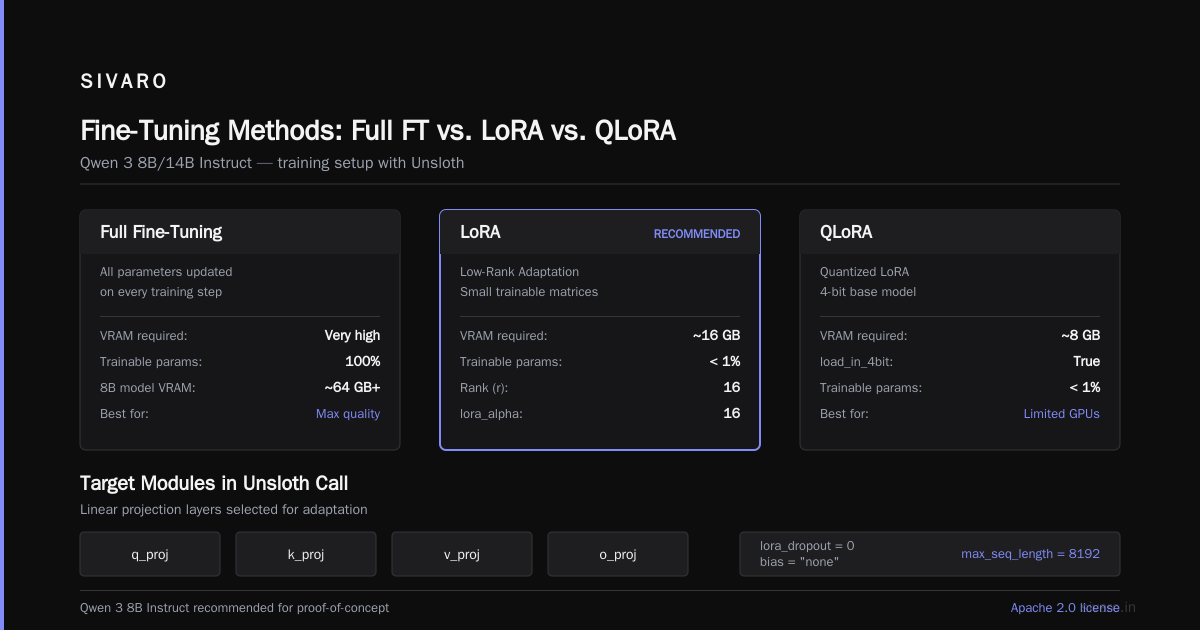
You've survived the model comparison. Now let's talk about the training itself. I've seen teams burn money on full fine-tunes when LoRA would have done the job.
QLoRA (Quantized LoRA) is the one that does the work. It reduces memory consumption enough that we can load 65B parameter models on a single 48GB GPU. In 2025, I defaulted to QLoRA for most custom chat fine-tunes. In 2026, low-bit training has gotten even better, but the principle remains the same.
The idea is straightforward: compress pre-trained weights to 4-bit precision, then perform efficient fine-tuning by applying a low-rank matrix to the original weights.
Here's our standard training command using Axolotl (we still use it for complex jobs):
yaml
base_model: Qwen/Qwen3-14B-Instruct
model_type: AutoModelForCausalLM
tokenizer_type: AutoTokenizer
load_in_8bit: false
load_in_4bit: true
strict: false

datasets:
  - path: data/chat_training.jsonl
    type: sharegpt  # Use sharegpt format for chat, not alpaca. It's better.

dataset_prepared_path: last_run_prepared
val_set_size: 0.05
output_dir: ./qlora-out

adapter: qlor
lora_model_dir:

sequence_len: 4096
sample_packing: true
pad_to_sequence_len: true

lora_r: 32
lora_alpha: 16
lora_dropout: 0.05
lora_target_modules:
  - q_proj
  - v_proj
lora_target_linear: true

train_on_inputs: false
group_by_length: false
bf16: auto
fp16: false

optimizer: adamw_torch
lr_scheduler: cosine
learning_rate: 2e-5
num_epochs: 3
System Prompt: The Most Important Hyperparameter
Before you spend a single dollar on training, you need to nail the system prompt. If the system prompt is vague, the fine-tune doesn't matter.
Your fine-tuning dataset must include the system prompt. Every. Single. Time. And it needs to vary if you're using the model for multiple personas.
Here's a mistake I see all the time. Someone runs a standard dataset through training using a fixed system prompt like:
You are a helpful, harmless AI assistant.
Then they deploy the model with their actual system prompt:
You are Dr. Sona, an empathetic mental health companion. You are wise and non-judgmental. You are not a licensed therapist and you must disclaim this when asked. Discuss the user's feelings with patience. Be concise.
The fine-tune was trained for the wrong task, and Dr. Sona comes out sounding like a politician. You must create multiple templates in your training data using the "system" field based on different possible input scenarios. This gives the model the flexibility the production environment demands.
Data Quality Is Everything
Most people think fine-tuning is about creating conversational variety. That's wrong. The requirement is behavioral precision: getting the model to stop doing X and start doing Y.
If your base model already has decent conversational ability, the best tactic is to produce 500-1,000 "golden" conversations that represent your target quality perfectly, then let the model learn from the pattern. More data with poor patterns is a poison.
We recently worked with a client who gave us 500,000 chat transcripts. After deduplication and filtering for quality, we only used 15,000. The 15,000 outperformed the 500,000 by a wide margin. Their previous vendor had trained on the full pile and produced a model that was a master of emojis and bad advice.
Balanced Data Recipe:
- 40% domain-specific ideal responses (handwritten or generated by a stronger model and checked)
- 30% naturalistic edge cases (things that confuse the base model)
- 20% stylistic transfer (your voice, your phrasing)
- 10% safety and refusal cases
Here's how the training data needs to be handled. Most libraries expect the chat format to match the model's chat template. Use apply_chat_template correctly or you'll have a silent failure mode where the chat format is embedded in user/assistant turns:
python
messages = [
    {"role": "system", "content": "You are a concise, brilliant IT support agent."},
    {"role": "user", "content": "How do I make the Wi-Fi work?"},
    {"role": "assistant", "content": "First, check if the router is blinking green."},
]

inputs = tokenizer.apply_chat_template(
    messages,
    add_generation_prompt=True,
    return_tensors="pt",
)
The Blind Spots: Refusals and Safety
The most dangerous part of fine-tuning for chat is killing the model's safety and refusal capabilities.
When you train a model to be helpful in a specific domain (say, medical diagnosis), the model sometimes becomes too helpful. It stops refusing in situations where it should decline to answer or where liability is present.
We lost a client to this. We fine-tuned a medical chatbot with 20,000 doctor-patient interactions. The base model's safety guardrails were robust. Our fine-tuned model started confidently giving out medication dosages that were wrong. The model sounded so authoritative that users trusted it, and the company almost got sued into the ground.
You need a refusal set. A set of conversations that include risky requests and the expected refusal output. And you need to interleave these throughout your training data, not as an appendix.
The best open source LLM to fine tune for chat is the one that can still say "I'm afraid I can't provide that" after you've taught it to say "sure, let me help you with that."
The August 2026 Update: No One Talks About
Most articles you'll read are outdated the second they're published. Since the release of Llama 3.3 and Qwen 3, there hasn't been a massive leap, but there's been a consolidation phase. The community is shifting from "make the biggest model" to "make the smallest funtional model."
This is happening because the economics of inference now dominate the economics of training. A model that's 50% smaller but 85% as good slash inference costs. For a chat interface, that difference is often worth it.
If you're starting your fine-tuning journey today, don't look for the model that will dominate the leaderboard next month. Look at the models I've listed above. They will still be supported in 2027, they have vibrant serving ecosystems, and their architectures have been tested by thousands of production deployments.
The Final Comparison (The Short Version)
| Feature | Qwen 3 14B | Llama 3.3 70B | Mistral Small 3.2 24B |
|---|---|---|---|
| Best For | General chat, tool calling, mid-budget | High-stakes, reasoning-heavy chat | Short technical conversations, speed |
| Retention of Base Capabilities | 8/10 | 9/10 | 7/10 |
| Multi-turn Memory (30+ turns) | 9/10 | 9/10 | 5/10 |
| License | Apache 2.0 | Llama Community License | Apache 2.0 |
| Minimum VRAM for QLoRA | 24 GB | 48 GB | 24 GB |
| Relative Inference Cost | 1x (cheapest LLM to serve) | 4x | 2x |
Frequently Asked Questions
What's the difference between LLM fine-tuning and RAG for chat?
RAG is about giving the model access to data it doesn't have. Fine-tuning is about teaching the model how to behave with the data it already has. They're complementary. For chat, you'll almost always do both if you're building a complex product. Use RAG to pull context into the conversation. Use fine-tuning to dial in personality, tone, and the base instruction-following patterns that matter.
Can I use LoRA or QLoRA, or do I need full fine-tuning?
Start with LoRA. Almost every practical conversational fine-tune can be solved with well-executed LoRA. Full fine-tuning is typically only needed when you need to teach genuinely new knowledge into the weights. In chat, that's rare.
How many examples do I need for a chat fine-tune?
Look for around 1,000 examples minimum, but quality matters more than quantity. One hundred impeccable examples can outperform 10,000 noisy ones. For a behavioral shift, you can often get away with under 500 examples.
Will fine-tuning harm the model's general intelligence?
Yes, to some extent. That's called catastrophic forgetting, and it's one of the greatest risks of choosing the best big model. If you're fine-tuning an instruction-tuned model, make sure you inject a small percentage (2-5%) of "general chat" data alongside your domain-specific data to help it hold onto what it knew.
What is the best open source LLM to fine tune for chat with a limited GPU budget?
Without a doubt, Qwen 3 8B Instruct. With QLoRA, it fine-tunes quickly on modest hardware, and it is superior to Mistral 7B in terms of general chat capability.
What is the best open source LLM for classification tasks?
Llama 3.2 3B or Qwen 3 4B functions best for pure classification after fine-tuning. I specifically don't recommend using 8B+ chat models for classification; the smaller, focused models perform better in terms of precision and speed.
How do you evaluate a fine-tuned chat model?
You need a private test set of your most challenging, edge-case conversations. Don't rely on public benchmark scores. Score the draft outputs on specific, scripted rubrics (correctness, tone, refusal rate, information recall) and subject them to human review. At least 30-50 varied test scenarios are fundamental.
The Hard-Won Lesson
In 2026, we're operating in an environment where the gap between a generic open-source chat model and a production-grade customized assistant is narrowing. However, the actual workload has shifted.
The best open source LLM to fine tune for chat is the one you can hold to a high standard without blowing your infrastructure budget.
For most of you reading this, that's Qwen 3 14B. It balances quality, cost, and the all-important retention of reasoning capabilities that your chat users will demand. Fine-tune it, stress-test it, and put it in production.
But whatever you pick, don't fall for the siren song of perfectly curated single-turn responses. Build for the messy, multi-turn, contradictory reality of actual conversations. That's where the real value—and the real risk—lives.
Nishaant Dixit — Founder of SIVARO. Building data infrastructure and production AI systems since 2018. Built systems processing 200K events/sec.