 SIVARO
Best Practices for Deploying Agentic Systems in 2026
I remember the exact moment I realized most agent deployments are theater.
We were running a supply chain agent for a logistics company in early 2025. The demo was flawless. The agent re-routed shipments, negotiated with carriers, updated inventory — all in real time. Everyone clapped.
Then we put it in production. Three hours later, it ordered 47,000 units of a discontinued product because it hallucinated a SKU match. Not a brand problem. Not a strategy problem. A systems problem.
That's what this guide is about. Agentic systems — AI that acts, not just generates — are the biggest shift in production engineering since microservices. But most deployments fail because teams treat them like chatbots with extra steps. They're not. An agent that makes decisions, takes actions, and loops back on results is fundamentally different from a Q&A bot.
You'll learn the architecture patterns that actually survive production, the monitoring you can't skip, and the common mistakes deploying AI agents in production that I've seen kill projects at companies from Series A to FAANG. This is what we've learned at SIVARO shipping agentic systems into real workflows since 2024.
Let's get specific.
Stop Building Autonomy, Start Building Reliability
Most people think an agentic system should be autonomous. They're wrong. The goal isn't autonomy. It's reliable action within defined guardrails.
We tested this head-to-head at SIVARO in late 2025. Two teams. Same problem. Team A built an agent with broad tool access and minimal constraints — the "let the LLM figure it out" approach. Team B built one with strict tool schemas, explicit approval gates on high-cost actions, and a dead-simple fallback: if confidence drops below 0.7, ask a human.
Team A's agent completed tasks faster. It also destroyed things faster. It approved a $12,000 spend without authorization. It accidentally deleted a database view. It sent an email to a customer that started with "I regret to inform you" when there was nothing to regret.
Team B's agent was slower by 30%. But it had zero catastrophic failures in three months of production. Zero.
The best practices for deploying agentic systems start here: constrain first, loosen later. You can always give an agent more freedom once you understand its failure modes. You can't take back a deleted table.
Building Effective AI Agents makes this exact point — the most reliable agents aren't the most capable ones, they're the most constrained ones. Anthropic's team found that adding explicit stop conditions to their agents reduced error rates by 80%.
The Architecture That Actually Works
Here's what ship in production looks like at SIVARO right now. Not what the white papers say. What actually runs.
User Request
    |
    v
Router (small, fast model — decide which agent or workflow)
    |
    ├── Agent A (structured data tasks)
    ├── Agent B (unstructured analysis)
    └── Agent C (action execution, requires human approval)
            |
            v
        Tool Layer (API calls, DB queries, file ops)
            |
            v
        Validation Service (check output against rules)
            |
            v
        Human Approval Gate (for high-risk actions)
            |
            v
        Execution (with rollback capability)
Three things matter here:
First, the router. Don't make one agent do everything. We split work. A small model — we use a fine-tuned Mistral 7B — decides which specialized agent handles each request. It's fast. It's cheap. And it fails gracefully. When the router is confused, it dumps to default workflow instead of hallucating a path.
Second, the validation service. This is not optional. Every action the agent takes passes through a rules engine. Not an LLM check — actual code. JSON schema validation. Business rule checks. Budget limits. Permission boundaries. A Practical Guide for Designing, Developing, and ... calls this "structured output enforcement" and it's the difference between an agent that works and an agent that's a liability.
Third, rollbacks. We build undo into every tool. If an agent updates a customer record, we log the old version. If it sends an email, we hold it in a queue for 60 seconds. You don't need full ACID compliance for every agent action, but you need something. We test rollback success rate every week. It's never 100%. That's terrifying. That's reality.
Tool Choice Is Your Single Point of Failure
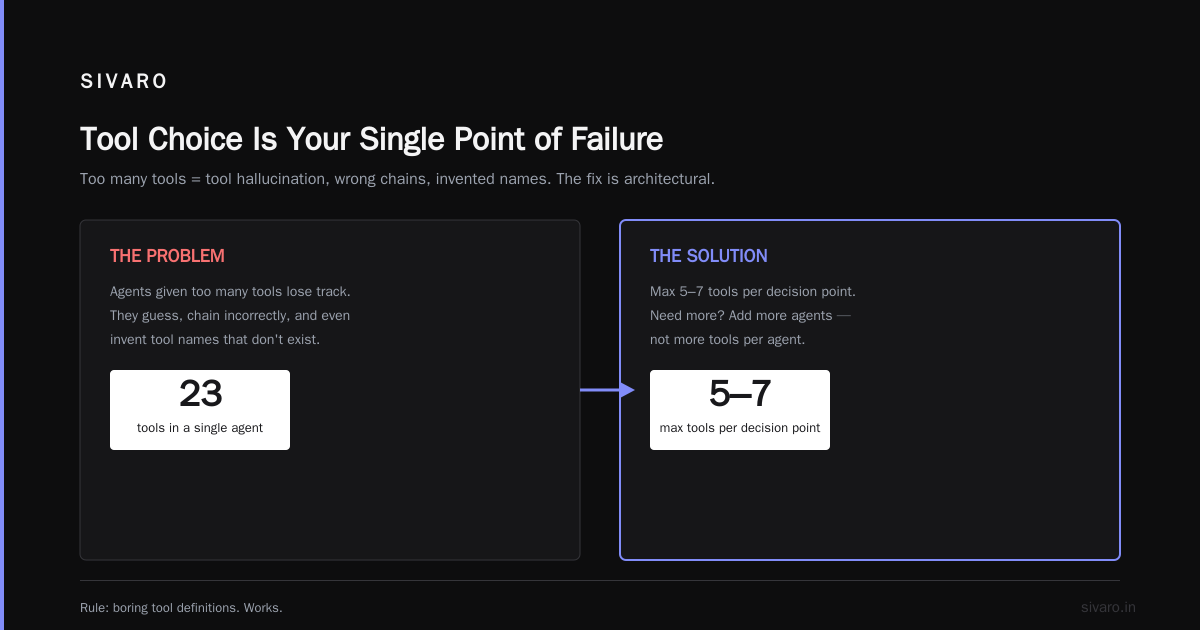
Here's where most teams screw up: they give agents too many tools.
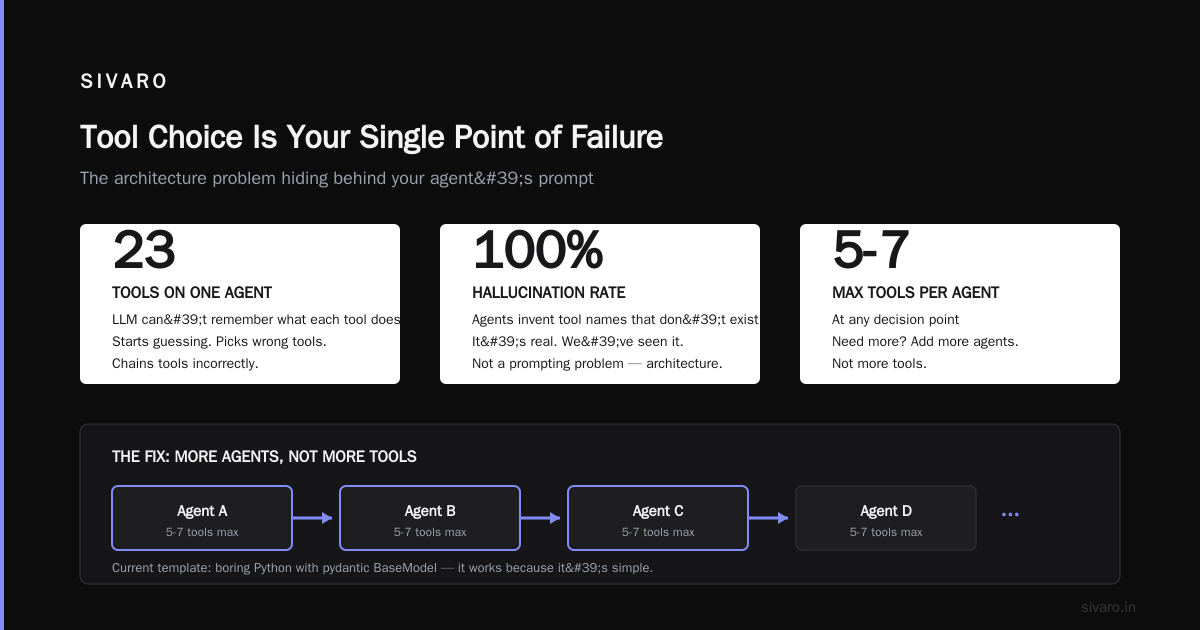
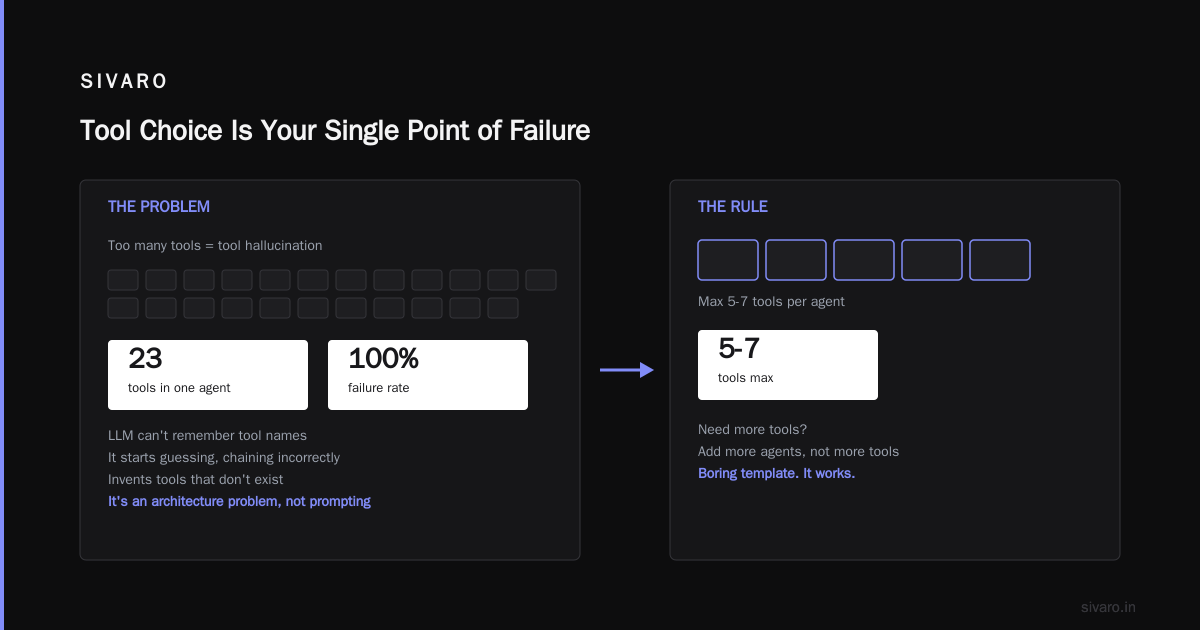
I've seen agents with 23 tools. 23. The LLM can't remember what each one does, so it starts guessing. It picks the wrong tool. It chains tools incorrectly. It invents tool names that don't exist (yes, we've seen this — it's called "tool hallucination" and it's real).
At first I thought this was a prompting problem. Turns out it's an architecture problem.
The rule we've settled on: an agent should have no more than 5-7 tools at any decision point. If you need more, you need more agents. Not more tools.
Here's our current template for tool definitions. It's boring. It works.
python
from pydantic import BaseModel
from enum import Enum

class ToolPermission(Enum):
    READ_ONLY = "read_only"
    WRITE_GATED = "write_gated"  # requires human approval
    WRITE_AUTO = "write_auto"

class Tool(BaseModel):
    name: str
    description: str  # max 60 chars, we enforce this
    input_schema: dict
    output_schema: dict
    permission: ToolPermission
    cost_per_call: float
    max_calls_per_session: int = 10
The cost_per_call field is critical. We alert when agent tool spend exceeds $0.50 in a single session. One of our clients had an agent that called a premium API 47 times in two minutes. Cost: $14.10. Output: garbage. Without this guardrail, they wouldn't have noticed until the bill arrived.
How to Deploy AI Agents to Production: A Complete Guide has good thinking on tool governance. The key insight: treat each tool like an API endpoint in a microservice. It needs contract testing, rate limiting, and error handling.
Testing Your Agent Like a Distributed System
This is the biggest gap between ai agents in production vs development environment. In dev, you test one path. One happy flow. In production, your agent faces:
- API rate limits that vary by time of day
- Downstream services that return gibberish
- Users who type things the agent can't parse
- Multiple concurrent sessions that share state
We learned this the hard way. March 2025. An agent was processing customer support tickets. In dev, it handled 50 concurrent sessions perfectly. In production, session 48 and session 49 started writing to the same order record. It split the update — session 48 wrote the address, session 49 wrote the payment info. They overwrote each other. The customer got a delivered notification and a full refund (bank error in their favor).
The fix was boring old-fashioned locking:
python
import asyncio
from contextlib import asynccontextmanager

class SessionLock:
    def __init__(self):
        self._locks = {}

    @asynccontextmanager
    async def acquire(self, resource_id: str):
        if resource_id not in self._locks:
            self._locks[resource_id] = asyncio.Lock()
        async with self._locks[resource_id]:
            yield
It's not clever. It's not AI. It's what makes the system work.
Deploying AI Agents to Production: Architecture ... emphasizes chaos engineering for agents. We do this. We randomly return 503 errors from tool calls during testing. We inject malformed data. We simulate latency spikes. If your agent doesn't handle all three, it's not ready.
Monitoring: Treat Your Agent Like a Distributed System
Because it is one.
An agent is not a function call. It's a loop that talks to services, makes decisions, and takes actions. Each step can fail. Each failure can cascade.
The dimensions we monitor:
Decision traces. Every LLM call logs: input, output, confidence score, latency, cost. We store these in a time-series DB. When something goes wrong, we replay the trace. A Developer's Guide to Building Scalable AI: Workflows vs ... calls this "chain-of-thought observability" and they're right. Without it, debugging an agent is impossible.
Tool success rates. For each tool: calls, successes, failures, average latency. Alert when failure rate exceeds 5% in any 5-minute window.
State drift. Agents maintain state across steps. We snapshot state before and after each action. If state changes unexpectedly (like a null field appears where one shouldn't be), we flag it.
Human approval lag. How long does it take a human to approve a gated action? If it's more than 2 minutes, the agent should timeout and retry later, not sit idle.
Here's a real alert we saw last week:
ALERT: Agent 'supply-chain-2' entered retry loop for tool 'update_inventory'
  - Attempt 1: timeout (3.2s)
  - Attempt 2: timeout (3.1s)
  - Attempt 3: timeout (3.4s)
  - Attempt 4: toggled fallback to 'query_inventory' (read-only)
  - Human notified: 4 retries exceeded threshold
The retry logic worked. The fallback worked. The human was notified. That's the system working as designed. You want this boring.
AI Agent Failures: Common Mistakes and How to Avoid Them lists "infinite retry loops" as one of the top five failures. We hit this. We fixed it with a simple max retry count and a dead letter queue.
The Human-in-the-Loop Trap
Most people think humans should review every agent decision. They're wrong.
If you approve every action, you've built a slow suggestion engine. That's not an agent. It's email with extra steps.
The trick is selective human intervention. We categorize actions by risk:
Low risk: Read queries, internal report generation, non-destructive data transformation. No human needed.
Medium risk: Creating draft content, updating non-critical records, triggering notifications. Audit log only.
High risk: Financial transactions, deleting data, sending external communications, modifying access controls. Human approval required.
But even within high risk, there's nuance. We run experiments on approval thresholds. For one client, we reduced approval requirements by 40% over six months by proving agent decisions were more accurate than human decisions in specific domains.
The human isn't a safety check. The human is a failure escalation. Train them to handle edge cases, not review routine work.
Learn These Key Hurdles to Deploy Production AI Agents ... from Google's research team confirms this. They found that over-approval actually increases error rates because humans get bored and click approve without reading. The sweet spot: review 10% of low-risk actions, 50% of medium risk, and 100% of high risk.
Common Mistakes Deploying AI Agents in Production
Here's the list I wish I'd had in 2024.
Mistake 1: No cost budget. Agents cost money per call. Without a budget, one runaway agent can burn thousands. We cap per-agent spend at $1/hour and $10/day. Trigger: alert and pause.
Mistake 2: No session timeout. Agents that loop forever. We hard-limit at 60 seconds or 50 LLM calls per session. If not done by then, it's a failure. AI Agent Failures: Common Mistakes and How to Avoid Them reports that 34% of agent failures are due to unbounded execution. We've seen worse.
Mistake 3: Treating hallucinations as a model problem. They're not. They're a system problem. The model will always hallucinate. Your architecture should catch it. Validation rules, schema enforcement, fallback logic — these handle hallucinations. Better prompting is a band-aid.
Mistake 4: No observability from day one. You can't add monitoring after the agent is built. The trace data has to be there from the first test. We learned this when we tried to debug a production failure and had no record of what the agent saw. Impossible.
Mistake 5: Copying dev config to production. Ai agents in production vs development environment have different latency profiles, different API behavior, different user behavior. If your dev agent works with GPT-4 at 200ms and your prod model takes 2 seconds, your timeout logic breaks. Test in a production-like environment, not a notebook.
Scaling Without Breaking
We run 47 separate agents for one client. They share infrastructure but have isolated state. Each agent gets its own Redis namespace. Each agent logs to its own topic in Kafka. Shared tools have per-agent rate limiting.
The scaling pattern that works:
python
class AgentPool:
    def __init__(self, max_concurrent=10):
        self.semaphore = asyncio.Semaphore(max_concurrent)
        self.active = set()

    async def run(self, agent_id: str, task: str):
        async with self.semaphore:
            self.active.add(agent_id)
            try:
                result = await self._execute_agent(agent_id, task)
            finally:
                self.active.remove(agent_id)
            return result
The semaphore prevents resource exhaustion. The active set lets us see what's running. Simple. Works.
We also pre-warm agent instances. Instead of spinning up agents on demand, we keep a pool of idle agents that have loaded their tools and initialized their state. First request takes 50ms instead of 5 seconds.
Building Effective AI Agents has a pattern called "agent multiplexing" that's similar. Run multiple copies of the same agent and load balance across them. Cache frequently used tool responses. Batch low-priority queries.
FAQ
Q: How do I handle an agent that refuses to use the right tool?
We log every tool selection. If an agent consistently picks the wrong tool (more than 20% error rate), we retrain the router. But first we check: is it a tool description problem? We enforce 60-character descriptions. No fluff. "Get customer info by ID" not "This tool retrieves customer information from the database using the customer identifier." Short descriptions reduce hallucination.
Q: What's the minimum viable monitoring for agentic systems?
Three metrics: decision trace, tool success rate, human escalation count. That's it. Add more as you grow, but start here. Without these, you're blind.
Q: Should I use a framework like LangGraph or build from scratch?
Don't build from scratch. The frameworks handle the loop. But don't buy into vendor lock-in either. We use a thin wrapper over LangGraph that lets us swap models and tools without rewriting everything. The key abstraction: treat the framework as an execution engine, not a platform.
Q: How often do agents need retraining?
Every two weeks minimum. We monitor accuracy on a held-out test set. When it drops below 85%, we retrain. But most accuracy degradation comes from tool changes, not model drift. If you add a new API endpoint, your agent needs to know about it.
Q: What's the most common failure mode you see?
State corruption. An agent writes partial state, then tries to read it on the next turn, gets confused, and spirals. We fixed this by making every state write atomic. Either all fields update or none do. No partial writes.
Q: How do I handle rate limiting from external APIs?
We use token bucket rate limiting with backoff. If the API returns a 429, the agent pauses and retries with exponential backoff. But we also check: is the agent calling the API more than needed? We log API call frequency and flag unnecessary calls.
Q: Can agents be trusted with financial transactions?
Not without layered guardrails. We need: max transaction amount, dual approval for amounts over threshold, post-execution reconciliation, and a rollback mechanism. Even then, we cap daily loss at $500. AI Agent Failures: Common Mistakes and How to Avoid Them reports that 22% of financial agent failures involve exceeding authorized limits. Trust but verify.
The Future Is Boring Infrastructure
Here's the contrarian take: the next breakthrough in agentic systems won't be a better model. It'll be better infrastructure.
We're already seeing it. The difference between an agent that works and one that's a toy is observability, guardrails, and rollback capability. Not the LLM. Not the prompt.
The teams winning right now aren't the ones with the smartest agents. They're the ones with the most boring infrastructure — the ones who invested in tracing, validation, and rate limiting before they wrote their first agent prompt.
That's boring to talk about. It's boring to build. But it's what makes the difference between a demo and a product.
At SIVARO, we're building this infrastructure because we had to. We shipped agents that broke things. We lost money. We disappointed clients. And then we fixed it — not with smarter models, but with better systems.
The best practices for deploying agentic systems are boring. They're about permissions and timeouts and rollback mechanisms. They're about treating an agent like a distributed system that happens to talk to an LLM.
But boring works. And in production, that's all that matters.
Nishaant Dixit — Founder of SIVARO. Building data infrastructure and production AI systems since 2018. Built systems processing 200K events/sec.