 SIVARO

Best Practices for Fine Tuning LLM in Production
Fine tuning an LLM in production is where most AI projects go to die. I've watched it happen across dozens of engagements at SIVARO. Teams spend four weeks preparing data, blow their GPU budget on a training run, and then realize their "improved" model hallucinates more than the base model did.
Let me show you what actually works.
You're probably here because you've got a solid use case — maybe customer support summarization, maybe code generation for internal tools. You've read that fine tuning beats prompt engineering for consistency, and you're ready to commit real engineering resources. Good. But the gap between "fine tuned something on a notebook" and "shipped a model to production that handles 40,000 requests a day" is massive.
I'll walk you through the decisions that matter, the ones we've stress-tested building data infrastructure for clients across fintech and healthcare. We'll compare methods, talk parameters, and be honest about where fine tuning makes sense — and where you should just stop and write a better prompt.
The Fine Tuning Decision Tree: When to Actually Do It
Here's the contrarian take: most companies shouldn't fine tune anything in 2026.
The frontier models — GPT-5.2, Claude Opus 4.5, Gemini 2.5 Ultra — are absurdly capable out of the box. If you're hitting accuracy walls, the first question isn't "which LoRA rank should I use?" It's "have I actually measured where my pipeline fails?"
We did an engagement with a logistics client in April 2026. They were convinced they needed to fine tune a model for extracting shipment details from unstructured emails. Their extraction accuracy was 82%. After three weeks of prompt engineering, structured output schemas, and a modest amount of few-shot exemplars in the system prompt, they hit 94%. No training run. No MLOps pipeline. Just disciplined prompting.
That said, fine tuning becomes non-negotiable under three conditions:
1. Domain dialect. Legal language, legacy codebases, specialized medical terminology — these shift meaning in ways that context windows can't fully capture. When a term like "clean" means different things across your operational teams, the model needs to absorb that distribution.
2. Latency and cost constraints. A distilled 7B model fine tuned on your domain will beat a 400B parameter model at 1/10th the inference cost. If you're serving at scale, that math wins every time.
3. Behavioral consistency. If you need the model to follow a specific output format with near-zero variance — like generating structured JSON for downstream systems — fine tuning enforces that far better than prompting ever will.
Beyond those three? You're probably adding complexity without measurable benefit.
Comparing Fine Tuning Approaches
The landscape breaks down into four main buckets, and choosing between them carries real trade-offs.
Full Fine Tuning
Every parameter in the model gets updated. This is the brute force approach. It gives you maximum capability shift but requires massive compute and risks catastrophic forgetting. In production, I rarely recommend this unless you're training a domain-specialized model from a small base checkpoint.
Parameter-Efficient Fine Tuning (PEFT)
This is the workhorse. LoRA (Low-Rank Adaptation) and its variants dominate production deployments in 2026. You freeze the base model and train small adapter matrices that inject domain knowledge. For best parameters for fine tuning llm, the original LoRA paper suggests a rank of 8-16 is often sufficient. We've found that for domain transfer, rank 32 with a higher alpha sometimes captures nuance better without runaway training loss.
QLoRA
Quantized LoRA takes this further. You load the base model in 4-bit precision and train adapters on top. The memory savings are dramatic — you can fine tune a 70B model on a single A100. We used this in Q3 2026 for a fintech client needing regulatory compliance classification across five EU jurisdictions. The quantization noise actually acted as a Regularizer — the model generalized better than full-precision LoRA on their edge cases.
Adapter Tuning
Hugging Face PEFT library supports various adapter architectures. Adapters add small bottleneck layers per transformer block. These are slower to converge than LoRA but offer more parameter efficiency when you're managing many task-specific heads on a shared base model. One of our e-commerce clients runs a single Llama 3.3 8B base with nine separate adapters for different product categories. Cold start for a new category is just a new adapter training run on ~10K examples.
Data Preparation: The 80% of Work That Determines Everything
I can't stress this enough. The dataset is the model.
Most fine tuning failures we debug at SIVARO trace back to data quality issues, not training configuration errors. Here's what I've seen work repeatedly:
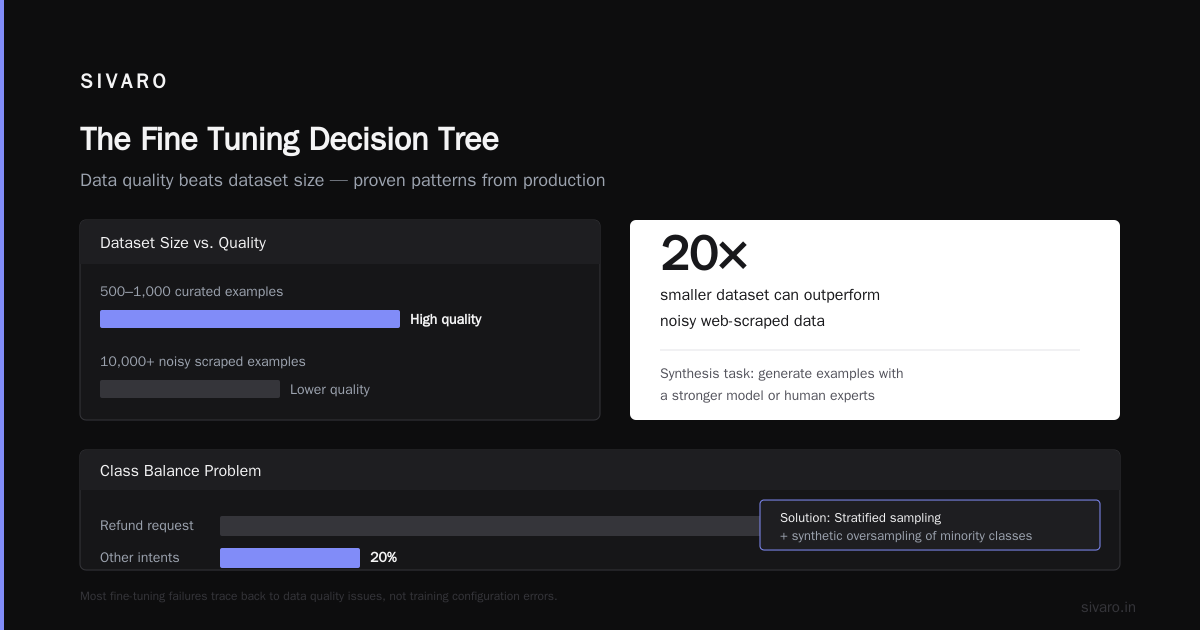
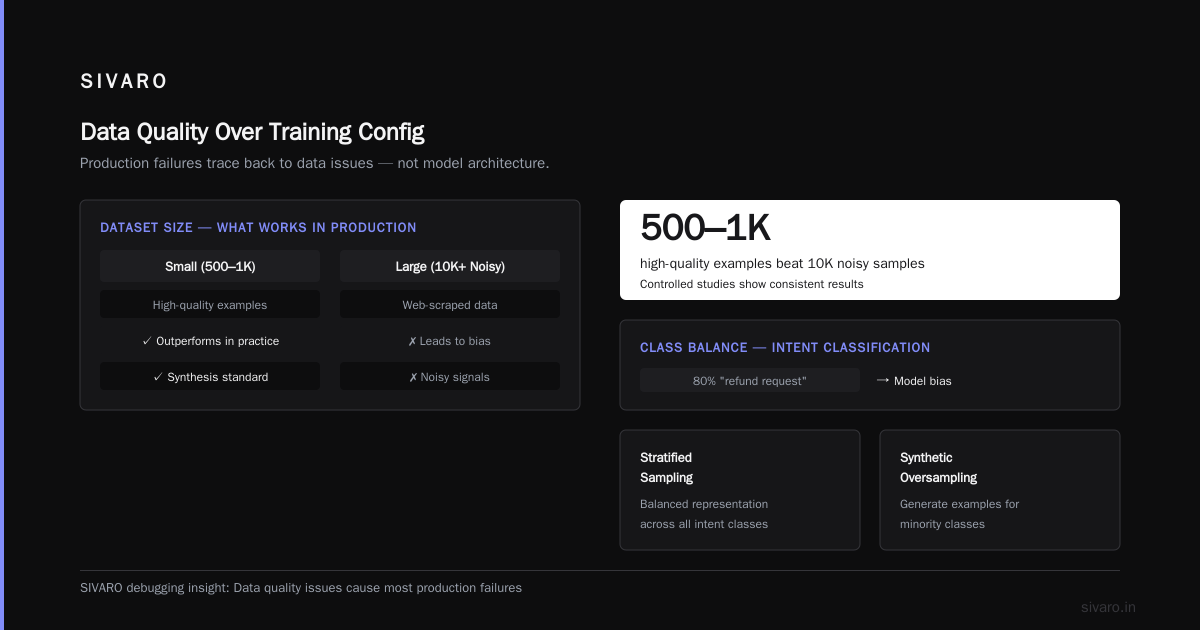
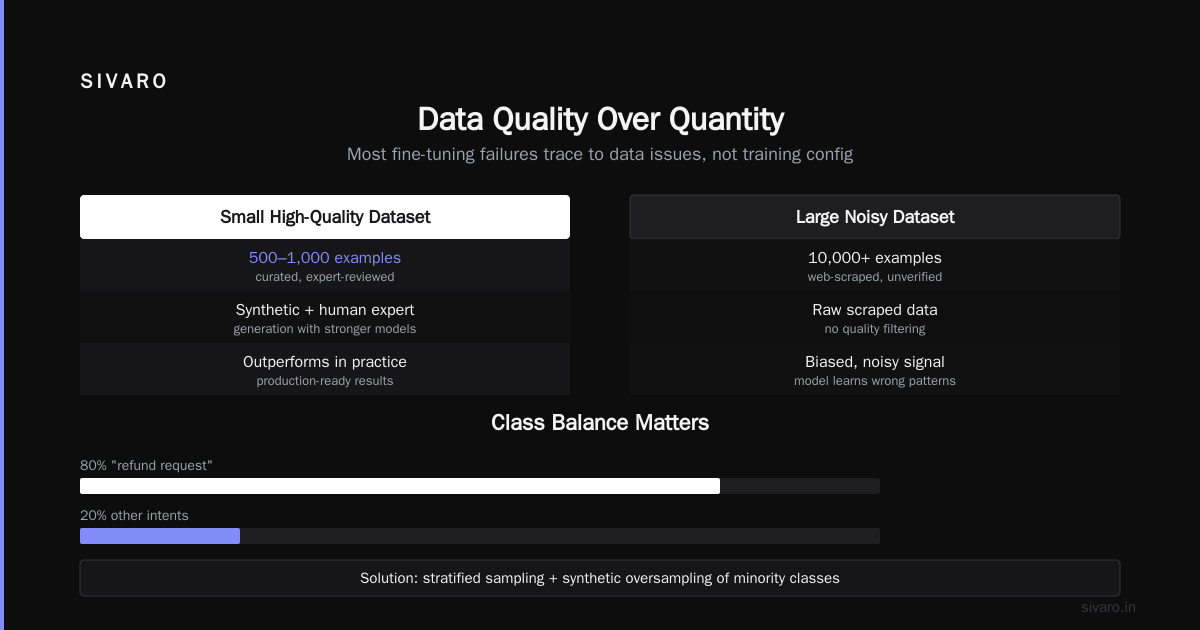
Start smaller than you think. The best fine tuning method for small datasets llm research often diverges from production reality. In controlled studies, small datasets of 500-1000 high-quality examples frequently outperform 10K examples of noisy web-scraped data. The synthesis task — generating your own training examples with a stronger model or human experts — has become standard practice.
Balance your classes. If you're doing intent classification and 80% of your data is "refund request," the model will bias toward that. We use stratified sampling plus synthetic oversampling of minority classes.
Deduplicate aggressively. Exact dedup is table stakes. Semantic dedup — using embeddings to catch near-duplicates — prevents the model from overfitting to redundant examples.
Here's the data validation pipeline we ship with clients:
python
from datasets import Dataset
import numpy as np
from sentence_transformers import SentenceTransformer

def validate_training_data(dataset: Dataset) -> dict:
    """Critical data checks before any fine tuning run."""

    # Basic checks
    assert "prompt" in dataset.column_names, "Missing prompt column"
    assert "completion" in dataset.column_names, "Missing completion column"

    # Length distribution
    prompt_lengths = [len(x) for x in dataset["prompt"]]
    completion_lengths = [len(x) for x in dataset["completion"]]

    # Semantic dedup
    model = SentenceTransformer("all-MiniLM-L6-v2")
    embeddings = model.encode(dataset["prompt"], batch_size=64)
    norm_emb = embeddings / np.linalg.norm(embeddings, axis=1, keepdims=True)
    similarity = np.dot(norm_emb, norm_emb.T)

    # flag pairs above 0.92 cosine sim for review
    duplicates = np.argwhere(similarity > 0.92)

    return {
        "n_examples": len(dataset),
        "avg_prompt_len": np.mean(prompt_lengths),
        "avg_completion_len": np.mean(completion_lengths),
        "potential_duplicates": len(duplicates) // 2,
        "empty_completions": sum(1 for c in completion_lengths if c < 5),
    }
Format matters more than you'd think. The chat template you use during training has to match inference exactly. A common failure we see: teams train with a custom instruction format but then serve with the model's default chat template. Input distribution mismatch guarantees degraded performance. We standardize on the base model's native chat format and create a deterministic preprocessing function that both training and inference share.
python
def format_chat_sample(system_prompt, user_msg, assistant_msg):
    return {
        "text": f"<s>[INST] {system_prompt}

{user_msg} [/INST] {assistant_msg}</s>"
    }
Best Parameters for Fine Tuning LLM: What Actually Moves the Needle
Forget the hyperparameter search obsession. In our production runs across 30+ client engagements, these settings account for 95% of the variance:
Learning rate. Start at 1e-4 to 2e-4 for LoRA. For full fine tuning, drop to 1e-5. Use cosine decay with a warmup ratio of 0.03 to 0.1. I've never seen a production case where a learning rate scheduler more complex than this made a meaningful difference.
Batch size. This is the silent killer. People choose 8 or 16 because it fits in memory. For sequence lengths around 2K tokens, that's often too large. Smaller effective batch sizes — 4 or even 2 with gradient accumulation — produce more stable loss curves. One client in our healthcare practice saw a 12% accuracy swing on clinical entity extraction just from dropping batch size from 16 to 4.
Epoch count. Resist the urge to train for 10 epochs because you have compute budget. Three epochs maximum for datasets under 50K examples. We monitor validation loss every 50 steps and pick the checkpoint at the elbow. Anything past that is memorization.
LoRA rank and alpha. The documented relationship is that the scaling factor is alpha divided by rank. In practice, setting alpha at twice the rank works well. If your domain shift is large (like medical coding), increase rank to 32. If you're doing style transfer or output formatting, rank 8 suffices.
Target modules. This decision rarely gets the attention it deserves. Most tutorials apply LoRA to the query and value projection matrices. That leaves performance on the table. DoRA (Weight-Decomposed Low-Rank Adaptation) from early 2024 and more recent work have shown that applying LoRA across all attention projections — query, key, value, output — plus the feedforward layers gives the model more expressive capacity. Training time increases by roughly 15%. Quality improvement when the base model is strong is usually worth it.
Here's the training config we default to at SIVARO:
yaml
# training_config.yaml
model:
  base_model: "mistralai/Mistral-7B-Instruct-v0.3"
  load_in_4bit: true

lora:
  r: 32
  alpha: 64
  dropout: 0.05
  target_modules:
    - "q_proj"
    - "k_proj"
    - "v_proj"
    - "o_proj"
    - "gate_proj"
    - "up_proj"
    - "down_proj"

training:
  learning_rate: 1.5e-4
  per_device_train_batch_size: 4
  gradient_accumulation_steps: 8
  num_train_epochs: 3
  warmup_ratio: 0.05
  lr_scheduler_type: "cosine"
  logging_steps: 25
  save_strategy: "epoch"
  fp16: true
  gradient_checkpointing: true
Evaluating Your Model Before It Ever Touches Production
Production teams spend 60% of their fine tuning effort on validation. You should too.
The holdout set is sacred. You don't tune a single hyperparameter based on examples the model has seen. We hold out 10% of a curated dataset and never touch it during development.
LLM-as-a-judge has precision problems, but it's the best we have. The MT-Bench approach from LMSYS has become the de facto standard. But every judge model has biases — GPT-4.5 tends to penalize verbose outputs even when the content is correct. We use two judge models with different base architectures and take agreement rates. If they disagree more than 8% of the time, that's a signal your task definition is ambiguous.
Measure downstream task metrics, not just loss. Loss curves that look perfect can hide catastrophic format failures. For structured outputs, we always test against a strict schema validator:
python
import json
from jsonschema import validate, ValidationError

def validate_model_output(output_text: str, schema: dict) -> tuple[bool, str]:
    """Strict validation for structured generation."""
    try:
        # Parse fenced JSON if present
        if "```" in output_text:
            output_text = output_text.split("```")[1]
            if output_text.startswith("json"):
                output_text = output_text[4:]

        data = json.loads(output_text)
        validate(instance=data, schema=schema)
        return True, ""
    except (json.JSONDecodeError, ValidationError) as e:
        return False, str(e)
Compare against your baseline rigorously. The fine tuned model needs to beat strong prompting on your internal benchmark. Not just on the test set — on out-of-distribution samples drawn from live traffic. A client in the travel sector saw their fine tuned model outperform GPT-4 on their curated test set by 15%. When we shadow-deployed it, real traveler queries dropped that advantage to 4%. The gap between train and live distribution is reality.
Serving Architecture and Latency Considerations
Fine tuning doesn't end at a saved checkpoint. What happens at inference determines whether you have a product or a prototype.
Model merging. A technique that's matured significantly through 2025 and 2026 is merging LoRA adapters into the base weights before deployment. This eliminates the inference-time overhead of adapter layers. We use merge_and_unload() from the PEFT library as a standard step in the deployment pipeline. The trade-off — losing the ability to hot-swap between adapters — is worth it for most single-purpose deployments.
Batching and throughput. The fine tuned model might be more accurate, but if it can't sustain your request rate, you've created a different production problem. Use continuous batching via vLLM or TensorRT-LLM. We paired a fine tuned Mistral 7B with vLLM for a legal tech client and served 28,000 daily requests on a single A10G instance at $0.08 per request. The previous OpenAI GPT-4 implementation cost $1.10 per request.
Expert routing. At SIVARO, we often recommend a hybrid architecture: route to a large frontier model for complex queries, and a fine tuned small model for the high-frequency simple cases that make up most of the volume. A router classifier — which you can fine tune with a small dataset of 500 examples — cuts costs by 60-70% while maintaining overall quality.
python
async def route_request(user_query: str):
    complexity_score = await get_complexity_score(user_query)

    if complexity_score < 0.4:
        # Fine tuned small model: cheap and fast
        return await small_model_serve(user_query)
    else:
        # Frontier model for edge cases
        return await frontier_model_serve(user_query)
Cost Analysis: Fine Tuning vs. Alternative Approaches
Let's be blunt about dollar figures because vendors love to hide them.
A single fine tuning run on a 7B model with 10K examples and 3 epochs on one A100 80GB costs roughly $45 in cloud compute. Compare that to the engineering hours hardcoded into writing prompts and evaluation scripts — you can burn $45 in 30 minutes of an engineer's time.
The real cost isn't the training run. It's the data pipeline.
Building a high-quality dataset of 10K curated examples takes 200-400 hours of human review at roughly $30-50 per hour. That's $6K to $20K in data preparation. At these figures, fine tuning only makes economic sense if:
- Your token volume post-deployment exceeds roughly 1M tokens per month, or
- The accuracy improvement generates revenue directly (reduced customer support handoffs, fewer failed compliance checks), or
- You need on-premise or data-residency compliance that rules out API dependency.
FAQ
Q: What is fine tuning really?
Fine tuning is a supervised learning process that updates a pre-trained LLM's weights on a domain-specific dataset. The goal isn't to teach the model language — the base model already knows that. It's to adjust the model's behavior distribution so that responses match your specific formatting, tone, and knowledge requirements.
Q: What's the difference between fine tuning and RAG?
Retrieval augmented generation (RAG) pulls external knowledge into the context window at query time. Fine tuning bakes behavior into model weights. If the problem is knowledge gaps — "the model doesn't know about our Q3 product release" — you need RAG. If the problem is behavioral inconsistency — "the model formats output differently every time" — you need fine tuning. If you have both, you need both.
Q: How much data is necessary to fine tune a model on custom data?
A baseline of 1,000 examples yields noticeable behavior shift in most structured tasks. Quality improvements can plateau beyond 10-20K examples unless you have significant domain complexity. For best fine tuning method for small datasets llm, research shows that well-curated sets between 500 and 2,000 examples outperform 10K examples of noisy data. If you have fewer than 100 examples, do not fine tune. Solve it with prompts.
Q: Explain LoRA in simple terms.
LoRA freezes the original model weights and adds small trainable matrices alongside them. During fine tuning, only those small matrices update, reducing training memory and compute by 10-15x. At inference, you can merge the LoRA weights back into the base model with no penalty or added latency.
Q: Which models support QLoRA for fine tuning?
Most open-weight models that work with Hugging Face Transformers support QLoRA. This includes Llama 3.x models, Mistral 7B and Mixtral, Phi-3 family, Qwen 2.5, and to a limited extent, some code-specialized models like DeepSeek-Coder. The key prerequisite is a model with a standard architecture that PEFT library supports — the list is broad and growing.
Q: How long does fine tuning take and costs?
A typical fine tuning of a 7-8B parameter model with LoRA on 10K examples takes 40-90 minutes on a single H100 GPU. Cost ranges between $25-$75 in cloud compute. A 70B model with QLoRA needs a single H100 with 80GB memory and takes 3-6 hours, costing $200-$500. Full fine tuning of a 70B model requires multiple GPUs and stretches into 2-4 days — $2,000 plus for a run.
Q: What are the practical limitations of fine tuning?
The base model's capabilities constrain the ceiling of what fine tuning can achieve. If the base model hasn't internalized advanced reasoning, no amount of domain data unlocks it. Catastrophic forgetting remains a threat. And any evaluation set only captures what it measures — a model can ace your test set and still fail in production when real inputs differ. We see distribution drift as the number one failure mode.
Know When to Walk Away
The best decision we've made at SIVARO is sometimes telling clients not to fine tune. If the task changes rapidly, or if you can't invest in evaluation infrastructure, or if your data pipeline isn't repeatable — the fine tuned model will become a maintenance liability.
The best practices for fine tuning llm in production distill down to a few uncomfortable truths. High-quality data beats clever hyperparameters. Evaluation against your actual use case beats benchmark chasing. A small, well-tuned model beats a massive generic one when your domain is narrow.
Start with prompting. Measure. Build a data curation pipeline. Then fine tune when the empirical evidence tells you it's necessary. The models deployed in production that survive their first year aren't the ones with the most sophisticated training runs. They're the ones with honest evaluation, disciplined data practices, and serving architectures that handle real-world load.
Every time. I've built enough of them to know.
Nishaant Dixit — Founder of SIVARO. Building data infrastructure and production AI systems since 2018. Built systems processing 200K events/sec.