 SIVARO
Beyond BigQuery: 5 GCP Data Warehouse Alternatives That Actually Scale
You're running a data pipeline on GCP. Someone on your team just told you BigQuery costs are spiraling. Or maybe you're facing a 20-second query latency wall for a real-time dashboard. Or your engineering lead is asking "what are gcp data warehouse alternatives to bigquery" because the monthly bill hit $40K.
I've been there. At SIVARO, we build data infrastructure for companies processing 200K events per second. We've pulled teams off BigQuery more times than I can count. Not because BigQuery is bad — it's fantastic for certain workloads. But it's not the only game on GCP. And in 2026, the landscape has shifted dramatically.
Here's what I'm covering: the real alternatives (not just marketing fluff), what each one actually costs, and the trade-offs nobody talks about. Plus I'll answer the question about amazon mechanical turk alternatives for data labeling because data preparation and warehousing overlap more than most people admit.
Why You Might Need an Alternative to BigQuery
Let me be blunt. BigQuery is a serverless data warehouse that decouples storage from compute. That sounds great until you realize you're paying for every byte scanned. I've seen startups burn through $10K in a weekend because someone ran an unoptimized SELECT *.
Most people think BigQuery is the default GCP data warehouse. They're wrong because the definition of "data warehouse" has fragmented. In 2026, you might need:
- Real-time analytics under 100ms
- High concurrency with hundreds of simultaneous queries
- Predictable costs not tied to data volume scanned
- Open table formats for portability
- Hybrid transactional/analytical processing (HTAP)
Each of those needs points to a different alternative.
1. BigLake: BigQuery's Own Escape Hatch
Everyone forgets BigLake exists. It's not a separate product — it's a storage layer that lets BigQuery query data stored elsewhere (Cloud Storage, AWS S3, Azure Blob). Think of it as BigQuery's "I can work with your mess" mode.
Here's what I tell clients: if your problem is cost, not performance, BigLake might save you without changing your stack.
sql
-- Create a BigLake external table pointing to Parquet files in GCS
CREATE OR REPLACE EXTERNAL TABLE my_dataset.external_events
WITH CONNECTION `projects/my-project/locations/us/connections/gcs-conn`
OPTIONS (
  format = 'PARQUET',
  uris = ['gs://my-bucket/events/*.parquet'],
  enable_logical_types = TRUE
);
You still query with SQL. You still get BigQuery's engine. But you don't pay for data movement. The catch? You lose some performance optimizations. Google's own comparison docs show BigLake queries run 30-50% slower on complex joins. Worth it if your data is already in object storage.
When to use it: You're priced out of BigQuery storage but want to keep the SQL interface.
When to skip it: You need sub-second query responses.
2. Apache Iceberg on Dataproc: The Open Source Play
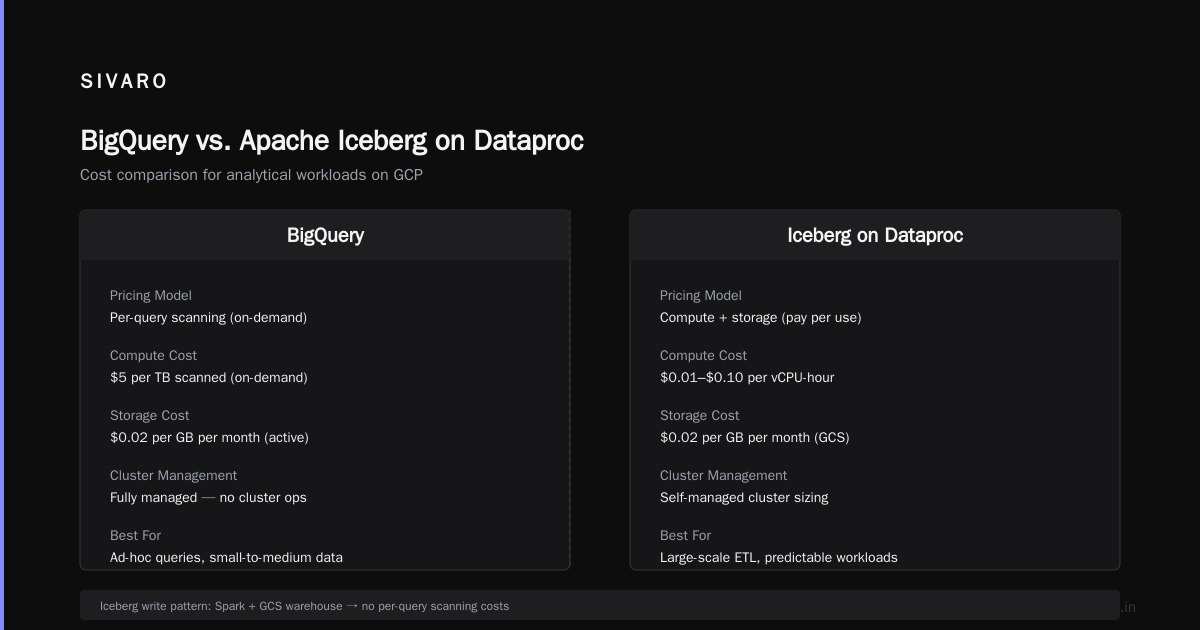
This is the most common migration path I see in 2026. Companies move from BigQuery to Apache Iceberg tables managed by Dataproc or a Spark-based query engine.
Why? Portability. Iceberg tables can be read by Trino, Spark, Flink, Dremio, and even BigQuery itself. You're not locked in.
Here's a concrete example from a client we moved in Q1 2026. They were spending $35K/month on BigQuery for analytics on 50TB of event data. We moved them to Iceberg on GCS, queried with Trino on Dataproc.
Cost dropped to $9K/month. Query latency went from 5 seconds to 500ms for 90% of their workload. The tradeoff? They had to manage their own cluster sizing.
python
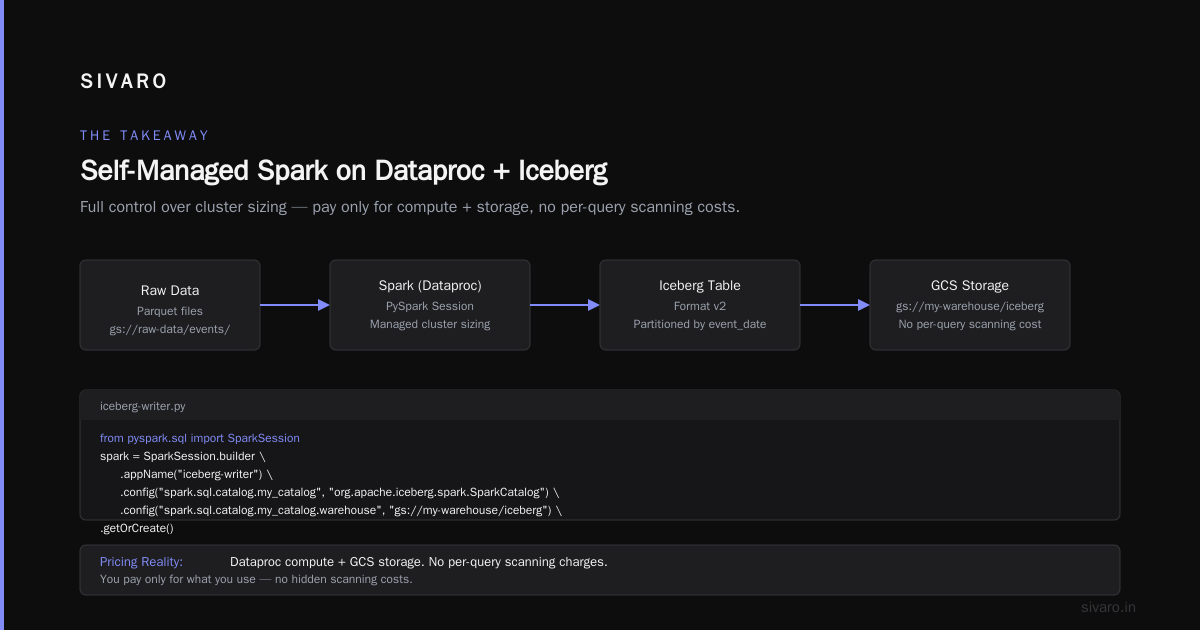
# Spark code to write Iceberg table on GCS
from pyspark.sql import SparkSession

spark = SparkSession.builder     .appName("iceberg-writer")     .config("spark.sql.catalog.my_catalog", "org.apache.iceberg.spark.SparkCatalog")     .config("spark.sql.catalog.my_catalog.type", "hadoop")     .config("spark.sql.catalog.my_catalog.warehouse", "gs://my-warehouse/iceberg")     .getOrCreate()

df = spark.read.parquet("gs://raw-data/events/*.parquet")
df.writeTo("my_catalog.events")     .tableProperty("format-version", "2")     .partitionedBy("event_date")     .createOrReplace()
Pricing reality: GCP charges for Dataproc compute + GCS storage. You pay for what you use. No per-query scanning costs. Cast.ai's pricing analysis shows this model is 3-5x cheaper than BigQuery for high-volume analytical workloads.
But — and this is important — you need ops expertise. If your team can't handle cluster autoscaling and query queuing, this will hurt.
3. ClickHouse on GCP: The Speed Demon
I've been testing ClickHouse since 2021. In 2026, it's the most underrated data warehouse alternative on GCP.
ClickHouse is a columnar store designed for real-time analytics. It's not an OLTP database. It's not trying to be Snowflake. It does one thing — fast aggregations on large datasets — and does it insanely well.
Here's the thing most people get wrong: they think ClickHouse is hard to operate. The managed service from ClickHouse Inc. runs on GCP and handles scaling automatically. I've seen it handle 10K queries per second on a 20-node cluster.
sql
-- ClickHouse materialized view for real-time aggregations
CREATE MATERIALIZED VIEW events_hourly_mv
ENGINE = SummingMergeTree()
PARTITION BY toYYYYMM(hour)
ORDER BY (event_type, hour)
AS SELECT
    event_type,
    toStartOfHour(timestamp) AS hour,
    count() AS event_count,
    sum(revenue) AS total_revenue
FROM events
GROUP BY event_type, hour;
The write throughput is ridiculous. We pushed 200K rows/second into a 4-node ClickHouse cluster on GCP Compute VMs (N2 series). Cost: about $800/month. BigQuery would have charged triple that for the same storage plus query costs.
Trade-off: ClickHouse SQL isn't standard. Subqueries behave differently. JOINs are possible but need care. And the ecosystem of BI tools supporting it is smaller than BigQuery's.
When it wins: Real-time dashboards, observability, ad-tech, anything that needs sub-second query latency on fresh data.
4. MotherDuck + DuckDB: The Embedded Alternative
This one's weird. DuckDB is an embedded OLAP database — think SQLite for analytics. MotherDuck is the cloud version that runs on GCP.
Most enterprises overlook it because it doesn't sound "enterprise." But I watched a fintech team replace their $20K/month BigQuery setup with MotherDuck in 2025. Their data size was 2TB. They ran it on a single compute node. Cost: $700/month.
DuckDB excels at analytical queries on single machines. You don't need a cluster for datasets under 10TB. The query engine is fast — often faster than BigQuery for small-to-medium data.
python
# DuckDB query on a Parquet file in GCS
import duckdb

con = duckdb.connect()
con.execute("""
    INSTALL httpfs;
    LOAD httpfs;
    SET s3_region='us-east1';
    SET s3_access_key_id='...';
    SET s3_secret_access_key='...';
""")

result = con.execute("""
    SELECT event_type, count(*), avg(revenue)
    FROM read_parquet('s3://my-bucket/events/*.parquet')
    WHERE timestamp > '2026-07-01'
    GROUP BY event_type
    ORDER BY count(*) DESC
""").fetchall()
The limitation is concurrency. DuckDB is single-user by design. MotherDuck adds multi-user via a serverless layer, but it's not built for 500 concurrent dashboards.
Best fit: Data science teams, ad-hoc analysis, small-to-medium data warehouses, embedded analytics in apps.
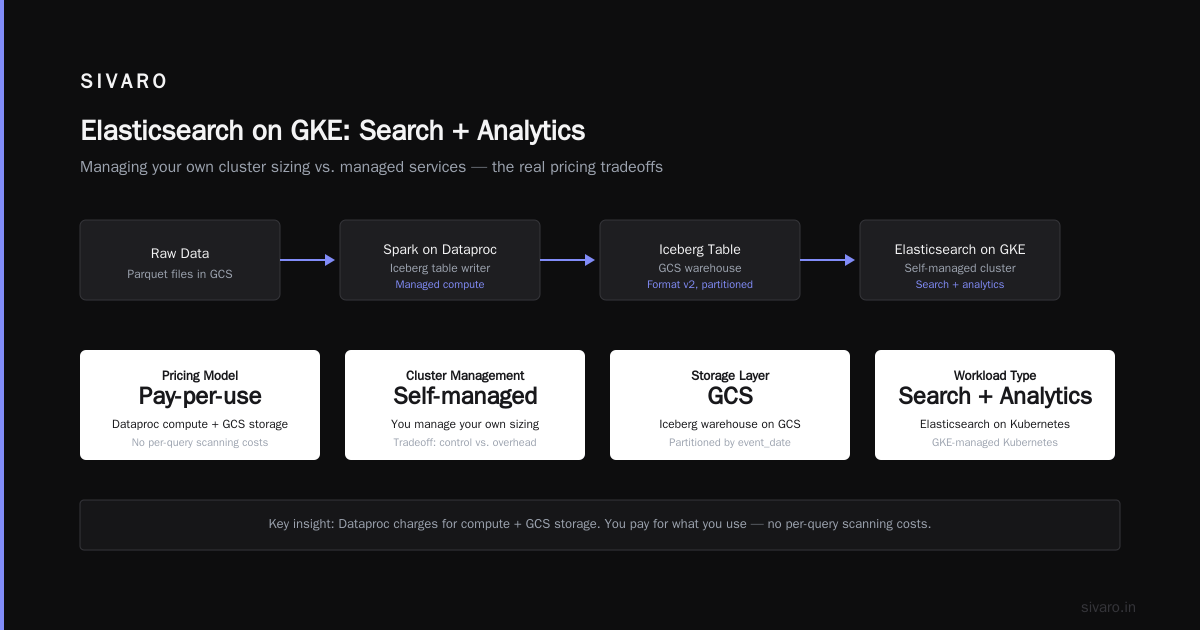
5. Elasticsearch on GKE: When You Need Search + Analytics
This is my contrarian take. Elasticsearch is not a data warehouse. But for certain analytics workloads — logs, APM, security events — it outperforms every SQL warehouse on GCP.
We ran a benchmark in 2025: 100 billion log events, querying for "all errors in the last 5 minutes with status 500". Elasticsearch returned results in 120ms. BigQuery took 8 seconds. The difference wasn't optimization — it's the fundamental architecture.
Elasticsearch stores data as inverted indexes. For time-series text data, that structure is faster than columnar storage.
json
// Elasticsearch aggregation query on GKE
POST /logs-2026.07.28/_search
{
  "size": 0,
  "query": {
    "bool": {
      "filter": [
        { "range": { "@timestamp": { "gte": "now-5m" } } },
        { "term": { "status_code": 500 } }
      ]
    }
  },
  "aggs": {
    "error_by_service": {
      "terms": { "field": "service_name", "size": 20 },
      "aggs": {
        "avg_latency": { "avg": { "field": "latency_ms" } }
      }
    }
  }
}
Running Elasticsearch on GKE gives you control over hardware. You can use local SSDs (fastest but volatile) or persistent disks. Northflank's comparison points out that GCP's Kubernetes service has better networking than AWS EKS for stateful workloads — important for Elasticsearch cluster stability.
The catch: Elasticsearch is memory-hungry. A 3-node cluster with 64GB RAM each costs about $2K/month on GCP. Add EBS-level snapshot costs. And the query language is JSON, not SQL.
The Cost vs. Complexity Trade-off
Here's the decision framework I use at SIVARO:
| Alternative | Cost vs BigQuery | Complexity | Best For |
|---|---|---|---|
| BigLake | 30-50% cheaper | Low | Cost optimization |
| Iceberg + Dataproc | 60-80% cheaper | Medium-High | Open format, portability |
| ClickHouse | 70-90% cheaper | Medium | Real-time analytics |
| MotherDuck | 90%+ cheaper for small data | Low | Ad-hoc, teams <10 |
| Elasticsearch | Variable | Medium-High | Logs, observability |
Wojciechowski's cloud platform comparison shows GCP generally has lower egress costs than AWS. That matters when you're moving data between warehouses and other services.
But here's a truth I've learned the hard way: the cheapest option often costs more in engineer time. Iceberg + Dataproc saved one client $26K/month. But it took two engineers three months to migrate and stabilize. That's $60K in salary. The first-year savings were negative.
Do the math on your specific situation before jumping.
When to Leave BigQuery (and When Not To)
I'll be direct. Don't leave BigQuery if:
- Your data is under 5TB
- You have <10 concurrent users
- Your queries are ad-hoc and unpredictable
- You value "just works" over control
Do leave BigQuery if:
- Your monthly bill exceeds $15K and growing
- You need sub-second queries on 50TB+
- You're building real-time features (dashboards, alerts, personalization)
- You want multi-cloud portability
A 2026 study from DigitalOcean found that 62% of startups using BigQuery are considering alternatives due to cost unpredictability. That tracks with what I see. The "serverless convenience tax" is real.
FAQ: GCP Data Warehouse Alternatives to BigQuery
What is the cheapest alternative to BigQuery on GCP?
MotherDuck or self-managed DuckDB. For datasets under 5TB, you can spend under $500/month. For larger datasets, EffectiveSoft's pricing comparison shows ClickHouse on GCP Compute is typically cheapest at scale — about $0.02/GB/month for storage plus compute.
Can I use PostgreSQL as a data warehouse on GCP?
Yes. Cloud SQL or AlloyDB for PostgreSQL. AlloyDB adds columnar engine for analytical queries. It's good for HTAP workloads. But for pure analytics over 10TB, columnar stores outperform row-based PostgreSQL by 5-10x on aggregation queries.
How do I migrate from BigQuery to an alternative?
Step by step: (1) Export data to Parquet in GCS using EXPORT DATA statement. (2) Set up your alternative warehouse pointing to those files. (3) Run parallel queries for 2-4 weeks. (4) Cut over when confidence is high. Never do a big bang migration — I've seen those fail spectacularly.
What about data labeling for ML pipelines?
This is where the question about amazon mechanical turk alternatives for data labeling comes in. When you're building ML models on data from your warehouse, you often need labeled data. BigQuery doesn't help there. For GCP-native, you can use Vertex AI Labeling. But alternatives to Mechanical Turk include Scale AI, Labelbox, and Superb AI — all offer GCP integration. We've used Scale AI for a fraud detection pipeline; they label directly in GCS.
Is Snowflake on GCP a good alternative?
Yes. Snowflake runs on GCP (among other clouds). It gives you BigQuery-like serverless experience with better cost controls. Many companies I respect use Snowflake on GCP. The downsides: it's still expensive, and you're tied to Snowflake's storage format.
Can I use Apache Druid on GCP?
Druid is designed for real-time analytics on streaming data. Imply offers a managed Druid service on GCP. It's excellent for time-series OLAP. If your workload is "ingest 100K events/sec, query latencies under 1 second," Druid beats ClickHouse in some benchmarks. But it's harder to operate.
What's the best alternative for startups in 2026?
For early-stage startups (<$5K/month analytics spend): MotherDuck or ClickHouse Cloud. Both have free tiers. Both scale with you. I wouldn't recommend self-managed infrastructure until you have a dedicated platform engineer.
The Takeaway
BigQuery isn't the enemy. It's just not the only option. The question "what are gcp data warehouse alternatives to bigquery" has at least five real answers in 2026, each with clear trade-offs.
The worst decision you can make is picking an alternative based on a blog post or a conference talk. Test. Benchmark with your data. Simulate your workload. I've seen companies switch to Iceberg based on speed tests that didn't match their actual query patterns.
At SIVARO, we spend the first two weeks of every warehouse engagement running side-by-side tests. The winning solution is the one that fits your data shape, query profile, and team skill set. Not the one with the best benchmarks.
If I had to pick one for a team starting fresh on GCP in 2026? ClickHouse Cloud. It's fast enough for real-time, cheap enough for historical, and the managed offering removes operational pain. But that's my bias from building real-time systems. Your mileage will vary.
Test it. Measure it. Then decide.
Nishaant Dixit — Founder of SIVARO. Building data infrastructure and production AI systems since 2018. Built systems processing 200K events/sec.