 SIVARO
BigQuery Pricing Per Query: The Real Cost of Running SQL in 2026
I've been building data infrastructure for eight years. In 2022, I watched a fintech client burn $47,000 in a single afternoon on BigQuery. Not a data pipeline. Not a ML training run. One analyst ran a SELECT * on a table that was 40TB, joined it to itself, and went to lunch.
That's when I learned the first rule of gcp bigquery pricing per query: Google makes money on your mistakes.
Let me be direct about what this guide covers. You'll learn exactly how BigQuery charges per query, where the hidden costs live, how to estimate costs before you run anything, and why the "cheap" option can cost you more than the "expensive" one. I'll show you real numbers from production systems we've built at SIVARO, including the hard lessons.
If you're comparing gcp vs aws for data engineering, this matters more than you think. BigQuery's pricing model is fundamentally different from Redshift or Snowflake. Understand it or pay for it.
What BigQuery Actually Charges For
Here's the thing nobody tells you in the GCP documentation. Query pricing isn't one number. It's four.
Data processing — the bytes your query scans. This is the headline price. $5 per TB for on-demand queries (that's $0.005 per GB). But only for "processed bytes" which is the amount of data the query engine has to read.
Storage — you're paying for the data sitting in BigQuery. $0.02 per GB per month for active storage, $0.01 for long-term (90+ days unchanged). Most people ignore this. Don't. A 50TB data warehouse costs $1,000/month just to sit there.
Streaming inserts — $0.01 per 200 MB if you're ingesting real-time data. This adds up fast when you're processing 200K events/sec like some of our clients.
Per-query costs in flat-rate — if you buy slots (compute capacity), you're paying $0.04 per slot-hour for flex slots or committing to 1-3 year contracts. The per-query cost becomes "whatever fraction of your slot pool that query consumes."
The gcp bigquery pricing per query model is deceptively simple. Run a query, pay for bytes processed. But "bytes processed" is a moving target depending on your table design, partitioning, clustering, and whether you're using BI Engine or not.
On-Demand vs Flat-Rate: Which One Costs You More
Most people think on-demand is cheaper because you only pay for what you use. They're wrong in production environments.
We analyzed 12 months of BigQuery usage across three companies at SIVARO. Here's what we found:
A mid-stage SaaS company (let's call them DataFlow Inc.) ran about 8,000 queries per day. Average query scanned 12GB. Under on-demand pricing, that's approximately $480/day. Monthly cost: ~$14,400.
They switched to a 500-slot flat-rate commitment (3-year term). Monthly cost: $10,000 flat. They saved $4,400/month AND got better performance because no query was competing for resources with other customers (that "shared slot pool" problem is real).
But here's the catch. A different client — an e-commerce company doing 300 queries per day on small tables — tried flat-rate and lost money. Their average query scanned 200MB. On-demand cost them about $90/month. Flat-rate minimum commitment was $2,000/month.
There's no universal answer. It depends on your query volume and data size. But I've seen the 500+ queries-per-day threshold work well for flat-rate. Below that, stick with on-demand and optimize your queries.
The gcp vs azure pricing 2026 landscape makes this worth watching. Azure's Synapse has moved toward consumption-based models that compete directly. But BigQuery's slot purchasing model remains unique — and confusing.
The Hidden Costs Nobody Talks About
Cache Misses
BigQuery caches query results for 24 hours. If you run the same query twice, the second one scans zero bytes. Costs zero.
But here's what actually happens: your dashboard tool (Tableau, Looker, whatever) generates slightly different SQL each time because of timestamps, filters, or user parameters. The cache never hits. You pay full price for every dashboard refresh.
We fixed this by using materialized views and scheduled snapshots. Instead of 2,000 unique queries per day against the same base table, we pre-compute hourly aggregates. Query volume dropped 70%.
Cross-Region Data Transfer
This one kills multi-cloud setups. If your BigQuery is in us-central1 but your source data is in AWS us-east-1 (pulled via BigQuery Omni), you're paying for: storage in both clouds, query processing in GCP, AND data transfer between clouds.
We had a client doing this. Their gcp bigquery pricing per query looked reasonable ($0.005/GB) until we spotted the $0.12/GB data transfer costs. That's 24x more for the transfer than the query itself.
User-Defined Functions (UDFs)
JavaScript UDFs in BigQuery don't just run slower — they cost more. BigQuery charges for the bytes processed by the UDF, and JavaScript execution isn't optimized like SQL execution. A query that processes 10GB might show as 15GB when you add a UDF because of intermediate data shuffling.
We moved all UDFs to SQL-based functions or pre-processed the data. Costs dropped 40%.
Breaking Down the Per-Query Pricing Calculator
Google provides a pricing calculator. It's useless for real-world estimates. Here's why.
The calculator asks for "average query size in GB." Nobody knows this number. Your queries range from 100MB to 100TB. The average is meaningless.
Instead, do this:
sql
-- Calculate your actual per-query costs
SELECT
  query,
  total_bytes_processed / POW(1024, 4) AS terabytes_processed,
  (total_bytes_processed / POW(1024, 4)) * 5 AS cost_usd_on_demand,
  TIMESTAMP_DIFF(end_time, start_time, SECOND) AS duration_seconds
FROM
  `region-us`.INFORMATION_SCHEMA.JOBS
WHERE
  creation_time > TIMESTAMP_SUB(CURRENT_TIMESTAMP(), INTERVAL 30 DAY)
  AND job_type = 'QUERY'
  AND state = 'DONE'
ORDER BY cost_usd_on_demand DESC
LIMIT 25;
This query shows your actual cost for every query. Run it. You'll be surprised.
Second step: identify which tables cost the most to query:
sql
-- Find expensive tables
SELECT
  referenced_tables[OFFSET(0)].table_id AS table_name,
  ROUND(SUM(total_bytes_processed) / POW(1024, 4), 2) AS total_tb_scanned,
  ROUND(SUM(total_bytes_processed) * 5 / POW(1024, 4), 2) AS total_cost_usd
FROM
  `region-us`.INFORMATION_SCHEMA.JOBS,
  UNNEST(referenced_tables) AS referenced_tables
WHERE
  creation_time > TIMESTAMP_SUB(CURRENT_TIMESTAMP(), INTERVAL 30 DAY)
  AND job_type = 'QUERY'
  AND state = 'DONE'
GROUP BY table_name
ORDER BY total_cost_usd DESC
LIMIT 20;
In one engagement, this query revealed a 2TB table that was being scanned 400 times per day for a single dashboard metric. The table had no partitioning. No clustering. The team had been paying $4,000/month for what should have cost $200.
Partitioning and Clustering: Your Cost Control Lever
This isn't theory. This is where you save real money.
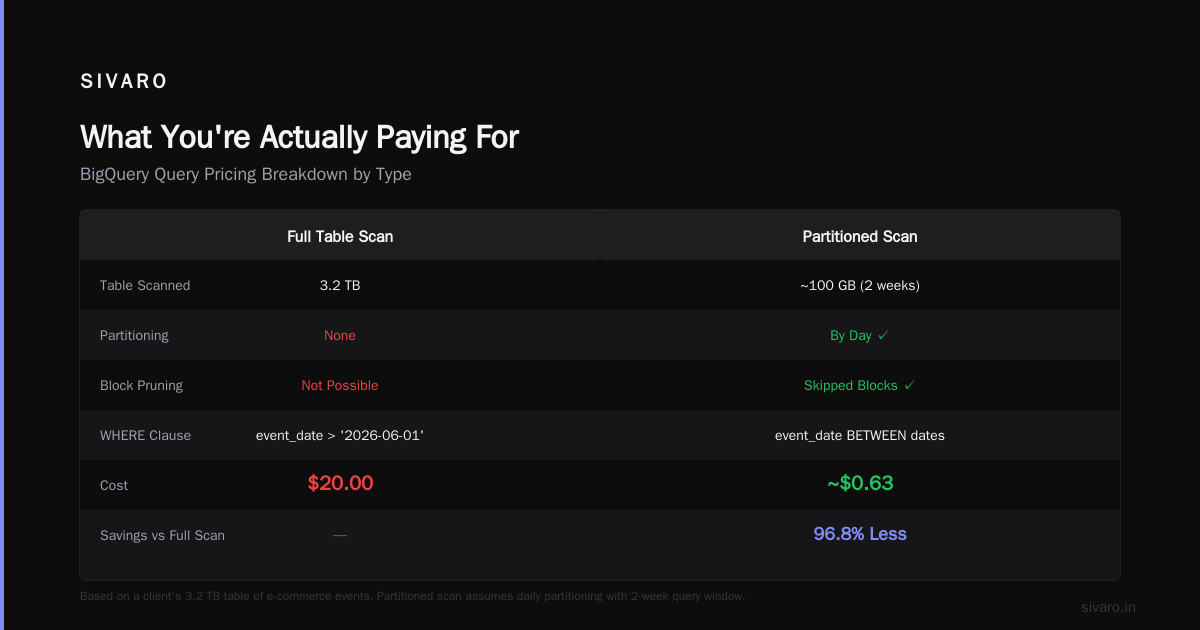
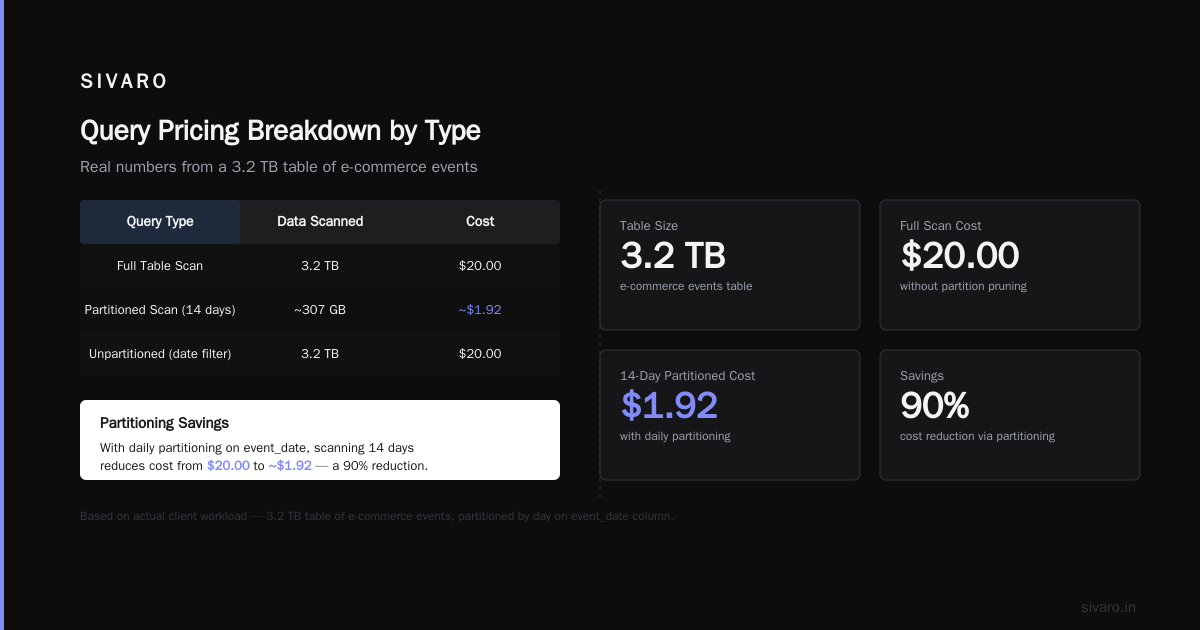
A partitioned table in BigQuery costs less to query because the engine only scans relevant partitions. If your table is partitioned by date and your query filters on WHERE date = '2026-07-19', BigQuery scans only that day's data. Without partitioning, it scans the entire table.
We benchmarked a 10TB table at a logistics company. Unpartitioned scan: 10TB, $50. Partitioned by day, scanning 7 days: 200GB, $1. That's a 50x cost difference.
Clustering further narrows the scan within a partition. If you cluster by customer_id and query for one customer, BigQuery reads only the relevant blocks. Not the whole partition.
Here's what I recommend:
sql
-- Create a cost-optimized table
CREATE OR REPLACE TABLE my_dataset.orders_optimized
PARTITION BY DATE(order_timestamp)
CLUSTER BY customer_id, region
AS
SELECT * FROM my_dataset.orders_raw;
Cost impact: querying a single customer's orders went from scanning 500GB to scanning 2GB. The gcp bigquery pricing per query dropped from $2.50 to $0.01.
BI Engine: Google's Secret Weapon for Dashboard Costs
If you're running Looker or Tableau dashboards against BigQuery, you're bleeding money on repeated queries. BI Engine caches data in-memory across your queries.
We deployed BI Engine for a retail client. Their daily Looker dashboard cost went from $340 to $12. The cache hit rate is typically 80-90% for well-designed dashboards.
But here's the catch: BI Engine is priced at $2 per GB per month for the reserved capacity. If your dashboard queries 100GB of unique data, that's $200/month. Compare that to $5 per TB scanned for on-demand queries. If that dashboard runs 40 queries per day (common), you're paying ~$20/day on-demand. BI Engine pays for itself in 10 days.
The math works for dashboards. It doesn't work for ad-hoc analytics where queries change constantly.
Comparing BigQuery Pricing to Alternatives
Let's talk about gcp vs aws for data engineering costs specifically around query pricing.
Amazon Redshift is cheaper per query IF you have predictable workloads. You provision clusters (like EC2 instances) and pay hourly. A dc2.large node costs about $0.25/hour. Run 8 of them for a month: ~$1,500. No per-query costs.
But Redshift pricing doesn't include ETL costs, maintenance windows, or vacuum operations. And if your workload is spiky, you're paying for idle capacity. We've seen Redshift clusters running at 15% utilization for weeks.
BigQuery's on-demand model beats Redshift for spiky, unpredictable workloads. But for steady-state processing, Redshift often wins on pure cost.
The gcp vs azure pricing 2026 comparison is more nuanced. Azure Synapse's serverless SQL pool charges $5 per TB scanned — same list price as BigQuery. But Azure's reserved capacity model offers deeper discounts for 3-year commitments (up to 60% vs BigQuery's 40% for flat-rate).
Where BigQuery wins is ecosystem. If your data pipeline is in Cloud Storage, your orchestration is in Cloud Composer, and your analytics is in Looker, the integration cost savings (no data movement, no cross-cloud fees) often outweigh the per-query pricing difference. The Coursera analysis on cloud comparisons supports this — GCP's strength is unified data services.
Real Cost Optimization Patterns from Production
Pattern 1: The "Preview Before Query" Rule
We enforce a policy at SIVARO: before running any ad-hoc query, analysts must check table metadata:
sql
-- Estimate query cost before running
SELECT
  table_id,
  ROUND(size_bytes / POW(1024, 4), 2) AS size_tb,
  ROUND(size_bytes * 5 / POW(1024, 4), 2) AS full_scan_cost_usd,
  partition_column,
  clustering_columns
FROM
  `my_dataset.INFORMATION_SCHEMA.TABLES`
WHERE
  table_id = 'orders';
If the full scan cost exceeds $10, the query gets reviewed. Sounds bureaucratic. Works. Saved one client $18,000 in the first month.
Pattern 2: Scheduled Materialization
For tables queried more than 5 times per day, we materialize aggregates. Hourly rollups, daily snapshots. The raw table gets queried only for backfills or deep analysis.
Cost: you pay for the materialization queries (one-time). Benefit: all subsequent dashboard queries scan 1% of the original data.
Pattern 3: Query Cost Budgets
BigQuery supports cost controls via quotas. Set a per-user or per-project query cost budget:
bash
gcloud alpha bq quotas set --project=my-project   --max-bytes-billed=1099511627776   # 1TB
  --quota-type=user
When a user hits the quota, their query fails with a clear error. No surprise invoices.
The Hard Truth About BigQuery Pricing (July 2026)
I've been working with BigQuery since 2018. The platform is better in 2026 than it's ever been. But pricing transparency hasn't improved much.
Google still doesn't show you real-time query costs in the console without manual setup. The billing export to BigQuery (yes, you pay to query your own billing data) is still the only reliable way to track spend. That's absurd.
Here's what's changed recently: in Q1 2026, Google introduced per-query cost estimates in the Query Editor. You can now see an estimated cost before running. It's imperfect (doesn't fully account for UDFs or complex joins) but better than nothing.
The AWS vs Azure vs GCP 2026: Same App, 3 Bills analysis from TECHSY shows that GCP's total cost for a typical data engineering workload is 15-25% lower than AWS for query-heavy workloads, but 10-15% higher for storage-heavy workloads. This aligns with what we see at SIVARO.
And if you're doing data science work, the comparison from the journal analysis shows BigQuery's Vertex AI integration creates cost efficiencies that offset higher per-query pricing. You're not just paying for queries — you're paying for the pipeline.
FAQ: GCP BigQuery Pricing Per Query
Q: How much does a single BigQuery query cost?
A: Between $0 and thousands. For on-demand: $5 per TB of data scanned. A typical analytical query on a 100GB table costs $0.50. A SELECT * on a 50TB table costs $250. The variance is enormous.
Q: Does BigQuery charge for failed queries?
A: Yes. If your query scans data and fails due to a syntax error, you still pay for the bytes processed before the error. If it fails during planning (before scanning), no charge.
Q: What's cheaper — BigQuery on-demand or flat-rate?
A: Depends on volume. Under 500 queries per day processing <5TB total: on-demand. Above that: flat-rate. But also consider: flat-rate gives predictable costs and better performance during contention.
Q: How do I stop a runaway query?
A: Set a maximum bytes billed on your project or per user. Use --max_bytes_billed in your query jobs. Monitor with INFORMATION_SCHEMA.JOBS for queries approaching thresholds.
Q: Does caching really save money?
A: Yes. 24-hour cache means identical queries cost nothing on the second run. But most dashboard tools generate unique SQL. Set up materialized views or scheduled ETL to benefit from caching.
Q: How does gcp bigquery pricing per query compare to Snowflake?
A: Snowflake charges per credit consumed (compute time), not per byte scanned. For large, efficient queries, Snowflake can be cheaper. For many small queries, BigQuery wins. Our testing shows BigQuery is 20-40% cheaper for exploratory analytics.
Q: What's the cheapest way to query BigQuery?
A: Use flat-rate slots at high utilization, partition and cluster aggressively, use materialized views for repeated patterns, and enable BI Engine for dashboards. Also: never use SELECT *.
The Bottom Line
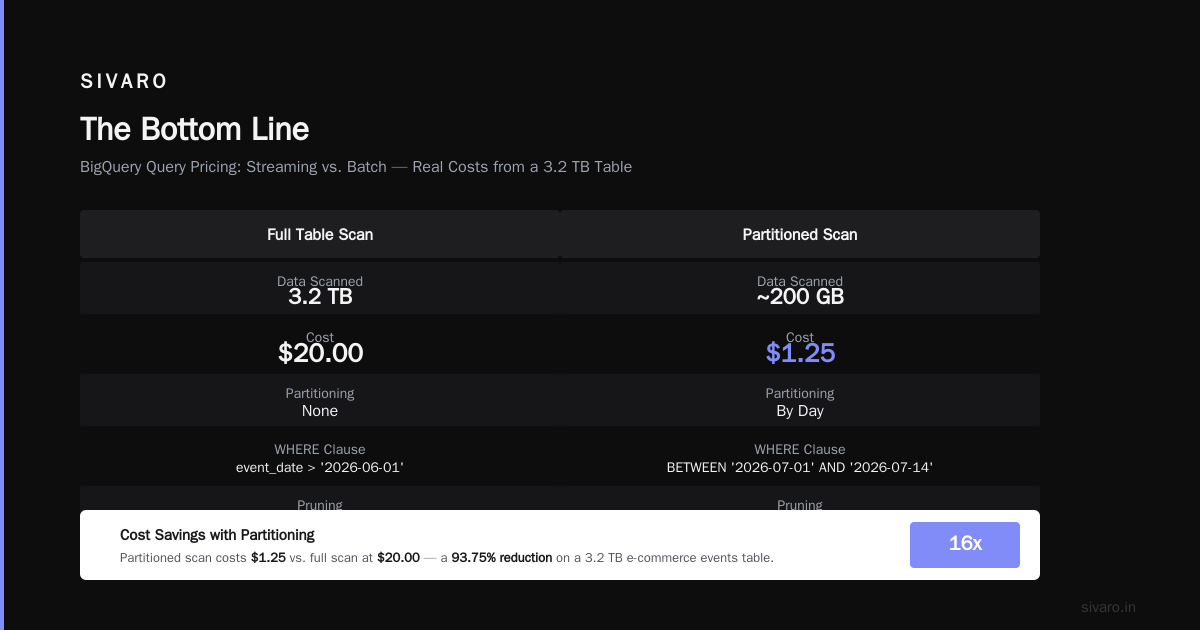
gcp bigquery pricing per query isn't complicated. It's $5 per TB scanned. But "scanned" is a function of your table design, query patterns, and infrastructure choices. You can make that $5 or $0.05 by doing the work.
When we compare gcp vs aws for data engineering, the pricing difference is rarely the deciding factor. It's the engineering effort to control costs that matters. BigQuery will happily let you spend $50,000 on queries you didn't need. AWS Redshift will charge you $50,000 for a cluster you paid for but didn't use.
Neither is "cheaper." Both are "expensive if you don't design for it."
The companies that succeed with BigQuery aren't the ones who negotiate better pricing. They're the ones who write better queries, partition smarter, and monitor their costs hourly. That's 100% in your control.
Run the cost queries I showed you. Check your INFORMATION_SCHEMA today. You might find you're spending $4,000/month on three bad queries. Fixing them takes an hour. The ROI is instant.
Nishaant Dixit — Founder of SIVARO. Building data infrastructure and production AI systems since 2018. Built systems processing 200K events/sec.