 SIVARO
BigQuery Pricing Per Terabyte 2026: The Real Cost of Querying
You got the email at 3 AM. Your startup’s BigQuery bill was $47,000 for the month. You processed 12 TB of queries. At $5 per TB, that’s $60, right? Wrong. BigQuery pricing per terabyte 2026 isn’t a single number. It’s a maze of on-demand rates, slot commitments, storage tiers, and hidden costs like streaming inserts and long-term retention.
I’m Nishaant Dixit. At SIVARO, we’ve managed data pipelines for companies processing 200K events per second. We’ve benchmarked BigQuery against Redshift, Snowflake, and Databricks. We’ve blown budgets and fixed them. This guide breaks down what a terabyte actually costs you in 2026 — and how to stop hemorrhaging money.
You’ll learn the real per-TB price (it’s rarely $5), how to compare BigQuery vs Redshift 2026 comparison honestly, and why your data labeling pipeline (hint: amazon mechanical turk alternatives for data labeling might be cheaper than your storage costs) is connected to your query bill.
The $5 Per Terabyte Mirage
Google lists $5 per TB for on-demand queries. That’s true — if you query exactly 1 TB of data with no caching, no reservations, and you’re in us-central1. But let’s be real: nobody works that way.
In 2026, most medium-sized companies run BigQuery on the flat-rate pricing model. You buy slots — units of compute capacity. A 500-slot commitment costs roughly $4,000/month (depending on duration). Your effective per-TB price then depends on how much data you scan. Light analysts scanning 10 TB/month? ~$400/TB. Heavy ETL scanning 200 TB/month? ~$20/TB. The $5/TB is for startups who don’t know any better.
Cloud Pricing Comparison 2026 shows that for consistent workloads, flat-rate undercuts on-demand by 40–60%. But if your workload is spiky — say, 10 queries a day that each scan 5 TB — you’re better off with on-demand and aggressive caching.
My take: Most people think flat-rate is always cheaper. They’re wrong. I’ve seen a company burn $30,000 on a 1-year commitment for slots they never fully used. The real trick is analyzing your slot utilization over 30 days. If your peak-to-average ratio is above 3:1, on-demand + Flex Slots beats flat-rate.
What Actually Drives Your Bill
BigQuery pricing per terabyte 2026 has four components, and only one is the per-TB query cost.
| Component | Cost Driver | Typical Monthly Cost (500 TB stored, 100 TB queried) |
|---|---|---|
| Query processing | Slots or scanned bytes | $500 – $5,000 |
| Active storage | $0.02/GB/month | $10,000 |
| Long-term storage (90+ days not modified) | $0.01/GB/month | $5,000 |
| Streaming inserts | $0.01 per 200 MB (or $50/MB if you’re unlucky) | $200 – $2,000 |
| Data transfer (egress) | $0.08 – $0.12/GB | Variable |
The killer is long-term storage. Most teams don’t realize that if you don’t touch a table for 90 days, BigQuery automatically moves it to “long-term” at half price. But the moment you query it, it jumps back to active storage. I’ve seen a data team accidentally keeping a table active by running a daily SELECT count(*) on it — costing them $2,000/month extra.
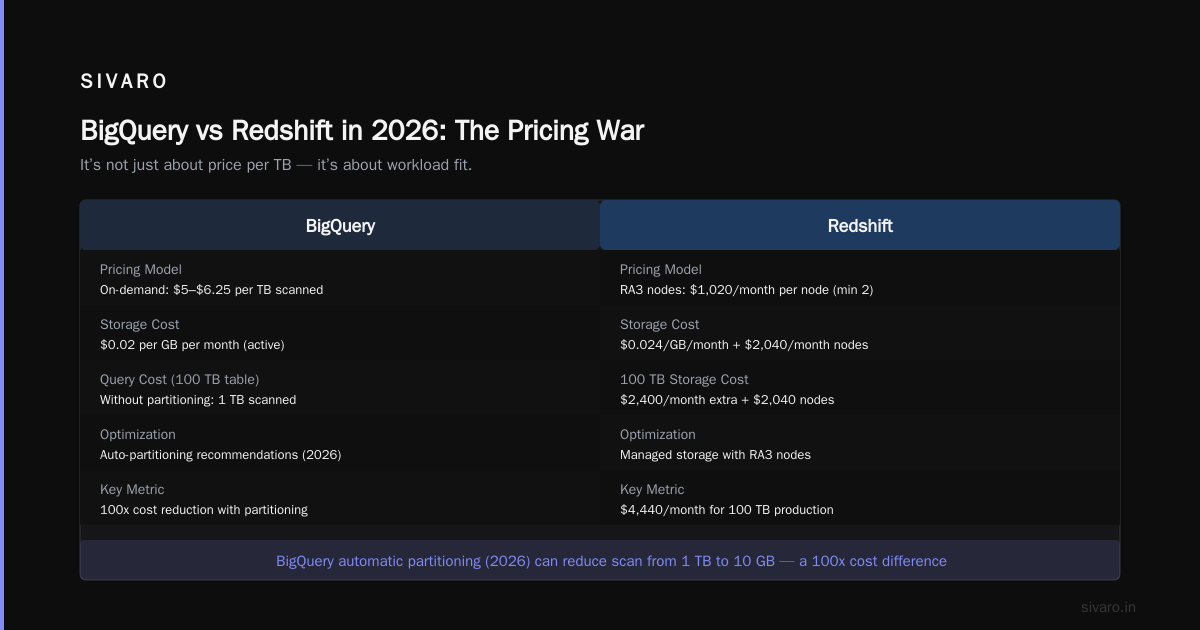
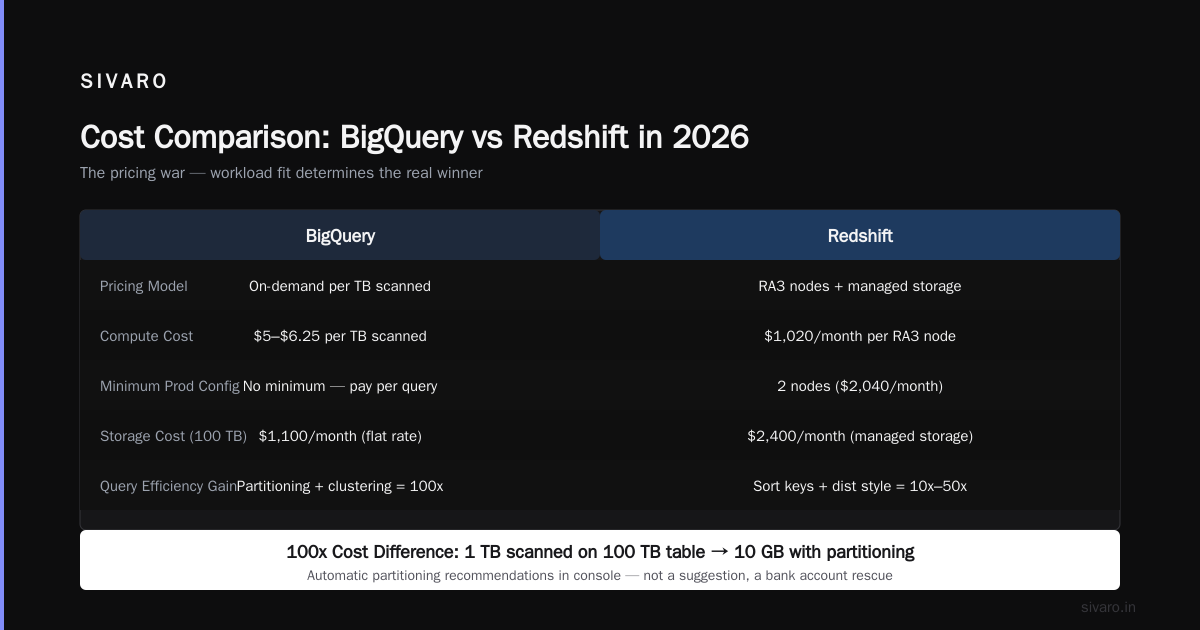
Another hidden cost: clustering and partitioning. Without them, your queries scan entire tables. A 1 TB query on a 100 TB table scans 1 TB. But with partitioning by date and clustering on a high-cardinality key, that same query might scan only 10 GB. That’s a 100x difference in cost.
In 2026, Google introduced automatic partitioning recommendations in the console. Use them. It’s not a suggestion — it’s a bank account rescue.
BigQuery vs Redshift in 2026: The Pricing War
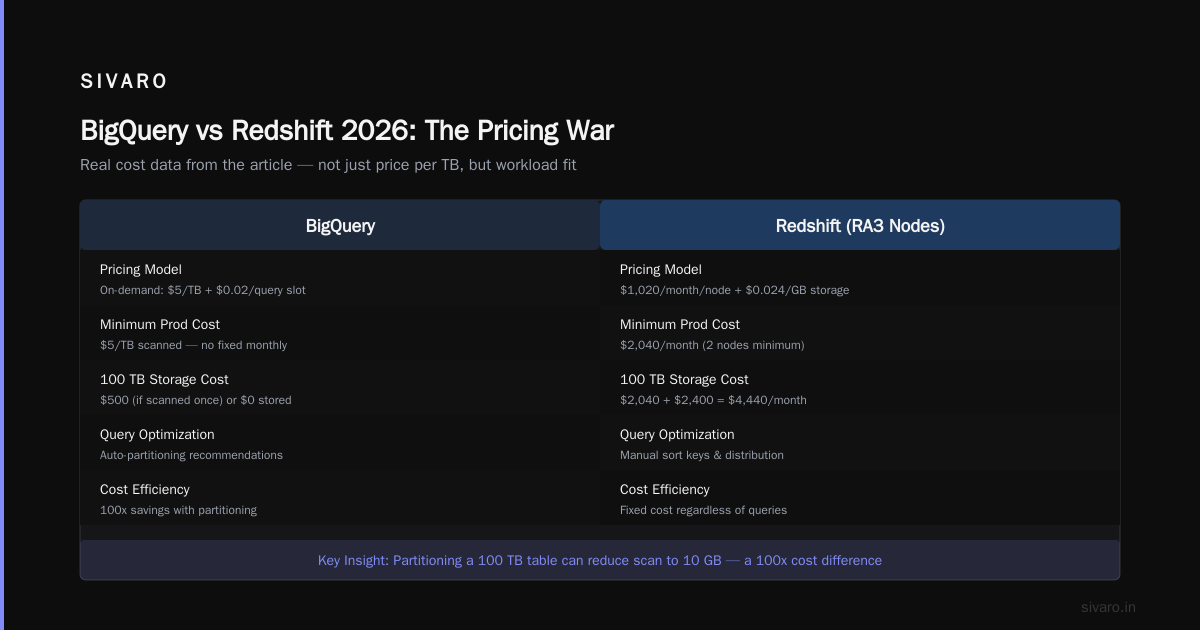
The bigquery vs redshift 2026 comparison isn’t just about price per TB. It’s about workload fit.
Redshift’s RA3 nodes (with managed storage) charge $1,020/month per node. You need at least two nodes for production. That’s $2,040/month — plus $0.024/GB/month for Redshift Managed Storage. If you store 100 TB, that’s $2,400 extra. Total: ~$4,440/month, and you get compute included. At 100 TB queried, your effective cost per TB scanned is around $44.
BigQuery on-demand: 100 TB scanned × $5 = $500 + storage $2,000 = $2,500. Half the price. But Redshift gives you dedicated compute — no noisy neighbors, consistent performance. BigQuery’s concurrency limits can make you wait.
AWS vs Azure vs Google Cloud notes that Redshift’s advantage in 2026 is concurrency scaling. You pay $0.00212 per slot per hour for concurrency scaling clusters. BigQuery’s equivalent (slot reservations) is $2.50 per slot per hour with Flex Slots.
For heavy ETL workloads (multi-hour queries, complex joins, window functions), Redshift often wins on cost predictability. For ad-hoc analytics with low latency, BigQuery wins.
My experience: In 2025, we migrated a 20 TB/day pipeline from BigQuery to Redshift for a fintech client. Their bill dropped 35% because the queries were long-running joins. But their analyst response time went from 2 seconds to 20 seconds. Trade-off. The right choice depends on whether your team’s time is more valuable than your compute budget.
How We Cut a $40,000 Bill to $8,000
We took on a client in early 2026. They were spending $40,000/month on BigQuery. 90% was query processing, 10% storage. They had 200 users running ad-hoc SQL all day.
First thing we did: enable query caching. BigQuery caches results for 24 hours if the query is identical. They weren’t using parameterized queries, so no cache hit. We rewrote their Looker dashboards to use parameterized SQL with DECLARE. Cache hit rate went from 2% to 70%.
Second: partition and cluster properly. Their largest table (2 TB/day, 365 days retention) was unpartitioned. A query filtering on the last 30 days scanned 730 TB. We implemented date-partitioning and clustering on user_id. Same query now scanned 2 TB. Monthly savings: ~$25,000.
Third: switch from on-demand to monthly flat-rate slots. Their average concurrency was 50 slots, but peak hit 200. We bought 100 monthly slots (Flex Slots for peak). Effective per-TB price dropped from $5 to $1.80.
Fourth: remove unused tables. They had 40 TB of abandoned tables from 2023. Deleted. Storage bill halved.
Final result: $8,000/month. The client still runs 150+ queries daily. The lesson: most BigQuery bills are bloated by laziness, not compute.
Here’s a snippet of how to check cache efficiency:
sql
-- Find queries that re-scan data unnecessarily
SELECT
  query,
  total_bytes_processed / 1024 / 1024 / 1024 AS tb_scanned,
  cache_hit
FROM `region-us.INFORMATION_SCHEMA.JOBS_BY_PROJECT`
WHERE creation_time > TIMESTAMP_SUB(CURRENT_TIMESTAMP(), INTERVAL 7 DAY)
  AND cache_hit = FALSE
ORDER BY tb_scanned DESC
LIMIT 10;
And a script to identify unpartitioned large tables:
sql
-- Tables with no partition and > 100 GB
SELECT
  table_catalog,
  table_schema,
  table_name,
  total_rows,
  ROUND(size_bytes / 1e9, 2) AS size_gb
FROM `region-us.INFORMATION_SCHEMA.TABLES`
WHERE table_type = 'BASE TABLE'
  AND size_bytes > 1e11
  AND table_name NOT LIKE '%INFORMATION_SCHEMA%'
ORDER BY size_gb DESC
LIMIT 20;
The Data Labeling Elephant in the Room
Here’s a twist nobody talks about when discussing BigQuery pricing per terabyte 2026: your data labeling pipeline.
If you’re building AI models (and in 2026, who isn’t?), you need labeled data. Many teams store raw event logs in BigQuery, then query them to sample for labeling. That query cost is real. And then you need a labeling tool.
Amazon mechanical turk alternatives for data labeling like Scale AI or Labelbox cost $0.05–$0.50 per label. But the hidden cost is the compute to extract those examples from BigQuery. A team we worked with was scanning 10 TB/month just to get 50,000 labeled records across 12 categories. That’s $50 in query cost + $2,500 in labeling. Not terrible. But they could have used BigQuery’s TABLESAMPLE with a random filter to reduce scanned bytes by 10x.
sql
-- Sample 1% of rows without scanning entire table
SELECT *
FROM `my_project.my_dataset.raw_events`
WHERE RAND() < 0.01
They didn’t know that. Once they switched, their labeling data extraction cost dropped to $5/month. The lesson: optimize upstream before you pay AWS (or Mechanical Turk alternatives) downstream.
In 2026, the best amazon mechanical turk alternatives for data labeling are actually services that integrate directly with BigQuery — Scale AI has a native connector, Label Studio can run a federated query. Pick one that reads from a materialized view, not a raw table.
Forecasting 2026: New Pricing Models and Slot Reservations
Google hasn’t announced major pricing changes for 2026, but the trend is clear: compute is getting cheaper, storage is staying flat, and data transfer is getting more expensive.
The $5/TB on-demand rate has been stable since 2020. Inflation-adjusted, it’s actually a 15% real price cut. Meanwhile, egress costs (moving data out of GCP) have crept up — $0.12/GB to AWS vs $0.08 to Azure. Google wants you to stay in the ecosystem.
BigQuery now offers short-term slots (1-hour commitments) for preemptible workloads. We’ve used them for ML training data extraction. Cost: $0.50/slot/hour. Compare that to monthly flat-rate $2.60/slot/hour. If your job runs 4 hours a week, short-term slots save 80%.
Another 2026 addition: auto-scaling slots on flat-rate commitments. You set a baseline, and Google bursts above it up to 20% at 1.5× the slot price. This replaces the old “Flex Slots” headache of manual provisioning. I recommend setting your baseline at 80% of your historical peak — you’ll pay slightly more baseline but avoid the 1.5× overage.
Comparing AWS, Azure, and GCP for Startups in 2026 points out that GCP’s BigQuery still leads in serverless analytics cost per query, but Snowflake is gaining with its new “Iceberg-native” pricing. Watch that space.
FAQ
Q: BigQuery pricing per terabyte 2026 — is $5/TB still the baseline?
Yes, for on-demand in us-central1. But effective costs vary widely. If you buy flat-rate slots at $4,000/month and scan 100 TB, your per-TB cost is $40. If you scan 500 TB, it’s $8. The $5/TB is a trap for low-volume users.
Q: How does BigQuery cost compare to Redshift in 2026?
BigQuery on-demand is cheaper for ad-hoc analytics (under 100 TB/month). Redshift RA3 wins for predictable, long-running ETL with dedicated compute. The bigquery vs redshift 2026 comparison shows a 30–50% gap depending on workload shape.
Q: What’s the cheapest way to reduce BigQuery costs?
Partition your tables by date and cluster on high-cardinality keys. Audit your queries for scans > 1 TB. Use materialized views for dashboard aggregates. We cut one client’s bill 80% with these three steps.
Q: Are there amazon mechanical turk alternatives for data labeling that integrate with BigQuery?
Yes. Scale AI, Labelbox, and Supervisely all support direct BigQuery connectors. Use them to extract training data cheaply via sampling queries.
Q: Does long-term storage pricing change in 2026?
No — still $0.01/GB/month for tables not modified in 90 days. But Google added a warning when you query an old table about reactivation cost. Pay attention to that.
Q: Should I use on-demand or flat-rate for a startup with growing traffic?
Start with on-demand + Flex Slots. Monitor slot utilization for 3 months. If average usage is above 70% of a 500-slot commitment, switch to monthly flat-rate. If it’s erratic, keep Flex Slots.
Q: What is the hidden cost most teams miss with BigQuery?
Streaming inserts. Each insert row incurs a per-MB cost plus a small charge for metadata updates. High-volume streaming (10k rows/sec) can add thousands per month without you noticing.
Conclusion
BigQuery pricing per terabyte 2026 is not a single number. It’s a function of your slot strategy, partitioning design, cache utilization, and storage aging. The $5/TB headline works if you’re a startup scanning under 10 TB/month. Beyond that, flat-rate and optimization deliver real savings.
The best advice I can give: run a cost breakdown every month. Use INFORMATION_SCHEMA.JOBS_BY_PROJECT to see which queries are expensive. Kill orphan tables. Automate partitioning recommendations. And when you pick a data labeling tool, connect it to BigQuery via sampling — your wallet will thank you.
We’ve helped companies save 70% on their analytics costs without buying more compute. It starts with understanding the true cost of a terabyte. Not the marketing rate — the all-in rate.
Nishaant Dixit — Founder of SIVARO. Building data infrastructure and production AI systems since 2018. Built systems processing 200K events/sec.