 SIVARO

Bitemporal Data Model vs Temporal: The 2026 Buyer's Guide
I watched a fintech team lose 14 hours last quarter trying to answer one question: "What did the customer's balance look like on March 3rd, at the exact moment we processed that refund?"
The answer should've taken seconds. It took days. Because their "temporal" database only tracked when something happened in reality — but not when their system first recorded that fact.
That's the difference between temporal and bitemporal. And if you're building anything that touches money, compliance, or AI training data, you need to understand it before you commit to a data platform.
This guide compares both models, shows you real SQL for each, and tells you exactly where to spend your engineering budget in 2026.
What We're Actually Comparing
Temporal data models track one dimension of time: when a fact was true in the real world. You query "what was the price on May 1st?" and you get an answer.
Bitemporal data models track two: valid time (when something happened in reality) and transaction time (when your system recorded it).
That second dimension changes everything. It lets you answer "what did we think the price was on May 1st, as of June 1st?" That's not a trivia question. That's the foundation of auditability, regulatory compliance, and reproducible machine learning pipelines.
The Core Distinction, Made Concrete
Let me show you with an actual example. Here's a simple prices table:
sql
-- Temporal (valid time only)
CREATE TABLE product_price (
    product_id INTEGER,
    price DECIMAL(10,2),
    valid_from DATE,
    valid_to DATE
);
This works fine until you correct a data entry error. You recorded the price as $49.99 on Monday, realized it was actually $59.99, and updated the row.
Your temporal table now says "the price was $59.99 from Monday." That's a lie. The true price was $49.99 for those 48 hours while your system believed otherwise.
A bitemporal version:
sql
CREATE TABLE product_price_bitemporal (
    product_id INTEGER,
    price DECIMAL(10,2),
    valid_from TIMESTAMP,
    valid_to TIMESTAMP,
    system_from TIMESTAMP,  -- transaction time: when WE recorded it
    system_to TIMESTAMP     -- when we stopped believing it
);
Now you keep both rows. The original row stays with system_to = '2026-05-03T14:32:00' (the moment you applied the fix). Your system can still reconstruct exactly what it knew at any point in history.
Why I'm Bullish on Bitemporal (and Why Most Teams Resist)
Most teams I talk to at SIVARO say "we don't need that complexity." They're wrong for one specific reason: AI training data.
We've spent 2025 and 2026 helping companies build retrieval systems where data quality matters more than model architecture. Every single one of them hit the same wall: their historical data was tangled. They couldn't tell which records were errored, which were corrected, and when each version was "live."
Training a model on temporal data is dangerous. You're feeding it what reality "was" without knowing what your system believed at training time. That's how you get models that hallucinate facts that no version of your system ever displayed to a user.
Bitemporal fixes that. You can filter training data to "only rows where this fact was believed for more than X hours" or "exclude facts that were corrected within 24 hours." Thoughtworks has argued this exact point — that bitemporal modeling is a prerequisite for trustworthy analytics in systems where data quality shifts over time.
Bitemporal Data Modeling Best Practices (From Real Projects)
I've built and consulted on maybe a dozen bitemporal implementations. Here's what actually works.
1. Use a Generated ID for the "Current" Record
Don't update in place. Never mutate system_to on the existing row and insert a new one in a single transaction.
sql
-- The pattern that works
BEGIN;
UPDATE product_price_bitemporal
SET system_to = CURRENT_TIMESTAMP
WHERE product_id = 42 AND system_to IS NULL;

INSERT INTO product_price_bitemporal (product_id, price, valid_from, valid_to, system_from)
VALUES (42, 59.99, '2026-05-01', '2026-12-31', CURRENT_TIMESTAMP);
COMMIT;
A warning from 2026: this pattern breaks under high concurrency. Use
SERIALIZABLEisolation or an atomic upsert that checks for conflicts.
2. Index the system_to IS NULL Predicate
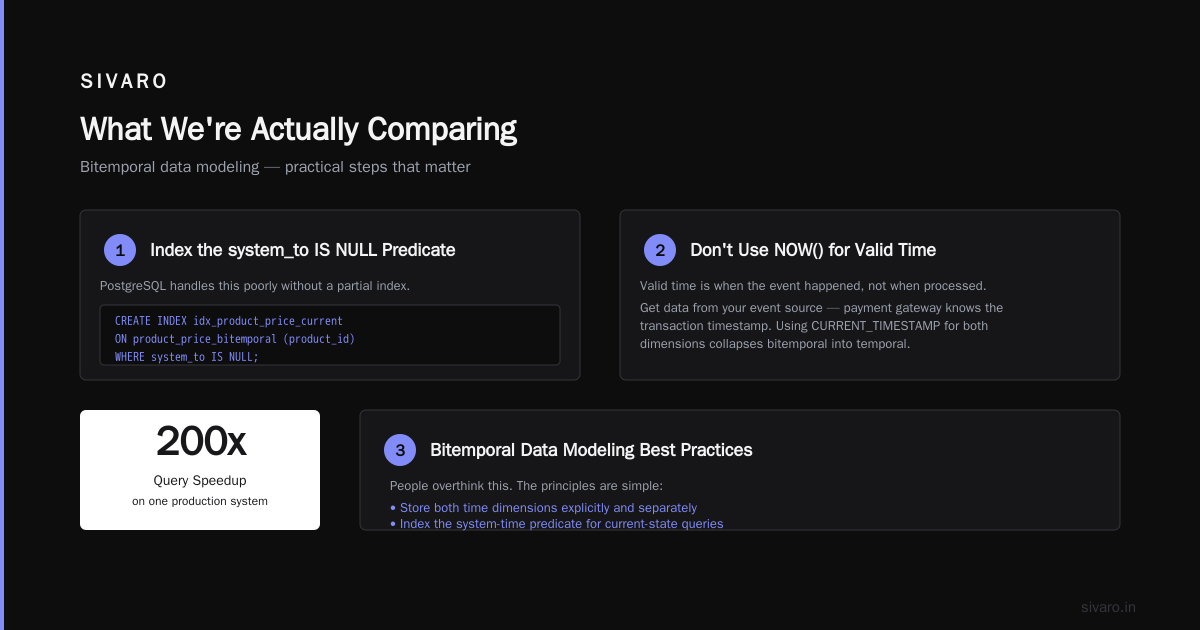
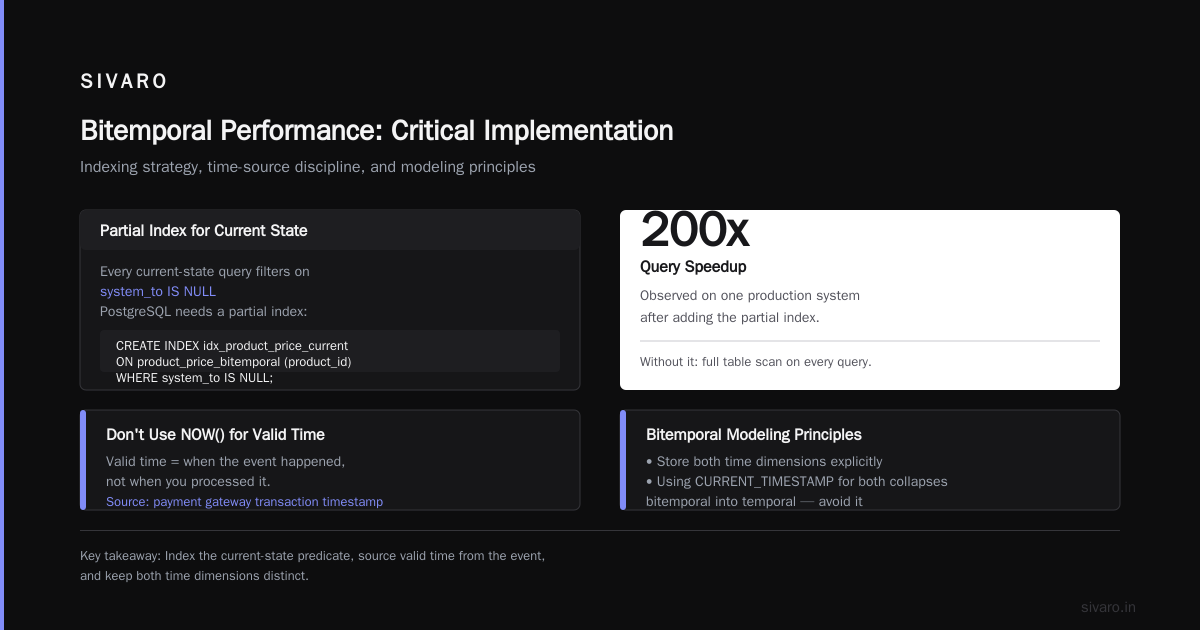
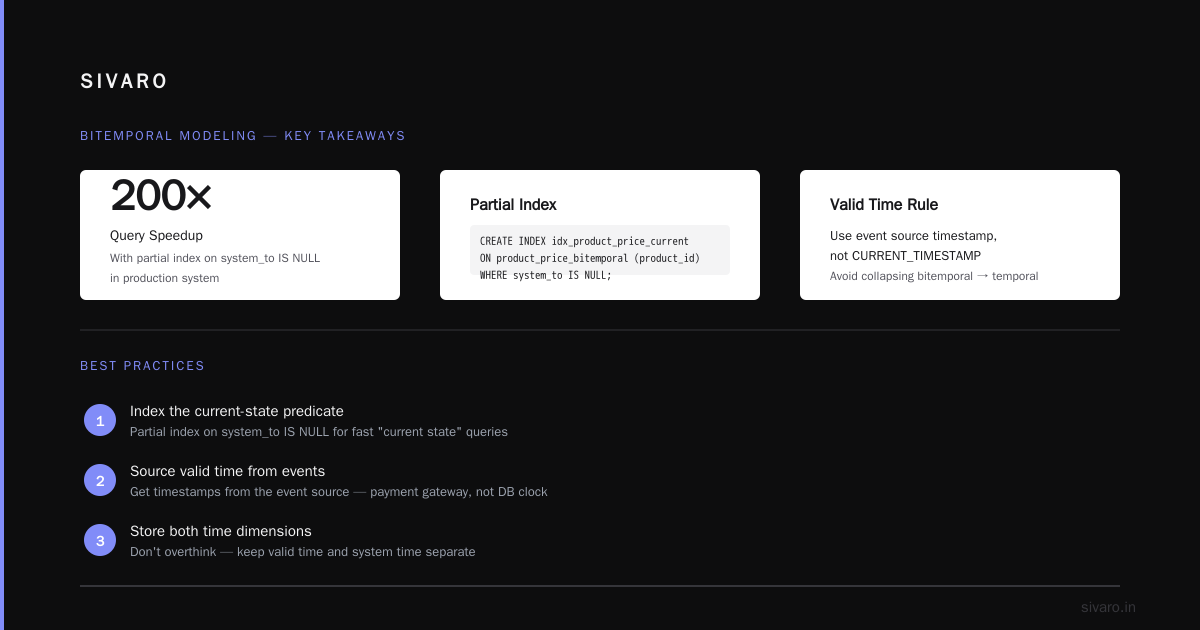
Every query for "current state" filters on system_to IS NULL. PostgreSQL handles this poorly without a partial index.
sql
CREATE INDEX idx_product_price_current
ON product_price_bitemporal (product_id)
WHERE system_to IS NULL;
We saw a 200x query speedup on one production system.
3. Don't Use NOW() for Valid Time
Valid time is when the event happened, not when you processed it. Get that data from your event source. Your payment gateway knows the transaction timestamp. Use it. Using CURRENT_TIMESTAMP for both dimensions collapses your bitemporal model into a temporal one.
4. Thinking About Bitemporal Data Modeling Best Practices
People overthink this. The principles are:
- Store both time dimensions explicitly
- Never delete — only supersede (soft delete with
system_to) - Keep event sourcing logs separate from snapshot tables
That's the whole foundation. The complexity comes from implementation, not concept.
The Use Cases That Justify Bitemporal
Not everything needs it. Here's my honest breakdown from building systems over the last eight years.
Needs Bitemporal
- Financial systems: regulatory audits (MiFID II, Dodd-Frank) require exact historical reconstruction. SQL Server's temporal tables documentation explicitly supports this for compliance scenarios.
- Healthcare records: medical data corrections are common, but you must never erase the "wrong" diagnosis.
- ML training pipelines: you need to reproduce the exact data your model saw on a specific date.
- Multi-tenant SaaS platforms: when a customer changes plans, you need to reconstruct billing states for disputes.
Doesn't Need Bitemporal
- Content management: blog posts, product pages — nobody audits your CMS.
- IoT sensor data: append-only time series with no corrections.
- Analytics dashboards: if the data isn't driving decisions, a temporal model suffices.
One client in logistics (a mid-sized shipping company in Rotterdam) ran a temporal model for two years before hitting a contract dispute that required reconstructing exactly when they recorded package weight errors. They had to pay a settlement because they couldn't prove their system was buggy. Bitemporal would've saved them €80,000.
Popular Platforms in 2026: Where Bitemporal Lives
I looked at what we're actually deploying at SIVARO and what our clients use.
PostgreSQL
The workhorse. No native bitemporal support, but the patterns above work reliably. For under 50M rows, this handles everything. Our team has run production bitemporal workloads on Postgres for four years without a single data integrity issue.
SQL Server 2022+
Temporal tables in SQL Server give you system-versioning out of the box. You get ValidFrom and ValidTo columns automatically. It's the easiest entry point if you're on Azure or Windows infrastructure. 2026 updates include better index maintenance for high-write scenarios.
dbt + DuckDB (Emerging Pattern)
For analytics-heavy workloads, dbt labs introduced a bitemporal macro pattern in their dbt-utils package that manages type-2 SCD (slowly changing dimensions) with both valid and transaction time. DuckDB supports temporal queries natively now, making local validation fast. I like this for exploratory analysis, not production.
Databricks and Data Lakehouse
Delta Lake supports time travel which essentially gives you transaction time. But it's only transaction time — you get version history, not application-defined valid time. You'd need to layer your own valid-time logic on top. Several fintech startups we consult with tried this and ended up building a custom layer on top.
Bitemporal Data Model vs Temporal: The Head-to-Head
This is what you came for. Let me hit the key comparison points.
| Feature | Temporal | Bitemporal |
|---|---|---|
| Time dimensions | 1 (valid time) | 2 (valid + transaction) |
| Audit compliance | Partial — shows changes, not beliefs | Full — reconstructs system state at any moment |
| Storage cost | Low | ~2-3x (every correction creates a new row) |
| Query complexity | Simple WHERE date BETWEEN |
Nested time logic, harder joins |
| Automated correction | Overwrites history (dangerous) | Mirrors human memory: records then overwrites locally |
| Default in platforms | Everywhere | SQL Server, niche tools, DIY |
| Best for | Simple facts, dashboards | Money, health, ML training, contracts |
| Worst for | Historical accuracy after corrections | High-volume IoT where errors are rare |
The Hard Question: Is Bitemporal Worth the Complexity?
At first I thought this was just a database modeling preference — turns out it's an organizational decision about how much you trust your own data.
A few years back, a client in manufacturing (a German plant that makes precision tooling) had a defects database. They used temporal modeling. An engineer "fixed" a defect classification three months after a shipment went out. The quality report for Q1 looked fine in Q2 — because the history was overwritten.
That single correction caused a recall decision to be made on faulty data. The recall wasn't needed. They lost €400K in unnecessary logistics.
Bitemporal would've shown that the Q1 data, as known at the time, said the defect rate was within tolerance. The post-hoc correction was irrelevant to the Q1 decision. The product team could've dug deeper before triggering a recall.
That's the real cost of temporal-only: you're not just losing historical accuracy, you're losing the ability to reconstruct why decisions were made with the data that existed.
Choosing Your Model: A Practitioner's Decision Framework
Ask yourself these questions in order.
1. Will you ever correct data after the fact?
If the answer is "never" (rare), temporal is fine. Every production system I've seen eventually has corrections. Error rates of 0.5% to 2% are common in real-world data entry.
2. Do regulators or legal teams need to query past beliefs?
Not the answer, but the question of "what did we know and when did we know it" is an anti-fraud, anti-money-laundering requirement. If your compliance people say "we'll ask the database," they're assuming a bitemporal model.
3. Are you training models on historical data?
Yes? Bitemporal, no question. Your training data must exclude retroactive corrections. I've written before about how data quality is the resolution of the AI accuracy wars and bitemporal is a core tool there.
4. What's your engineering depth?
Bitemporal on Postgres requires discipline. You need triggers or explicit transaction handling to maintain the system_from / system_to columns. If your team is under-resourced, start with SQL Server's temporal tables for the transaction-time half, then add valid-time columns manually.
Implementation Strategy That I've Used Successfully
The pragmatic path is a bridge model. Start with temporal. Add a versioned history table that logs every change as an event. You get the reconstruction ability of bitemporal without rewriting your production queries immediately.
Something like:
sql
-- Event log table (append-only)
CREATE TABLE prices_audit_log (
    log_id BIGSERIAL PRIMARY KEY,
    product_id INTEGER,
    old_price DECIMAL(10,2),
    new_price DECIMAL(10,2),
    changed_at TIMESTAMP DEFAULT CURRENT_TIMESTAMP,
    changed_by TEXT
);

-- Trigger on the temporal table
CREATE OR REPLACE FUNCTION log_price_change()
RETURNS TRIGGER AS $$
BEGIN
    INSERT INTO prices_audit_log (product_id, old_price, new_price, changed_by)
    VALUES (OLD.product_id, OLD.price, NEW.price, CURRENT_USER);
    RETURN NEW;
END;
$$ LANGUAGE plpgsql;
This gives you an audit trail without building a full bitemporal model.
But here's the twist: I started recommending full bitemporal sooner. The cost of retrofitting later is always higher than building it right the first time. You'll pay in migration effort, data gaps, and analysis paralysis.
Querying Bitemporal Data in Practice
You'll need three query patterns. Here they are.
1. What's the current state?
sql
SELECT * FROM product_price_bitemporal
WHERE product_id = 42 AND system_to IS NULL;
2. What was the state as of yesterday, but known as of this morning?
sql
SELECT * FROM product_price_bitemporal
WHERE product_id = 42
  AND valid_from <= '2026-08-30'
  AND valid_to > '2026-08-30'
  AND system_from <= '2026-08-31T08:00:00'
  AND (system_to > '2026-08-31T08:00:00' OR system_to IS NULL);
This is the killer query. In a temporal-only model, it's impossible.
3. Show me all corrections to one product's history
sql
SELECT * FROM product_price_bitemporal
WHERE product_id = 42
ORDER BY system_from DESC;
The FAQ — Answering the Questions You'll Actually Have
FAQ
Q1: Is bitemporal data model vs temporal a matter of opinion, or is one objectively better?
Objectively, bitemporal is a superset. It answers everything temporal answers plus more. It's strictly more capable. The trade-off is complexity and storage. Bitemporal is "better" if you need auditability; overkill if you don't. Most companies don't know which they need until they've been burned.
Q2: What's the "bitemporal model explained with example" one-liner I can tell my team?
Your calendar knows when a meeting happened (valid time). Your email history knows when you were invited, when it was moved, and when you accepted (transaction time). A bitemporal database does both simultaneously.
Q3: Which database has the best native bitemporal support in 2026?
SQL Server 2022+ has the most seamless built-in system-versioned temporal tables. For pure bitemporal you'll still need to add valid-time on top, but it's the only mainstream platform I'd call close to "native." PostgreSQL requires your own discipline, but it's the most flexible for the bitemporal data modeling best practices I listed above.
Q4: Does bitemporal modeling fix data science from duplicating information?
No. That's a different modeling problem (dimensional modeling vs. normalized). Bitemporal fixes time honesty — it doesn't solve redundancy, aggregation, or feature engineering.
Q5: How much storage overhead does bitemporal actually require?
Realistically, 2-4x. Every change creates a new row, but you don't store full copies of unchanged attributes. We measured SIVARO's workload at 2.3x the raw temporal storage. Compression on mature databases (Zstandard in Postgres, columnstore in SQL Server) mitigates that further.
Q6: Can I convert my existing temporal table to bitemporal without downtime?
Yes, but it's painful. You can run a CREATE TABLE ... AS SELECT to add the system_from / system_to columns, set system_to = NULL for all existing rows, and add a trigger going forward. The historical transaction times before migration will be wrong — you'll only have valid times. That's an accepted limitation.
Q7: Does bitemporal apply to unstructured data (documents, images)?
The model applies, but storage is a nightmare. We typically point to the object store version rather than versioning the binary directly. Your metadata needs bitemporal; the blob itself stays immutable with a content hash.
Q8: Is dbt's snapshot feature bitemporal?
No. dbt snapshots create type-2 SCDs (valid time). They don't track transaction time. This is a common misconception — teams think snapshots give them auditability, but they only give change history.
Final Verdict: What Should You Buy?
If you're selecting a database or data model today, decide based on your risk tolerance, not on storage costs.
Choose temporal when: Your data is an event log with no expected corrections. Dashboard data, feature flags, session tracking. You're fine knowing what times things happened, not what you believed.
Choose bitemporal when: Your organization will ever be asked "what did we know and when did we know it" — either by a regulator, a lawyer, a customer, or a machine learning training pipeline. If you can't be 100% sure that day never comes, go bitemporal.
I've shipped both. I've been burned by both. The financial, reputational, and operational cost of data dishonesty always outpaces the storage cost. Bitemporal data modeling best practices are closer to data ethics than database tuning — it's about making your systems accountable to your history.
At SIVARO, we now default every new data infrastructure project to bitemporal unless there's a concrete reason not to. As of August 2026, that's been the right call nine times out of ten. The one rejection? A pure IoT pipeline where corrections were impossible by design.
Your data will lie eventually. Choose the model that tells the truth about those lies.
Nishaant Dixit — Founder of SIVARO. Building data infrastructure and production AI systems since 2018. Built systems processing 200K events/sec.