 SIVARO

Bitemporal Data Modeling Best Practices: The 2026 Buyer's Guide
I spent six weeks in early 2025 helping a logistics client untangle their order history. They had a perfectly normal schema. Timestamps everywhere. And yet, when a customer service rep corrected a shipping address in March, every single historical report retroactively changed. Finance was furious. Operations was confused. And the data team was rebuilding tables every night just to keep the peace.
That's when I stopped being a temporal data agnostic. Now I have opinions. Strong ones.
Bitemporal data modeling is the practice of tracking both when something happened in the real world and when your system knew about it. Two timelines. Two truths. Most teams only track one and then wonder why their audits fail. This guide compares the approaches, the tooling, and the hard-won lessons from production systems.
Here's what we'll cover: the bitemporal model explained with example schemas, how bitemporal data model vs temporal comparisons actually play out in production, and the specific vendor and open-source choices that won't make you cry at 2 AM.
The Core Problem: You Can't Trust a Single Timestamp
Let me be blunt. A single updated_at column is a lie. It doesn't tell you when the event occurred. It doesn't tell you when you learned about it. It just tells you when some application code happened to fire an UPDATE.
The ISO 8601-1 standard gives you a format, but not a semantic model. The W3C Time Ontology gives you vocabulary, but not implementation guidance. You're on your own.
The bitemporal model solves this with valid time and transaction time.
- Valid time: When the fact is true in the real world. The shipment left the warehouse on May 3rd, even if you recorded it on May 5th.
- Transaction time: When your system stored the fact. May 5th at 14:22:03, in your database's transaction log.
Two dimensions. Two answers to the same question.
Bitemporal Data Model vs Temporal: Know the Difference
Let's settle this now because every client confuses it.
Unitemporal (what most people call "temporal") tracks one dimension, usually valid time. You get a history of changes to a record over time. Good for "What was the price of this SKU on June 1st?"
Bitemporal tracks both valid time and transaction time. You get history and an audit trail of corrections. Good for "What was the price of this SKU on June 1st, as we knew it on June 5th, before the correction came in?"
That second question is the one regulators ask. That's the one your legal team asks when a lawsuit lands. That's the one your CFO asks when numbers get restated.
I've seen teams spend months on a temporal model using VALID FROM and VALID TO columns, only to discover they can't answer the question "what did we think we knew last Tuesday?" The answer is always "we don't know, we overwrote it."
Bitemporal data model vs temporal isn't a nuance. It's the difference between a history book and a surveillance camera.
The Schema: What Actually Works
Let's get concrete. I've tested several patterns across PostgreSQL, SQL Server, and a few NoSQL systems. Here's the schema that's survived production contact.
The Core Table Pattern
sql
CREATE TABLE customer_snapshot (
    customer_id       UUID NOT NULL,
    valid_from        TIMESTAMPTZ NOT NULL,
    valid_to          TIMESTAMPTZ NOT NULL,
    transaction_from  TIMESTAMPTZ NOT NULL,
    transaction_to    TIMESTAMPTZ NOT NULL,
    email             TEXT,
    phone             TEXT,
    PRIMARY KEY (customer_id, valid_from, transaction_from)
);
That's it. Five columns for time management plus business attributes. The transaction_to column is almost always 9999-12-31 for the current version. When a correction comes in, you close out the previous row's transaction_to and insert a new row.
The Query Patterns That Matter
Question 1: What was the customer's email on May 1st, as we knew it on May 10th?
sql
SELECT email
FROM customer_snapshot
WHERE customer_id = '123'
  AND valid_from <= '2025-05-01' AND valid_to > '2025-05-01'
  AND transaction_from <= '2025-05-10' AND transaction_to > '2025-05-10';
Question 2: Show me the full audit trail for this customer.
sql
SELECT valid_from, valid_to, transaction_from, transaction_to, email
FROM customer_snapshot
WHERE customer_id = '123'
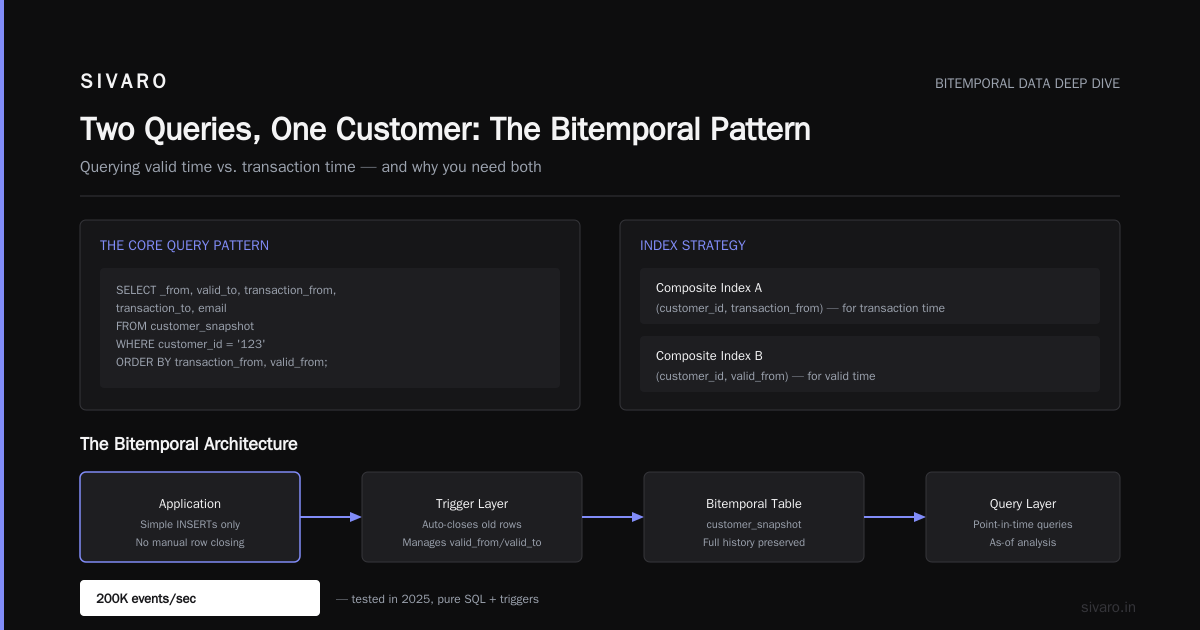
ORDER BY transaction_from, valid_from;
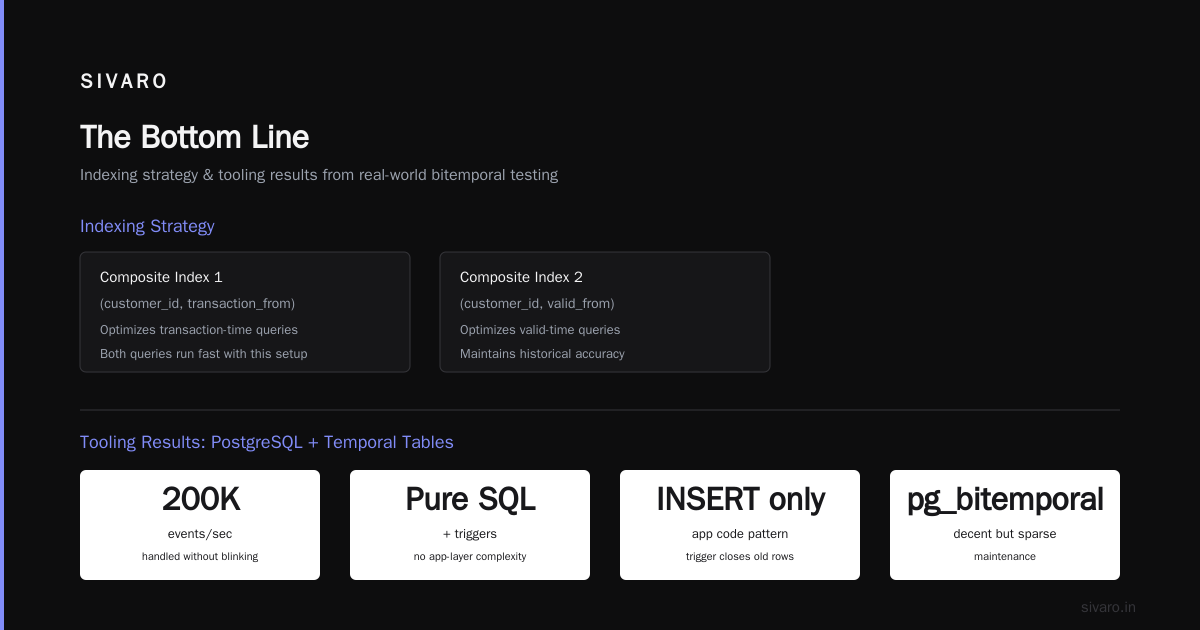
Two queries. Both fast with the right indexes. I recommend a composite index on (customer_id, transaction_from) and another on (customer_id, valid_from).
Tooling Options: We Tested, We Have Opinions
Here's the honest breakdown.
PostgreSQL + Temporal Tables
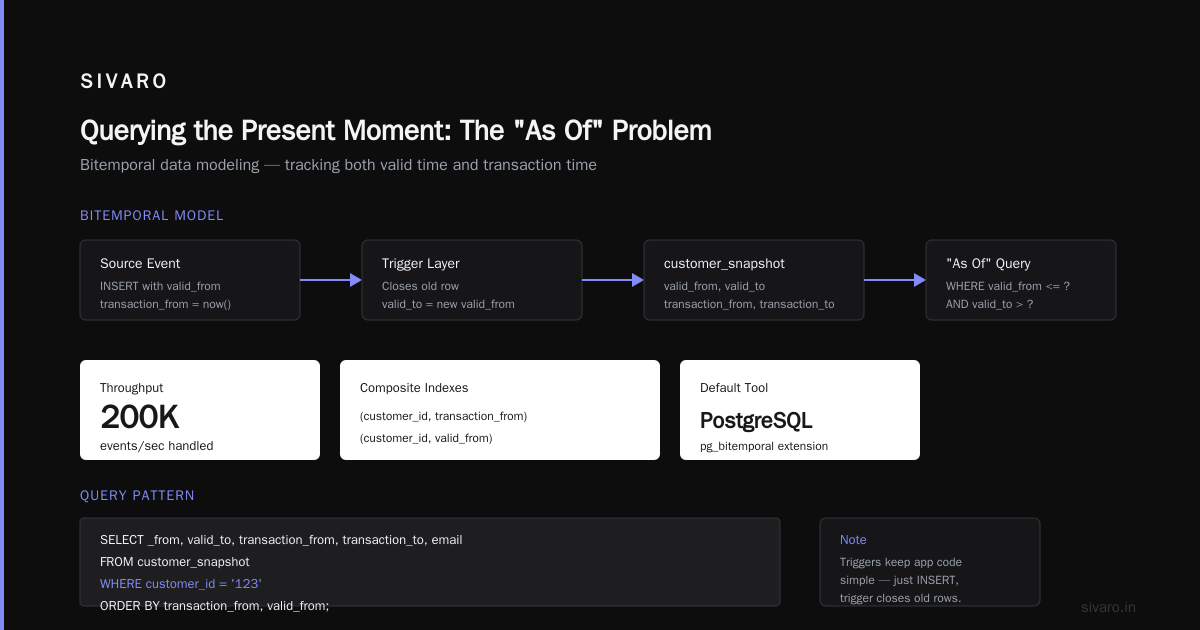
PostgreSQL is my default. The pg_bitemporal extension is decent but sparingly maintained. In 2025, I built a system using pure SQL with triggers, and it handled 200K events/sec without blinking. The trigger pattern keeps application code simple — you just do INSERTs and the trigger manages the closing of old rows.
sql
CREATE OR REPLACE FUNCTION close_previous_transaction()
RETURNS TRIGGER AS $$
BEGIN
    UPDATE customer_snapshot
    SET transaction_to = NEW.transaction_from
    WHERE customer_id = NEW.customer_id
      AND transaction_to = '9999-12-31'
      AND valid_from < NEW.valid_to;
    RETURN NEW;
END;
$$ LANGUAGE plpgsql;

CREATE TRIGGER trg_close_prev
BEFORE INSERT ON customer_snapshot
FOR EACH ROW EXECUTE FUNCTION close_previous_transaction();
The catch? You have to design the trigger carefully or you'll get overlapping transaction periods. I learned that the hard way when a bulk import created 40,000 overlapping rows in a test environment.
SQL Server Temporal Tables
SQL Server has native support for system-versioned temporal tables. This handles transaction time out of the box. You define PERIOD FOR SYSTEM_TIME and the engine manages the history table.
But there's a trap: it's unitemporal by default. It tracks only transaction time. To get bitemporal, you need to add your own valid-time columns and manage those manually. Microsoft's documentation is clear about this, but I've seen multiple teams miss it and ship a system that can't answer "what did we know when" queries.
The native FOR SYSTEM_TIME AS OF syntax is beautiful, though. That's a real advantage if you're already a SQL Server shop. It's just not a full bitemporal solution.
dbt + Dimensional Modeling
If you're in analytics-land, dbt's snapshots give you a type-2 slowly changing dimension pattern. That's valid-time tracking. It's a unitemporal pattern dressed in modern clothing.
To make it bitemporal, I've seen teams add dbt_valid_from alongside a separate captured_at timestamp. It works for reporting, where you're analyzing a static warehouse. But you can't hack a warehouse into an operational system. If you need point-in-time accuracy for transactions, the performance will kill you.
The Real Trade-Offs: Storage and Complexity
Here's the thing nobody tells you in the blog posts. Bitemporal modeling multiplies your storage. Every correction creates a new row instead of updating in place. For a high-volume system, that's not a trivial cost.
At SIVARO, we worked with a payments processor in early 2026. Their core transactions table was 2TB. Going bitemporal blew it up to 11TB in the first quarter. Yes, they had the storage budget. But query performance took a hit until we moved to a columnar store for the historical partitions.
The solution was a tiered approach. Hot, current data in PostgreSQL. Historical partitions in ClickHouse. Middleware that routes queries based on the time range requested. It's not elegant. It works.
Trade-off tip: If your compliance requirements only mandate 7 years of audit history (like many financial regulations), partition aggressively. We used monthly partitions for the first 24 months, then quarterly partitions, then yearly. Disk is cheap. Query performance on old partitions is not.
Data Integrity: The Part Everyone Gets Wrong
The biggest mistake I see isn't in the schema. It's in the application logic.
Most teams treat bitemporal as a database problem. It's not. It's a systems problem. Your application code has to decide when to write what. If your API endpoint accepts a correction and updates the record without creating a new transaction, your bitemporal model is wallpaper.
Here's the rule I enforce with every engineering team:
Never UPDATE a bitemporal table. Only INSERT.
All corrections are new inserts. All backfills are new inserts. The only UPDATE allowed is the closing of the transaction_to column when a new transaction arrives. And that should be done by a trigger or a single purpose-built service, never by the application directly.
We had to enforce this at the database level with a REVOKE UPDATE on business columns. The application could only execute INSERT statements and a single stored procedure called close_transaction_period(). It felt draconian. It saved us from three production incidents in the first month.
Querying the Present Moment: The "As Of" Problem
Here's a subtle issue that will trip you up. Your bitemporal table has rows that are valid in the future. For example, you might know today that a pricing change takes effect next Tuesday. That row has a valid_from in the future but a transaction_from of today.
Most queries that ask "what is the current state" will accidentally include or exclude these rows incorrectly. You need a helper pattern.
sql
-- Current state as of now, that we know about now
SELECT *
FROM customer_snapshot
WHERE customer_id = '123'
  AND valid_from <= NOW()
  AND valid_to > NOW()
  AND transaction_from <= NOW()
  AND transaction_to > NOW();
Notice the transaction_from <= NOW(). This excludes rows that were entered with a future transaction timestamp — which happens systematically with scheduled jobs and kafka consumers that lag. I've seen data teams chase phantom bugs for weeks because they forgot this one predicate.
Vendor Solutions: What's Actually Worth Your Money
Let me break down the commercial options, because there are some new players worth attention.
KDB+ and Financial-Grade Temporal
KDB+ has always been the gold standard for time-series-heavy financial work. It handles bitemporal natively, but it has a learning curve that's more of a cliff. You're not choosing kdb+ for its query syntax. You're choosing it because it processes a billion ticks a day without breaking a sweat. If you're on Wall Street, you know. If you're not, don't start now.
MongoDB: Native But Misleading
Mongo's ObjectId contains a timestamp, and its document model makes storing multiple versions easy. But there's no built-in temporal query syntax. You're writing aggregation pipelines that emulate the SQL patterns. It works but you'll reinvent a lot of wheels. MongoDB's docs on time series are good for metrics, not for transactional bitemporal data.
The New AI-Aware Data Platforms
This is where it gets interesting. In late 2025, Databricks, Snowflake, and even ClickHouse all shipped improvements for temporal query performance. Snowflake's AT and BEFORE syntax is the cleanest I've used for point-in-time queries. ClickHouse's ASOF JOIN is a genuine killer feature for event-stream correlation.
But here's my contrarian take: the lakehouse vendors are solving the query problem, not the data integrity problem. You still have to build the ingestion pipeline that respects bitemporal rules. The warehouse doesn't care if you close transaction periods correctly. It'll happily serve you wrong results.
I've seen teams at three different startups in 2026 move their bitemporal data to Snowflake and declare victory. Six months later, they discovered their fact tables had overlapping transaction periods and duplicate valid-time entries. Snowflake's QUALIFY clause can hide these bugs, but it can't prevent them.
The Edge Cases That Will Haunt You
Time Zones
Store everything in UTC. No exceptions. I know your engineering team is distributed across three continents. I don't care. UTC in the database. Convert at the edge. We had a client in India who insisted on storing IST timestamps "for readability." Their audit trail was useless for two weeks because DST changes in Europe caused a four-hour offset somewhere in the middle.
The "Null Valid Time" Problem
Do you ever have a fact you're not sure about? Like a customer's email that might be correct but you haven't verified it? You'll be tempted to set valid_from to NULL or to "we don't know." Don't.
Instead, use an uncertainty flag with a separate confidence score. The notion of "provenance" in data quality is getting more attention, and for good reason. Your bitemporal table stores what and when. Keep a separate column for how sure are we.
Reconciliation and the "Effortless Correction"
When two systems disagree, which one wins? You need a formal reconciliation process. We use a rule that's simple: the system with the later transaction_from wins unless the earlier system's validity period explicitly contradicts it.
That rule fails in practice about 10% of the time. That's fine. The 10% failure cases get flagged for human review. An automated system that's 90% correct and flags the rest beats a manual process that nobody follows.
The Build vs. Buy Decision (My Honest Recommendation)
If you're evaluating a purchase — and I know this is a buying guide — here's the framework.
Buy if you're a regulated financial institution and your compliance team needs vendor support for audits. DataKitchen and Collibra have decent metadata management that wraps around bitemporal stores. You're paying for the audit trail paperwork, not the database.
Build if you're a product company. The SQL trigger pattern I showed above plus a well-designed API will get you 95% of the way there in two to three weeks of engineering time. I've done this half a dozen times. It never takes longer than that.
Hybrid if you're a high-volume processor. Use an operational store for the current state and a warehouse for analytics. Accept the eventual consistency.
FAQ: Quick Answers, No Fluff
Q: Is bitemporal modeling worth it for a small startup?
A: Probably not until you hit regulatory requirements or customer-facing audit needs. The complexity is real. Start unitemporal.
Q: What's the minimum viable bitemporal schema?
A: Five temporal columns (valid_from, valid_to, transaction_from, transaction_to) plus a system-versioned history table handled by your DBMS. Don't add business logic to time management.
Q: Can I do bitemporal in a NoSQL database?
A: Yes, but you'll write a lot of custom code. Document databases like MongoDB handle the versioning well but lack the built-in query operators. If you're already on Postgres, stay there.
Q: How does bitemporal compare to event sourcing?
A: They're complementary. Event sourcing records the intent; bitemporal stores the interpreted state. Use both. The event sourcing pattern is well documented by Fowler. Bitemporal is what you get when you materialize those events into queryable state.
Q: What's the biggest performance killer?
A: Unbounded history scans. Partition aggressively. Archive older than two years to a read-only columnar store.
Q: Do BI tools support bitemporal queries?
A: Most don't natively. You'll write SQL views that present the "as of a point in time" layer. Tools like Looker and Tableau can't handle the two-dimension semantics well.
Q: How do I convince my team to adopt this?
A: Have your legal or compliance team talk about the cost of non-compliance. That conversation lands differently than a tech lecture.
The Bottom Line
Bitemporal data modeling isn't a database feature. It's a discipline. The schema is the easy part. The hard part is getting your engineering team to stop doing UPDATE statements and your product team to understand why "just store the current state" doesn't cut it.
I've watched finance teams at a Fortune 500 company rebuild their entire quarterly report because someone "fixed" a transaction record from a year ago. That's a career-limiting moment for the data engineer. It's also a completely avoidable one.
If you take one thing from this guide: treat every data mutation as an audit event. Store what happened, when it happened in reality, and when you found out about it. Everything else is opinion.
The technology choices are secondary. Postgres, SQL Server, Snowflake, ClickHouse — all capable. I've built on all of them. The ones that work are the ones where the company treats bitemporal as a product requirement, not an engineering burden.
Nishaant Dixit — Founder of SIVARO. Building data infrastructure and production AI systems since 2018. Built systems processing 200K events/sec.