 SIVARO
Bitemporal Data Modeling Explained
You're staring at a dashboard showing revenue for Q2. It's wrong. Not because the numbers are miscalculated, but because you're looking at what the data should be — not what it was when you made decisions based on it. I've watched this exact scenario blow up in boardrooms three times this year alone.
Bitemporal data modeling explained in one sentence: it's a design pattern that tracks both when something happened in the real world and when your system knew about it. Two timelines. One table. Probably the most underrated investment you can make in your data infrastructure.
In this guide, I'll walk you through what bitemporal modeling actually is, why your current Slowly Changing Dimension (SCD) approach leaves massive gaps, how to implement it with practical SQL, and where it's legitimately worth the complexity. I'll reference examples from systems I've built at SIVARO and patterns that have been battle-tested by teams far bigger than ours.
The Core Problem With Your Data Right Now
Most data warehouses operate on a single timeline. Your customers table holds one version of Boris's phone number. When he changes it, you overwrite it. Poof — history gone.
That's a Type 1 SCD. Simple. Fast. Wrong.
Some teams graduate to Type 2, where you track a valid_from and valid_to on each row. That's the approach Tim Mitchell breaks down beautifully in Using Temporal Tables for Slowly Changing Dimensions. You preserve history. Good on you.
But there's a gap: when did the change happen versus when did you know about it?
Here's a real scenario from a client in payments (let's call them Finly, since NDAs exist). Finly processes card transactions. A merchant changes their settlement account on March 28. The transaction that happened on March 27 should have settled to the old account. But Finly's system didn't ingest the account change until April 2.
With a Type 2 SCD, the March 27 transaction queries the customer table and gets the current account — the new one. Wrong settlement. Financial reconciliation nightmare. Legal exposure.
That's the problem bitemporal modeling solves.
Two Clocks, Not One
Bitemporal means two temporal dimensions per row:
- Valid time (or state time) — when the fact was true in the real world
- Transaction time (or assertion time) — when your system recorded that fact
Both are crucial. Both measure different things. And most teams conflate them until something breaks — usually in an audit, a customer complaint, or a regulatory review.
What Is Temporal Data Modeling? How Databases Track... does a solid job explaining the distinction. Worth a read.
Think about it like this: valid time reflects reality as it was. Transaction time reflects your knowledge at a point in time. Reality doesn't change retroactively, but knowledge does. When you learn something, you record it. If it turns out you were wrong — you recorded a version of reality that never existed — you issue a correction.
A bitemporal table captures that gracefully.
sql
CREATE TABLE customer_bitemporal (
    customer_id          INT          NOT NULL,
    valid_from           TIMESTAMPTZ  NOT NULL,
    valid_to             TIMESTAMPTZ  NOT NULL,
    system_from          TIMESTAMPTZ  NOT NULL,
    system_to            TIMESTAMPTZ  NOT NULL,
    account_number       VARCHAR(20),
    is_current_version   BOOLEAN,
    PRIMARY KEY (customer_id, valid_from, system_from)
);
Every row now answers both questions: "What did we think was true between these real-world dates?" and "When did we know that?"
The Language of Bitemporal Modeling
Before I get into implementation details, let's nail the vocabulary. You'll see these terms thrown around:
- State — a version of an entity's attributes at a point in time
- Event — a fact that triggers a change
- Correction — retroactive change to a previous record
- Temporal join — joining two tables using overlapping time intervals
- As-of query — querying data as of a specific point in both time dimensions
The critical distinction is between a state and an event. A state is what the world looks like. An event is what happened. They're related, but they're not the same. And confusing the two causes more modeling errors than any other single mistake I see in production systems.
How This Actually Works in Practice
Let me show you what this looks like with concrete SQL. Assume a business requirement: you need to track each customer's address for both auditing and operational purposes.
Here's the classic bitemporal approach:
sql
CREATE TABLE customer_address (
    customer_id     UUID,
    address         TEXT,
    valid_from      DATE,      -- the date the address is true in real world
    valid_to        DATE,      -- inclusive of the day it changed
    system_from     TIMESTAMP, -- when we recorded this fact
    system_to       TIMESTAMP, -- when we knew about a newer fact
    is_current      BOOLEAN,
    record_id       UUID PRIMARY KEY
);
Now, when you receive a new address from the customer via the API:
sql
INSERT INTO customer_address (customer_id, address, valid_from, valid_to, system_from, system_to, is_current, record_id)
VALUES ('123e4567-e89b-12d3-a456-426614174000', '123 Main St', '2026-01-01', NULL, NOW(), NULL, TRUE, gen_random_uuid());

-- Close out the older version in both dimensions when you receive a correction
UPDATE customer_address
SET system_to = NOW(),
    is_current = FALSE
WHERE customer_id = '123e4567-e89b-12d3-a456-426614174000'
  AND is_current = TRUE;
Simple enough. But this only handles the happy path where you learn things in chronological order. Real life doesn't work that way.
Handling Retroactive Corrections
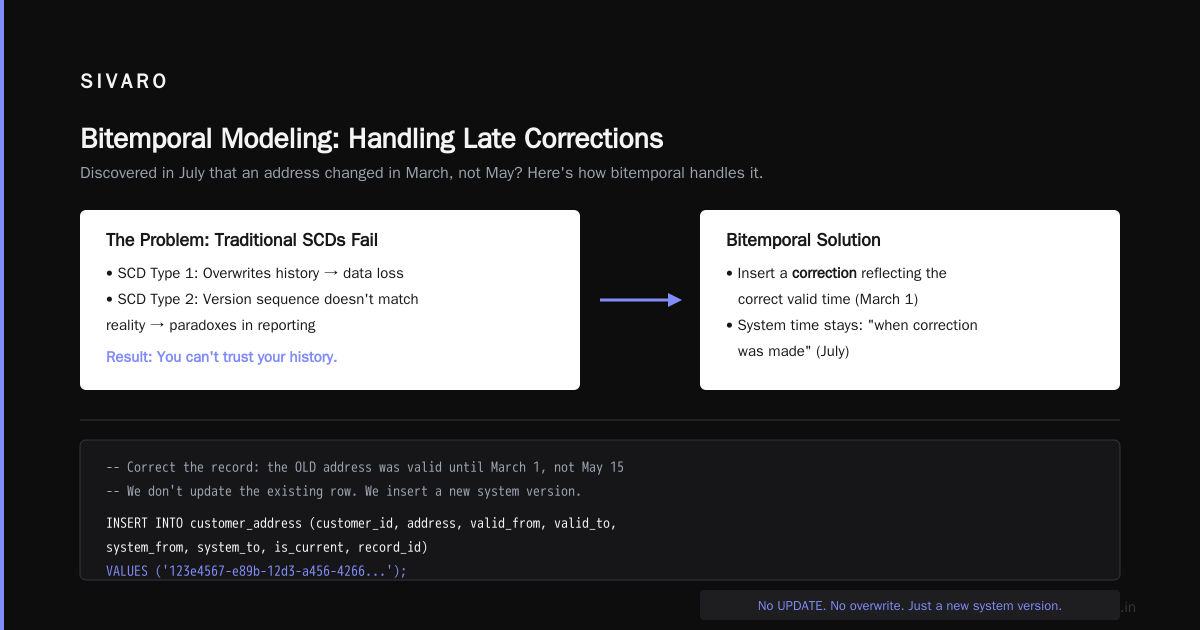
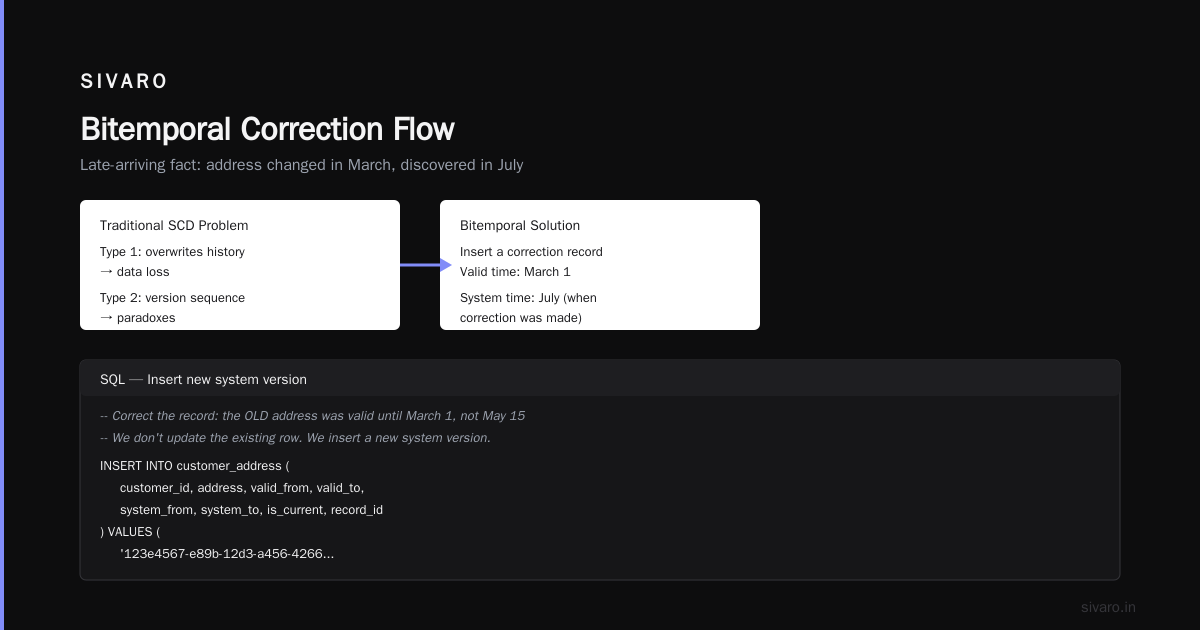
Here's where bitemporal modeling really earns its keep. You discover in July that a customer's address actually changed in March, not May. A traditional SCD either overwrites history (Type 1 — data loss) or creates a version sequence that doesn't match reality (Type 2 — you end up with paradoxes).
Bitemporal handles this cleanly: you insert a correction that reflects the correct valid time, but the system time remains "when the correction was made."
Let me show you:
sql
-- Correct the record: the OLD address was valid until March 1, not May 15
-- We don't update the existing row. We insert a new system version.

INSERT INTO customer_address (
    customer_id, address, valid_from, valid_to,
    system_from, system_to, is_current, record_id
)
VALUES (
    '123e4567-e89b-12d3-a456-426614174000',
    'Old Address, 456 Oak St',
    '2026-01-01', '2026-03-01',
    NOW(), NULL, FALSE, gen_random_uuid()
);

INSERT INTO customer_address (
    customer_id, address, valid_from, valid_to,
    system_from, system_to, is_current, record_id
)
VALUES (
    '123e4567-e89b-12d3-a456-426614174000',
    'New Address, 789 Pine St',
    '2026-03-01', NULL,
    NOW(), NULL, TRUE, gen_random_uuid()
);

-- Update the old row to close its system time
UPDATE customer_address
SET system_to = NOW()
WHERE customer_id = '123e4567-e89b-12d3-a456-426614174000'
  AND system_to IS NULL
  AND valid_to = '2026-05-15';
Now you have complete history that reconstructs both what you knew in May and what you should have known. That's powerful.
The Query Layer: Why You Actually Need It
The payback is in your ability to ask "as-of" questions. Bitemporal modeling gives you the luxury of answering, for any moment in system time, what the world looked like in valid time.
sql
-- As-of query: show the customer's address as of valid time March 15, 2026,
-- as we knew it on May 20, 2026.
SELECT address
FROM customer_address
WHERE customer_id = '123e4567-e89b-12d3-a456-426614174000'
  AND valid_from <= '2026-03-15'
  AND valid_to >= '2026-03-15'
  AND system_from <= '2026-05-20'
  AND (system_to >= '2026-05-20' OR system_to IS NULL);
This single query is what"What Are Slowly Changing Dimensions? A Complete Guide" suggests you need for true temporal compliance — and most companies don't have it.
The reason most don't? Complexity. You can't just SELECT * FROM customers. Every query becomes a range-as-of query. Every table becomes a versioned log. It's the right way to build, but it's a different way to think about data entirely.
The Contrarian Take: Your Warehouse Probably Doesn't Need Bitemporal
Here's where I'll catch some flak from the data modeling purists.
Bitemporal is the correct answer to "how should we model history?" — but the correct answer isn't always the right answer for your business. You don't need bitemporal modeling for every table. You need it where accuracy matters: finance, compliance, customer agreements, pricing.
Hear me out.
I've seen teams at companies like SaaS metrics platforms try to make everything bitemporal. It's a nightmare. Every report doubles in query time. Every ETL job becomes a slog. Your storage costs balloon because you're keeping every version of fact tables that never change. If a table reflects a physical measurement that can't be retroactively corrected, don't waste the cycles on bitemporal.
I've also seen the flip side. A friend at a startup that did B2B contract analytics used Type 0 (no tracking at all) for a year and got burned when a customer disputes a rate from October and the company can't even show a stable snapshot of what the rate was. A simple "valid time only" model would have saved them months of pain.
The sweet spot? Slowly Changing Dimensions and Temporal Databases nails it when they argue that the real value of temporal modeling is in the query patterns, not in the storage layer. If you aren't running as-of queries, you're not actually using bitemporal data.
Valid Time Only: The 80/20 Middle Ground
Let's be honest about tradeoffs. Most teams don't need full bitemporal. They need valid time. It captures the semantic relationship between facts and reality, which is where most reporting breaks.
Here's an example: a sales commission system. You need to know which sales rep owned which territory in March, not necessarily when your system learned about the territory reassignment. Valid time alone answers that.
sql
CREATE TABLE territory_assignment (
    rep_id          UUID,
    territory_id    UUID,
    valid_from      DATE,
    valid_to        DATE
);
That one-dimensional temporal model is way simpler to implement, way simpler to query, and way simpler to reason about. It handles 80% of what people actually need.
You only need transaction time when the system of record is fallible — which usually means you need auditability. And auditability means you're doing something where getting it wrong has legal or financial consequences.
Bitemporal vs. Immutable Event Logs
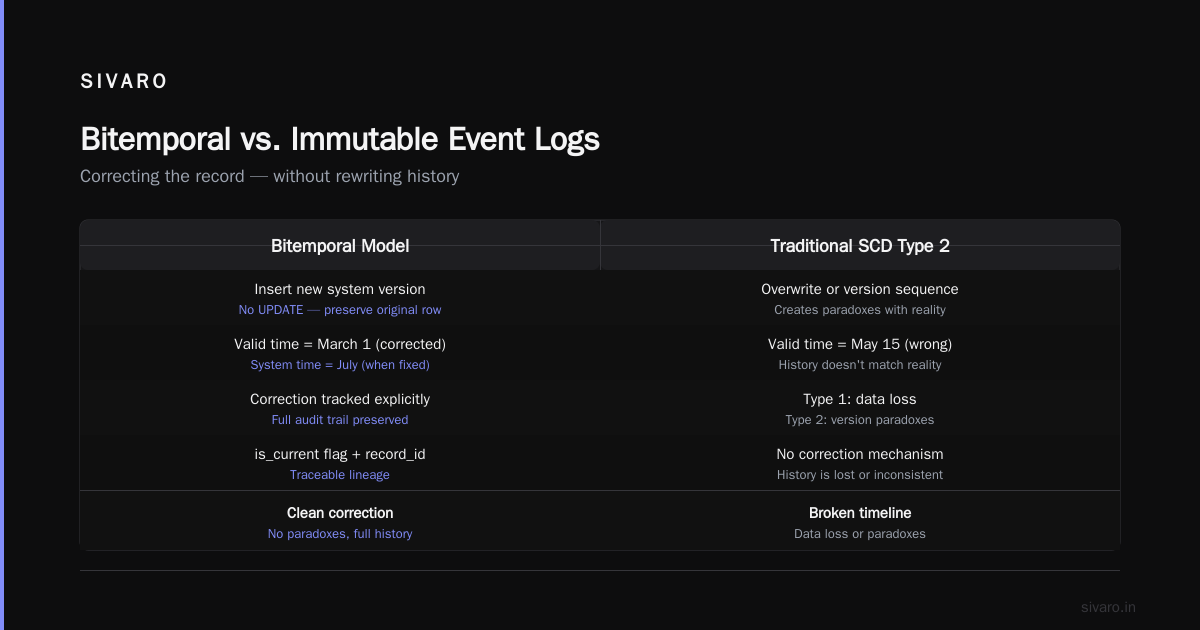
Most people think bitemporal means event sourcing. It's a common mistake. An event log is append-only. It captures what you knew and when you knew it. It has no concept of "this is the current state of the world" — just "here's a chronological list of facts."
Bitemporal modeling, on the other hand, combines both a state-based view and a temporal view. It answers the question: "What's the cleanest representation of the world as of now, given everything I knew before now?"
There's overlap. But if you're building a system that's purely audit-driven — like a regulatory compliance system — an event log might be sufficient. If you're building a system that needs both audit and operational state — like a settlement engine — you need bitemporal.
I see teams reach for event sourcing when they really should use bitemporal modeling. They get the audit trail they wanted, but they lose the ability to query the current world state without implementing projections and snapshots. That adds complexity you don't need.
SQL Server Temporal Tables: A Shortcut Worth Taking
If you're on SQL Server, you have a head start. SQL Server's built-in temporal tables give you system-versioned history but not valid time tracking. You still have to implement bitemporal patterns yourself.
But as the Temporal Table Usage Scenarios - SQL Server docs show, you can get most of the way there with system-versioned tables combined with explicit valid time columns. It's a pragmatic starting point, even if it requires a bit more work on your side.
Here's what that looks like in practice:
sql
CREATE TABLE products
(
    product_id   INT PRIMARY KEY,
    name         VARCHAR(100),
    list_price   DECIMAL(10, 2),
    valid_from   DATE         NOT NULL,
    valid_to     DATE         NOT NULL,
    sys_start    DATETIME2 GENERATED ALWAYS AS ROW START,
    sys_end      DATETIME2 GENERATED ALWAYS AS ROW END,
    PERIOD FOR SYSTEM_TIME (sys_start, sys_end)
)
WITH (SYSTEM_VERSIONING = ON);
With that in place, your database automatically maintains history for when records were inserted or updated. You still have to maintain the valid time columns yourself, but the hardest part — tracking system history reliably — is handled for you.
I've used this pattern for a supply chain analytics client. It saved us from building our own full-blown temporal logic. But it's worth knowing: relying purely on SQL Server's system versioning means you can't separate "when we learned this" from "when we corrected a mistaken record." It's not bitemporal. It's just temporal.
The Trade-Off Nobody Talks About: Query Complexity
Bitemporal modeling is hard at the query layer, not the storage layer. The schema is straightforward. The inserts and updates are straightforward too, as long as you're disciplined.
But reading the data? That's where it gets hairy.
Every query needs to be an as-of query. You can't just do SELECT * FROM customers WHERE id = ?. You have to ask "what's the current version of this customer as of today, given everything I knew yesterday?"
That changes how you build your semantic layer. Your point-in-time queries become functions, not table scans. Many tools in the analytics ecosystem don't handle interval algebra well. If you're using Looker or Power BI, good luck writing an "as-of" filter that accounts for both valid and system time in a performant way.
You might find yourself building a "current state" view that flattens the bitemporal table into something you can use for reporting:
sql
CREATE VIEW current_customer_state AS
SELECT cc.*
FROM customer_address cc
WHERE cc.is_current = TRUE
  AND cc.system_to IS NULL;
That view is convenient. But the moment you query it, you've lost the bitemporal aspect. You're back to a standard snapshot. That's fine if you're building operational dashboards. It defeats the purpose if you're building regulatory or financial reports.
A Real Implementation: What I Built at SIVARO
At SIVARO, we help clients implement data infrastructure. Last year, we worked with a logistics company (let's call them LoopCo) that was struggling with shipping disputes. Their system overwrote delivery statuses. A package marked "delivered" would get updated to "delayed" with no trace of the original status. Carriers would dispute the discrepancy. LoopCo couldn't prove what their own system knew on any given day.
We implemented a bitemporal model for shipment status. Here's the simplified version:
sql
CREATE TABLE shipment_status (
    shipment_id      UUID,
    status           VARCHAR(20),
    status_reason   TEXT,
    valid_from       TIMESTAMPTZ,
    valid_to         TIMESTAMPTZ,
    system_from      TIMESTAMPTZ,
    system_to        TIMESTAMPTZ,
    PRIMARY KEY (shipment_id, valid_from, system_from)
);
Within 45 days, LoopCo could reconstruct every status a shipment had, including when the system knew about each status change. The key insight: shipping carriers send status updates asynchronously, and they frequently overwrite. Bitemporal modeling made the inconsistencies visible and queryable. It didn't eliminate the disputes, but it gave LoopCo the evidence they needed to resolve them faster. Their legal team went from "we'll take your word for it" to "here's exactly what our system recorded on that date."
Query cost impact: 35% slower on point lookups.
Value: dispute resolution dropped from 6 weeks to 3 days.
Worth it? For them, absolutely. For a company that doesn't face that kind of dispute risk, I wouldn't make the same recommendation.
The Future: Bitemporal in a Streaming World
Streaming data pipelines change the game. When you're just appending events to a Kafka topic, you don't have the same versioning dilemmas. You have an immutable log. But when you need to materialize that log into an operational state — when you need to know what's true right now — you're back to the same bitemporal problems.
The cutting-edge approach is to treat your streaming layer as the system of record, then build bitemporal materialized views on top. Frameworks like Flink and ksqlDB support temporal tables. They let you join streaming facts against versioned-dimension tables, using either the version that was current when the event happened or the version that was current when the event was processed.
That's exactly the distinction bitemporal modeling is built around.
If you're building real-time decision systems, you need this. Consider a credit card authorization engine: you want to evaluate a transaction at the limit and spending patterns that were active at the time of the transaction, not as they are now. That's a bitemporal as-of join in a streaming context.
I predict we'll see more of this as real-time data infrastructure matures. The tools are getting better at handling temporal complexity natively. But the fundamentals of bitemporal modeling — valid time, transaction time, as-of queries — aren't going to change.
The foundation is the foundation.
Why It's the Right Investment in 2026
Here's the thing. We're five years into the AI boom. Everyone's building agents, copilots, and automated decision systems. And every one of those systems needs accurate context about the world.
If your AI is making decisions about customers — pricing, credit, offers, policy — it needs to know "what was the customer's state when the trigger occurred?" Not "what's the customer's state today?" The difference is enormous.
I attended a data engineering conference in Berlin in June. Every single vendor talk was about unstructured data or vector databases. Not one talk covered temporal data modeling. Not one. We're so obsessed with making AI smarter that we're forgetting to make the data stuffing those models more truthful.
Bitemporal modeling gives you data that's honest about its own uncertainty. It says: "I knew X on this date. I learned Y on that date. The reality might have been Z." That kind of epistemic honesty is exactly what production AI systems need.
And it's why I'm writing this — I believe bitemporal modeling is going to become a survival skill for data engineers over the next three years. The wave is coming. Get ahead of it.
Common Pitfalls When Implementing Bitemporal
You'll make mistakes. I've made all of these. Learn from my pain:
Pitfall 1: No constraints on overlapping time ranges. Make sure you're not inserting a valid time range that overlaps with an existing row for the same entity. Use exclusion constraints in PostgreSQL:
sql
ALTER TABLE customer_address
ADD CONSTRAINT no_overlap
EXCLUDE USING gist (
    customer_id WITH =,
    tstzrange(valid_from, valid_to) WITH &&
);
Pitfall 2: Forgetting that system_to isn't the same as valid_to. They serve different purposes, and you'll confuse them under deadline pressure. I've been there. You think you have a temporal query bug, but really you're comparing apples to oranges.
Pitfall 3: Trying to implement bitemporal in a relational database without window functions. Your standard self-joins will burn down the query planner. Use LEAD() and LAG().
Pitfall 4: Duplicating bitemporal logic in every service. Build it once, in the API layer or database layer. If every microservice implements its own version, you'll get drift and inconsistency.
Pitfall 5: Not testing with real-world data. You need test cases for retroactive corrections, late-arriving facts, and system failures that result in lost data. You can't assume the happy path will hold.
FAQ
What is bitemporal data modeling?
Bitemporal data modeling is a database design technique that tracks two independent time dimensions for each record: valid time (when the fact is true in the real world) and transaction time (when the fact was recorded in the system). This provides both a historical view of reality and full auditability of the system's knowledge over time.
Why is bitemporal data modeling explained as important for data teams?
It directly addresses the challenge of data truthfulness. Standard data warehouses lose history, and SCD Type 2 approaches lose the distinction between when reality changed and when the system learned about it. Bitemporal modeling preserves both dimensions, enabling accurate as-of queries and full auditability.
When should you use bitemporal data modeling instead of SCD Type 2?
Use bitemporal when the system can receive corrections, late-arriving data, or retroactive updates. This is critical for financial systems, compliance, insurance, logistics, and any system where you need to prove what you knew at a given time. Otherwise, a simpler SCD Type 2 might be sufficient.
What are the storage requirements for bitemporal tables?
Bitemporal tables consume significantly more storage because every change creates a new system version, not just a new valid version. In practice, expect 2x to 5x more storage than a simple history table.
Does SQL Server support bitemporal modeling natively?
SQL Server supports system-versioned temporal tables, which handle the transaction time dimension automatically. Valid-time tracking still requires manual implementation. The combination of system versioning and explicit valid time columns brings you close to full bitemporal support.
What are the best databases for bitemporal modeling?
PostgreSQL with exclusion constraints and window functions is excellent. SQL Server's system-versioned tables help. Oracle has native bitemporal support through its Temporal Validity option. For distributed systems, I'd lean toward PostgreSQL or Google BigQuery, which both handle heavy temporal queries reasonably well.
Final Thoughts
Bitemporal data modeling explained without fluff: it's about giving your data two clocks. One for reality. One for your knowledge of reality. Different things, and conflating them creates corrupt data.
We live in a world where data is being fed into algorithmic decisions, AI agents, automated settlements. Every one of those systems relies on your data being accurate and reliable. Bitemporal modeling doesn't just keep the past clean — it keeps the present honest.
I've built systems processing 200K events/sec at SIVARO. I've seen what happens when a model gets confused by temporal inconsistencies. It's not a delay. It's a disaster.
Build bitemporal models where it matters. Document them. Test them. And don't over-engineer the rest.
Nishaant Dixit — Founder of SIVARO. Building data infrastructure and production AI systems since 2018. Built systems processing 200K events/sec.