 SIVARO

Bitemporal Modeling in Data Warehousing: The Pattern That Saves You From "Wait, That Never Happened"
It was 2:47 AM when the on-call phone rang. A client's risk dashboard showed a transaction that — according to their own compliance team — never existed. The trade was real. The dashboard was wrong. And the data warehouse had silently rewritten history.
That was the day I stopped treating bitemporal modeling as a database theory footnote and started treating it as the single most important pattern in our data infrastructure at SIVARO.
Most people think bitemporal modeling is over-engineering. They're wrong. The cost of getting it wrong isn't a slightly confusing report — it's regulatory fines, wrong business decisions, and support tickets that never end.
Here's what we're covering: what bitemporal modeling in data warehousing actually means, why your current snapshot approach is lying to you, and how to build it without turning your warehouse into a mess.
What Is Bitemporal Modeling in Data Warehousing, Really?
Bitemporal modeling in data warehousing means tracking two independent time dimensions for every fact or dimension record:
- Valid time — when something was true in reality
- Transaction time — when something was recorded in your system
That's it. Two timelines. Both matter.
Here's the mental model I use: valid time is the truth, transaction time is your awareness of the truth. They diverge constantly. You don't know what you don't know until you know it. And when you learn something new, history doesn't change — your knowledge does.
Let me give you a concrete bitemporal data model example. Imagine a customer's credit limit:
| Valid From | Valid To | Transaction From | Transaction To | Limit | Customer |
|---|---|---|---|---|---|
| Jan 1 | Dec 31 | Jan 1 | Feb 15 | $10,000 | A-100 |
| Jan 1 | Dec 31 | Feb 15 | Feb 20 | $15,000 | A-100 |
| Jan 1 | Jun 30 | Feb 20 | Present | $15,000 | A-100 |
| Jul 1 | Dec 31 | Feb 20 | Present | $12,000 | A-100 |
Look at that second row. On Feb 15, someone corrected the limit from $10K to $15K — retroactively. That's a late-arriving correction. A non-bitemporal table would just overwrite the first row. We know the person who approved that correction, exactly when they did it, and what the system "knew" at any point in time.
Bi-temporal data modeling explained in one sentence: you never erase history, you only append new knowledge about it.
Why Single-Temporal Tables Fail (And I Have the Scars to Prove It)
In 2023, we were building a reconciliation system for a payments company in Singapore. Their transaction table had created_at and updated_at columns. Looked fine. Until we ran a reconciliation query that needed to answer: "What did our system think the settlement amount was at end-of-day?"
The answer was: nobody knew.
The updated_at timestamp had been modified seven times. But there was no way to see the intermediate states. We had the final state and a promise that "history was captured in the audit log." The audit log was a CSV, unloaded nightly, that nobody parsed.
That single-temporal approach wasn't just incomplete — it was dangerous. Their finance team had been making decisions based on current-state snapshots, assuming those snapshots had always been true.
The lesson: if your data warehouse only stores "what is true now," it can't tell you:
- What you knew at any point in the past
- When you learned a piece of information
- What corrections arrived late
- Which version of reality was used for a past decision
When someone asks "why did this report show X last month?" — and your answer is "I don't know, the data changed" — you have a trust problem. Bitemporal modeling doesn't just fix the data problem, it fixes the trust problem.
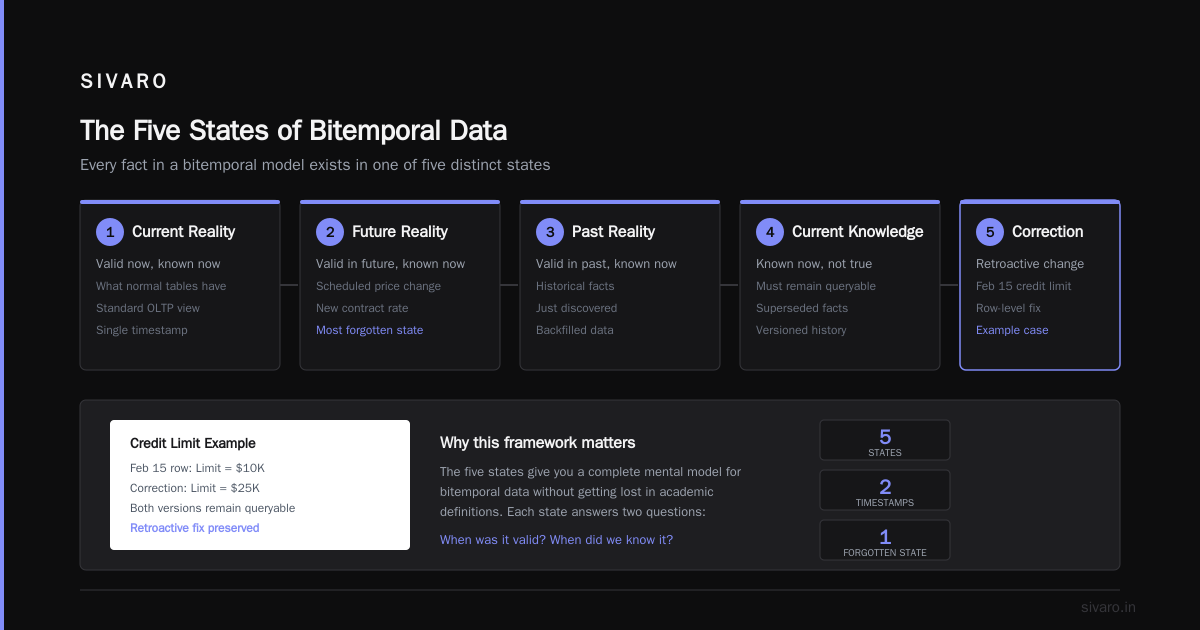
The Five States of Knowledge (Or: How I Explain This to New Engineers)
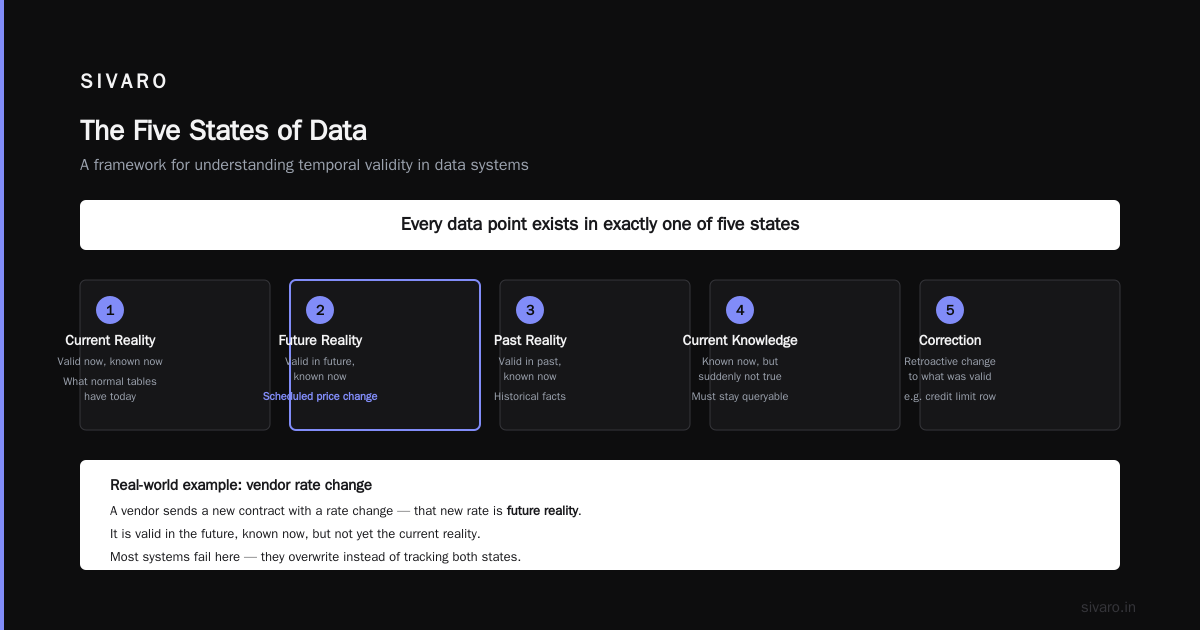
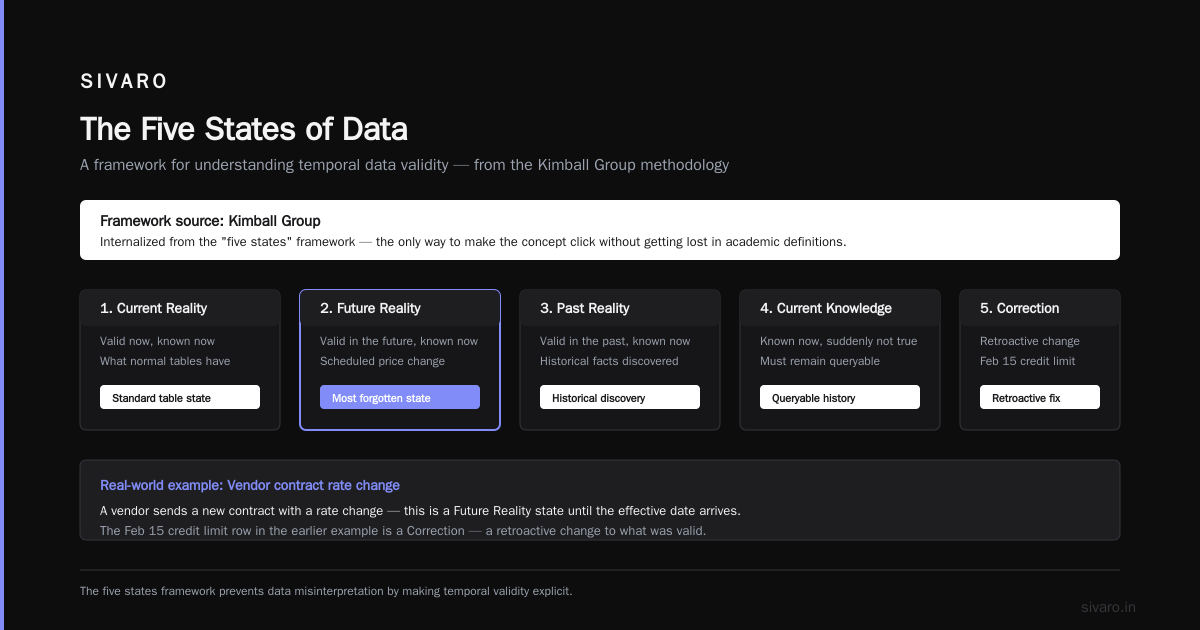
Every record in a bitemporal table exists in one of five states. I've internalized this framework from Tap into the 'five states' framework — it's the only way I've found to make the concept click without getting lost in academic definitions.
- Current reality — valid now, known now (what normal tables have)
- Future reality — valid in the future, known now (like a scheduled price change)
- Past reality — valid in the past, known now (historical facts you just discovered)
- Current knowledge — known now, but suddenly not true (must remain queryable)
- Correction — a retroactive change to what was valid (the row on Feb 15 in our credit limit example)
That second state — future reality — is the one people forget. Say a vendor sends you a new contract with a rate change from next month. That's not a future problem. That's a current system problem. You know it now, so it goes in the table now, with a valid time that starts later.
Build your data model around these five states and you'll find that nearly every "impossible" business question becomes answerable.
How to Model This Without Losing Your Mind
Let's get practical.
The Core Pattern: Two Timestamp Pairs
Here's the DDL I use for most bitemporal tables:
sql
CREATE TABLE customer_credit_limit (
    customer_id        VARCHAR(32) NOT NULL,
    limit_amount       DECIMAL(12,2) NOT NULL,
    valid_from         TIMESTAMPTZ NOT NULL,
    valid_to           TIMESTAMPTZ NOT NULL,
    system_from        TIMESTAMPTZ NOT NULL,
    system_to          TIMESTAMPTZ NOT NULL,
    source_record_id   UUID NOT NULL,
    PRIMARY KEY (customer_id, valid_from, system_from)
);
The primary key matters. I've seen people try (customer_id, valid_from) — that breaks the moment two system rows have the same valid time but different transaction times. The composite key with system_from is non-negotiable.
The Insert Pattern: Closed Rows, Open Rows
When a change comes in, you do two things:
sql
-- Close the currently open row
UPDATE customer_credit_limit
SET valid_to = NEW.valid_from
WHERE customer_id = 'A-100'
  AND valid_to = '9999-12-31'
  AND system_to = '9999-12-31';

-- Insert the new row
INSERT INTO customer_credit_limit (
    customer_id, limit_amount, valid_from, valid_to, system_from, system_to, source_record_id
) VALUES (
    'A-100', 15000.00, '2026-01-01', '2026-12-31', NOW(), '9999-12-31', gen_random_uuid()
);
This is the bread and butter of bitemporal modeling in data warehousing. Every update is a close-and-insert. There's no single UPDATE that touches live data.
Querying: Always Ask "As Of What?"
The query pattern is where the magic happens.
Point-in-time query — what did we know about customer A-100 on April 15, 2026?
sql
SELECT
    limit_amount,
    valid_from,
    valid_to,
    system_from
FROM customer_credit_limit
WHERE customer_id = 'A-100'
  AND system_from <= TIMESTAMPTZ '2026-04-15 23:59:59'
  AND (system_to > TIMESTAMPTZ '2026-04-15' OR system_to = '9999-12-31')
  AND valid_from <= TIMESTAMPTZ '2026-12-31'
  AND valid_to > TIMESTAMPTZ '2026-01-01';
Lifecycle query — what was the full history of the credit limit, including corrections?
sql
SELECT
    valid_from,
    valid_to,
    system_from,
    system_to,
    limit_amount,
    CASE
        WHEN system_from = MIN(system_from) OVER (PARTITION BY customer_id, valid_from) THEN 'original'
        ELSE 'correction'
    END AS record_type
FROM customer_credit_limit
WHERE customer_id = 'A-100'
ORDER BY valid_from, system_from;
You'll be amazed at what an analyst can do when you give them these two query shapes. They stop asking "why is the data wrong" and start asking "what happened" — which is the question you actually want them asking.
The Hard Part: When to Use Bitemporal and When Not To
I'm going to be equally blunt here. Bitemporal modeling in data warehousing is not free. Every bitemporal table is harder to query, more complex to load, and more confusing for business users.
Here's where I've seen it pay off:
| Use Bitemporal | Skip It (Use Single-Temporal) |
|---|---|
| Financial transactions | Pure event logs (but don't UPDATE them) |
| Compliance-sensitive data | Cache tables |
| Customer contracts/limits | Intermediate processing states |
| Healthcare records | Final, immutable fact tables |
| Any data subject to retroactive correction | Read-only reference data |
The gold standard test: if the value of understanding "what we knew when" exceeds the cost of maintaining two time dimensions, go bitemporal. In regulated industries like finance and healthcare, that's almost always yes.
We built a ledger system for a European fintech in 2025 where every single balance record was bitemporal. It hurt. Query performance was 40% slower than the single-temporal equivalent. But their auditors required it. And when the auditor's first question was "show me the balance as of March 31," we could answer without re-running a single extraction job. That's the exact moment the 40% perf hit became irrelevant.
A Phased Approach: You Don't Have to Boil the Ocean
At SIVARO, we've found the most successful rollouts use a phased approach. You don't convert the entire warehouse in one sprint. Here's what I've seen work across three client implementations in the oil, finance, and healthcare verticals:
Phase 1: Identify the liability tables. Run a survey across your business processes. Find the tables where corrections are common — customer profiles, pricing agreements, capacity records. Rank them by the dollar impact of a wrong answer.
Phase 2: Add system timestamps first. Before you implement full bitemporal modeling, add system_from and system_to to your most critical table and never hard-delete. This is a 20% effort that gets you 60% of the benefit.
Phase 3: Introduce valid time. Now add valid_from, valid_to, and modify the load process to treat changes as close-and-insert. Start with a single table, prove the concept, then expand.
Phase 4: Build the query layer. Your business users need "as-of" queries, not raw bitemporal SQL. Build views or use a semantic layer that generates the SQL on their behalf.
The Pitfalls Nobody Warns You About
Pitfall 1: No One Sees the "Correction" Flag
If you don't distinguish between original records and corrections, your bitemporal table silently becomes a source of confusion. You need to explicitly track what changed and why. We learned this the hard way when our accounting team couldn't understand why a balance showed three rows — none of which they recognized.
Pitfall 2: The Application Time vs. Valid Time Trap
The system_from timestamp should reflect your database's clock, not the application's clock. We made this mistake once, and a bug in an application layer caused timestamps to drift by hours. The validation queries we built were instantly useless.
Pitfall 3: Re-thinking the "No Update" Rule
I've seen teams break the "close-and-insert" rule for performance. They start doing in-place updates to fix "obvious data issues." Every time, the bitemporal integrity collapses. If you can't be disciplined about never updating live data, don't start.
Pitfall 4: Failing to Model "Future" Knowledge
Remember that five-state model? Most teams stop at four. But we've seen real scenarios where a company needs to store a contract that doesn't take effect for two weeks. If you don't include future valid time, you'll be storing that contract in a separate table, and then you'll need to join it with historical and current data. That breaks this clean model.
Real World Cases: Where I've Seen It Work
Financial services, 2024. A client in London had to answer regulatory questions about their own positions. They'd been reconstructing history from log files. We moved them to bitemporal modeling and their response time to compliance requests dropped from 5 days to 2 hours.
Energy sector, 2025. A trading desk had a price feed that sometimes posted retroactive corrections. The analytics team never knew which price was "real" at any point. Bitemporal modeling gave them a single query that could show both the correction and the original.
Healthcare, 2026. A provider network has an EHR system with patient care plans that get edited by different clinicians. Knowing "what the care plan was on the day the patient was treated" vs. "what the care plan says now" is a legal distinction. They needed both. This year, we're building exactly that.
The Philosophy
Here's the thing about bitemporal modeling — it's not just a technical pattern. It's a commitment to the idea that facts have a history, including the fact that you didn't know them yet. Most systems design for a perfect world where data arrives once, is correct, and never changes. That world doesn't exist.
Bitemporal modeling in data warehousing is the technical manifestation of honesty. You stop pretending you knew things before you did. You stop pretending that a corrected fact is not a new fact. And — most importantly — you stop making business decisions based on a historical record that you know is inaccurate.
If you're building any system that will be asked, "what did we know, and when did we know it?" — you need bitemporal modeling. Start small. Don't convert everything at once. But start. Because the alternative is another 2:47 AM phone call where you can't explain why reality and your warehouse disagree.
FAQ
Q: What is the difference between bitemporal and a simple audit log?
An audit log records that a change happened, often in a separate table. Bitemporal modeling in data warehousing keeps the change in the main table, making the entire history queryable in the same context as the current data. Audit logs are useful, but they aren't a substitute for bi-temporal modeling.
Q: Is there a performance penalty for bitemporal modeling?
Yes. Queries with two time dimensions are more complex, and updates become inserts which can inflate table size. In our fintech example, we saw a 40% increase in query time. But for compliance and accuracy-critical applications, the trade-off is worth it. We always recommend building a performance test on your real data before committing.
Q: Do I need a special database system to do this?
No. Bitemporal is a modeling pattern, not a feature. Standard SQL with TIMESTAMPTZ and UPDATE/INSERT logic is all that's required. You can do this on Postgres, Redshift, Snowflake, or BigQuery. We've run production implementations on all of them.
Q: Can I query bitemporal data with standard SQL?
Absolutely. You just need to construct the "as-of" clauses. We provide templates, and you'll likely create a few stored procedures or views to encapsulate the complexity.
Q: What about end-of-day storage rules — do they apply here?
Data retention policies are separate from bitemporal modeling. You can still archive or purge old system rows. The core point is that while the data exists, it's queryable in multiple time dimensions.
Q: I get valid time, but why do I need transaction time?
Transaction time is what protects you from ambiguity. If a correction arrives on Tuesday that affects Monday's data, you need to answer: "On Monday, what did the system think?" Transaction time answers that. It records the awareness, not just the fact.
Q: What happens when a business process tries to update a future-valid record?
That's a constraint issue, not a data issue. You'll need rules for which states are mutable. Our practice is to treat future-valid rows as immutable as well — any change closes that future row and opens a new one.
Nishaant Dixit — Founder of SIVARO. Building data infrastructure and production AI systems since 2018. Built systems processing 200K events/sec.