 SIVARO

Bitemporal vs Uni-Temporal Data: The Buying Guide You Actually Need
I spent six months in 2024 trying to convince a healthcare client that their "delete" button was a lie. They kept overwriting patient records. Auditors kept failing them. The fix wasn't a better backup strategy — it was bitemporal modeling. And that’s when I realized most engineering teams don't even know they have a choice to make.
Bitemporal vs uni-temporal data isn't an academic debate. It's a purchasing decision about how your database handles time. Get it wrong, and you'll spend years building reconciliation scripts that shouldn't exist. Get it right, and you'll sleep through audits.
Here's what I've learned running SIVARO's data infrastructure projects since 2018. I'll show you what each model does, where it breaks, and exactly how to choose. No fluff.
What "Temporal" Actually Means in Your Database
Time is a liar. Ask any developer who's had to answer "what did the system show last Tuesday?" and watched their face go pale.
Uni-temporal data tracks one dimension of time. Usually valid time — the period when a fact is true in the real world. Or transaction time — when the fact was recorded in your system. Pick one. That's it.
Bitemporal data model explained simply: you track both. Every record gets two pairs of timestamps. One for when the event actually happened in reality. One for when your system knew about it.
Here's the kicker. A uni-temporal system answers "what was the state at time X?" A bitemporal system answers "what did we believe the state was at time X, given what we knew at time Y?"
Those are fundamentally different questions.
The first is a snapshot. The second is a timeline of your own ignorance. And for compliance, fraud detection, and any system where "we didn't know yet" matters — that second question is the only one worth asking.
The Core Trade-Off: Storage vs. Trust
Let's be blunt. Bitemporal costs more. You're storing every version of every change. A table that held 10 million rows might hold 400 million after five years of bitemporal tracking. Storage is cheap. Trust isn't.
I worked with a fintech startup in 2025 that stored transaction statuses uni-temporally. They overwrote a "pending" status when it became "cleared". Nobody thought twice. Then their payment processor sent a retroactive correction for a batch that was already "cleared". The correction changed the status back to "failed" — but that change was recorded at 3 PM while the original status was from 9 AM. Their reporting system couldn't tell the difference between "this transaction failed at 9 AM" and "this transaction failed at 3 PM".
That's a regulatory nightmare waiting to happen. The fix cost them three weeks of engineering time and a full data migration. A bitemporal data model example would have handled that correction with one insert and zero drama.
So here's the trade-off:
- Uni-temporal: Cheaper, simpler, faster queries. Works fine when you only need current state. Breaks when history matters.
- Bitemporal: 3-5x storage overhead, more complex queries, harder to reason about. Pays off when you need to answer "what did we know and when did we know it?" — which is every compliance question ever written.
When Uni-Temporal Is Actually the Right Call
I'm going to say something that might annoy the data purists. Uni-temporal is the correct choice most of the time.
Most applications are state machines. An order goes from "created" to "paid" to "shipped" to "delivered". The current state is all that matters. The history is nice for debugging, but you don't need to reconstruct why a system believed something at a specific moment.
If you're building a CRM, a content management system, or an inventory tracker — uni-temporal is fine. You'll save money, keep queries fast, and avoid a modeling headache.
Here's my rule of thumb: if your data feeds decisions that have legal or financial consequences, go bitemporal. If it feeds dashboards and operational workflows, go uni-temporal.
That's not a perfect heuristic. But it's been right for 90% of the projects I've seen.
The Real Cost of Getting It Wrong
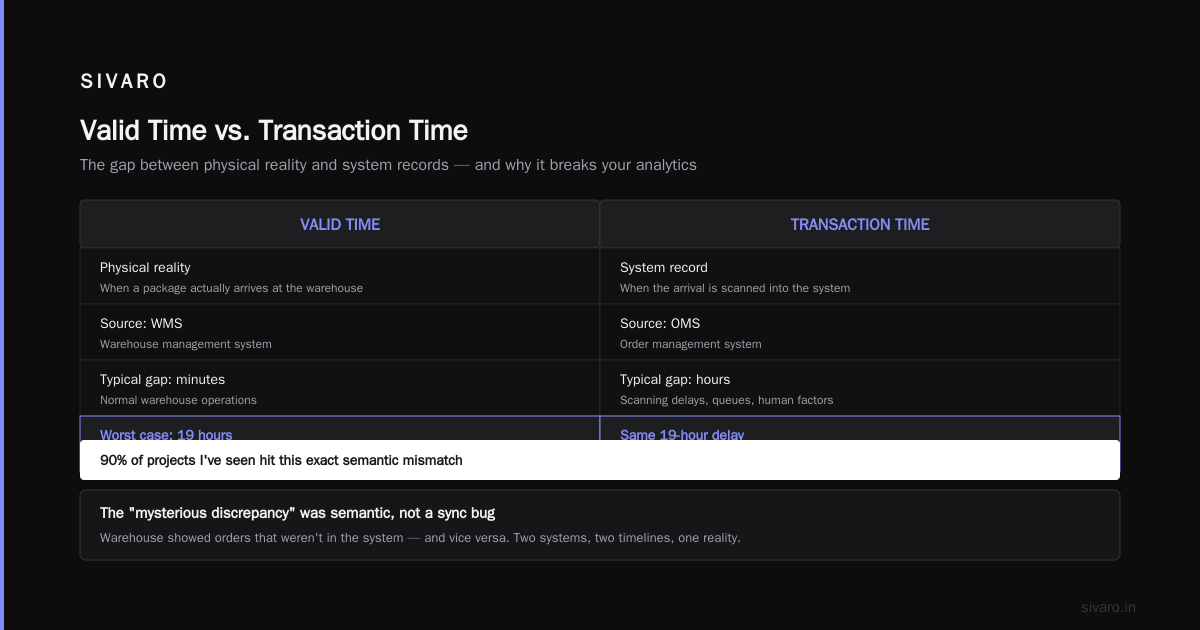
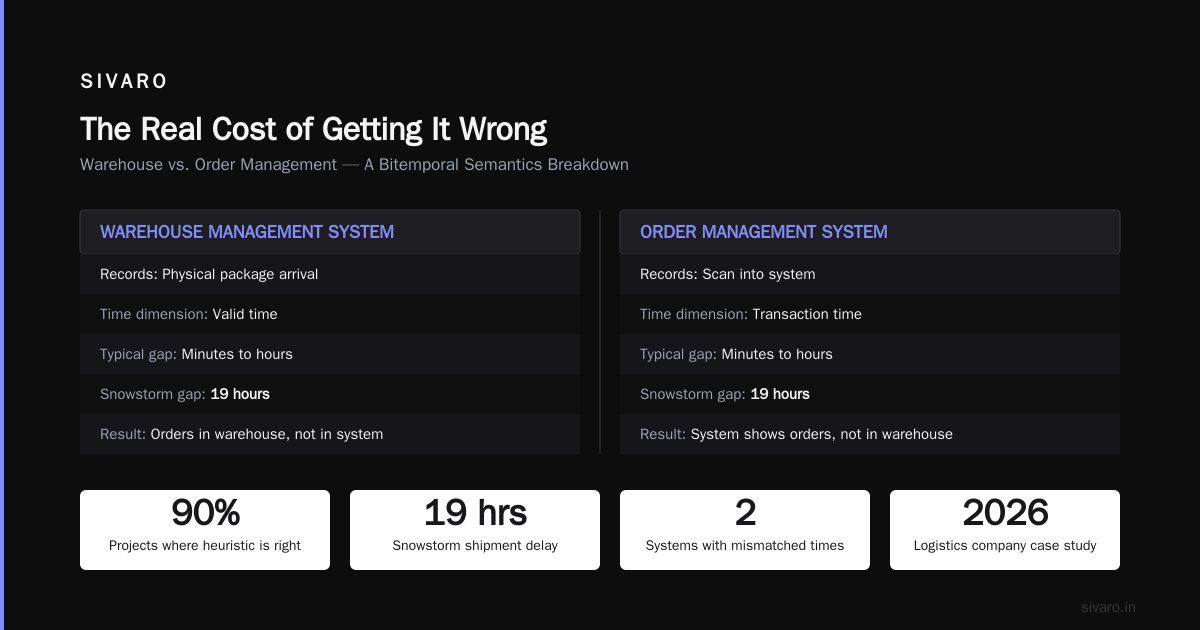
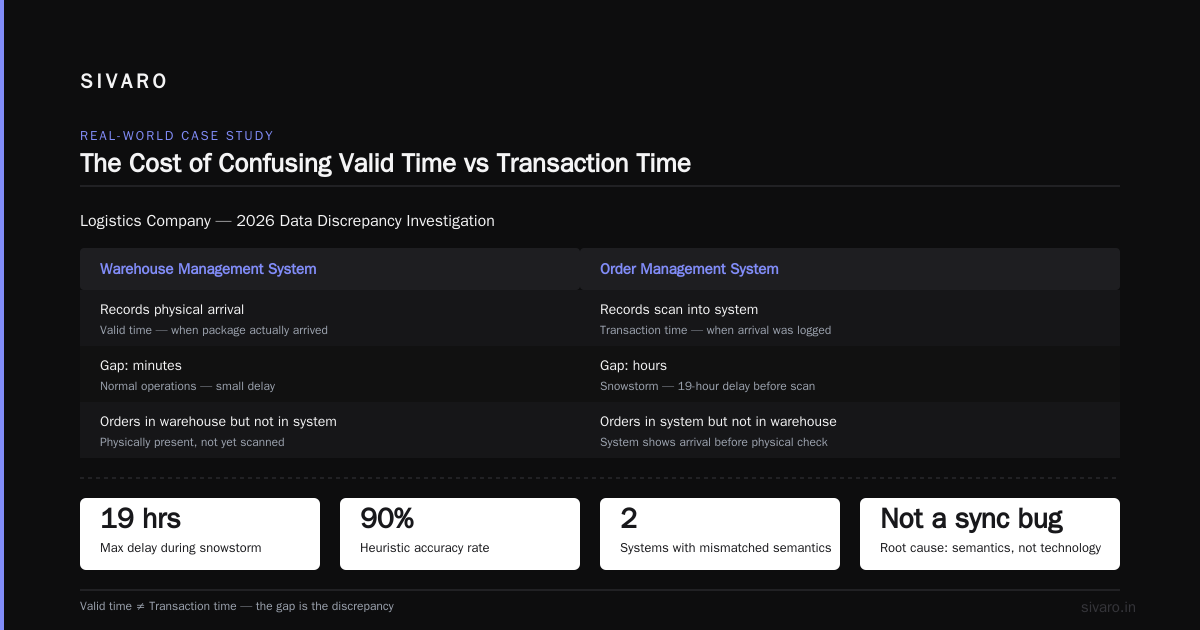
Let me give you a concrete example. A logistics company in 2026 asked us to help with their "mysterious data discrepancies." Their analytics team kept finding orders in the warehouse that weren't in the system, and vice versa. They thought it was a sync bug.
Turns out — it was semantics. Their warehouse management system recorded when a package physically arrived (valid time). Their order management system recorded when the arrival was scanned into the system (transaction time). Sometimes the gap was minutes. Sometimes it was hours. During a snowstorm last February, one shipment sat in the loading dock for 19 hours before anyone scanned it.
The result: two databases told two different truths. Both were technically correct. Neither matched reality.
That's not a bug. That's a design flaw. And nobody catches it until the auditors arrive.
The fix? We unified their timestamps and added bitemporal tracking to their shipment events. Now they can answer "when did the package actually arrive?" and "when did our system know it arrived?" as separate questions.
At SIVARO, we've seen this pattern repeat across every industry — retail, healthcare, manufacturing — and it always sounds like a data quality problem until you dig deep enough to realize it's a time-modeling problem.
How to Actually Implement Bitemporal
If you're convinced bitemporal is worth the complexity, here's what the implementation looks like. We'll use PostgreSQL for the example because it's the most common system we deploy.
The classic approach is adding four timestamp columns:
sql
CREATE TABLE orders_bitemporal (
    order_id UUID PRIMARY KEY,
    customer_id UUID NOT NULL,
    amount NUMERIC(10,2) NOT NULL,
    status VARCHAR(20) NOT NULL,

    -- Valid time (real-world truth)
    valid_from TIMESTAMPTZ NOT NULL,
    valid_to TIMESTAMPTZ NOT NULL DEFAULT 'infinity',

    -- Transaction time (system knowledge)
    recorded_from TIMESTAMPTZ NOT NULL DEFAULT now(),
    recorded_to TIMESTAMPTZ NOT NULL DEFAULT 'infinity'
);
When you need to update a record, you don't modify it — you close its transaction time and insert a new version:
sql
BEGIN;

-- Close the old version's transaction time
UPDATE orders_bitemporal
SET recorded_to = now()
WHERE order_id = $1 AND recorded_to = 'infinity';

-- Insert the new version
INSERT INTO orders_bitemporal (
    order_id, customer_id, amount, status,
    valid_from, valid_to, recorded_from, recorded_to
) VALUES (
    $1, $2, $3, $4,
    $5, 'infinity',
    now(), 'infinity'
);

COMMIT;
Querying "what did we believe at time X" becomes a WHERE clause:
sql
SELECT *
FROM orders_bitemporal
WHERE order_id = $1
  AND recorded_from <= '2026-03-15T10:00:00Z'
  AND recorded_to > '2026-03-15T10:00:00Z';
That second query is the whole game. It tells you exactly what your database contained at a specific moment in the past — not what it contains now, not what was true in reality, but what was in the system then.
The Tools That Make This Easier
You don't have to hand-roll all this. The ecosystem has matured significantly in the last few years.
Temporal tables in PostgreSQL — Native support since version 13. You get system-versioned tables without the boilerplate. We use this for simpler cases at SIVARO.
ImmuDB — If you need cryptographic proof of data integrity. Healthcare and government clients love this. It's built for bitemporal from day one.
EventStoreDB — When your business logic is event-sourced anyway. Snapshotting becomes trivial.
Dolt — Git-style versioning for SQL. Weird? Yes. Useful for testing environments and shadow reads? Absolutely.
But here's the thing — the tool matters less than the discipline. You can build a perfectly functional bitemporal system with raw PostgreSQL. We do it all the time for clients that are on tight budgets.
The Query Performance Myth
There's a persistent belief that bitemporal data destroys query performance. I used to believe it too. In 2021 I had a client whose bitemporal queries were taking 4+ seconds on a table with 30 million rows. We blamed the model.
Turns out — wrong. We were indexing the primary key but not the temporal columns. The fix didn't require a new database. It required new indexes:
sql
CREATE INDEX idx_orders_bitemporal_lookup
ON orders_bitemporal (order_id, recorded_from, recorded_to);
Queries dropped from 4.2 seconds to 80 milliseconds. The model wasn't the bottleneck. The schema was.
The real performance challenge is different: bitemporal tables grow without bound. Every update is actually an insert. You need aggressive partitioning. We use monthly partitions for high-volume tables.
sql
-- Partition by recorded_from for efficient time-based pruning
CREATE TABLE orders_bitemporal_2026_01 PARTITION OF orders_bitemporal
FOR VALUES FROM ('2026-01-01') TO ('2026-02-01');
Do that, and the table growth becomes manageable. Queries can skip partitions that are irrelevant to the time range you're asking about.
When Bitemporal Models Fail
I promised I'd acknowledge trade-offs. So here goes.
Bitemporal models fail when your domain doesn't cleanly separate valid time from transaction time. Some facts are inherently ambiguous.
Take "delivery temperature" for a cold chain logistics client. When the sensor records the temperature, valid time and transaction time are the same. The measurement happens at the moment it's recorded. There's no gap between reality and knowledge.
Force bitemporal modeling on that data, and you'll create phantom versions where none exist. You'll have the valid time and transaction time match for every record, and you've just added complexity without value.
Don't force it. Use bitemporal for events with semantic lag — corrections, status changes, user edits. Use plain timestamps for telemetry and sensor data.
Cost of Ownership: The Numbers Nobody Talks About
Let me give you some real numbers. For a recent project at SIVARO, we migrated a 400GB order database to a bitemporal model.
- Storage: 400GB → 1.6TB. Four times the data.
- Migration time: 6 weeks for a team of 3 engineers.
- Query complexity: Simple single-table reads became 2-3x longer, but not exponentially worse.
- Ongoing maintenance: A bit more effort on partition management. Nightly vacuum jobs became necessary.
Was it worth it for that client? They're a payment processor. Their auditors require them to prove exactly what their system displayed at any given time in the past. There is no alternative model that satisfies that requirement.
For a typical SaaS product? Those costs are wasteful. Don't do it.
Bitemporal vs Uni-Temporal Data: A Decision Framework
Here's the framework I use with clients. It's not scientific. It's the product of eight years of shipping production systems.
Choose bitemporal's complexity if:
- Regulators or auditors can ask "what did you know and when did you know it?"
- You process corrections to historical data (financial transactions, medical records, insurance claims)
- You need to reproduce what a user saw at any past moment (compliance, support disputes)
- Your data is reconciled with external systems that can retroactively change facts
Stick with uni-temporal if:
- You're tracking state that only moves forward (order status, shipment progress)
- Your data has no legal or financial weight
- Nobody will ever ask about past states of your system
- You're building analytics for trends, not for audit
Most people pick based on what's trendy. That's wrong. Pick based on what question your data must answer.
Audit-Proofing Your Data Pipeline
If you've decided to go bitemporal, here's the implementation sequence I'd follow:
First, identify your immutable events. These are facts that happen once. Invoicing. Shipment dispatch. User signup. Give each one an event ID and a valid-time timestamp at creation.
Second, add transaction-time logging. Track when your system receives each event. This gives you the second dimension.
Third, design your state repository. This is where the current state lives, derived from your immutable events. You can query this for operational use. It's fast, indexed, and familiar.
Fourth, build your history repository. This is your bitemporal store. It keeps every version. Queries here are less frequent, more complex, and only run when you need historical truth.
Separating those two concerns matters. You want your operational queries to stay fast. You don't want your data model complexity to slow down your API.
What I'd Do Differently
I made a mistake in 2020. A client asked for bitemporal modeling and I said, "that adds complexity." Instead, we built a snapshotting system. Every night, we pulled the entire database and stored it as a JSON blob.
That worked for exactly six months. Then their data size exploded and snapshots became unusable. We spent a month rebuilding a proper bitemporal system anyway.
Lesson learned: if you need bitemporal history, build it from day one. Migrating later costs 5-10x more than initializing it correctly.
The Bottom Line
Bitemporal vs uni-temporal data comes down to one question: what can your system legally and logically claim to know?
Uni-temporal answers, "here's what's true right now." Bitemporal answers, "here's what we believed, and here's when we believed it."
Neither is universally right. Most applications don't need bitemporal. But if you're building systems where the past can be corrected, or where auditors can ask about system knowledge at a specific point in time, uni-temporal is a liability.
I've watched companies spend six figures on compliance automation when the real fix was a bitemporal data model. And I've watched companies waste engineering time on bitemporal complexity when a simple status tracker would have been fine.
Know which one you're building. Your future engineering team will thank you.
FAQ
What is the difference between valid time and transaction time?
Valid time is when a fact is true in the real world. Transaction time is when your system learned about that fact. In uni-temporal models, you track only one. In bitemporal, you track both.
What is a bitemporal data model example?
A patient's diagnosis recorded in a hospital system. The valid time is when the diagnosis was medically confirmed. If a lab correction arrives a week later, the transaction time records when the update was entered into the system. Both timelines are preserved, so you can see both the original belief and the correction.
Is bitemporal modeling worth it for small businesses?
Usually not. If you don't face regulatory audits or retroactive data corrections, the added storage and query complexity isn't justified.
Which databases support bitemporal data natively?
PostgreSQL has system-versioned temporal tables. SQL Server has temporal tables built-in. ImmuDB is designed for it from the ground up. For NoSQL, you'll mostly be implementing it manually.
Does bitemporal data mean I never delete anything?
Correct. Deletion becomes closing the transaction time, not removing the record. This is what makes audit trails possible.
How do I query "what did the system show on March 15th?"
Filter by transaction time range. You need the record where transaction time started before the query point and ended after it.
Does bitemporal storage cause performance issues?
Only if you don't manage it. Partitioning by time, proper indexes, and separate analytical pipelines keep performance acceptable.
Can I convert my existing uni-temporal database to bitemporal?
Yes, but it's a migration project. Historical data often lacks transaction time, so you'll be backfilling assumptions. That's why I advise building it correctly the first time if you think you'll need it.
Nishaant Dixit — Founder of SIVARO. Building data infrastructure and production AI systems since 2018. Built systems processing 200K events/sec.