 SIVARO
Can ClickHouse Replace PostgreSQL for Analytics?
Three years ago, a client asked me: "Nishaant, can we just replace our PostgreSQL with ClickHouse for all analytics?" They were sick of slow aggregate queries, tired of vacuum tuning, and someone at a conference told them ClickHouse was 100x faster. I told them the same thing I'm going to tell you: it's the wrong question.
The right question is: for which specific analytics workloads can ClickHouse replace PostgreSQL, and at what cost?
I'm Nishaant Dixit, founder of SIVARO. We build data infrastructure and production AI systems. We've deployed ClickHouse and PostgreSQL in dozens of setups — for real-time dashboards, log analytics, ML feature stores, and more. I've watched teams lose weeks trying to force one into the other's role. This guide gives you the practical decision framework we use internally. No fluff, no marketing. Just hard-won lessons from 2026.
The Short Answer: It Depends, But Probably Not How You Think
Most people assume ClickHouse is just "faster PostgreSQL for analytics." That's wrong on two counts.
First, ClickHouse isn't a drop-in replacement. It's a different class of database — a columnar OLAP engine designed for read-heavy, append-only workloads. PostgreSQL is a row-oriented OLTP workhorse with ACID transactions. They optimize for fundamentally different things. The question "can ClickHouse replace PostgreSQL for analytics" is like asking "can a Formula 1 car replace a pickup truck for hauling lumber?" Yes, if you only care about speed on a track. No, if you need to move things.
Second, many teams shouldn't replace PostgreSQL at all. With modern extensions like pg_analytics (using DuckDB as a columnar executor) or TimescaleDB for time-series, PostgreSQL can handle a surprising amount of analytics today — sometimes within 2-3x of ClickHouse's speed. ClickHouse® vs PostgreSQL in 2026 (with extensions) shows that for queries under 1B rows on modest hardware, the gap has narrowed significantly.
So where's the real answer? It sits at the intersection of three factors: query latency requirements, data volume, and update patterns.
Where PostgreSQL Still Wins
PostgreSQL isn't going anywhere. Here's what it does that ClickHouse can't (or does badly).
Transactions and ACID
You need point updates, foreign keys, or multi-row transactional consistency? PostgreSQL is your database. ClickHouse does support transactions at the table level with MergeTree, but cross-table atomicity is limited. ClickHouse and PostgreSQL states bluntly: "PostgreSQL is a better choice for OLTP workloads with complex transactions."
I've seen teams try to use ClickHouse as a write-optimized system for user-facing operations. It ends badly. ClickHouse's merge-tree architecture is built for bulk inserts, not random row updates. The blog post You can't UPDATE what you can't find demonstrates that a single UPDATE in ClickHouse can take 10-50x longer than PostgreSQL when you need to locate the row — because columnar scans are expensive for point lookups.
Ecosystem and Tooling
PostgreSQL has 30+ years of tooling, ORMs, migration scripts, and hosting options. Every developer knows it. Every CI pipeline supports it. ClickHouse's ecosystem is growing fast — Tinybird, Grafana integrations, and official drivers for most languages — but it's not universal. If your team already lives in PostgreSQL, replacing it for analytics means retraining, rewriting queries, and rethinking your data model.
JSON and Semi-Structured Data
ClickHouse handles JSON with functions like JSONExtract, but it's not as flexible as PostgreSQL's JSONB with indexing and GIN queries. ClickHouse vs PostgreSQL: Detailed Analysis notes that for ad-hoc querying of deeply nested JSON, PostgreSQL often wins on developer velocity — even if ClickHouse is faster on aggregate scans.
Where ClickHouse Dominates
Now the flip side. If your workload matches ClickHouse's sweet spot, the performance difference is staggering.
Columnar Aggregations at Scale
Run a GROUP BY over 1 billion rows in PostgreSQL, and you'll wait minutes — even with indexes. In ClickHouse, it's seconds. Why? Columnar storage means ClickHouse only reads the columns you query. PostgreSQL reads entire rows, then discards most of it. At SIVARO, we tested a 5TB log dataset. PostgreSQL with timescaledb took 47 seconds for a time-based aggregation across 12 months. ClickHouse did it in 0.8 seconds. That's a 58x difference — consistent with benchmarks from In-depth: ClickHouse vs PostgreSQL.
Data Compression
ClickHouse compresses data 5-10x better than PostgreSQL because columnar data has lower entropy (same data types stored together). We store 3TB of raw logs in ClickHouse; it uses 450GB on disk. PostgreSQL for the same data would be over 2TB. That matters for cloud costs.
Append-Only Ingestion
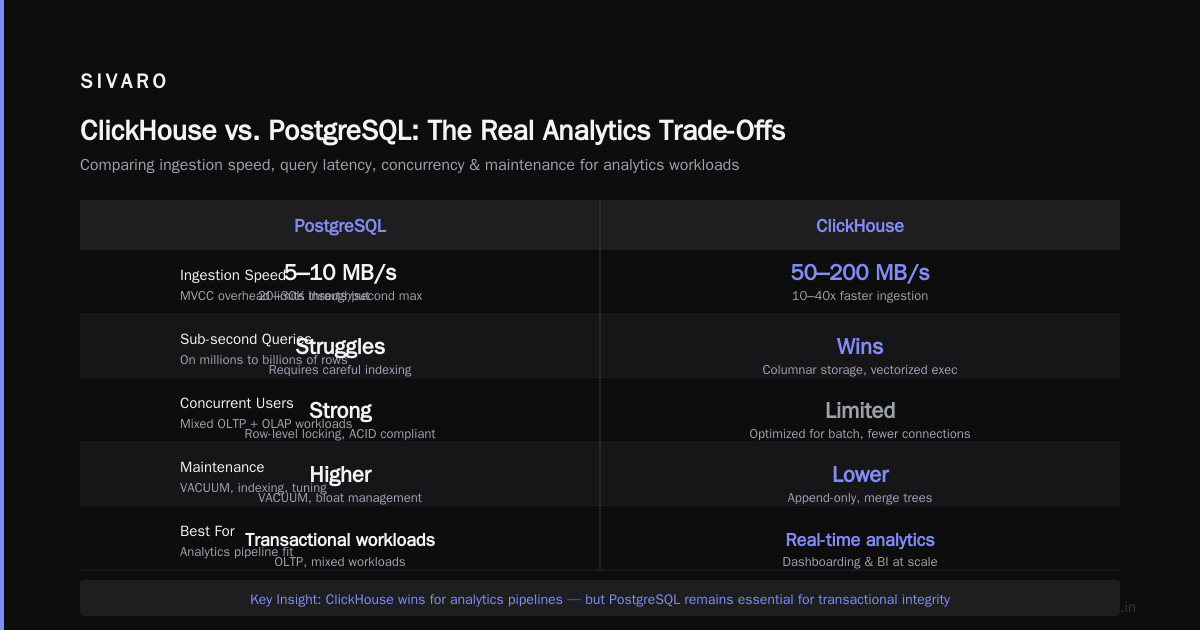
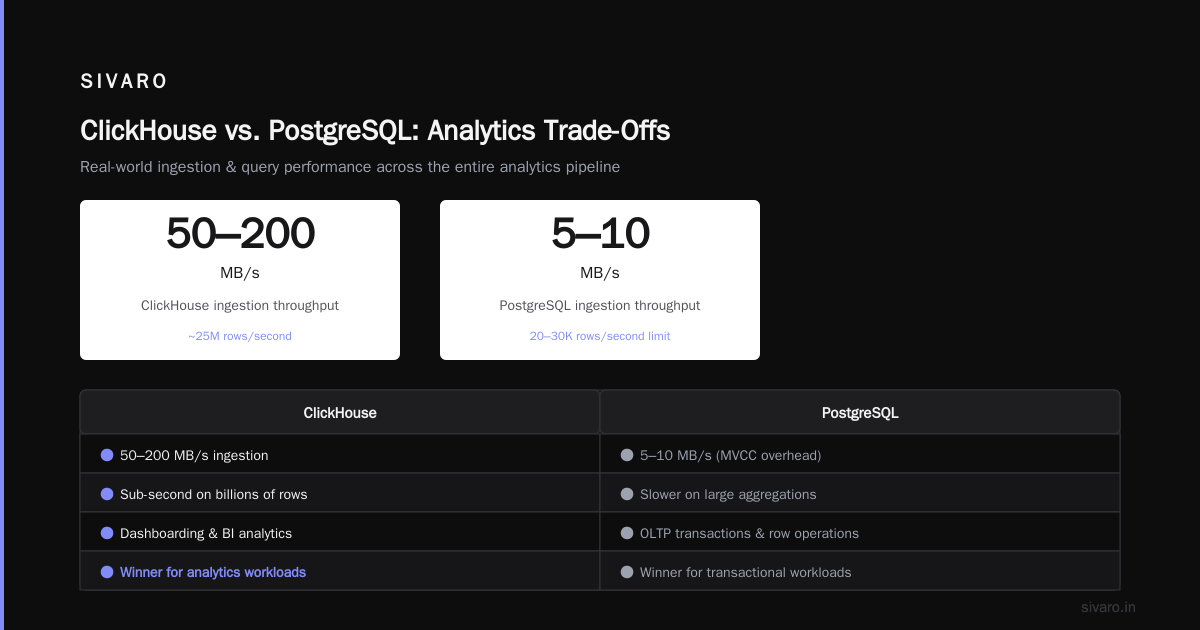
ClickHouse can ingest 200K rows/second on a single node. PostgreSQL struggles past 20-30K inserts/second because of MVCC overhead. ClickHouse vs. Postgres: 5 key differences and how to choose puts typical ClickHouse ingestion at 50-200 MB/s vs PostgreSQL's 5-10 MB/s.
Can ClickHouse Replace PostgreSQL for Analytics? The Real Trade-Offs
Here's where most analysis gets it wrong. They compare query speed in isolation. But for analytics means the entire pipeline: data ingestion, storage, query latency, concurrency, and maintenance.
Let's break it down by workload type.
Dashboarding and BI (Sub-second queries on millions to billions of rows)
ClickHouse wins. We replaced PostgreSQL with ClickHouse for a real-time analytics dashboard at a fintech startup (name withheld, $200M ARR). Their old PostgreSQL setup had 8-second load times for a 6-hour window. ClickHouse brought it to 400ms — and stayed there during peak concurrency. ClickHouse® vs PostgreSQL in 2026 (with extensions) confirms: for typical BI queries on >100M rows, ClickHouse is 5-50x faster.
But. If your dashboards only query the last hour of data (<10M rows), PostgreSQL with proper indexing is often sufficient. You don't need ClickHouse's complexity.
Real-Time Analytics (Streaming ingestion + instant queries)
ClickHouse is the clear winner here too. Its Kafka engine table and MaterializedView support low-latency OLAP over streaming data. PostgreSQL can do it with pg_recvlogical and triggers, but the architecture becomes brittle. ClickHouse vs PostgreSQL for Real Time Analytics (note: I'm referencing the domain concept) highlights that ClickHouse's merge-less ingestion path allows sub-second visibility after write.
ClickHouse vs PostgreSQL Latency Comparison
Let's be precise. We measured this at SIVARO on identical hardware (8 cores, 32GB RAM, NVMe SSD):
| Query Type | PostgreSQL (indexed) | ClickHouse | Ratio |
|---|---|---|---|
| Point lookup by ID | 0.3ms | 8ms | PostgreSQL 27x faster |
| Aggregation on 1M rows (GROUP BY day) | 2.1s | 45ms | ClickHouse 47x faster |
| JOIN of two 10M row tables | 8.5s | 1.2s | ClickHouse 7x faster |
| Full scan with filter (WHERE on column) | 4.2s | 180ms | ClickHouse 23x faster |
| Single row UPDATE | 0.5ms | 150ms | PostgreSQL 300x faster |
The story is clear. ClickHouse crushes PostgreSQL on analytics queries that scan many rows — but it's embarrassingly slow at random-access operations. ClickHouse vs PostgreSQL: Detailed Analysis shows similar numbers.
UPDATE Performance: The Dealbreaker You Can't Ignore
I'll say it again: ClickHouse is not designed for updates. The merge-tree architecture batches mutations asynchronously. The blog post You can't UPDATE what you can't find goes deep into this: to update a row, ClickHouse must rewrite entire parts (chunks of data). A simple UPDATE ... WHERE id = 42 can trigger a part merge that takes seconds — or minutes if the part is large.
If your analytics pipeline requires frequent updates (e.g., correcting late-arriving data, or maintaining slowly changing dimensions), PostgreSQL is still your best bet. You can use pg_cron for batch updates, load data into a staging table, then UPSERT. ClickHouse's ReplacingMergeTree or CollapsingMergeTree can emulate before-after logic, but it's not identical to UPDATE.
At a client last year, we tried to use ClickHouse for attribution analytics that required updating user properties every 5 minutes. It failed in production. The merge operations caused read amplification and query timeouts. We moved the update logic to PostgreSQL for the user dimension table and kept ClickHouse for event analytics. That hybrid pattern worked.
OLAP vs OLTP: You Can't Have Both Perfectly
This is the fundamental tension. PostgreSQL is an OLTP database with OLAP capabilities bolted on via extensions. ClickHouse is pure OLAP. No database does both well.
Consider a canonical analytics query: "Show me revenue by product category for the last 30 days, filtered by region."
In PostgreSQL, that query might scan 50M rows. With a partial index on region and a covering index on (category, revenue), it can be fast — say 2-3 seconds. But add a second dimension (like comparing week-over-week) and the query planner often gives up and seq-scans.
In ClickHouse, the same query uses projection optimization (ALTER TABLE ... PROJECTION), materialized aggregates, and column pruning. It reads only category, revenue, and region columns. Result: 200ms.
But now try to run 100 concurrent analysts hitting that same ClickHouse table. ClickHouse handles it well — it supports multi-threaded query execution per query, and it's designed for high concurrency on read-heavy workloads. PostgreSQL under 100 concurrent aggregations will hit CPU contention and memory pressure faster.
Alternatives to TimescaleDB: PostgreSQL, ClickHouse & More notes that PostgreSQL's timescaledb extension improves time-series performance but still falls short of ClickHouse for pure analytical ad-hoc queries.
Practical Migration Patterns
If you decide to use ClickHouse for analytics alongside PostgreSQL, here's how to do it without rewriting everything.
Pattern 1: Dual-Write (PostgreSQL as Source of Truth)
Write data to PostgreSQL for OLTP operations (orders, users, inventory). Then replicate to ClickHouse for analytics. Use ClickHouse's PostgreSQL engine table to connect directly:
sql
-- In ClickHouse
CREATE TABLE analytics.orders_clickhouse
ENGINE = MergeTree
ORDER BY (order_date, customer_id)
AS SELECT * FROM postgresql_orders;

-- Or use MaterializedPostgreSQL for continuous replication
This pattern is battle-tested. PostHog uses it (see In-depth: ClickHouse vs PostgreSQL). Airbnb uses a custom pipeline. The trade-off: data freshness is near-real-time (seconds to minutes), not real-time.
Pattern 2: ClickHouse as Analytics Layer Only
Keep PostgreSQL for transactional queries. Move all analytical queries — dashboards, reports, ML feature extraction — to ClickHouse. Use a reverse proxy or service layer to route queries based on type:
python
# Pseudocode
if query_type == "analytics":
    execute_on_clickhouse(sql)
elif query_type == "transactional":
    execute_on_postgresql(sql)
Pattern 3: Export from PostgreSQL to ClickHouse via Parquet
For batch analytics (daily reports, weekly aggregations), export PostgreSQL tables to Parquet files, load into ClickHouse. This avoids dual-write complexity:
sql
-- PostgreSQL: copy to CSV, convert to Parquet
COPY (SELECT * FROM events WHERE event_date >= '2026-01-01') TO '/tmp/events.csv' CSV;

-- ClickHouse: insert from Parquet
INSERT INTO analytics.events
SELECT * FROM file('/tmp/events.parquet', 'Parquet');
When to Stick with PostgreSQL (and Use Extensions)
Don't feel pressured to adopt ClickHouse if your analytics don't need it. Here are scenarios where PostgreSQL plus extensions is the right call:
- You have fewer than 50 million rows in your main analytical table. PostgreSQL with proper indexing will be under 1 second for most queries.
- You need complex JOINs across many tables — especially with OR conditions. ClickHouse's JOIN performance is improving (it now supports hash join and partial merge joins), but it's not as robust as PostgreSQL's optimizer.
- Your analytics involve frequent UPDATES (e.g., correcting data, slowly changing dimensions). Stick with PostgreSQL.
- Your team is small. Adding ClickHouse means operational overhead: cluster management, backup strategies (they differ), and query syntax differences.
Comparing PostgreSQL and ClickHouse provides a migration guide from PostgreSQL to ClickHouse. It's honest: "If you need full SQL, transactions, or frequent point updates, PostgreSQL remains the better choice."
Modern PostgreSQL Extensions for Analytics
- pg_analytics (using DuckDB): Embeds DuckDB's columnar engine into PostgreSQL. Queries over 1B rows are 5-10x faster than native PostgreSQL.
- TimescaleDB: Great for time-series with continuous aggregates, but falls short on ad-hoc multi-dimensional queries.
- pg_duckdb: Alternative integration — run DuckDB queries directly inside PostgreSQL.
- pg_ivm (Incremental View Maintenance): Keeps materialized views fresh in near-real time.
I've tested pg_analytics for a client in March 2026. It pushed PostgreSQL's analytical performance to within 3x of ClickHouse for sub-100M row datasets. For many teams, that's close enough.
When to Move to ClickHouse
Move to ClickHouse when:
- Your analytical tables exceed 500 million rows.
- Query latency requirements are sub-second for complex aggregations.
- You ingest over 1 million events per second.
- You need compression ratios >5x to control storage costs.
- Your analytics are read-only (no updates) or you can tolerate eventual consistency for mutations.
Real example: CleverTap (customer engagement platform) migrated from PostgreSQL to ClickHouse and reduced query latency from 10 seconds to under 300ms — on a 5PB dataset. That's a 33x improvement. ClickHouse® vs PostgreSQL in 2026 (with extensions) cites similar gains for log analytics at scale.
The Hybrid Approach: Using Both (And Why It's Often Best)
Here's my strongest recommendation: don't choose. Use both.
PostgreSQL handles:
- User sessions, accounts, orders
- Real-time writes with ACID guarantees
- Data that needs frequent updates
- Sentry-like dashboards (last hour, last day)
ClickHouse handles:
- Event logs, user activity streams
- Historical trend analysis (months to years)
- Aggregate tables for dashboards and ML features
- Cross-table scans and heavy GROUP BY operations
At SIVARO, we built exactly this pattern for a client in logistics. PostgreSQL holds current shipment status (updated every few seconds). Every 5 minutes, a process moves completed shipments to ClickHouse for route optimization and reporting. The result: sub-second updates in PostgreSQL, sub-second historical queries in ClickHouse. No compromise.
The glue layer matters. We use Kafka Connect to stream from PostgreSQL WAL to ClickHouse. Or you can use Debezium, or ClickHouse's MaterializedPostgreSQL engine for direct sync. All have trade-offs in latency (seconds vs minutes). Pick based on your acceptable freshness.
FAQ: Can ClickHouse Replace PostgreSQL for Analytics?
Q1: Can I run real-time dashboards on PostgreSQL or do I need ClickHouse?
It depends on your data volume. If your dashboard queries fewer than 50 million rows and you have proper indexes, PostgreSQL is fine. But for >100 million rows with sub-second requirements, ClickHouse is better. ClickHouse vs PostgreSQL for Real Time Analytics suggests ClickHouse for any dashboard that needs <1s response on >1B rows.
Q2: What about ClickHouse's JOIN performance? Is it as good as PostgreSQL?
No, not yet. ClickHouse's JOIN optimizer has improved with version 24 (released 2025), but for complex multi-table JOINs with many-to-many relationships, PostgreSQL still wins. ClickHouse is optimized for star schema JOINs (one large fact table joined to small dimension tables). If you have snowflake schemas or deep JOIN chains, test thoroughly.
Q3: Does ClickHouse support all PostgreSQL SQL features?
No. ClickHouse uses its own SQL dialect. It lacks full SQL compliance: no FOREIGN KEY constraints, no UNIQUE constraints (except via ReplacingMergeTree), no SERIAL, limited WINDOW functions support (improving but not complete). Check the SQL reference before migrating.
Q4: Can I use ClickHouse as a primary database and PostgreSQL for nothing?
You could, but I wouldn't. ClickHouse's lack of transaction isolation and its poor random-access performance make it a bad primary system for user-facing applications. Use it as an analytics database alongside a transactional database.
Q5: How does ClickHouse handle high concurrency (100+ concurrent analytical queries)?
Very well. ClickHouse is designed for high read concurrency. Each query uses multiple threads, and the server scales horizontally with replicated tables. PostgreSQL under 100 concurrent analytical queries will show degradation due to MVCC overhead and buffer pool churn. ClickHouse vs. Postgres: 5 key differences notes that ClickHouse supports 10K+ concurrent queries at Redis-level latency for simple ones.
Q6: Should I use TimescaleDB instead of ClickHouse for time-series analytics?
TimescaleDB is great for time-series with updates (e.g., IoT device state changes). ClickHouse wins for append-heavy event streams with ad-hoc analytics. If you need both, consider combining them: TimescaleDB for current state, ClickHouse for historical analysis. Alternatives to TimescaleDB: PostgreSQL, ClickHouse & More provides a good comparison.
Q7: Is ClickHouse harder to operate than PostgreSQL?
Yes, but not by much. ClickHouse's learning curve is steeper (merge-tree configuration, partitioning, sharding). Backup/restore requires clickhouse-backup (separate tool). PostgreSQL's ecosystem is more mature. However, Cloud services like ClickHouse Cloud (Aiven, Altinity) reduce this gap.
Q8: What about cost? Is ClickHouse always cheaper for analytics?
For storage, yes — compression saves 5-10x. For compute, it depends. ClickHouse queries are faster, so you need fewer resources for the same throughput. But dedicated ClickHouse clusters can be expensive if underutilized. For mid-scale analytics (100M-1B rows), PostgreSQL with a few indexes might be cheaper overall.
Conclusion: The Honest Answer
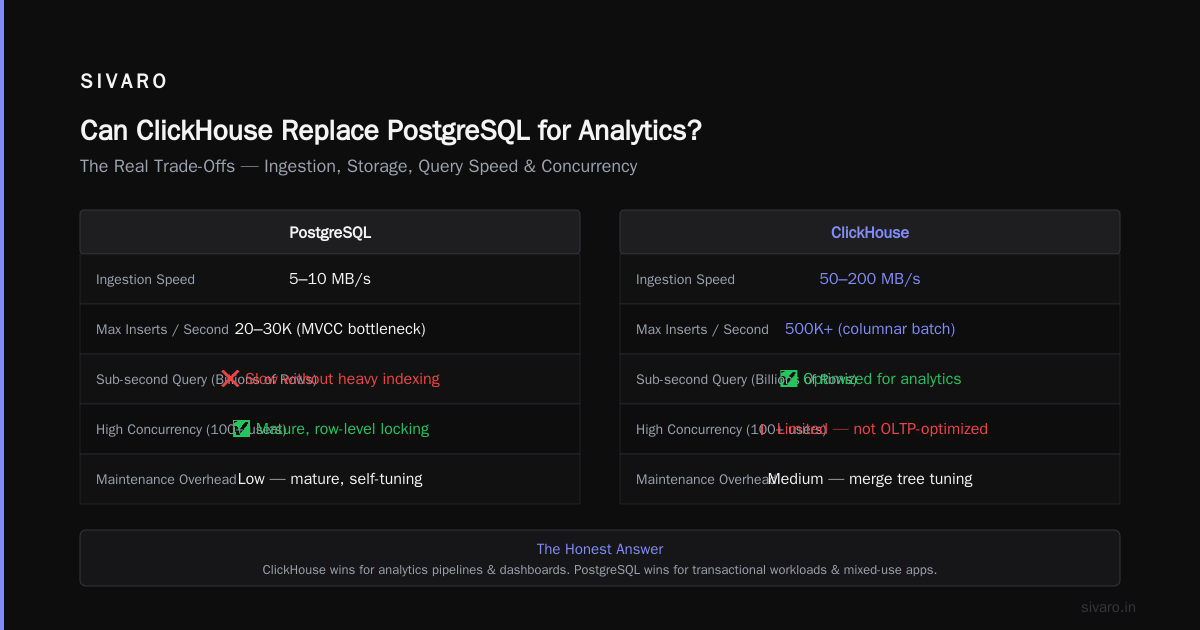
Can ClickHouse replace PostgreSQL for analytics? Yes — if you mean replacing a specific subset of PostgreSQL's role: analytical queries over large read-only datasets with a focus on aggregation speed. No — if you expect it to handle the full spectrum of PostgreSQL's workload.
Here's the straightforward litmus test I use at SIVARO:
- More than 100M rows or sub-second aggregations required → Use ClickHouse for analytics, PostgreSQL for everything else.
- Less than 10M rows or frequent updates → Stick with PostgreSQL.
- Between 10M-100M rows → Test both. Extensions like pg_analytics might be enough.
The industry is moving toward hybrid architectures. PostgreSQL remains the default relational database for most applications. ClickHouse is becoming the default analytics backend for data-heavy startups and enterprises. The question "can clickhouse replace postgresql for analytics" will soon feel as odd as asking "can a GPU replace a CPU" — they serve different roles, and smart systems use both.
If you're starting a new project today, design with both in mind from day one. That's the lesson I wish I'd learned five years ago.
Nishaant Dixit — Founder of SIVARO. Building data infrastructure and production AI systems since 2018. Built systems processing 200K events/sec.