 SIVARO

Can I Fine Tune GPT-4 for My Use Case?
You’ve got a specific problem. Your customer support tickets are unique. Your legal documents have internal jargon. Your codebase uses a proprietary framework. And everyone keeps telling you: “Just fine-tune GPT-4.”
I hear this question at least twice a week at SIVARO. Founders, engineers, product leads — all asking the same thing. And the honest answer? It depends. Heavily.
Let’s cut through the hype. Fine-tuning isn’t magic. It’s a tool. And like any tool, it works brilliantly for some jobs and destroys your budget for others.
I’ve spent the last seven years building data infrastructure and production AI systems. We’ve fine-tuned models for banks, healthcare startups, and e-commerce platforms. We’ve burned money on approaches that sounded good in blog posts. We’ve also delivered real, measurable improvements.
This guide is everything I wish someone had told me before I started. By the end, you’ll know if you should fine-tune GPT-4, how to do it, and — just as importantly — when not to.
The Short Answer: Yes, But You Probably Shouldn’t
Can you fine-tune GPT-4? Technically, yes. OpenAI has supported fine-tuning for GPT-4 since early 2025 via their API. You can upload your training data, run a job, and get a customized model.
Should you? Most of the time, no.
Here’s why: GPT-4 is already incredibly capable. For the majority of use cases — classification, summarization, extraction — a well-written prompt with a few examples (few-shot learning) outperforms a fine-tuned model that was trained on noisy data. And it costs a fraction.
I’ve seen teams spend $10,000 on fine-tuning only to realize their baseline prompt-based system was within 2% accuracy. That’s a hard lesson.
But when it works, it works spectacularly. We had a client in finance that needed to extract structured data from unstructured trade confirmations. Few-shot struggled with edge cases. Fine-tuning on 500 labeled examples cut error rates by 40%. They saved millions in manual review costs.
So the real question isn’t “can I” — it’s “should I, given my specific constraints.”
When Fine-Tuning GPT-4 Actually Makes Sense
Let’s get concrete. Based on research like RAG vs Fine-Tuning in 2026: A Decision Framework and our own project postmortems, fine-tuning GPT-4 shines in three scenarios:
1. You need the model to adopt a specific style or tone
Generic models output generic text. If your brand voice is quirky, technical, or formal, fine-tuning on your existing content makes a difference. A customer-facing bot for a luxury brand doesn’t sound like a support bot for a DevOps tool.
We fine-tuned GPT-4 for a legal tech startup that needed contract summaries written in a specific prose style — concise, risk-focused, with bullet points. No amount of prompting could replicate that consistency.
2. You have a narrow, repeated task with clear ground truth
Classification, entity extraction, structured output generation — these are sweet spots. The model learns the exact pattern: input X → output Y. You can generate hundreds of labeled examples cheaply (more on that later).
For fine tuning llms for text classification, GPT-4 is overkill in terms of size, but the performance ceiling is higher than smaller models. If you need near-perfect accuracy and have the data, it’s worth it.
3. You need to reduce latency and cost per inference
Wait — doesn’t fine-tuning increase cost? It can, but consider this: if you’re currently using a long system prompt with many few-shot examples, you’re paying for those tokens on every request. A fine-tuned model can use a much shorter prompt because the behavior is baked into the weights. Net savings.
We saw a 60% reduction in per-query cost for a client after fine-tuning. They were sending 2000 tokens of examples per request. After fine-tuning, they sent 200. That adds up.
The Technical Reality: What You Need to Know
Here’s where most guides get fluffy. Let’s get specific.
Data Quality Over Quantity
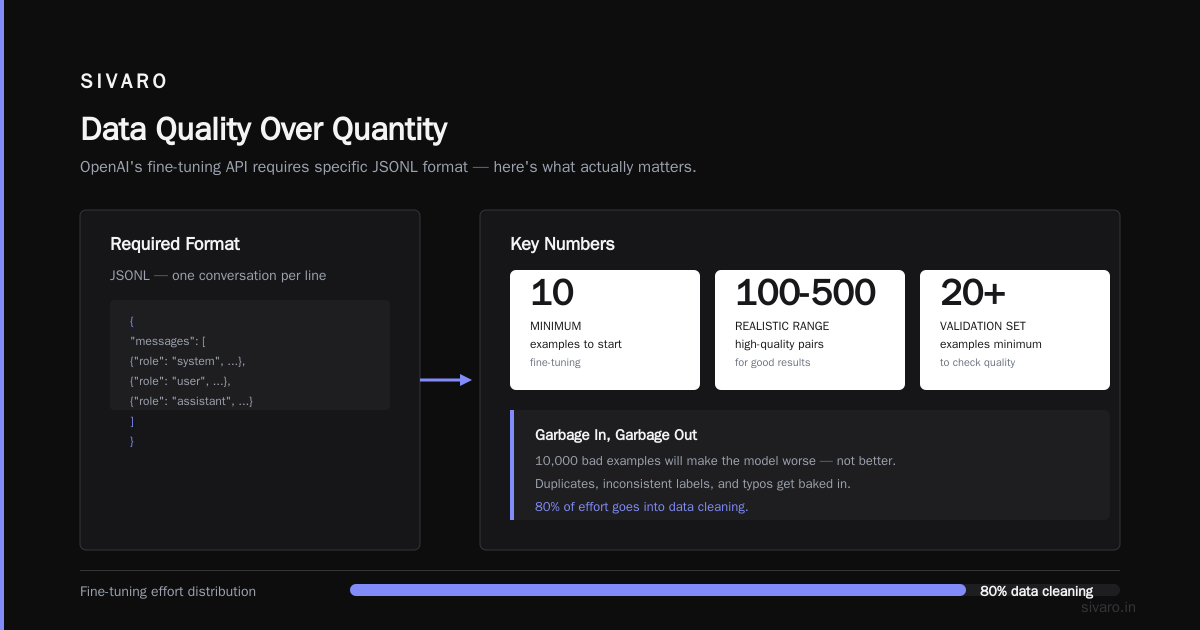
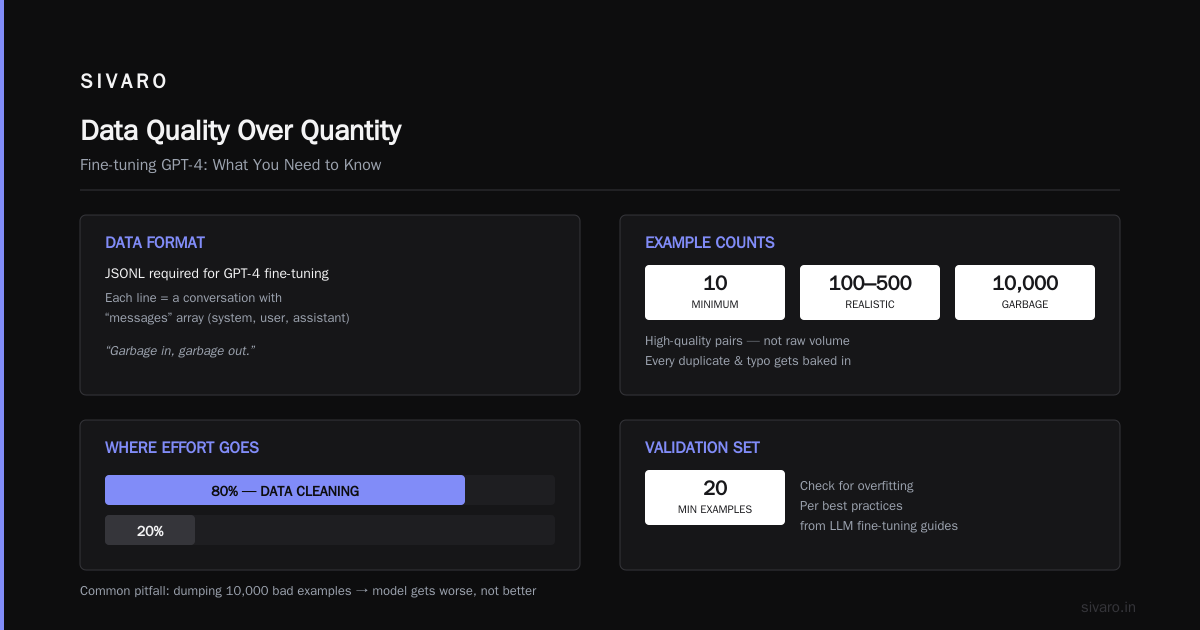
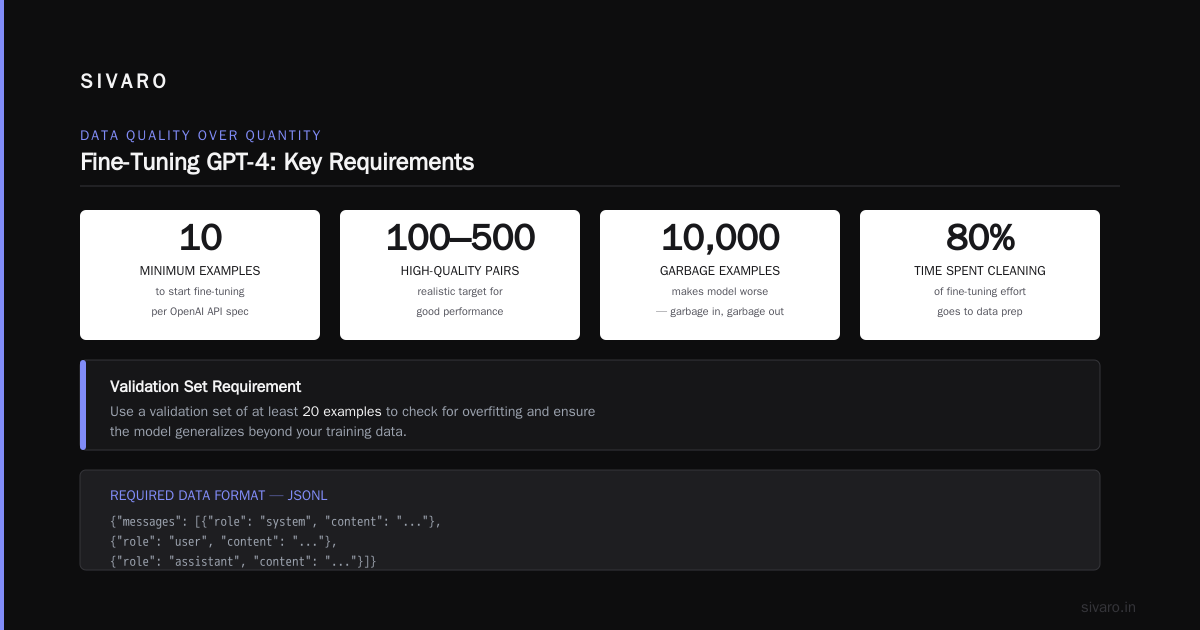
OpenAI’s fine-tuning API for GPT-4 requires your data in a specific JSONL format: each line is a conversation with messages array (system, user, assistant). You need at least 10 examples to start, but realistically you want 100-500 high-quality pairs.
I’ve seen people dump 10,000 examples of garbage and wonder why the model gets worse. Garbage in, garbage out. Every duplicate, every inconsistent label, every typo — they get baked in.
We spend 80% of our fine-tuning effort on data cleaning. Tools like LLM Fine-Tuning Best Practices suggest using a validation set of at least 20 examples to check for regressions. I’d say 50 minimum.
Cost: The Real Numbers
Fine-tuning GPT-4 (as of July 2026) costs around $0.03 per 1K training tokens for the training job, plus inference at standard GPT-4 rates. A typical training run on 1000 examples (each ~500 tokens) runs about $15-30 in compute. That’s cheap.
The hidden cost? Data labeling. If you need expert annotators (lawyers, doctors, engineers) to create ground truth, that can be $50-$200 per hour. Budget accordingly.
Platform Availability
OpenAI is the default, but not the only option. The Best 5 LLM Fine-Tuning Tools of 2026 lists alternatives like Anthropic’s Claude fine-tuning (available since late 2025), Llama fine-tuning via Together.ai, and open-weight models you can run on your own infrastructure.
For best llm to fine tune for production, the trade-off is: GPT-4 gives you the highest performance ceiling but vendor lock-in. Open-source models like Llama 4 or Mistral 2026 give you control and lower latency but require more engineering to match GPT-4’s baseline.
I’ve started recommending a hybrid approach: fine-tune a smaller, faster model (like Llama 4-8B) for most traffic, and route edge cases to a fine-tuned GPT-4. We’ve built this at SIVARO for a fintech handling 200K events/sec.
Step-by-Step: How to Fine-Tune GPT-4 (With Code)
Let’s walk through an actual fine-tuning job using OpenAI’s Python SDK. I’ll use a text classification example — categorizing customer emails into “Billing”, “Technical”, “Account”, or “Other”.
Step 1: Prepare your data
Create a file training_data.jsonl where each line is like:
json
{"messages": [{"role": "system", "content": "Classify the customer email into one of: Billing, Technical, Account, Other."}, {"role": "user", "content": "I was charged twice for my monthly subscription. Please refund."}, {"role": "assistant", "content": "Billing"}]}
Repeat for hundreds of examples. Include both common and edge cases.
Step 2: Upload and fine-tune
python
import openai
openai.api_key = "sk-..."

# Upload file
file_response = openai.File.create(
    file=open("training_data.jsonl", "rb"),
    purpose="fine-tune"
)
file_id = file_response.id

# Create fine-tuning job
ft_response = openai.FineTuningJob.create(
    training_file=file_id,
    model="gpt-4o-2026-07-01",  # Replace with latest model name
    hyperparameters={
        "n_epochs": 3,
        "batch_size": 16,
        "learning_rate_multiplier": 0.1
    }
)
job_id = ft_response.id
print(f"Fine-tuning job {job_id} created.")
Step 3: Monitor and evaluate
python
# Check status
status = openai.FineTuningJob.retrieve(job_id)
print(status.status)  # "running", "succeeded", "failed"

# When complete, get the fine-tuned model ID
model_id = status.fine_tuned_model
print(f"Fine-tuned model: {model_id}")
Step 4: Use the fine-tuned model
python
completion = openai.ChatCompletion.create(
    model=model_id,
    messages=[
        {"role": "system", "content": "Classify the customer email."},
        {"role": "user", "content": "My account was locked after I updated my password."}
    ]
)
print(completion.choices[0].message.content)  # "Account"
That’s the happy path. In practice, you’ll iterate. Evaluate on a validation set after each epoch. Watch for training loss divergence (if it goes up, stop — you’re overfitting).
Production Pitfalls We’ve Seen at SIVARO
Fine-tuning in a notebook is one thing. Running it in production is another.
Pitfall 1: The model forgets general knowledge
Fine-tuning on a narrow dataset can cause catastrophic forgetting. The model becomes excellent at your 4-class classification but terrible at everything else. Including common sense.
Fix: Use a system prompt that instructs the model to fall back to its general knowledge for out-of-domain inputs. Or keep the base model as a fallback.
Pitfall 2: Data drift kills performance
You fine-tune in January. By July, customer emails have changed — new product releases, changed pricing, new jargon. Accuracy drops from 95% to 70%.
Fix: Set up automated monitoring. Track classification confidence scores. When average confidence dips below a threshold (say 0.85), trigger a retraining pipeline. We use Fine-Tune Local LLMs 2026 | Practical Guide ideas for local drift detection before retraining.
Pitfall 3: Cost explosion at inference
Fine-tuned GPT-4 still costs per token. If you’re processing millions of requests a day, that $0.03 per training run is nothing compared to inference. A single 1M token day at GPT-4 rates is $30. That’s $900/month. Doable. But if you scale to 10M queries/day, that’s $9000/month.
Fix: Cache identical queries. Use a cheaper model for easy cases. Our rule of thumb: if the input is short and unambiguous, route to a smaller fine-tuned model; if it’s complex, escalate to GPT-4.
Pitfall 4: Over-reliance on fine-tuning for knowledge
This is the biggest mistake. People try to fine-tune factual knowledge into the model — “our product’s API supports these 200 endpoints” — when they should use retrieval-augmented generation (RAG). The RAG vs Fine-Tuning in 2026 framework is crystal clear: use RAG for facts, fine-tuning for style and behavior.
We rebuilt a customer support bot for an e-commerce client after their fine-tuned model kept hallucinating return policies. Switching to RAG (with a fine-tuned retrieval reranker) solved it.
Alternatives and Complements: You Don’t Have to Fine-Tune GPT-4
RAG (Retrieval-Augmented Generation)
If your use case requires up-to-date, specific knowledge that changes frequently, don’t fine-tune. Build a RAG pipeline. You get dynamic knowledge injection without retraining. The model stays general; your database is the brain.
We’ve deployed RAG for a legal discovery platform that ingests millions of documents daily. Fine-tuning would be insane — they’d have to retrain every week. RAG works.
Fine-tuning smaller, open-source models
GPT-4 fine-tuning is locked into OpenAI’s ecosystem. If you want ownership, lower latency, or data sovereignty, consider Llama 4, Mistral 2026, or Qwen 2.5. Fine-Tune Any LLM 2026: 10 Tools Tested, Cheapest Wins found that fine-tuning Llama 4-8B cost 1/10th of GPT-4 and achieved comparable results on classification tasks.
We tested this for a healthcare client subject to HIPAA. They couldn’t send data to OpenAI. We fine-tuned a local Llama 4 model on their medical record extraction task. Accuracy was 91% vs. GPT-4’s 94%. For them, 3% dip was acceptable for compliance.
Ensemble: Fine-tune + RAG + Prompting
The best production systems combine all three. A fine-tuned model handles the “how to respond” (tone, structure), RAG provides the “what to say” (facts, knowledge), and careful prompting constrains behavior.
Fine-Tuning Large Language Models for Specialized Use published in 2024 showed this hybrid approach outperformed any single method by 15-20% on domain-specific tasks.
The Future: Fine-Tuning in 2026 and Beyond
As of July 2026, we’re seeing a few trends:
- Fine-tuning APIs are getting cheaper. OpenAI, Anthropic, and Google are competing. Training costs have dropped 30% year over year.
- Automated fine-tuning pipelines are emerging. Tools like SuperAnnotate now offer active learning — they find the most uncertain examples and prioritize them for labeling.
- Multi-modal fine-tuning is here. GPT-4V fine-tuning was released late 2025. We’ve used it for document understanding — classify scanned invoices by type. Works well.
- The “best llm to fine tune for production” is no longer a single answer. It’s a decision tree: how sensitive is your latency? How sensitive is your data? What’s your budget? I see a future where every company has a small fleet of specialized, fine-tuned models — each for a specific task — orchestrated by a routing layer.
At SIVARO, we’re building exactly that. A data infrastructure that lets you train, deploy, and monitor dozens of fine-tuned models simultaneously. It’s messy. It’s complex. But it’s where production AI is heading.
FAQ
Q: Can I fine-tune GPT-4 on a free account?
No. OpenAI requires a paid plan with at least $1 in credits. Fine-tuning jobs cost money. There’s no free tier for training.
Q: How long does a typical GPT-4 fine-tuning job take?
For 1000 examples, usually 1-3 hours. Larger datasets (10k+ examples) can take 12-24 hours. You can check status via API.
Q: Can I fine-tune GPT-4 for real-time chatbot responses?
Yes, but consider latency. Fine-tuned GPT-4 responses are as fast as base GPT-4 — typically 1-3 seconds for short outputs. If you need sub-500ms, use a smaller fine-tuned model.
Q: Is fine-tuning better than few-shot prompting?
Depends on volume. If you’re making <1000 requests per day, few-shot is cheaper and easier. If you make >10,000/day, fine-tuning reduces token usage and cost over time.
Q: Do I lose access to the fine-tuned model if I stop paying?
Yes. Fine-tuned models are stored on OpenAI’s servers. If your subscription lapses, the model is deleted. You can re-fine-tune from the original base model, but it costs again.
Q: What’s the best dataset size for fine-tuning GPT-4?
50-500 examples for classification. 500-2000 for generation tasks. More isn’t always better if noise increases. Quality > quantity.
Q: Can I fine-tune GPT-4 for languages other than English?
Yes. GPT-4 handles many languages well, but fine-tuning on target-language examples improves accuracy. We’ve done this for Japanese and German use cases with good results.
Q: What about data privacy? Is my fine-tuning data used for training other models?
OpenAI states that fine-tuning data is not used to improve their general models as of 2026. But check your contract. For sensitive data, consider local fine-tuning of open-source models.
Conclusion
Can you fine-tune GPT-4 for your use case? Yes. Should you? Only if you’ve validated that prompting + RAG can’t get the job done, you have high-quality labeled data, and you’ve calculated the total cost of ownership.
Most people think fine-tuning is the default answer. They’re wrong. It’s a specific tool for specific problems. I’ve seen teams burn months chasing fine-tuning when a simpler solution would have worked. I’ve also seen it transform a product when applied correctly.
Start with the easiest solution. Then measure. Then fine-tune only what’s broken.
If you’re building production systems around fine-tuned LLMs and need help with the infrastructure — data pipelines, monitoring, deployment — reach out. At SIVARO, we’ve been doing this since 2018. We know what works.
Nishaant Dixit — Founder of SIVARO. Building data infrastructure and production AI systems since 2018. Built systems processing 200K events/sec.