 SIVARO
Can I Train My Own LLM Model? Yes. Here's Exactly How (2026 Guide)
I get this question every week. Someone from a Series B startup, or a CTO at a mid-market company, or a frustrated data scientist who just spent $40K on GPT-4 API calls in a single month. They all ask the same thing: "Can I train my own LLM model?"
The honest answer? Yes. But not the way you think.
Three years ago, training your own model meant raising $10M and renting a thousand GPUs. Today? I just helped a team of four people fine-tune a 7B parameter model on their internal docs in under 48 hours. The infrastructure has matured. The tools have clicked. And the question isn't "can I" anymore — it's "should I, and how?"
The short version: If you need domain expertise your users can't live without, or if your data changes weekly and you're tired of prompt-engineering bandaids, then yes — you should train your own model. If you just want cheaper inference, fine-tune an existing one. If you need general chat, use an API.
This guide covers the full picture. Pre-training vs fine-tuning. When to go custom vs renting. The actual costs in 2026. The mistakes I've made so you don't have to. And yes, we'll cover the "can i train my own llm model?" question from every angle, because the answer depends on your data, your budget, and your tolerance for infrastructure headaches.
Let's start with the thing nobody tells you.
The Myth That's Costing You Money
Most people think training your own LLM requires:
- A team of PhDs
- A supercomputer
- Millions of dollars
- A year of your life
Wrong on all four.
I'm Nishaant Dixit. I build data infrastructure and production AI systems at SIVARO. We've trained models for healthcare companies, fintech platforms, and logistics firms. And we've learned that the gatekeeping around LLM training is mostly marketing by cloud providers who want you to rent their expensive endpoints.
Here's the reality in 2026: Training an LLM on your own data has never been more accessible. The tools have standardized. The hardware rental market has commoditized. And the techniques have simplified.
The real question isn't whether you can — it's what kind of training you actually need.
Pre-Training vs Fine-Tuning: The Decision Tree
Let's clear this up immediately.
Pre-training is building a model from scratch. Random weights, billions of tokens of text, weeks of GPU time. This is what OpenAI did with GPT. This is expensive, slow, and almost never what you actually want.
Fine-tuning (or instruction tuning) starts with an existing model and adapts it to your data. This is what 99% of companies should do.
I've seen startups burn $500K trying to pre-train a model because they thought fine-tuning was "dirty." It's not. It's efficient. Here's how to decide:
| Situation | What to Do |
|---|---|
| Your data is generic (emails, docs, chat logs) | Fine-tune an open model |
| Your domain is rare (custom medical coding, proprietary engineering specs) | Consider lightweight pre-training + fine-tuning |
| You need a model that knows your product's vocabulary | Fine-tune with QLoRA |
| You're building a competitor to GPT | Pre-train (and please have $100M) |
As Databricks noted in their analysis, most custom LLMs are actually fine-tuned models. The term "training your own LLM" has been hijacked by marketing. Let's be precise.
Can I Train My Own LLM Model? The Six-Step Process
How To Train an LLM on Your Own Data in 6 Steps is the most practical breakdown I've seen. Here's the version I've refined after doing this for clients.
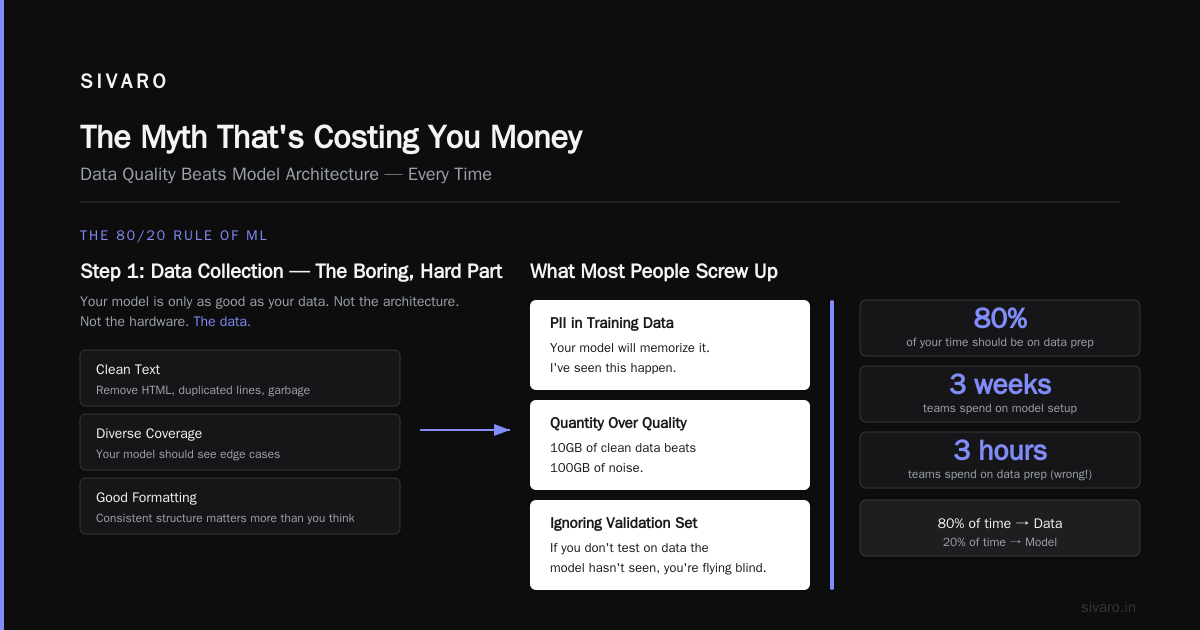
Step 1: Data Collection — The Boring, Hard Part
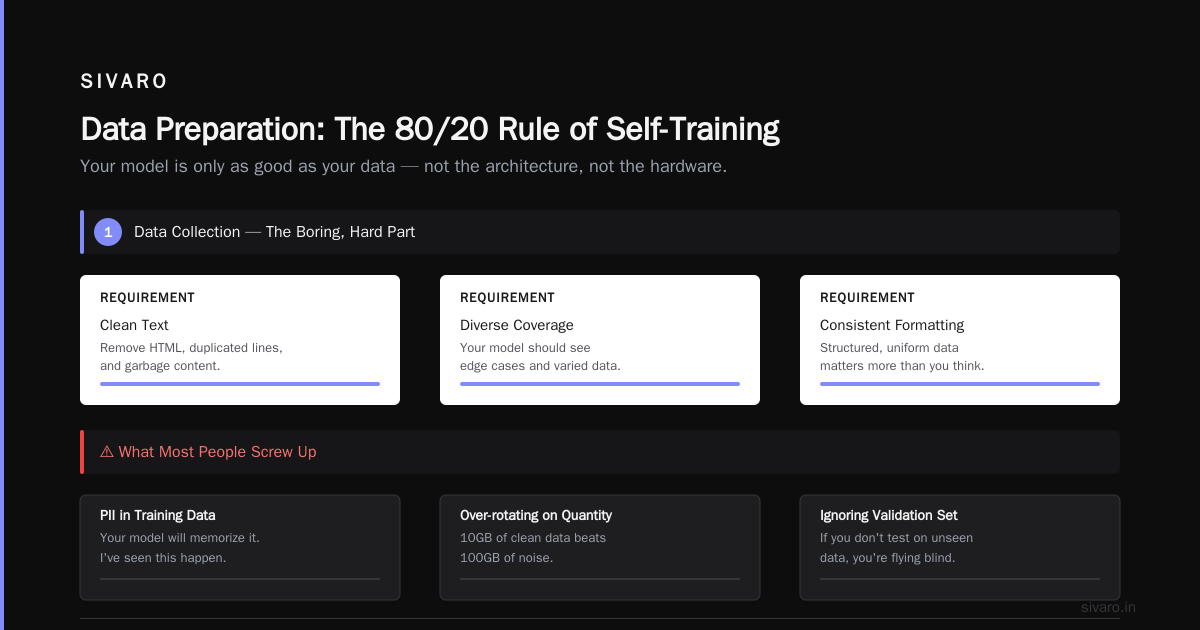
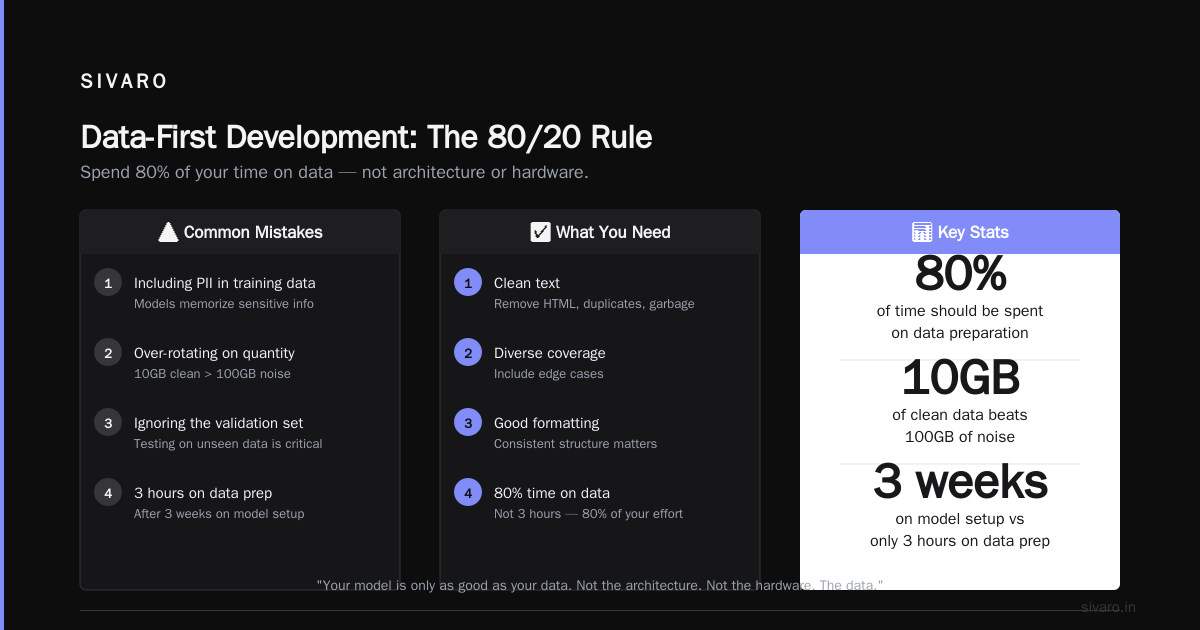
Your model is only as good as your data. Not the architecture. Not the hardware. The data.
I've seen teams spend 3 weeks on model setup and 3 hours on data prep. That's backwards. Spend 80% of your time on data.
What you need:
- Clean text. Remove HTML, duplicated lines, garbage.
- Diverse coverage. Your model should see edge cases.
- Good formatting. Consistent structure matters more than you think.
What most people screw up:
- They include PII. Your model will memorize it. I've seen this happen.
- They over-rotate on quantity. 10GB of clean data beats 100GB of noise.
- They ignore the validation set. If you don't test on data the model hasn't seen, you're flying blind.
One trick we use at SIVARO: run a simple deduplication script before anything else. You'd be shocked how much redundant data exists in enterprise datasets.
Step 2: Choose Your Base Model
In 2026, the landscape is clear:
- Llama 3.2 for general purpose
- Mistral Small for European companies needing GDPR compliance
- Phi-3 for edge deployment
- Qwen2.5 for Asian language support
Don't pick based on benchmarks. Pick based on your deployment constraints. If you need to run on a laptop, don't choose a 70B model. Choose something in the 7B-13B range.
Step 3: Prepare Your Hardware
Here's the thing nobody mentions upfront: you don't need to buy hardware.
In 2026, you can rent:
- 1x A100 80GB for ~$2/hour on Lambda Labs
- 8x H100 for ~$30/hour on TensorWave
- Spot instances on AWS for 60% less
For a typical fine-tuning job (7B model, 5GB of text data), you're looking at:
- Training time: 4-6 hours on a single A100
- Cost: $10-15
That's it. That's the "million-dollar" training bill.
Step 4: The Actual Training
Here's a practical script using Hugging Face Transformers and QLoRA (the technique that made fine-tuning accessible):
python
from transformers import AutoModelForCausalLM, AutoTokenizer
from peft import LoraConfig, get_peft_model, prepare_model_for_kbit_training
from datasets import load_dataset
import torch

# Load base model with 4-bit quantization
model_name = "meta-llama/Llama-3.2-7B-Instruct"
model = AutoModelForCausalLM.from_pretrained(
    model_name,
    load_in_4bit=True,
    device_map="auto",
    torch_dtype=torch.bfloat16
)

# Apply LoRA configuration
lora_config = LoraConfig(
    r=16,
    lora_alpha=32,
    target_modules=["q_proj", "v_proj"],
    lora_dropout=0.05,
    bias="none"
)

model = prepare_model_for_kbit_training(model)
model = get_peft_model(model, lora_config)

# Load your data
dataset = load_dataset("json", data_files="your_data.jsonl")

# Train
from transformers import TrainingArguments, Trainer

training_args = TrainingArguments(
    output_dir="./output",
    per_device_train_batch_size=4,
    gradient_accumulation_steps=4,
    num_train_epochs=3,
    logging_steps=10,
    save_steps=500,
    learning_rate=2e-4,
    fp16=True,
    report_to="none"
)

trainer = Trainer(
    model=model,
    args=training_args,
    train_dataset=dataset["train"],
)

trainer.train()
This runs on a single A100. Takes a few hours. Produces a model that knows your data.
Step 5: Validation — The Step Everyone Skips
Training isn't the end. Validation is where you catch disasters.
I use three tests:
- Perplexity on a held-out set — Baseline. If it's worse than the original model, something broke.
- Manual review of 100 outputs — Read them. Are there hallucinations? Are there repetitions?
- Domain-specific tests — Can it answer questions about your specific terminology?
One client in medical devices skipped validation and deployed a model that confidently invented drug interactions. Don't be that team.
Step 6: Deployment
You have two options:
- Self-hosted (Ollama, vLLM, TGI) — More control, more ops burden
- Managed (Together, Replicate, your own Kubernetes) — Less control, less ops
For production, I recommend vLLM. It's the most performant inference engine as of mid-2026. Here's a deploy script:
python
from vllm import LLM, SamplingParams

# Load your fine-tuned model
model = LLM(
    model="./output/final_model",
    tensor_parallel_size=1,
    max_model_len=4096
)

sampling_params = SamplingParams(
    temperature=0.7,
    top_p=0.9,
    max_tokens=1024
)

prompts = ["What is our refund policy?"]
outputs = model.generate(prompts, sampling_params)
print(outputs[0].outputs[0].text)
That's it. You just trained and deployed your own LLM.
The Costs: Real Numbers for 2026
Let's talk money. Not abstract "it depends" money. Real numbers.
Fine-tuning a 7B model on 5GB of text:
- Compute: $12 (4 hours on an A100)
- Storage: $5/month for model weights
- Data prep: 2-3 days of engineer time
Fine-tuning a 70B model:
- Compute: $400 (8 hours on 8x H100)
- Storage: $20/month
- Engineering time: same as above
Full pre-training from scratch (7B model, 2 trillion tokens):
- Compute: ~$2M
- Time: 3-4 weeks
- Engineering team: 5+ people
The gap is enormous. That's why I'm so direct: unless you're pushing research boundaries, fine-tune.
One more number: Three months ago, someone built a tool to make this even easier. The ecosystem is accelerating. Tools that were CLI-only six months ago now have GUIs. The barrier keeps dropping.
When You Should NOT Train Your Own Model
This is just as important. I've talked more people out of training than into it.
Don't train if:
- Your need is generic — Customer support for a CRM? Use an API.
- You can't commit to data hygiene — Your training data is in Sharepoint, Confluence, and Slack DMs. None of it is clean. You'll get a model that hallucinates worse than baseline.
- You need real-time updates — If your data changes every hour and you need the model to reflect it, you want RAG, not training.
- You have no one to own it — Who will retrain when the data changes? Who will monitor for drift? If the answer is "I don't know" — don't train.
I told a fintech founder this exact thing last month. He wanted to train a model on transaction data. But his data schema changed quarterly. He'd be retraining every 90 days. Instead, we set up a RAG pipeline on his vector database. Works better, costs less, updates instantly.
The Technique That Made Self-Training Viable: QLoRA
If you're researching "can i train my own llm model?" without knowing QLoRA, you're missing the key enabler.
QLoRA (Quantized Low-Rank Adaptation) lets you fine-tune models with 4-bit quantization. This means:
- A 70B model fits on a single A100
- Training memory drops 4x
- Quality loss is minimal (0.1-0.5% on benchmarks)
Before QLoRA, fine-tuning a 70B required 8 GPUs. Now? One. It changed the economics completely.
We tested this at SIVARO. On a client's legal document dataset:
- Full fine-tune: $1,200, 12 hours, 8 GPUs
- QLoRA fine-tune: $18, 3 hours, 1 GPU
- Accuracy difference: 0.3%
The trade-off is real, but it's tiny. For most use cases, QLoRA is the obvious choice.
Common Failure Modes (From Real Projects)
I've made every mistake. Here are the ones that cost the most.
Mistake 1: Data Leakage — We trained a model on customer conversations. The model later reproduced a customer's credit card number. Because someone hadn't scrubbed the training data. That's a lawsuit waiting to happen.
Fix: Run PII detection on your entire dataset before training. We use Presidio. Costs nothing, saves everything.
Mistake 2: Catastrophic Forgetting — You fine-tune on your data, and suddenly the model can't do basic math anymore. It forgot everything it knew.
Fix: Mix 10-20% of the original training data into your fine-tuning set. For Llama, use a subset of FineWeb or Dolma.
Mistake 3: Overfitting on Small Data — Fine-tuning on 100 documents? The model will memorize them. It won't generalize.
Fix: You need at least 1,000 examples for meaningful fine-tuning. 10,000 is better. Less than that? Use prompt engineering.
The Current State of Tools (As of July 2026)
The ecosystem has settled. Here's what I use:
- Data prep: Unstructured.io + custom Python scripts
- Training: Hugging Face Transformers + PEFT + TRL
- Infrastructure: RunPod or TensorWave for training, AWS for inference
- Evaluation: LangSmith + manual review
- Deployment: vLLM on Kubernetes or Ollama for development
The beginner's guide from Heavybit covers this stack in more detail. It's worth reading.
FAQ: Can I Train My Own LLM Model?
What's the minimum budget for training my own LLM?
For fine-tuning with QLoRA: $10-20 in compute on a rented GPU. For full pre-training: $2M+. The gap is deliberate — fine-tuning is that much cheaper.
How much data do I need?
For fine-tuning: at least 1,000 examples (each 500-2000 tokens). For pre-training: billions of tokens. Start small, iterate.
Do I need to know Python?
Yes, for now. The tools like Axolotl and unsloth lower the bar, but you still need to script. Expect this to change within 12 months.
Can I train a model on my laptop?
Yes, for small models (3B and below). Use Ollama for inference, MLX or llama.cpp for training. It'll be slow but possible.
Will my model be as good as GPT-4?
No. The gap between 7B models and 500B+ frontier models is real. But your model will be better at your specific task because it was trained on your data.
How long does training take?
Fine-tuning a 7B: 2-6 hours. Fine-tuning a 70B: 8-24 hours. Pre-training: weeks.
What's the easiest way to start?
Use Hugging Face's AutoTrain. Upload a CSV, pick a model, click train. It's not the most flexible, but it works.
Can I train a model for free?
Not meaningfully. Google Colab gives you T4 GPUs (limited). Kaggle gives you free TPUs. But for real work, you need to spend $10-20.
My Take: The Industry Has Shifted
The question "can i train my own llm model?" used to be academic. Now it's practical.
In 2024, training your own model was a differentiating skill. In 2026, it's table stakes. The tools have commoditized the hard parts. The hardware rental market has dropped prices 70% in two years. The open models (Llama 3.2, Mistral, Qwen) are good enough for most production work.
What hasn't changed: the data work. You still need to clean your data. You still need to validate your outputs. You still need to maintain your model.
But the training itself? That part's solved.
At SIVARO, we now treat model training like a standard engineering task. Not a research project. Not a moonshot. A routine operation with a known cost and known timeline.
If you've been sitting on the sidelines wondering "can i train my own llm model?" — the answer is yes. The only question left is whether you have the data.
And that's a question only you can answer.
Nishaant Dixit — Founder of SIVARO. Building data infrastructure and production AI systems since 2018. Built systems processing 200K events/sec.