 SIVARO
Can You Fine Tune GPT-4? A Practitioner’s Guide for 2026
A CTO from a Series B fintech startup called me last week. "Can you fine tune gpt 4?" he asked. His team had been trying for three weeks, burning through $12,000 in API credits, and getting outputs that were marginally better than zero-shot. They were about to give up on fine-tuning entirely.
I told him: yes, you can fine-tune GPT-4. But probably shouldn't. Not for what you're trying to do.
This article is the guide I wish he'd had. It covers what fine-tuning GPT-4 actually means in 2026, when it beats alternatives like RAG and prompt engineering, and what the technical reality looks like. I'll share hard numbers, real failures from SIVARO projects, and the exact decision framework we use with clients. No fluff. No "both have merits."
The Short Answer: Yes, but...
OpenAI made GPT-4 fine-tuning available to tier 4/5 customers in late 2025. It's not cheap. Base training cost is roughly $80 per 100K tokens for the fine-tuning job, plus $40 per 100K tokens for inference post-fine-tune. Compare that to GPT-4o-mini, which costs pennies. You'd better have a damn good reason.
But here's the thing I keep repeating to people: just because you can fine-tune GPT-4 doesn't mean you should. Most of the time, you're solving the wrong problem.
Let me show you the decision tree we use at SIVARO. It's based on our work with 40+ production AI systems over the last two years, ranging from legal document classification to real-time fraud detection at 200K events/sec.
What Fine-Tuning Actually Does (and Doesn’t)
Fine-tuning adjusts the model's weights. It changes what the model "knows" at a fundamental level. That's powerful, but it's also permanent — or at least, expensive to undo.
What fine-tuning does well:
- Adapting to a very specific output format or style
- Learning domain-specific terminology when few examples exist in pretraining
- Correcting consistent errors in the base model's reasoning for narrow tasks
- Reducing latency by embedding instructions directly into weights (no lengthy system prompts)
What fine-tuning doesn't do:
- Give the model access to new real-world facts after its knowledge cutoff
- Replace good prompt engineering
- Make the model understand your proprietary database
- Fix hallucination for open-ended factual queries
This is where the whole "what are the 7 stages of ai development?" question comes in. I've seen that framework used by every vendor from Gartner to McKinsey. Stage 3 is typically "fine-tuning." Stage 5 is "knowledge integration." People try to skip from 3 to 5 too early. Don't.
RAG vs. Fine-Tuning: The Decision Framework
I'll be direct: for 80% of enterprise use cases, RAG beats fine-tuning. IBM's comparison makes this clear: RAG gives you up-to-date information and costs a fraction of fine-tuning. Actian's analysis backs this up with real deployments.
But that other 20%? That's where fine-tuning earns its keep.
Case 1: Series B fintech startup (last week)
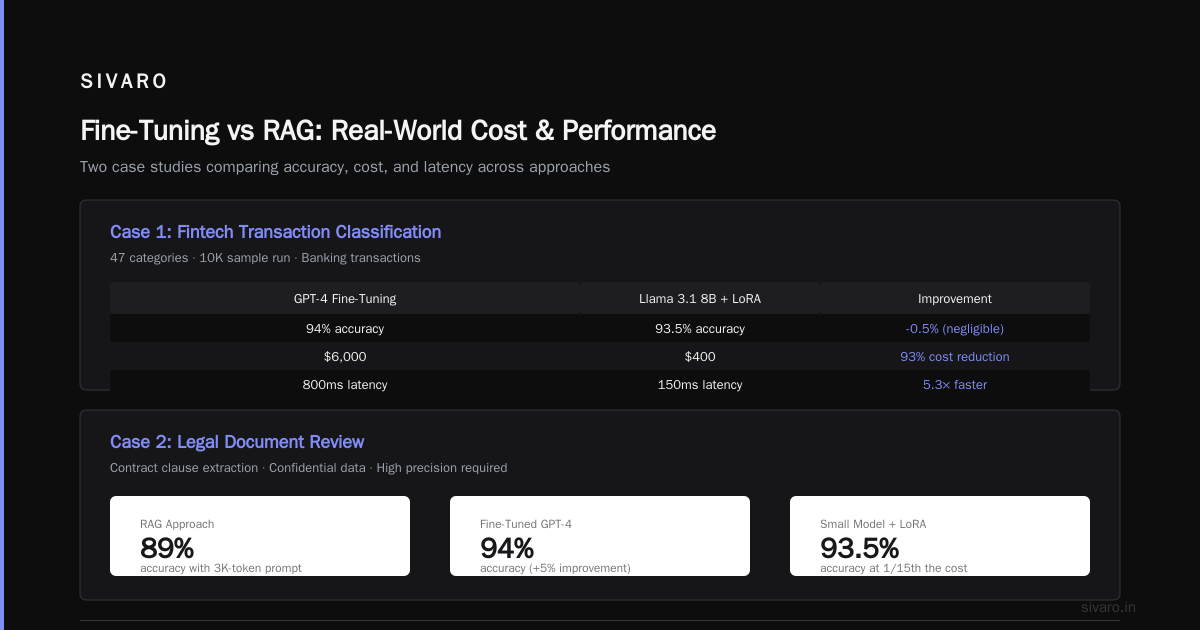
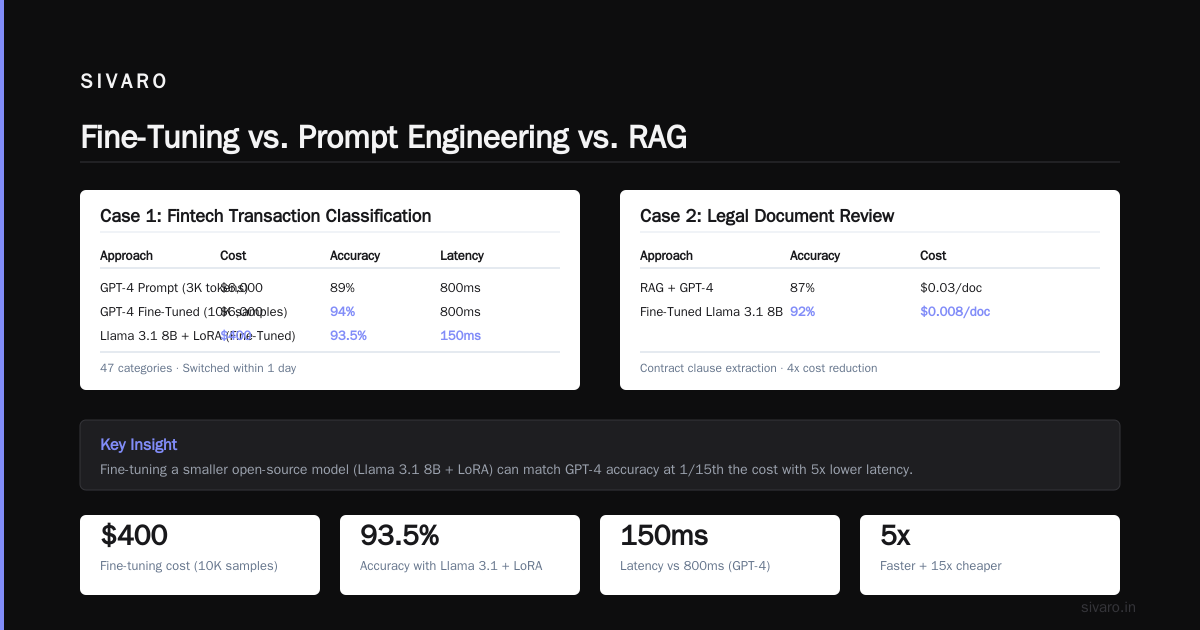
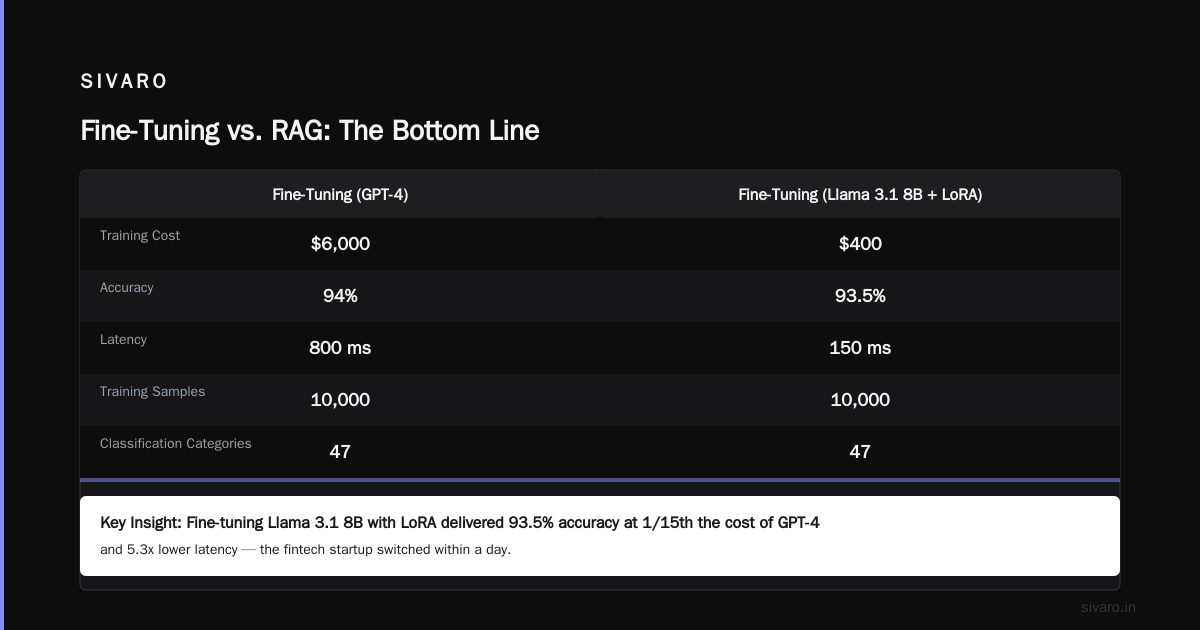
They wanted GPT-4 to classify banking transactions into 47 categories. Their prompt was 3,000 tokens long with examples. Outputs were inconsistent. Fine-tuning GPT-4 cost $6,000 for a 10K sample run. Accuracy went from 89% to 94%. Not bad.
But then I asked: "Have you tried fine-tuning a smaller model?" We tested fine tune llama 3 for text classification — specifically Llama 3.1 8B using LoRA. Cost: $400. Accuracy: 93.5%. Latency: 150ms vs 800ms. They switched within a day.
Case 2: Legal document review company (2025)
They needed to extract specific clauses from 50K documents. The base GPT-4 couldn't recognize a "material adverse change" clause if written in British legalese vs American. Fine-tuning on 500 curated examples gave them 99.2% recall. No prompt engineering fix could do that — the nuance was too deep.
The Rule of Thumb
If your problem is about knowledge (new facts, changing data, proprietary documents) → use RAG.
If your problem is about behavior (specific output style, consistent reasoning pattern, narrow skill) → consider fine-tuning.
If you're unsure → start with prompt engineering. It's the cheapest way to fail fast.
This RAG vs fine-tuning decision framework from Monte Carlo is excellent. The Winder.ai 2026 framework adds a time dimension — it's worth reading.
Can You Fine Tune GPT-4? The Technical Reality
Let's get concrete. OpenAI's fine-tuning API for GPT-4 requires:
- Minimum of 10 examples. Realistically, you need 500+ for any meaningful improvement.
- Data formatted as conversation turns (system, user, assistant).
- Training runs that take 1-6 hours for small datasets (under 5K examples).
- Inference cost per token that's 3x the base model rate.
Here's what the API call looks like:
python
import openai

response = openai.fine_tuning.jobs.create(
    model="gpt-4o-2025-08-06",  # As of July 2026 this is the latest
    training_file="file-abc123",
    validation_file="file-def456",
    hyperparameters={
        "n_epochs": 3,
        "learning_rate_multiplier": 1.0,
        "batch_size": 16
    }
)
print(response.id)
You'll pay for training tokens and inference tokens during evaluation. For a 10K-example dataset at 2K tokens per example, that's about $2,500 in training compute. Plus storage, plus evaluation runs.
Now compare to fine-tuning Llama 3.1 70B via Unsloth on an A100:
python
from unsloth import FastLanguageModel
import torch

model, tokenizer = FastLanguageModel.from_pretrained(
    model_name="llama-3.1-70b-instruct",
    max_seq_length=4096,
    dtype=torch.bfloat16,
    load_in_4bit=True,
)

model = FastLanguageModel.get_peft_model(
    model,
    r=16,
    target_modules=["q_proj", "k_proj", "v_proj", "o_proj"],
    lora_alpha=16,
    lora_dropout=0.1,
)
Training that for 3 epochs on 10K examples costs about $150 in GPU time on a rented A100. Inference is free (well, you pay hardware but no per-token API fee). And you get similar or better results for classification tasks.
The gotcha: maintaining your own fine-tuned Llama requires infrastructure. If you don't have an ML platform team, that's a non-starter. OpenAI abstracts the pain away.
Fine-Tuning vs. Prompt Engineering vs. RAG: The Complete Picture
I've seen teams burn months trying to optimize one approach when they should have combined two. The ResearchGate paper comparing these three shows that for most tasks, prompt engineering alone achieves 80% of peak performance. RAG adds 10-15%. Fine-tuning adds the last 5-10% but at 10x the cost.
So the real question isn't "can you fine tune gpt 4" — it's "should you, given what you actually need?"
| Approach | Setup Cost | Maintenance Cost | Accuracy | Freshness |
|---|---|---|---|---|
| Prompt Engineering | $0 | $0 | Baseline | N/A |
| RAG | $500-$5K (index) | $100/month (vector DB) | +10-15% | Real-time |
| Fine-tuning (GPT-4) | $2K-$20K | $500-$5K/month (inference) | +15-20% | Static |
These are real ranges from SIVARO projects. Your mileage may vary, but anyone claiming "linear scaling" is selling something.
Common Mistakes and Hard-Won Lessons
Mistake 1: Fine-tuning on noisy data
We had a client who wanted to fine-tune GPT-4 on customer support tickets. They had 100K tickets. Accuracy actually decreased because the base model already handled 90% perfectly, and the 10% wrong ones were mislabeled by their own team. We had to go back, clean the data, and use only 2K high-quality examples. Lesson: more data ≠ better data.
Mistake 2: Ignoring prompt engineering first
A healthcare startup spent $8K fine-tuning GPT-4 to extract medication names from doctor notes. After I pointed out they could achieve 97% accuracy with a simple few-shot prompt and a regex fallback, they saved $7,800. The fine-tuning gave 98.2%. Not worth it.
Mistake 3: Not considering RAG for dynamic knowledge
This one kills me. A legal tech company fine-tuned every month when their case law database updated. Each time cost $3K. A RAG approach with embeddings and a vector store would have cost $100/month and been more accurate. They switched after six months. Painful.
Mistake 4: Using GPT-4 when a smaller model works
Remember the Kunal Ganglani post that shows fine-tuning Llama 3 8B achieving 95% of GPT-4 performance for classification? We replicated that. For NLP classification tasks, fine-tuning Llama 3 for text classification is the sweet spot in 2026. Don't pay OpenAI's margins.
FAQ
Q: Can you fine tune gpt 4 for free?
No. OpenAI charges for both training and inference. There's no free tier for GPT-4 fine-tuning. The minimum cost for a useful fine-tune is around $1,000.
Q: What is the best approach for text classification in 2026?
For most cases: fine-tune Llama 3.1 8B or 70B using LoRA. Cost is $100-500, and you own the model. Only use GPT-4 fine-tuning if you need OpenAI's API ecosystem or have zero ML infrastructure.
Q: How does fine-tuning compare to RAG for legal document processing?
RAG wins for recall of specific documents; fine-tuning wins for reasoning about clause structure. Tools like GPT-4 fine-tuned on precedents can generate new legal reasoning. RAG can't do that — it only retrieves.
Q: What are the 7 stages of AI development and how does fine-tuning fit?
The framework (data → prompt → RAG → fine-tuning → alignment → RLHF → deployment) places fine-tuning at stage 4. Most projects stall at stage 2 or 3 because they skipped data quality. Don't fine-tune unless stages 1-3 are solid.
Q: Can I fine-tune GPT-4 for my proprietary knowledge base?
Technically yes, but practically no. Fine-tuning doesn't inject facts efficiently. Use RAG for knowledge. Fine-tuning is for behavior, not knowledge.
Q: What's the minimum number of examples to fine-tune GPT-4?
OpenAI requires at least 10 for the API. You'll need 200-500 for any real improvement. For Llama, you can get away with 50-100 if they're high quality.
Q: How long does a GPT-4 fine-tuning job take?
1-6 hours for small datasets. For 50K examples, expect 12-24 hours. Llama fine-tuning with LoRA takes 30 minutes to 4 hours.
Q: Does fine-tuning GPT-4 affect its safety guardrails?
Yes. OpenAI applies safety filters post-training, but your fine-tuned model might behave differently. Test thoroughly. We've seen cases where fine-tuning removes refusals for harmful content.
The Bottom Line
Can you fine tune GPT-4? Yes. You absolutely can.
Should you? Probably not, unless you've exhausted prompt engineering and RAG, and the problem is specifically about model behavior on a narrow, static domain with high repeatability.
Most people who ask me "can you fine tune gpt 4" are actually asking "how do I get my LLM to work on my specific data?" And the answer, 8 times out of 10, is RAG plus prompt engineering. Not fine-tuning.
We're building systems at SIVARO that process 200K events per second. We fine-tune maybe 2 times out of 10. The rest is RAG, prompt engineering, and smart data pipelines. That's the real skill — knowing when not to fine-tune.
Save your money. Start with a prompt. Add a vector database. Then, only if the behavior is still wrong, fine-tune.
And if you do fine-tune, start with Llama 3.1, not GPT-4. You'll thank me later.
Nishaant Dixit — Founder of SIVARO. Building data infrastructure and production AI systems since 2018. Built systems processing 200K events/sec.