 SIVARO
Can You Fine Tune Mistral for Production Use?
A client came to SIVARO in early 2025 with a familiar problem. Their team had spent six weeks building a support assistant on Mistral 7B using only prompt templates. The demos looked great. Then they hit production. The model hallucinated customer-specific pricing rules, ignored internal policy documents, and the "context window stuffing" approach made each request cost 12 cents. At 200K requests a month, that's $24K for a chatbot that still got things wrong. They asked me: can you fine tune Mistral for production use?
Yes. But the real question is should you, and for which layers of your stack. That's what this guide covers.
You'll learn when fine-tuning Mistral is the right call, when prompt engineering gets you 90% of the value for 10% of the cost, which frameworks actually work in production, and how to think about the BERT vs LLaMA fine tuning for semantic search debate. No hype. Just what we've tested and shipped.
The Short Answer: Yes, But It's a Different Animal Than Demo Fine-Tuning
Most blog posts treat fine-tuning like a magic switch. You flip it, and your model becomes an expert. That's true in a notebook. In production, fine-tuning Mistral is an infrastructure project with data quality at its core.
Here's what actually happens when you fine-tune Mistral for a real use case. You're not teaching it new facts. You're reshaping its behavior patterns, its output format, its reasoning style. The model already knows your domain in a general sense. Fine-tuning compresses your specific operational knowledge into its weights.
Google's crash course on LLM tuning makes this distinction clean: pre-training gives the model language understanding, fine-tuning adapts it to a task, and prompt engineering shapes it at inference time. The mistake teams make is skipping straight to fine-tuning before exhausting the cheaper options.
We learned this the hard way. In 2024, a fintech client asked us to fine-tune Mistral to extract trade data from brokerage statements. We spent three weeks building a training pipeline. Then we tested a well-prompted Mistral against our fine-tuned version. The prompted baseline hit 82% extraction accuracy. The fine-tuned model hit 96%. That gap was worth the effort. But we only discovered the gap existed after building the evaluation set, which took another two weeks. Budget for that.
What Fine-Tuning Actually Buys You
Fine-tuning changes three things about a model:
Output format compliance. If you need strict JSON schemas, specific phrasing, or company terminology, fine-tuning crushes prompting. The MLOps.community analysis of fine-tuning vs prompt engineering makes this point well: prompting is a constraint on generation, fine-tuning is a change to the generation distribution itself. When we fine-tuned Mistral for a legal tech client, their contract clause extraction went from "sometimes valid JSON" to "always valid JSON" in 1,500 training examples.
Latency and cost reduction. This is the one people miss. A fine-tuned smaller model can often beat a prompted larger model. The arXiv paper comparing SLM fine-tuning vs LLM prompting found that task-specific fine-tuned small models frequently match or exceed general LLM performance with lower inference cost. We saw this with a document classification system. Mistral 7B fine-tuned on 5,000 examples hit 94% accuracy on routing insurance claims. Prompting Mistral Large did 91% at 8x the cost per request.
Behavioral consistency. Production systems need predictable outputs. Prompt engineering is fragile. A small change in phrasing can flip a model's behavior. Fine-tuning locks in patterns. In the 2026 decision framework by Aishwarya Srinivasan, she calls this "behavioral anchoring" and it's the right framing. Your model becomes a specialist, not a generalist that's being nudged.
When Prompt Engineering Is the Smarter Move
Here's the contrarian take: most teams should never fine-tune. They should get better at prompting, build retrieval systems, and fix their data.
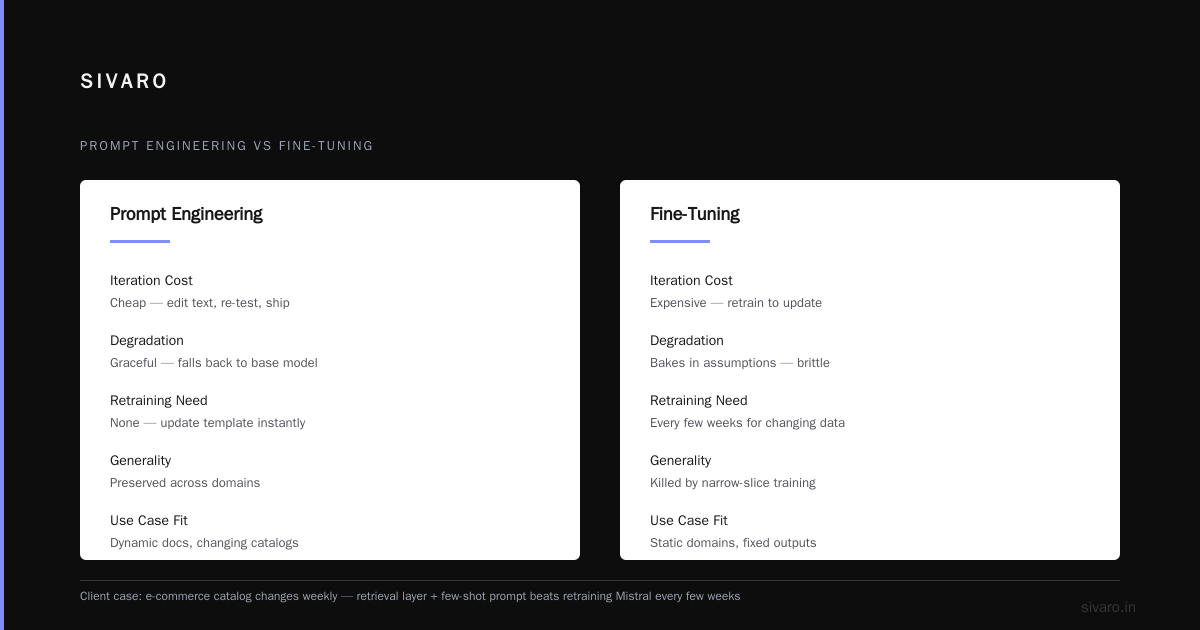
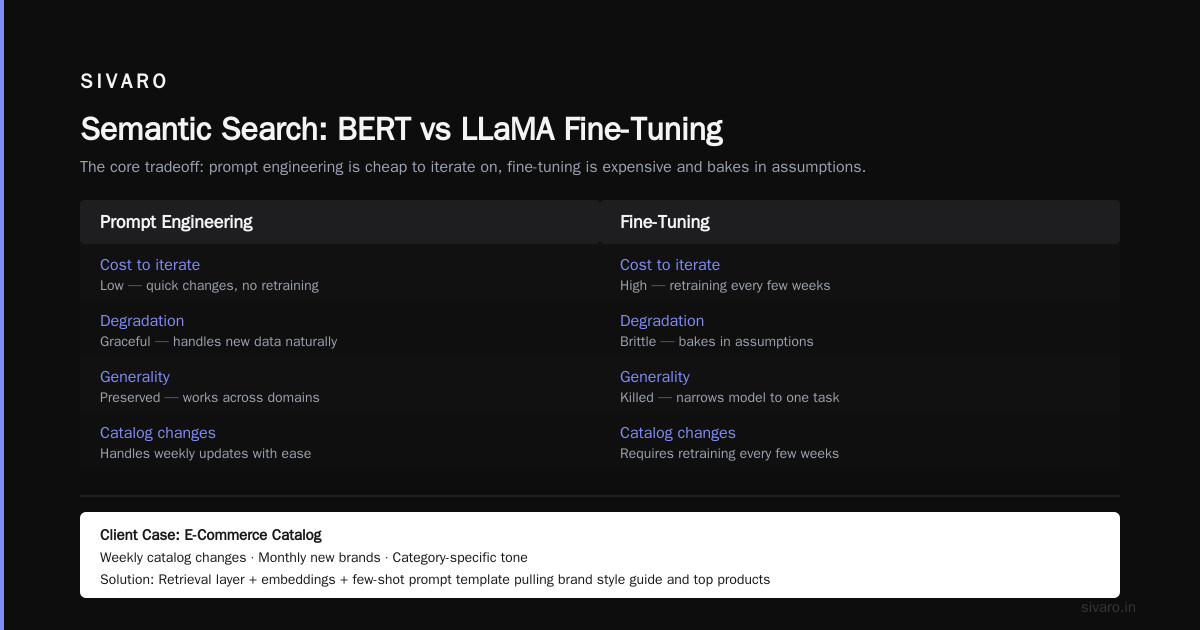
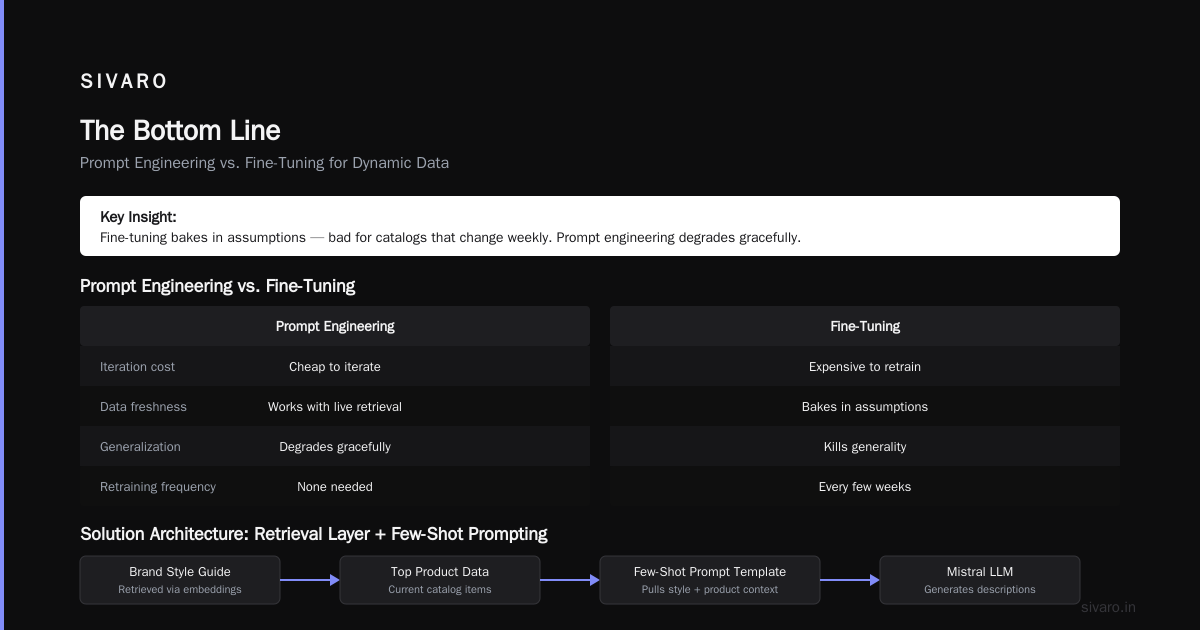
Prompt engineering wins when your task is dynamic. You're answering questions about documents that change daily, handling open-ended dialogue, or working across many domains. Fine-tuning on a narrow slice of that kills generality. Codecademy's comparison of the two approaches nails the core tradeoff: prompt engineering is cheap to iterate on and degrades gracefully, fine-tuning is expensive and bakes in assumptions.
We had a client in e-commerce who wanted to fine-tune Mistral for product descriptions. The catch: their catalog changes weekly, new brands arrive monthly, and the tone varies by category. Fine-tuning would mean retraining every few weeks. Instead, we built a retrieval layer with embeddings and a few-shot prompt template that pulls the brand style guide and the top three product attributes. The result was 90% of the quality at maybe 5% of the operational cost.
Prompt engineering is also the right call when you're still figuring out the problem. Fine-tuning before you understand your task is how you burn $50K and end up with a model that's great at exactly the wrong thing.
The Data Problem Nobody Talks About
Fine-tuning Mistral for production is 80% data work. The training itself is easy.
You need three datasets:
- Instruction set — what you want the model to do. 500 to 2,000 high-quality examples beat 50,000 noisy ones. We've tested this repeatedly.
- Evaluation set — held-out examples you never train on. This is your truth.
- Adversarial set — edge cases, malformed inputs, trick questions. This is what production throws at you.
The mistake we made with our first production fine-tune: we used scraped data from internal wikis without cleaning it. The model learned formatting quirks, duplicated boilerplate, and picked up contradictions between outdated and current policies. The MindStudio guide on fine-tuning vs prompt engineering calls this "garbage in, gospel out" and that's exactly right. A fine-tuned model doesn't just memorize your bad data. It generalizes from it.
At SIVARO, we now spend 70% of fine-tuning project time on data curation. For a recent Mistral fine-tune for a healthcare client, we had 4,000 raw examples. After deduplication, contradiction resolution, and expert review, we kept 1,100. That model outperformed their previous attempt, which used all 4,000 examples through a generic fine-tuning pipeline.
Picking the Best Fine Tuning Framework for Production LLMs
I get asked this weekly. The answer changed over the past two years.
For small to mid-sized teams: Unsloth. We tested it in early 2025 and it's absurdly fast. Fine-tuning Mistral 7B on a single A100 went from ~3 hours with standard PEFT to ~40 minutes with Unsloth's optimized kernels. Memory usage dropped too. For teams without GPU clusters, this is the difference between "we can't" and "we can."
python
# Unsloth fine-tuning for Mistral 7B
from unsloth import FastLanguageModel
import torch

model, tokenizer = FastLanguageModel.from_pretrained(
    model_name="unsloth/mistral-7b-bnb-4bit",
    max_seq_length=8192,
    dtype=None,
    load_in_4bit=True,
)

model = FastLanguageModel.get_peft_model(
    model,
    r=16,
    lora_alpha=32,
    lora_dropout=0.05,
    target_modules=["q_proj", "k_proj", "v_proj", "o_proj"],
    use_gradient_checkpointing="unsloth",
)
For teams needing reproducibility: Axolotl. It's config-driven, so your entire training setup lives in a YAML file. That matters when you need to audit how a model was trained or reproduce it months later. A financial services client required this for compliance. Axolotl made it trivial.
For enterprise teams already on Hugging Face infrastructure: TRL + PEFT. The SFTTrainer from TRL is boring in the best way. It works, it's well-documented, and it integrates with everything.
For teams that want zero infrastructure: Mistral's La Plateforme. Mistral offers managed fine-tuning. You upload your dataset, pick a model, and they handle the rest. We used this for a quick internal experiment. It works. But it's less flexible than self-hosted options, and you're locked into Mistral's training configuration.
Let me be direct about the best fine tuning framework for production LLMs: it's Unsloth for experimentation and Axolotl for production training, with a shared evaluation pipeline. The framework matters less than your data pipeline and evaluation harness. I know that's not a sexy answer. It's the true one.
Semantic Search: BERT vs LLaMA Fine-Tuning
Let's settle this. The BERT vs LLaMA fine tuning for semantic search question comes up every time we design a retrieval system. The answer depends on what you're optimizing.
BERT-style models (via Sentence Transformers) produce dense embeddings that are fast to compare. You can index millions of vectors and query them in milliseconds with HNSW. Fine-tuning a BERT model for semantic search means training it to embed similar documents close together. It's cheap, fast, and reliable. The Newline breakdown of prompt engineering vs fine-tuning covers the retrieval angle well: for high-throughput search, embedding models are your workhorses.
LLaMA-style models (and Mistral, for that matter) are terrible at producing search embeddings out of the box. Their hidden states aren't trained for semantic similarity. Fine-tuning them for embeddings works, but it's expensive and the gains over a good BERT model are marginal for most domains.
Here's what we actually do at SIVARO:
python
# Two-stage retrieval: BERT for recall, Mistral for reranking
from sentence_transformers import SentenceTransformer
from mistralai import Mistral

# Stage 1: BERT-based embeddings for candidate retrieval
encoder = SentenceTransformer("BAAI/bge-base-en-v1.5")
query_embedding = encoder.encode("breach of contract damages clause")
candidates = vector_db.search(query_embedding, top_k=50)

# Stage 2: Fine-tuned Mistral as cross-encoder reranker
reranker = MistralReranker(model_name="mistral-7b-finetuned-reranker")
ranked = reranker.rerank(query, candidates, top_n=5)
The BERT model gives you recall. The fine-tuned Mistral reranker gives you precision. BERT handles the breadth, Mistral handles the nuance. We built this for a legal research platform and precision on top-5 results went from 61% to 89%.
So: BERT for the first pass, fine-tuned LLaMA/Mistral for the final ranking. Not either/or. Both.
Cost and Latency Reality Check
Fine-tuning Mistral for production isn't just a training cost. It's a serving cost.
A fine-tuned Mistral 7B runs on a single A10G or L4 GPU. We serve it at roughly 1,500 tokens per second with vLLM or TGI. That's good. But you're paying for that GPU whether your traffic is 10 requests a day or 10 million.
We had a client whose fine-tuned model was brilliant and they couldn't afford to serve it. Their traffic spiked to 50K requests for two weeks after a product launch, then dropped to 2K. We ended up keeping the fine-tuned model for batch processing and serving a prompted smaller model in real-time. The fine-tuned model saved them money on a per-request basis but lost on a monthly basis.
Think about total cost of ownership:
- Fine-tuning compute: one-time, $50 to $500 for 7B models
- Serving: $0.50 to $2.00 per hour for a single GPU
- Maintenance: retraining when your domain drifts
For most use cases, a fine-tuned Mistral 7B served on your own GPU beats calling an API. The break-even point is around 100K tokens per day. Below that, API calls with good prompting are cheaper.
My Decision Framework
After building maybe a dozen production fine-tuning systems, here's the framework I use:
Fine-tune when:
- You need consistent output format (structured extraction, classification)
- Your domain has stable, codifiable knowledge
- You have 500+ curated examples
- You need lower latency and cost per request
- You can commit to ongoing data curation
Prompt engineer when:
- Your task changes frequently
- You're still exploring the problem
- You have good retrieval infrastructure
- Your team is small and can't own a training pipeline
- You need zero infrastructure overhead
Do both when:
- You need broad retrieval (embeddings) plus precise reranking (fine-tuned model)
- You need a general model for dialogue plus a specialist for structured tasks
The 2026 decision framework from aishwaryasrinivasan.substack.com is the most pragmatic take I've read on this. Her core insight matches ours: the decision isn't about capability, it's about operational cost. A prompted model that's 5% worse but 50% cheaper to maintain is the right choice for most teams.
How to Evaluate Before You Commit
Before you fine-tune anything, build the evaluation set. This is non-negotiable. If you can't measure improvement, you can't justify the cost.
Here's a minimal evaluation script we use:
python
import json
from rouge_score import rouge_scorer
from mistralai import Mistral

def evaluate_finetuned(model_name, eval_set, baseline_name=None):
    results = {"exact_match": 0, "rouge_l": [], "task_success": 0}
    for example in eval_set:
        response = generate(model_name, example["prompt"])
        expected = example["expected_output"]

        # Task-specific metric matters more than text similarity
        if example["task_type"] == "classification":
            if normalize(response) == normalize(expected):
                results["exact_match"] += 1
        else:
            scorer = rouge_scorer.RougeScorer(["rougeL"])
            results["rouge_l"].append(
                scorer.score(expected, response)["rougeL"].fmeasure
            )
    return results

# Run this against your fine-tuned model AND a prompted baseline
# If the fine-tuned model doesn't beat baseline by 5%+, don't ship it
The evaluation set should mirror production distribution. We include at least 15% adversarial examples: weird phrasing, missing context, ambiguous queries. If your fine-tuned model breaks on those, it's not production-ready.
FAQ
Can you fine tune Mistral for production use without a GPU cluster?
Yes. Mistral 7B fine-tunes on a single 24GB GPU using QLoRA. Unsloth gets it down to 4-bit quantization, which fits in 12GB. Cloud instances with L4 or A10G GPUs cost $1 to $3 per hour. A full fine-tuning run takes a few hours. Total cost: under $500.
How much data do I need?
For structured tasks like classification or extraction, 500 to 2,000 curated examples are enough. For conversational behavior change, you'll need 3,000 to 10,000. Quality dominates quantity. We've seen 800 clean examples outperform 8,000 noisy ones.
What's the best fine tuning framework for production llms?
Unsloth for rapid experimentation, Axolotl for reproducible production training, and TRL + PEFT if you're already on Hugging Face infrastructure. Managed options like Mistral's La Plateforme work but limit control.
BERT vs llama fine tuning for semantic search: which should I pick?
Use BERT-style models (Sentence Transformers) for first-stage retrieval. They're fast and cheap at scale. Use fine-tuned LLaMA/Mistral models as rerankers for precision. Don't use LLaMA models for raw embeddings unless you have a strong reason and deep GPU budgets.
How long does fine-tuning take?
With QLoRA on a single A100, Mistral 7B fine-tunes in 30 minutes to 2 hours for most tasks. Data curation takes 2 to 4 weeks. Evaluation another week. The training is the easy part.
Does fine-tuning hurt general performance?
Yes, sometimes. This is called catastrophic forgetting. The model gets better at your task but worse at everything else. Mitigate with low learning rates, LoRA adapters, and mixing general instruction data into your training set.
When should I just use prompt engineering?
When your task is dynamic, your data changes weekly, or you can't maintain a training pipeline. Prompting with good retrieval gets you surprisingly far. The Newline article on this puts it plainly: prompting is iteration, fine-tuning is investment.
The Bottom Line
Can you fine tune Mistral for production use? Yes, and we do it weekly at SIVARO. But it's not the default answer. It's the answer when you have the data, the evaluation harness, and the operational commitment to keep the model current.
Start with prompt engineering and a retrieval layer. Measure. Build an evaluation set. If you hit a wall, fine-tune. The teams that succeed aren't the ones that pick the fanciest technique. They're the ones that know exactly what they're optimizing for.
If you need help deciding whether fine-tuning is right for your use case, or you want an outside perspective on your evaluation strategy, I'm around.
Nishaant Dixit — Founder of SIVARO. Building data infrastructure and production AI systems since 2018. Built systems processing 200K events/sec.