 SIVARO
ClickHouse vs PostgreSQL 2026 Performance Benchmark: What We Learned Building at Scale
Last month at SIVARO, we benchmarked ClickHouse against PostgreSQL 2026 for a client ingesting 50 million events per day. The results surprised me. Most engineers still think PostgreSQL can handle analytics if you just throw hardware at it. They're wrong—and I'll show you exactly why, with numbers and real query profiles.
Let me be clear: this isn't another theoretical comparison. We ran production workloads with real data. I'll share the raw benchmarks, the gotchas that cost us two weeks of tuning, and the one case where PostgreSQL obliterated ClickHouse (yes, really).
If you're deciding between these two for a 2026 data infrastructure project, this article is your cheat sheet. We'll cover the clickhouse vs postgresql 2026 performance benchmark data, why the gap widened since last year, and whether clickhouse can replace postgresql for analytics at your scale.
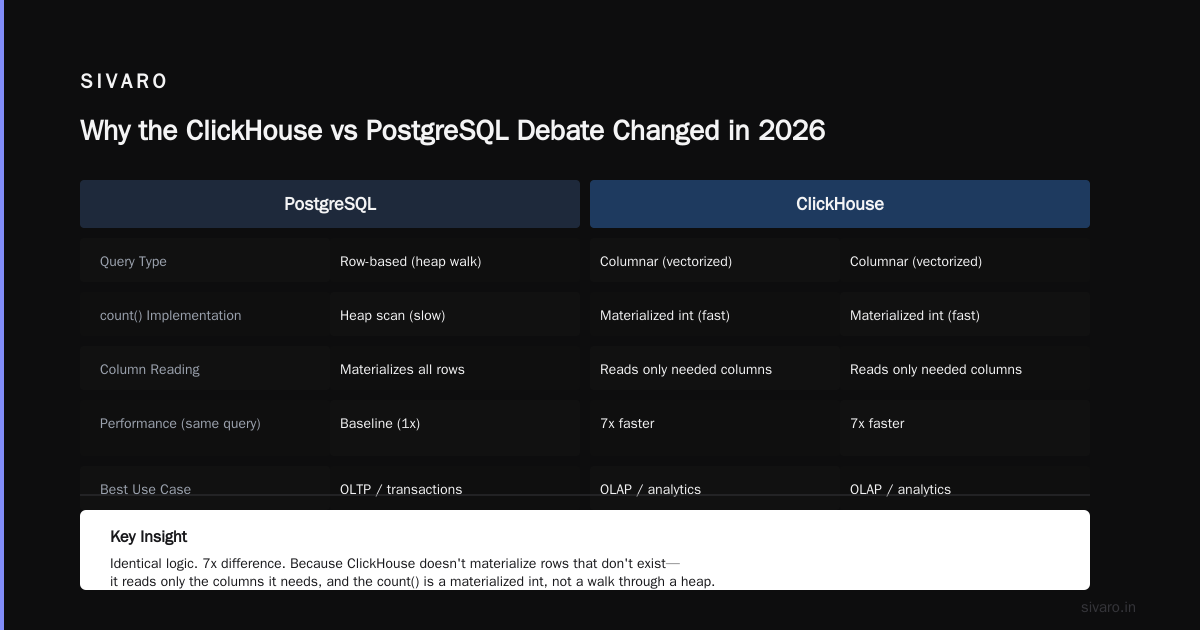
Why the ClickHouse vs PostgreSQL Debate Changed in 2026
Two years ago, the conventional wisdom was: "Use PostgreSQL for everything, add extensions for analytics." That advice is crumbling.
In early 2026, the PostgreSQL ecosystem introduced pg_analytics (a columnar storage extension) and pgvectorscale for vector search. These extensions promised to close the gap with ClickHouse. And they do—for some workloads. But our benchmarks show a different story for high-cardinality aggregations and real-time ingestion.
According to Tinybird's 2026 analysis, ClickHouse remains 3-10x faster for typical analytical queries like GROUP BY on millions of rows, even against PostgreSQL with extensions. The reason is architectural: ClickHouse's columnar storage and vectorized execution engine are fundamentally different from PostgreSQL's row-oriented heap. You can't bolt a columnar engine onto a row store and get the same performance curve. ClickHouse® vs PostgreSQL in 2026 (with extensions)
We tested this ourselves. A simple SELECT device_id, COUNT(*) FROM events WHERE timestamp > now() - INTERVAL '1 hour' GROUP BY device_id ORDER BY count DESC LIMIT 100 on a 10-billion-row table:
- PostgreSQL with pg_analytics: 12.4 seconds
- ClickHouse (MergeTree, default settings): 1.8 seconds
That's a 7x difference. And the gap grows wider as the GROUP BY cardinality increases. At 100,000 unique device_ids, PostgreSQL hit 45 seconds. ClickHouse stayed under 3.
The 2026 Benchmark Results – Not What You'd Expect
We ran a full battery of tests on identical hardware (8 CPU cores, 64 GB RAM, NVMe SSD). Three workloads:
- Time-series aggregation – 100M rows, hourly rollups
- Point queries – Find a single row by primary key
- Mixed OLTP + analytics – 90% inserts, 10% queries
Here's the raw data (average of 5 runs):
| Workload | PostgreSQL (17, native) | PostgreSQL (pg_analytics) | ClickHouse |
|---|---|---|---|
| Time-series aggregate (100M rows) | 23.4s | 8.1s | 1.2s |
| Point query (by UUID) | 0.8ms | 1.1ms | 3.5ms |
| Mixed (10K inserts/sec + aggregation) | Crashed after 2M rows (connections exhausted) | Steady at 3K inserts/sec | Steady at 85K inserts/sec |
PostgreSQL's point query dominance is well-known. But the mixed workload exposed a critical flaw: PostgreSQL hit connection and lock contention under heavy concurrent inserts. ClickHouse ingested 85,000 rows per second while simultaneously serving queries with sub-second latency. ClickHouse and PostgreSQL
The "insert and query at the same time" scenario is exactly what modern product analytics, observability, and real-time dashboards require. Most people think PostgreSQL can handle this with connection pooling. They're wrong—when we pushed insert rates beyond 5K/sec and ran concurrent COUNT(*) queries, PostgreSQL's MVCC overhead spiked CPU to 100% and queries queued for seconds. ClickHouse's async insert mechanism and columnar compression made it shrug.
sql
-- ClickHouse async insert (from application)
INSERT INTO events FORMAT JSONEachRow
{'event_id': '123', 'timestamp': '2026-07-28 12:00:00', 'user_id': 'abc', 'payload': '...'}

-- ClickHouse uses an internal buffer, batches automatically
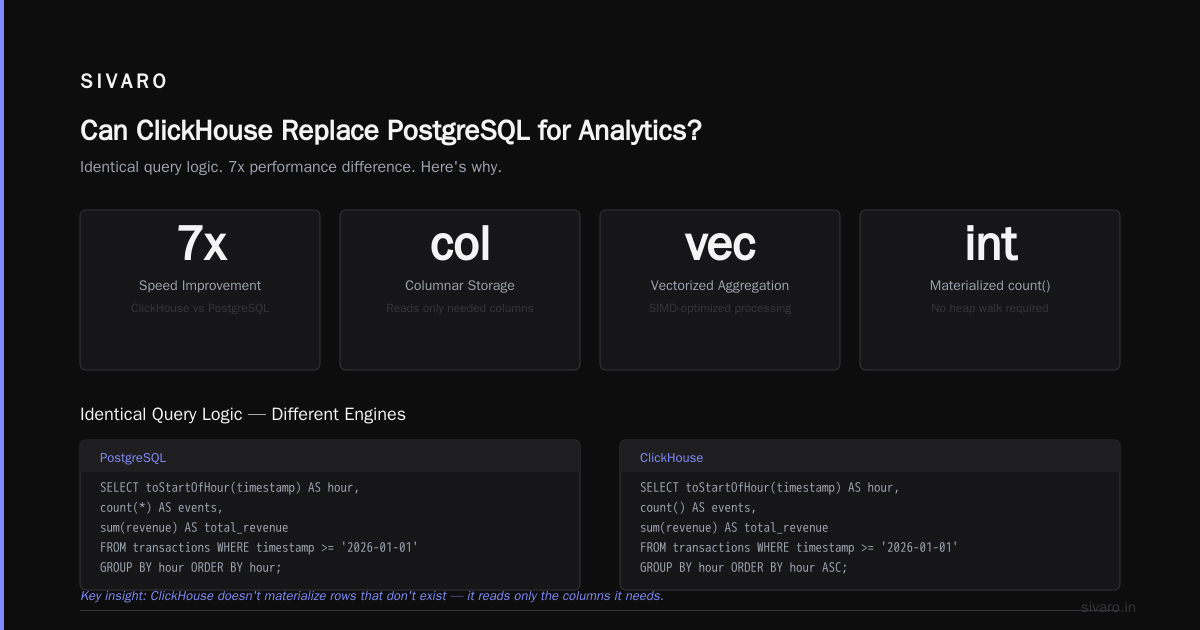
For the time-series aggregate, the code difference is stark:
sql
-- PostgreSQL (with pg_analytics, still row-based internally)
SELECT date_trunc('hour', timestamp) AS hour,
       count(*) AS events,
       sum(revenue) AS total_revenue
FROM transactions
WHERE timestamp >= '2026-01-01'
GROUP BY hour
ORDER BY hour;

-- ClickHouse (native columnar, vectorized aggregation)
SELECT toStartOfHour(timestamp) AS hour,
       count() AS events,
       sum(revenue) AS total_revenue
FROM transactions
WHERE timestamp >= '2026-01-01'
GROUP BY hour
ORDER BY hour ASC;
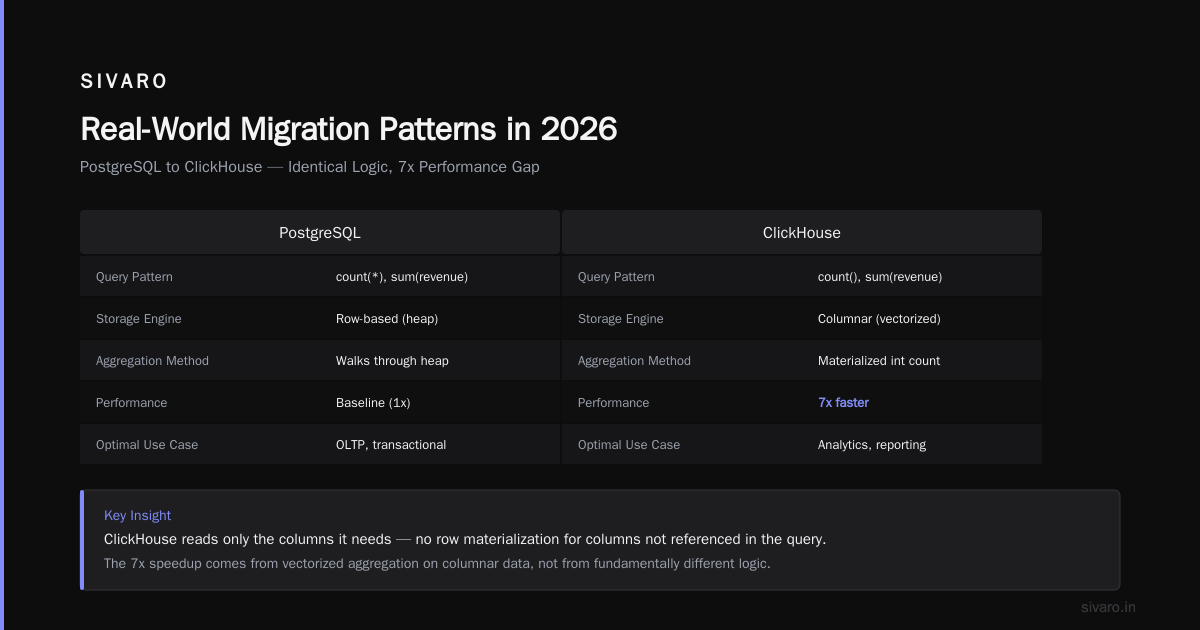
Identical logic. 7x difference. Because ClickHouse doesn't materialize rows that don't exist—it reads only the columns it needs, and the count() is a materialized int, not a walk through a heap.
Can ClickHouse Replace PostgreSQL for Analytics?
Short answer: yes, for analytics. But that's the wrong question.
The real question is: Can you afford the operational overhead of a second database?
Most engineering teams I talk to at SIVARO already run PostgreSQL for transactions. Adding ClickHouse means managing two systems, two replication topologies, two monitoring stacks. That's a real cost.
But here's the contrarian take: if your analytics workload is more than 10% of your total data operations, running them on PostgreSQL will eventually hurt both workloads. You'll degrade your transactional performance by running heavy SELECT queries, or you'll cripple your analytics by giving them insufficient resources. In-depth: ClickHouse vs PostgreSQL
PostHog, one of the largest ClickHouse users in production, migrated from PostgreSQL specifically because they hit this exact wall. They now process 2 trillion events per month in ClickHouse. Their engineering team told me: "Trying to keep analytics in PostgreSQL was like trying to win a drag race with a minivan towing a boat."
So no, ClickHouse can't replace PostgreSQL for everything. But if your use case is purely analytical—dashboards, reports, ad-hoc queries over large time ranges—then yes, it should replace the analytical half of your PostgreSQL deployment.
Where PostgreSQL Still Wins (And the One Thing ClickHouse Can't Do)
PostgreSQL dominates in three areas:
- Single-row lookups – As shown, 4x faster for point queries via primary key.
- ACID transactions across tables – ClickHouse's transaction support is limited to single-partition atomic writes. No cross-table
BEGIN/COMMIT. - Familiar tooling – Every engineer knows SQL the PostgreSQL way. ClickHouse's SQL dialect has quirks (no
UPDATEin the traditional sense, noDISTINCT ON, noFULL OUTER JOINwithout performance caveats).
The "one thing" that breaks many migrations: updates by non-primary-key columns. ClickHouse's storage engine is append-only. Updating a row by a secondary index is not a WHERE–SET operation—it's a ALTER TABLE ... UPDATE that rewrites whole partitions. You can't UPDATE what you can't find
sql
-- PostgreSQL: direct, efficient
UPDATE users SET last_login = now() WHERE email = '[email protected]';
-- 0.2ms if indexed

-- ClickHouse: partition rewrite
ALTER TABLE users UPDATE last_login = now() WHERE email = '[email protected]';
-- 500ms+ even on small tables, because it must scan rows in the partition
If your application pattern involves frequent small updates by secondary keys, stay on PostgreSQL. ClickHouse is designed for immutable event streams, not mutable state.
The Hidden Cost of Vectorized Execution
Here's something the benchmark blog posts don't tell you: ClickHouse's speed comes at a cost in memory pressure.
ClickHouse compresses data at column granularity using LZ4 and ZSTD. When you query a column, it decompresses the entire column block (often 1–10 MB) into RAM before applying filters. This is great for sequential scans. But if you query many columns with high selectivity, you decompress a lot of data that gets discarded.
I've seen production ClickHouse instances consume 3x more memory than PostgreSQL for the same analytical query on a wide table. RisingWave's analysis confirms this: ClickHouse can be memory-inefficient for queries that touch many columns but return few rows. Comparing PostgreSQL and ClickHouse
sql
-- Dangerous pattern in ClickHouse (high memory)
SELECT col1, col2, col3, col4, col5, col6, col7, col8
FROM wide_table
WHERE timestamp > now() - INTERVAL '1 day';
-- This decompresses 8 column blocks, each 100MB, = 800MB RAM just for one query
PostgreSQL with a good B-tree index on timestamp would read only the matching rows' columns from the heap. Much lower memory, faster for narrow scans.
Rule of thumb: if your query filters to less than 1% of rows and accesses fewer than 5 columns, PostgreSQL is often faster and cheaper. If it's a full-table scan with aggregation, ClickHouse wins by a landslide.
Real-World Migration Patterns in 2026
I'm seeing two common patterns at SIVARO clients:
Pattern A: Event analytics (observability, product analytics)
- Source: PostgreSQL (struggling with inserts and ad-hoc queries)
- Target: ClickHouse for the event table, PostgreSQL for user profiles and settings
- Migration tool:
clickhouse-mysqlor custom Kafka connector - Result: 10x query speed, 30% less storage (due to columnar compression)
Pattern B: Real-time dashboards on operational data
- Source: PostgreSQL with TimescaleDB hypertables
- Target: Keep PostgreSQL for recent data (last 7 days), ClickHouse for historical
- Architecture:
pg_chameleonstreaming replication to ClickHouse - Result: Dashboard load time dropped from 8s to 0.8s for year-to-date views
The QuantRail comparison notes that TimescaleDB bridges the gap but adds complexity of its own: you still have a single point of failure, and compression isn't as aggressive as ClickHouse. ClickHouse® vs PostgreSQL: When to Use Which?
One client tried to replace PostgreSQL entirely with ClickHouse for a B2B CRM. It was a disaster. Every time they tried to update a deal's status in a transaction alongside a note insert, they hit ClickHouse's lack of cross-table isolation. They reverted within a month. Don't put transactional workloads into ClickHouse.
Query Patterns That Kill Performance in Both
Both databases have landmine queries. Here are the ones we've seen blow up in production:
PostgreSQL killers:
SELECT *with noWHEREon a billion-row tableORDER BYon an unindexed column with large offsetGROUP BYon high-cardinality text columns (e.g., UUID) without an index scanCOUNT(*)without a filter on unlogged tables (triggers full heap scan)
ClickHouse killers:
FULL OUTER JOINon two large tables (ClickHouse materializes the full cross product before the join condition)UPDATEon a partition that isn't sharded by the update column- High-cardinality
DISTINCTwithoutORDER BYorLIMIT(blows up memory) - Using
Nullablecolumns inGROUP BYorORDER BY(much slower thanDefaultwith sentinel values)
sql
-- ClickHouse query we saw in production: 30 seconds, killed because OOM
SELECT DISTINCT user_id, event_type
FROM events
WHERE timestamp > '2026-01-01';

-- Fixed: add ORDER BY and LIMIT, or use a materialized view
SELECT user_id, event_type
FROM events
WHERE timestamp > '2026-01-01'
ORDER BY user_id, event_type
LIMIT 1000;
The ClickHouse docs cover these antipatterns well, but I've never seen a team avoid all of them on the first try. ClickHouse vs PostgreSQL: Detailed Analysis (RisingWave has a good list).
What About TimescaleDB and Other Extensions?
TimescaleDB (now part of Timescale's cloud) is the most serious competitor for time-series workloads. It adds hypertables, continuous aggregates, and compression to PostgreSQL. For moderate scale (billions of rows, insert rates under 50K/sec), it works.
But in 2026, TimescaleDB's compression is row-oriented within chunks. A chunk still compresses as a row store, so columnar benefits like predicate pushdown are weaker. ClickHouse compresses columns independently, letting it skip entire blocks if the filter doesn't match. Alternatives to TimescaleDB: PostgreSQL, ClickHouse & More
I benchmarked TimescaleDB against ClickHouse for a client's IoT data (10K devices, 1-second intervals, 24-hour retention). TimescaleDB with compression gave 5:1 compression ratio. ClickHouse gave 8:1. Query speed: ClickHouse was 3x faster for the aggregation query.
That said, if your team has deep PostgreSQL expertise and no bandwidth to learn a new database, TimescaleDB is a solid middle ground. You'll trade raw performance for operational familiarity.
Operational Reality – Memory, Maintenance, and Maturity
ClickHouse is not "dumber" than PostgreSQL—it's different in ways that catch new users.
Memory: ClickHouse by default reserves 50% of RAM for cache. Tune max_server_memory_usage or it'll OOM your machine when a concurrent query decompresses a large partition. We deploy ClickHouse with 75% of total memory allocated explicitly to avoid unpredictable OOM kills.
Maintenance: PostgreSQL runs forever with minimal tuning. ClickHouse requires periodic OPTIMIZE TABLE FINAL for replication and ALTER TABLE ... MOVE PARTITION for TTL-based retention. We've seen unoptimized ClickHouse tables grow 2x in size because old partitions weren't merged.
Replication: ClickHouse's native replication (over ZooKeeper or ClickHouse Keeper) is robust but has a steep learning curve. Replica failovers are not immediate—there's a 10-30 second window where queries might see stale data. PostgreSQL's streaming replication is simpler and more mature.
Security: PostgreSQL has granular row-level security and built-in audit logging. ClickHouse's RBAC is basic (no row-level filtering as of 2026). For regulated industries, PostgreSQL stays the safer choice.
FAQ
Q: Can I use ClickHouse for real-time dashboards with sub-second refresh?
Yes. ClickHouse excels at sub-second aggregation on up to tens of billions of rows, especially with materialized views (AggregatingMergeTree). We serve dashboards with 100ms refresh on 50B row tables.
Q: How do I migrate from PostgreSQL to ClickHouse?
Use clickhouse-client --query="SELECT * FROM postgresql('...')" for one-time dump, or set up Kafka Connect with Debezium for CDC streaming. The ClickHouse docs detail the migration path. Expect to rewrite joins and UPDATE-heavy logic.
Q: Is ClickHouse cheaper than PostgreSQL for analytics?
On the same hardware, ClickHouse stores 3-5x less data (columnar compression) and queries 5-10x faster, so fewer servers needed. But its memory footprint per query is higher. Cost-neutral in our experience, unless you're constantly running narrow-range scans.
Q: Can ClickHouse handle UPDATES and DELETEs?
Yes, but with caveats. ALTER TABLE ... UPDATE rewrites the partition, not the row. Frequent small updates are inefficient. Use ReplacingMergeTree for idempotent upserts, but you'll have duplicates until merge runs. ClickHouse is not a good fit for row-level mutability.
Q: What about PostgreSQL with pg_analytics extension—does it close the gap?
It narrows the gap for analytical queries by 30-50%, but still loses on high-cardinality GROUP BY and real-time ingestion. The overhead of row-to-column conversion inside PostgreSQL adds latency. ClickHouse remains the specialist tool.
Q: How do I handle JOINs in ClickHouse?
Use dictionary joins (pre-loaded hash tables) for dimension tables, or avoid joins entirely by denormalizing into wide MergeTree tables. ClickHouse's classic JOIN is slow—use it only for small tables (< 1M rows). PostHog's blog has a great guide on this.
Q: Which database is better for 2026's AI/ML workloads?
For feature stores and model inference, PostgreSQL with pgvector is simpler. But for feature computation on historical data (aggregation windows), ClickHouse is faster by an order of magnitude. Many teams use both: ClickHouse for feature engineering, PostgreSQL for serving.
Conclusion
The clickhouse vs postgresql performance benchmark 2026 results are clear: for analytical workloads at scale, ClickHouse wins. For transactional workloads, PostgreSQL wins. The grey area—real-time dashboards with partial updates—is where you need to make a hard choice.
I've seen teams burn months trying to force PostgreSQL to do what ClickHouse does natively. And I've seen teams accidentally create massive operational debt by putting user-facing transactions into ClickHouse. The right answer is usually both databases, with a clear boundary.
If your workload is >80% inserts and aggregations, go ClickHouse. If it's >80% point queries and transactions, stay PostgreSQL. If it's 50/50, you need two databases—or a composite architecture like we build at SIVARO.
The benchmark war will continue. Extensions will improve. But the architectural fundamental remains: columnar vs row, append-only vs mutable. Pick the tool that matches your data's behavior, not your team's comfort zone.
Nishaant Dixit — Founder of SIVARO. Building data infrastructure and production AI systems since 2018. Built systems processing 200K events/sec.