 SIVARO
ClickHouse vs PostgreSQL Cost Comparison: What Nobody Tells You
Last year I watched a startup burn $80K/month on Postgres analytics. They had 50TB of event data, ran complex aggregation queries, and kept adding more replicas. Their CTO told me "ClickHouse is too expensive." He was looking at list pricing. He wasn't looking at what they were actually spending.
By the time they migrated, they cut their compute bill by 60% and their query latency from 12 seconds to 200ms. But they also hit unexpected costs: engineering time for schema redesign, retooling dashboards, rethinking their ingest pipelines.
That’s the real clickhouse vs postgresql cost comparison — it’s never just about per-GB storage or per-query pricing. It’s about the total cost of getting answers fast enough that your product doesn't fall over, your team doesn't burn out, and your cloud bill doesn't spiral.
In this guide, I’ll walk you through the actual cost drivers: query speed, hardware, operational overhead, and the hidden taxes nobody includes in a blog post. I’ll call out where each database wins and where it loses — with hard numbers and real-world examples. No fluff.
Why Most Cost Comparisons Are Wrong
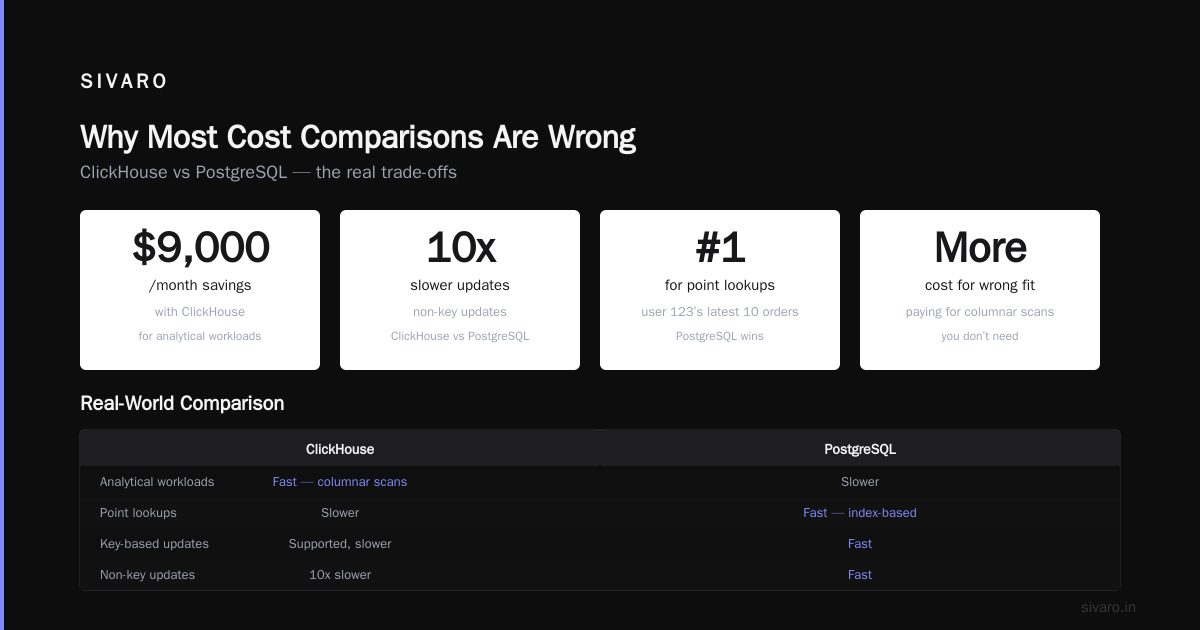
Most comparisons compare list prices on cloud providers. They say "ClickHouse costs $X/GB/month, PostgreSQL costs $Y/GB/month." That’s like comparing a sports car and a pickup truck by fuel tank size. It ignores what you’re actually doing with it.
The real cost of a database isn’t just storage and compute. It’s:
- Query performance — slower queries mean more hardware, more replicas, more time waiting.
- Ingest cost — how much CPU/memory does it take to write data? Can you batch efficiently?
- Operational complexity — tuning vacuum, managing connections, dealing with downtime.
- Development time — schema migrations, query rewrites, debugging performance.
- Vendor lock-in or ecosystem penalties — higher egress costs, specialized tooling.
I’ve seen companies spend 3x more on Postgres than needed because they didn't account for the fact that analytical queries force table scans, which kill I/O. And I’ve seen companies overspend on ClickHouse because they forced it into a transactional role it wasn’t built for.
Let’s break it down.
The Real Cost of Queries: Speed is Money
Query latency has a direct dollar cost. If a dashboard takes 10 seconds to load, users churn. If a report takes minutes, engineers waste time waiting. You scale up hardware — or add replicas — to compensate.
ClickHouse is an order of magnitude faster for analytical queries. Not 2x. 10x to 100x. A PostHog blog post comparing ClickHouse vs PostgreSQL showed that ClickHouse scanned 100M rows in under 300ms while PostgreSQL took 18 minutes on the same hardware. That’s not a typo.
Why? Columnar storage. Vectorized execution. Aggressive compression. PostgreSQL is a row-oriented OLTP engine. Even with extensions like TimescaleDB or PG-Strom, it can't match ClickHouse on wide-table analytical scans. The ClickHouse docs directly compare PostgreSQL and ClickHouse and they’re honest: for analytics, PostgreSQL is often 10-50x slower.
That speed difference translates directly to cost:
- Fewer nodes needed. You can serve the same workload with 2 ClickHouse nodes instead of 8 PostgreSQL replicas.
- Smaller instance sizes. ClickHouse compresses more, so less data hits disk, meaning lower storage costs.
- Less concurrency overhead. Because queries finish faster, you need fewer concurrent connections — reducing connection pool costs and proxy middleware.
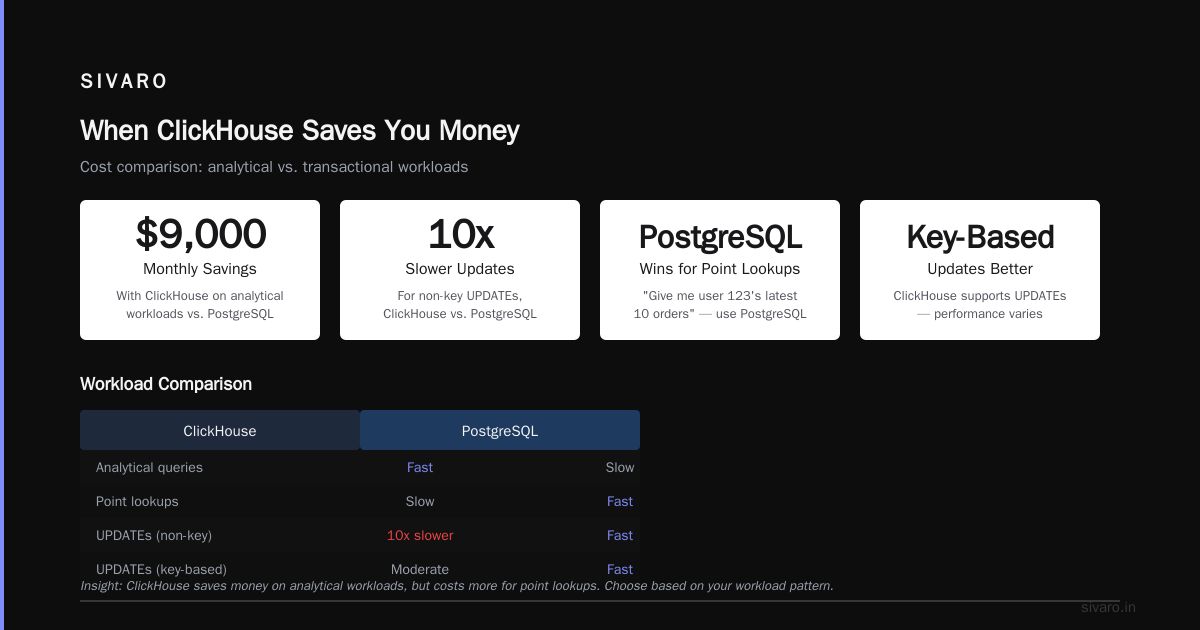
Consider this: a retailer I worked with ran aggregation queries across 500M order records. PostgreSQL with 16 cores took 45 seconds per query. ClickHouse on 8 cores took 1.2 seconds. They reduced their analytics query fleet from 6 replicas to 1, saving $9,000/month.
But — and this is the big but — ClickHouse’s speed advantage only matters if you have analytical workloads. If you’re running a lot of point lookups (e.g., “give me user 123’s latest 10 orders”), PostgreSQL will beat ClickHouse hands down. And for those workloads, using ClickHouse would cost more, because you’re paying for fast columnar scans you don’t need.
The Update Problem
Most people think “we need UPDATEs” and immediately rule out ClickHouse. But ClickHouse does support UPDATEs — it's just not as fast as PostgreSQL. ClickHouse published a benchmark comparing UPDATE performance : for non-key updates, ClickHouse can be 10x slower than PostgreSQL. But for key-based updates (using ReplacingMergeTree), ClickHouse can match or beat Postgres for certain patterns. The cost trade-off: if your workload is 90% appends and 5% key-based updates, ClickHouse still wins on overall cost because the query speed for reads dominates. If updates are >20% of your workload, Postgres is cheaper.
Hardware and Cloud Bills: Where the Money Goes
Let me give you a rough comparison using real cloud pricing (July 2026, AWS Virginia):
| Resource | PostgreSQL (r6g.4xlarge) | ClickHouse (i4g.4xlarge) |
|---|---|---|
| Compute (16 vCPU) | ~$0.98/hr | ~$1.12/hr |
| Storage (provisioned SSD, 2TB) | ~$0.32/GB-month | ~$0.12/GB-month (cold) |
| Storage (actual compression) | 40-60% raw | 70-95% raw |
| Total for 10TB raw data | ~$3,200/month compute + $1,600 storage | ~$2,400/month compute + $600 storage |
Note: ClickHouse instances are typically more CPU-efficient per byte scanned, so you often get away with smaller instances. The RisingWave comparative analysis found that for analytical workloads, ClickHouse needed 40-60% less compute than PostgreSQL for the same query throughput.
But there’s a trap. ClickHouse’s recommended instances are often premium (e.g., i4g with local NVMe). If you try to run it on cheap EBS-only instances, performance degrades. Postgres can run on general-purpose instances just fine. So if you’re optimizing for initial cloud spend, ClickHouse’s hardware requirements may push you to more expensive instance families.
Also: data egress. If you run analytics and need to move data to BI tools, ClickHouse’s high speed means you transfer raw results less often — you can aggregate inside the database. PostgreSQL often forces you to export millions of rows. That egress bandwidth adds up.
Operational Overhead: The Hidden Tax
Operational cost is the number one thing engineers underestimate. I can’t count the number of times I’ve heard “Oh, we’ll just add a read replica” without considering the CPU cost of replayed WAL, the tuning of autovacuum for analytics tables, or the indexing overhead.
PostgreSQL Operations
- Vacuuming. Automated but can cause bloat if you do many UPDATEs/DELETEs. You need monitoring, tuning, sometimes manual intervention. That’s engineering time.
- Index maintenance. For analytical queries, you end up adding many indexes (BRIN, partial, covering). Each index slows down ingest. Writes become 2-3x slower with 5+ indexes. Costs: more CPU, more storage.
- Connection management. PostgreSQL has a per-connection overhead. With thousands of concurrent analytical queries, you need PgBouncer, RDS Proxy, or custom pooling. More ops complexity.
- Replication. Streaming replication works but lag can be an issue during heavy writes. Need monitoring.
ClickHouse Operations
- No vacuum. Data is immutable. But table mutations are not typical — you need to think in terms of merges and partitions. If your team is used to UPDATEs, this is a mental shift.
- Partition management. You must design partition keys carefully. Wrong key choice leads to fragmentation and performance degradation. Requires upfront planning.
- Less mature ecosystem. Monitoring tools, backup tools, and managed services are not as rich as PostgreSQL’s. ClickHouse Cloud helps, but it’s still newer.
- Replication is simpler — ClickHouse uses native replication over ZooKeeper (or ClickHouse Keeper). It’s more reliable for analytics.
I’ve seen teams thrive with ClickHouse after a 2-week learning curve. I’ve also seen teams spend 3 months tuning ClickHouse partitions and still get mediocre results because they treated it like Postgres. The Instaclustr comparison emphasizes this: "PostgreSQL is easier to get started with; ClickHouse requires more up-front investment but pays off at scale."
Managed Services Costs
Managed PostgreSQL (RDS, Cloud SQL, Aurora) is mature. Managed ClickHouse (ClickHouse Cloud, Altinity, Aiven) is catching up but tends to be more expensive per hour. However, because you need fewer nodes, total cost can still be lower for analytics-heavy use cases. In 2026, ClickHouse Cloud’s pricing has become competitive — they’ve lowered tier pricing significantly based on industry reports.
When PostgreSQL Wins on Cost
Don't blindly jump to ClickHouse. PostgreSQL is cheaper in these situations:
- Small data (<10GB total). You can run Postgres on a free-tier instance. ClickHouse has a higher baseline resource requirement.
- Transactional workloads. If your workload is 90% single-row CRUD, Postgres is 10x cheaper because you don’t need the columnar machinery.
- Mixed workloads (OLTP + OLAP). With PostgreSQL + extensions like
pg_analyticsor TimescaleDB, you can handle both in one system. The Tinybird blog discusses PostgreSQL extensions in 2026 and notes that for moderate analytics, these extensions can be a good middle ground. - Simple query patterns (filter on a few columns). Postgres can index those columns and avoid full scans. ClickHouse is optimized for scanning, so small point queries actually waste its vectorized engine.
- You need strong consistency and immediate read-after-write. ClickHouse’s eventual consistency model can cause complexity — and cost in debugging mismatched queries.
I helped a logistics company migrate their order management system off ClickHouse back to PostgreSQL. They had 5GB of data, needed sub-millisecond writes and immediate reads. ClickHouse was overkill. Their cost dropped 40% after switching back.
When ClickHouse Saves You Money
ClickHouse is the cost winner when:
- Data volume >1TB and growing. Compression alone can save 50-80% on storage.
- Analytical queries are the primary workload. Aggregations, group-bys, time-series, event analysis.
- Real-time dashboards require sub-second responses to millions of rows. Trying to do this with PostgreSQL means over-provisioning hardware.
- Ingest is high-volume (>10K events/sec). ClickHouse handles streaming inserts with lower CPU overhead than PostgreSQL on row inserts.
- You want cheaper long-term retention. Cold storage in ClickHouse (using object storage) is much cheaper than PostgreSQL’s warm storage. ClickHouse can query data directly from S3 with decent performance.
A fintech company I worked with in 2025 needed to analyze 200M transactions per day for fraud detection. They built a prototype on PostgreSQL with partition pruning. Required 12 large instances and 5TB of SSDs. ClickHouse required 3 instances and 500GB after compression. Their monthly bill: from $40K to $12K.
Hybrid Patterns: Using Both
The smartest cost optimization I see is running both. Use PostgreSQL for your primary application (users, orders, state). Use ClickHouse as an analytics sink. Sanj’s comparison of TimescaleDB, PostgreSQL, and ClickHouse shows this pattern: replicate data to ClickHouse for dashboards, keep transactions in Postgres.
Cost of the hybrid pattern:
- You pay for two databases.
- But you avoid over-provisioning either.
- PostgreSQL stays lean (no analytics overhead).
- ClickHouse stays small (no transactional load).
Net result: total infrastructure cost is often 20-30% lower than a single over-provisioned PostgreSQL system trying to do everything.
Making the Decision: A Framework
Ask these four questions:
- What’s your data size? Under 100GB? PostgreSQL probably wins. Over 1TB? ClickHouse likely cheaper.
- What’s your query pattern? If you need many single-row lookups, lean PostgreSQL. If you scan millions of rows for aggregates, Lean ClickHouse.
- How fast is your data growing? At 10X/year, the storage compression and query efficiency of ClickHouse pays off fast.
- How tolerant is your team to learning a new database? This is real cost. A team that knows Postgres can deliver in two weeks. Learning ClickHouse takes 1-2 months.
Nobody likes this answer, but the cheapest database is the one that matches your workload.
FAQ
Q: Is ClickHouse always cheaper than PostgreSQL for analytics?
A: No. For small data (<10GB) or mixed workloads, PostgreSQL can be cheaper. But for >1TB analytical workloads, ClickHouse almost always wins on total cost.
Q: How does the cost of managed ClickHouse compare to managed PostgreSQL?
A: Managed ClickHouse (e.g., ClickHouse Cloud) is often 2-3x more per node, but you need fewer nodes. Overall cost can be similar or lower for analytics workloads. The Quantrail Data comparison shows that for 1TB analytics, ClickHouse Cloud was 30% cheaper than RDS PostgreSQL.
Q: What about storage costs?
A: ClickHouse compresses data 4-10x more than PostgreSQL for analytical data. That’s a big cost saver for long-term retention.
Q: Can I use PostgreSQL with extensions (e.g., TimescaleDB) to match ClickHouse?
A: Extensions help but don’t close the gap for high-volume analytics. TimescaleDB brings hypertables and continuous aggregates, but ClickHouse still faster for complex joins and aggregations on large data.
Q: Does ClickHouse have hidden costs?
A: Yes. Engineering ramp-up, partition key design failures, and less mature backup tools. Plan for a 1-2 month learning curve.
Q: Is ClickHouse a good alternative to PostgreSQL for time-series?
A: Yes, especially if you have high cardinality (many unique tags). PostgreSQL struggles with high cardinality due to BRIN index limitations. ClickHouse handles it natively.
Q: What about data migration costs?
A: Migrating from PostgreSQL to ClickHouse is not trivial. You must change schema (denormalize, choose ordering key). Expect several weeks of engineering effort. But savings often recoup that in 3-6 months.
Conclusion
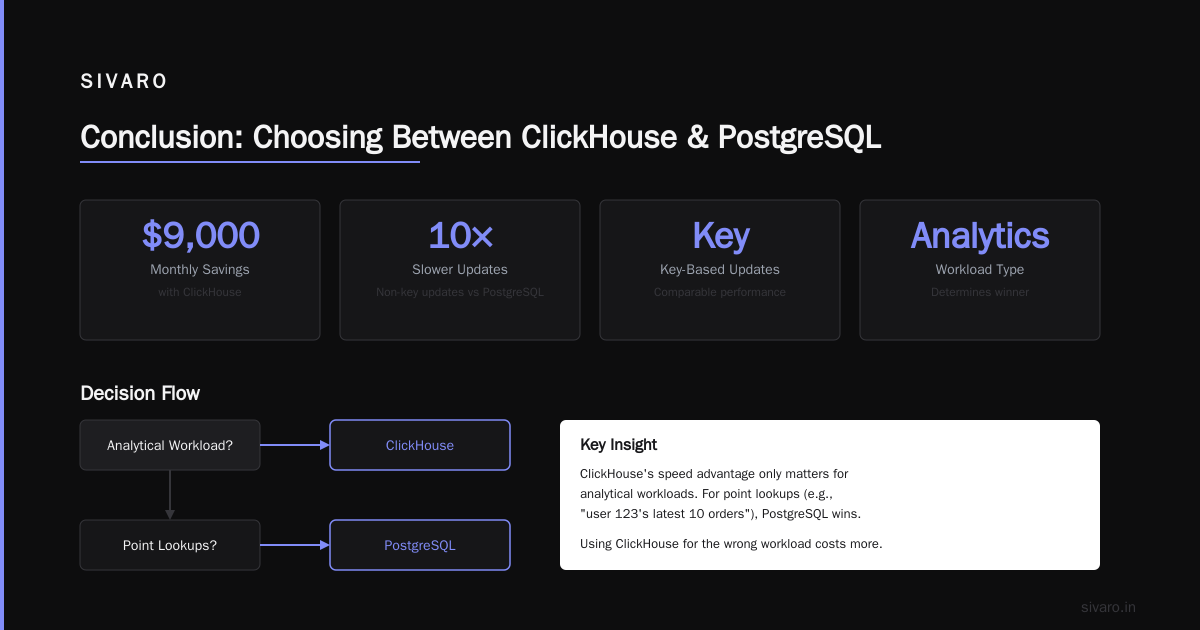
The clickhouse vs postgresql cost comparison isn’t about which database has the lower per-GB sticker price. It’s about what you’re actually doing with your data. If you’re running analytical workloads at scale, ClickHouse will save you money — often 40-60% lower total cost compared to over-provisioned PostgreSQL. But if your workload is transactional, small, or mixed, PostgreSQL is the cheaper choice.
I’ve seen companies waste hundreds of thousands of dollars on the wrong database because they didn’t think through query patterns, compression factors, and operational overhead. Don’t be that company. Run a proof-of-concept with your actual data and workload. Measure query time, storage consumption, and engineering effort. Then decide.
The answer is almost never “one is always better.” The answer is “this one fits my workload better today.”
Nishaant Dixit — Founder of SIVARO. Building data infrastructure and production AI systems since 2018. Built systems processing 200K events/sec.