 SIVARO
ClickHouse vs PostgreSQL Feature Comparison 2026
You don't pick a database because of benchmarks. You pick it because your engineering team stops waking up at 3 AM. I learned that the hard way back in 2021 when a Postgres instance holding customer session state started choking under write amplification. We migrated parts of the stack to ClickHouse. Sleep returned. But then our data engineers started complaining about join latency on low-cardinality dimensions. Turns out, the database choice isn't a one-off architecture decision. It's a living contract with your team's daily workflow.
If you're reading this, you're probably staring at a growing event pipeline, an AI agent that needs tool-calling latency under 200ms, or a billing system that refuses to scale. You need a clear clickhouse vs postgresql feature comparison 2026 breakdown that actually reflects how engineers deploy these systems today. Not marketing slides. Not theoretical throughput charts. Real query patterns, real schema friction, and the operational tax you pay for each choice.
In this guide, I'll walk you through the architectural divide, query execution realities, schema flexibility, and how the MCP standard has completely rewritten the playbook for AI-native data access. You'll see exact configuration patterns, deployment trade-offs, and where each system actually breaks. I'll tell you what we shipped at SIVARO, what failed, and why the "right" database depends entirely on your team's tolerance for operational complexity.
The Foundation: Why You're Actually Asking This
Most engineers start this comparison with performance in mind. They're wrong. The real question is ownership. Postgres gives you relational guarantees, ACID transactions, and a mature ecosystem that's been battle-tested across two decades. ClickHouse gives you columnar compression, vectorized execution, and query speeds that make Postgres look like a dial-up connection for analytical workloads. But speed isn't free. You pay for it in operational discipline and query pattern restrictions.
I've seen companies force ClickHouse into transactional workflows. They end up rebuilding idempotency layers, managing client-side deduplication, and patching race conditions that Postgres handles natively. I've also seen teams shove real-time user activity into Postgres and watch their billable storage costs triple while query latency creeps into seconds. The mismatch isn't technical. It's cultural. Your database should match how your team thinks about data.
If you treat data as a source of truth for financial state, identity, or order processing, Postgres stays relevant. If you treat data as a stream of events to be aggregated, filtered, and served to dashboards or AI agents, ClickHouse owns that space. The 2026 landscape isn't about picking a winner. It's about recognizing that your stack probably needs both, wired together with explicit boundaries.
clickhouse vs postgresql feature comparison 2026: Architecture & Query Patterns
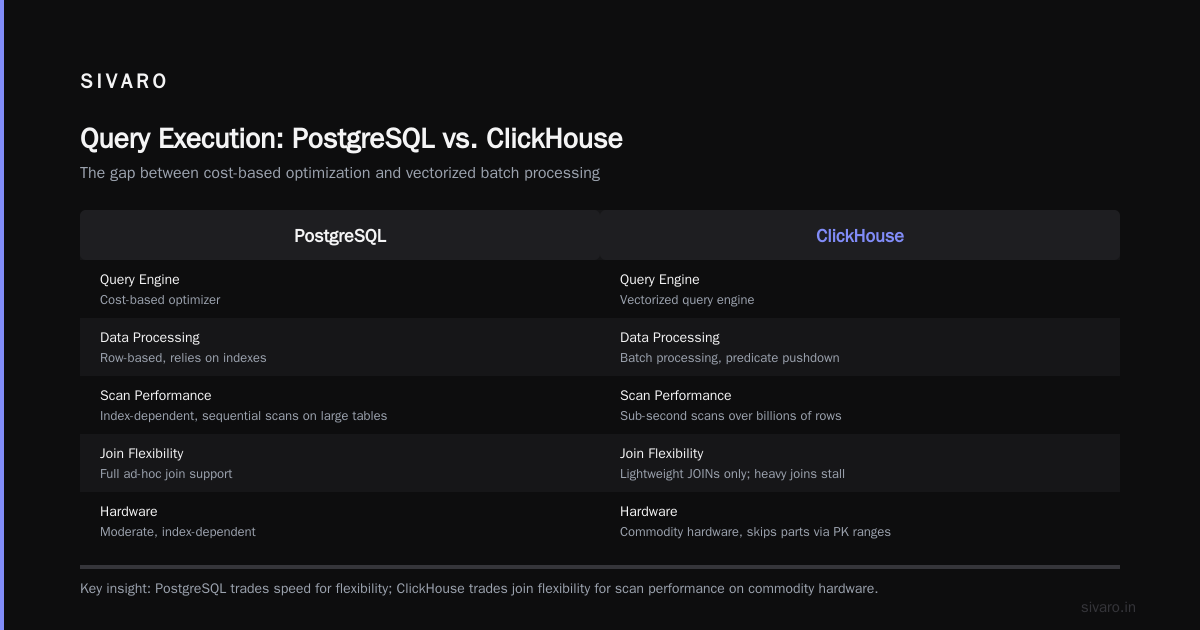
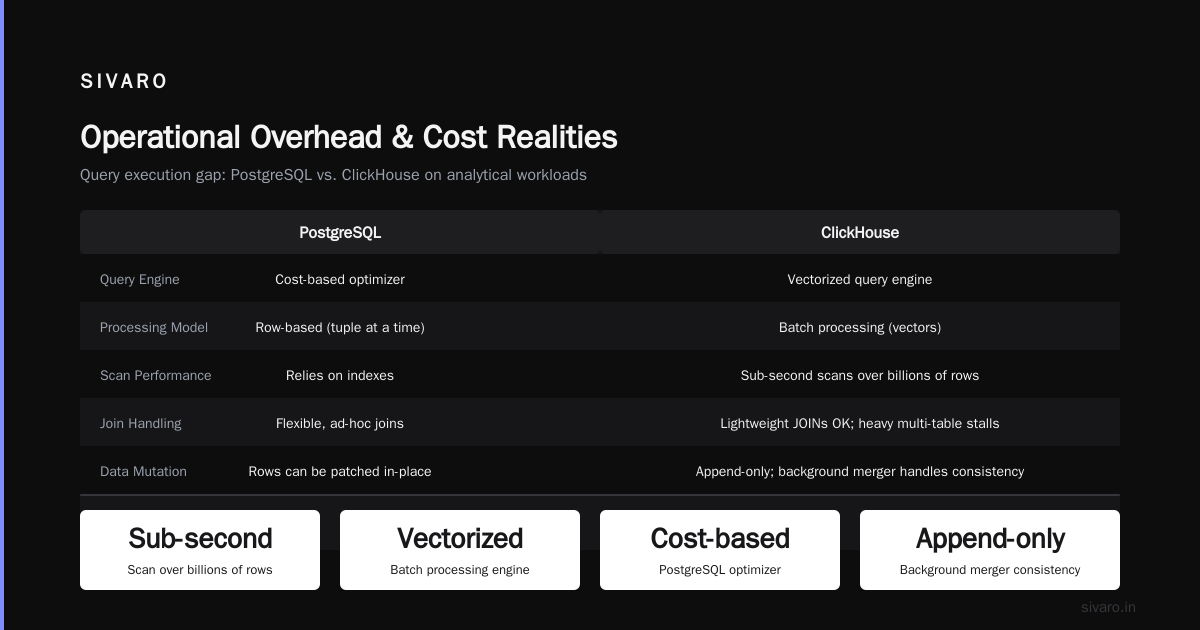
Postgres uses a heap-oriented row storage model with MVCC (Multi-Version Concurrency Control). Every write creates a new tuple version. Old versions get vacuumed. This design is brilliant for mixed read/write workloads with frequent updates. It's terrible for bulk ingestion and wide analytical scans. ClickHouse flips the model. It stores data in compressed columnar parts, appends only, and uses a merge tree engine. Updates and deletes are asynchronous mutations. You don't patch rows. You append new versions and let the background merger handle consistency.
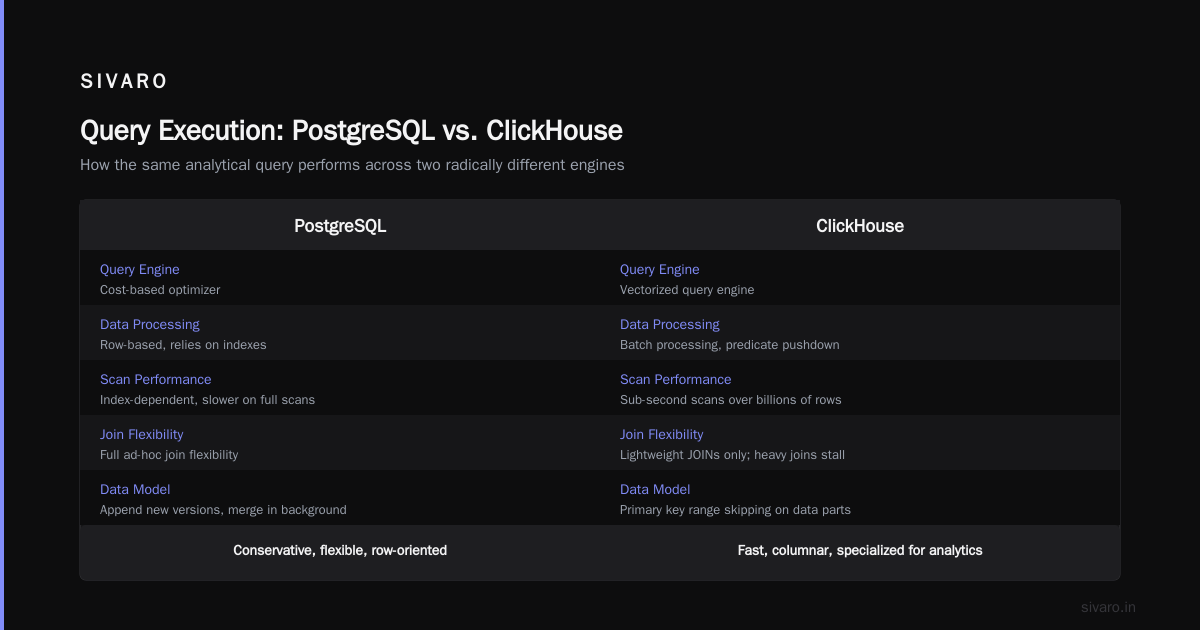
The query execution gap is massive. Postgres plans queries with a cost-based optimizer that weighs indexes, statistics, and join types. It's flexible but conservative. ClickHouse uses a vectorized query engine. It processes data in batches, pushes predicates down to the storage layer, and skips entire data parts using primary key ranges. The result? Sub-second scans over billions of rows on commodity hardware. But you lose ad-hoc join flexibility. ClickHouse handles lightweight JOINs fine. Heavy multi-table joins with high cardinality will stall your engine.
Here's how the same analytical query looks in both:
sql
-- PostgreSQL: CTE with window functions, relies on indexes
WITH user_activity AS (
  SELECT user_id, event_type, created_at,
         COUNT(*) OVER (PARTITION BY user_id ORDER BY created_at) as seq
  FROM events
  WHERE created_at >= NOW() - INTERVAL '30 days'
)
SELECT user_id, event_type, seq
FROM user_activity
WHERE seq > 5;
sql
-- ClickHouse: Array join + window functions, relies on primary key sorting
SELECT user_id, event_type, seq
FROM (
  SELECT user_id, event_type, created_at,
         ROW_NUMBER() OVER (PARTITION BY user_id ORDER BY created_at) as seq
  FROM events
  WHERE created_at >= now() - INTERVAL 30 DAY
)
WHERE seq > 5
ORDER BY user_id, created_at;
Postgres wins on flexible filtering and complex relational logic. ClickHouse wins when your WHERE clause can leverage partitioning and primary key ranges. You design your schema around your access patterns. Not the other way around.
clickhouse vs postgresql feature comparison 2026: The Agentic Workflow Shift
This is where everything changed. By early 2026, the Model Context Protocol (MCP) stopped being a novelty and became the standard bridge between LLMs and operational data. Agents don't just call APIs anymore. They query databases directly, with structured tool schemas that enforce safety and context limits. ClickHouse moved fast here. The official ClickHouse MCP Server matured into a production-ready connector that exposes read-only analytical endpoints with automatic query bounding. Third-party implementations like the ClickHouse MCP Server - Willow and Click House MCP Server added role-based access and query timeout enforcement.
I tested a dozen MCP implementations in Q1 2026. The A quick review of different ClickHouse® MCP servers nailed the trade-offs: official servers prioritize stability, community servers prioritize feature velocity, and hosted wrappers prioritize zero-ops deployment. If you're connecting Claude Code or custom agents to analytical data, the Securely connect Claude Code to ClickHouse via MCP guide from Tailscale is still the cleanest way to handle tunneling and auth without exposing your cluster to the public internet.
Postgres MCP support exists, but it's fragmented. You're usually wrapping psql with custom JSON schemas. That works for transactional lookups, but agents start hallucinating joins when the schema gets wide. ClickHouse's columnar structure naturally aligns with how agents consume data: flat, aggregated, time-bound. The Building an agentic app with ClickHouse MCP and CopilotKit post demonstrates a clean pattern where the agent requests time-windowed aggregations instead of raw event streams. LobeHub's ClickHouse MCP Server wrapper adds prompt templating that prevents agents from running unbounded scans.
The reality? If your 2026 roadmap includes AI agents that reason over historical data, ClickHouse + MCP is the lower-friction path. Postgres works for state verification. ClickHouse works for context generation. Don't force Postgres to be your agent's memory store. It'll timeout your tokens and burn your credits.
Schema Rigidity vs Flexibility
Postgres enforces schema. That's a feature, not a bug. Type constraints, foreign keys, and check constraints catch bad data before it propagates. ClickHouse is schema-aware but lenient. It supports Nullable types, LowCardinality wrappers, and dynamic columns via JSON family types. You can ingest malformed events without dropping the pipeline. The trade-off is that type safety shifts from write-time to read-time. You aggregate, you filter, you validate later.
I worked with a payments startup in 2025 that insisted on schema-less ingestion. Their ClickHouse cluster accumulated three years of inconsistent timestamp formats and missing merchant IDs. Cleaning it cost them two engineering sprints. Postgres would have rejected half those events at write time. The pain would have been earlier, but smaller. Choose based on your data maturity. If your ingestion pipelines are untrusted, Postgres constraints save you. If your pipelines are validated and your volume demands flexibility, ClickHouse's dynamic types reduce operational drag.
Operational Overhead & Cost Realities
Postgres is familiar. That familiarity is expensive in the long run if you're scaling beyond a single primary. You need logical replication, connection pooling, read replicas, and a vacuum schedule that actually runs. Cloud providers wrap this in managed services, but you still pay for storage bloat from dead tuples and index fragmentation. A 10TB Postgres cluster often consumes 15-18TB of actual disk after bloat and WAL retention.
ClickHouse compresses data aggressively. LZ4 and ZSTD routinely achieve 10x to 20x compression ratios on event data. Storage costs drop. But you pay in operational complexity. Replication requires explicit ZooKeeper or ClickHouse Keeper coordination. Sharding isn't automatic. You design your ORDER BY and PARTITION BY clauses correctly, or your merges fragment and your queries degrade. Backups aren't incremental by default. You snapshot parts and manage retention.
At SIVARO, we standardize on ClickHouse for anything exceeding 500MB/day of write volume. We keep Postgres for transactional state, user accounts, and billing ledgers. We connect them via CDC pipelines (Debezium → Kafka → ClickHouse) rather than dual-writes. Dual-writes create consistency debt. CDC accepts eventual consistency and keeps your transactional source of truth intact.
clickhouse vs postgresql feature comparison 2026: When to Choose What
Stop looking for a universal winner. Match the database to the workload:
- Use Postgres when you need ACID guarantees, frequent row updates, complex joins across normalized tables, or mature ORM integration. Your write patterns should be transactional, not append-heavy.
- Use ClickHouse when you ingest high-volume event data, run time-series aggregations, serve dashboards, or feed AI agents with historical context. Your writes should be append-only. Your reads should be filterable by time or primary key.
- Use both when your product has a transactional core and an analytical surface. Connect them with CDC. Never dual-write. Never force analytical scans on a row store. Never force transactional updates on a column store.
The 2026 stack isn't either/or. It's both, with explicit boundaries. Your engineering velocity depends on respecting those boundaries.
Frequently Asked Questions
Q: Can ClickHouse replace Postgres for a SaaS application?
No. ClickHouse lacks row-level locking, synchronous replication for OLTP, and mature foreign key enforcement. It's an analytical engine, not a transactional workhorse. You'll spend months rebuilding consistency guarantees that Postgres provides out of the box.
Q: Does Postgres 17 close the analytical performance gap?
Partially. JSONB indexing improved, logical replication got faster, and the optimizer handles complex queries better. But heap storage and MVCC still create bloat under high write volume. For sub-second scans over billions of rows, columnar execution still wins.
Q: How do I handle real-time data in ClickHouse?
Use the Kafka engine or HTTP ingestion endpoints with async merges. Avoid synchronous writes if your producer expects immediate ACKs. Batch inserts at 5,000-10,000 rows per request. Smaller batches fragment your merge tree.
Q: Is the MCP standard production-ready for database access?
Yes, for read-only analytical access. The protocol enforces tool schemas, query bounding, and session isolation. It's still evolving for write operations. Treat it as a safe context bridge for agents, not a replacement for your API layer.
Q: What's the backup strategy for ClickHouse?
Snapshot-based part copying to object storage. Use clickhouse-backup or vendor-managed tools. Verify with SYSTEM CHECK TABLE. Restores are fast, but cross-region replication requires explicit configuration.
Q: Can I run both on the same Kubernetes cluster?
Absolutely. We do. Isolate resource requests. Pin Postgres to CPU-heavy nodes. Pin ClickHouse to memory-and-I/O optimized nodes. Use separate persistent volume claims. Network policies should restrict direct cross-cluster queries. Route everything through your data pipeline.
Conclusion
The clickhouse vs postgresql feature comparison 2026 conversation isn't about raw throughput or marketing benchmarks. It's about workload alignment. Postgres protects your transactional truth. ClickHouse accelerates your analytical surface. The teams that win this year are the ones that stop treating databases as monoliths and start treating them as specialized components in a larger data fabric.
If you're building AI agents, your context window needs fast, bounded, time-filtered data. ClickHouse + MCP delivers that without blowing your token budget. If you're managing customer state, billing, or inventory, you need row-level consistency and mature tooling. Postgres remains the default for a reason. Ship both. Wire them with CDC. Respect their boundaries. Your on-call calendar will thank you.
Nishaant Dixit — Founder of SIVARO. Building data infrastructure and production AI systems since 2018. Built systems processing 200K events/sec.