 SIVARO

ClickHouse vs PostgreSQL for Analytics: The 2026 Buying Guide
Two databases walk into a bar. One is the most trusted relational database on Earth, powering half the startups you know. The other is a columnar powerhouse that processes billions of rows before the first one finishes its drink.
You're trying to decide which one to build your analytics stack on. And you're getting terrible advice from both camps.
Let me save you the pain I went through in 2024 when I helped a fintech client rebuild their reporting pipeline. We started with PostgreSQL. We hit a wall at 50 million rows. We migrated to ClickHouse. We never looked back. But — and this is the part everyone skips — we still use PostgreSQL daily. They're not enemies. They're teammates with different superpowers.
This guide walks through clickhouse vs postgresql for analytics with real benchmarks, real trade-offs, and real code. No fluff. No vendor worship.
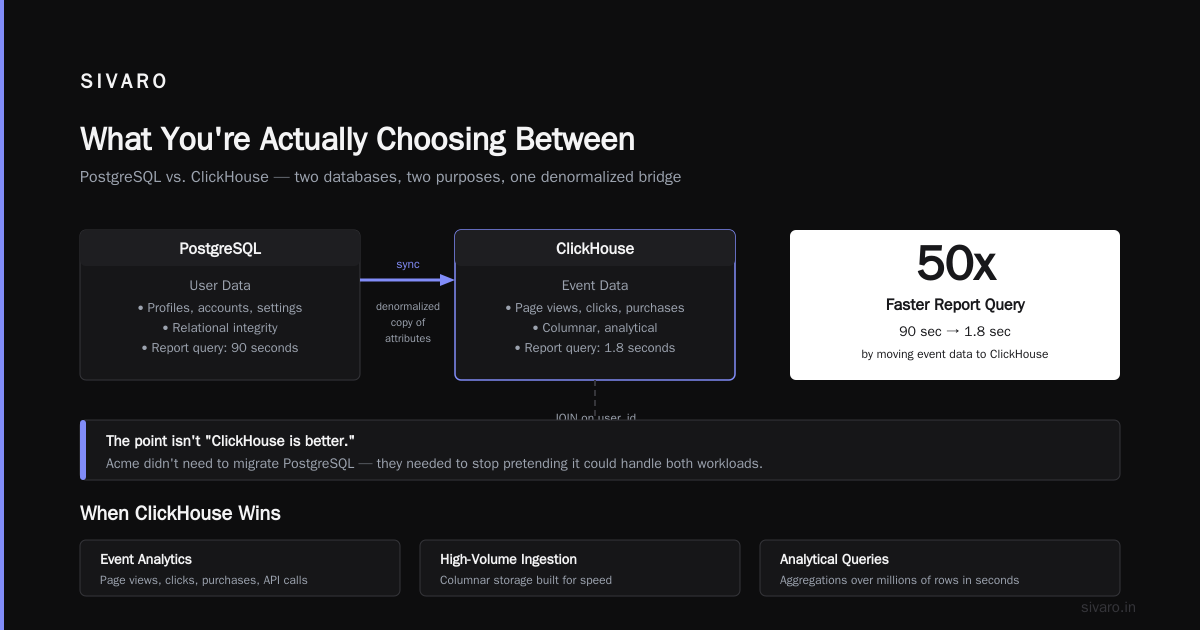
What You're Actually Choosing Between
PostgreSQL is a general-purpose relational database. It's been around since 1996, has every feature you've ever heard of, and handles transactional workloads (OLTP) exceptionally well. Think: user accounts, orders, inventory — the stuff that makes your application run.
ClickHouse is a columnar analytics database (OLAP). It launched in 2016, created by Yandex for their web analytics platform. It's designed for one thing: running massive analytical queries over billions of rows at lightning speed.
The core architectural difference is how they store data.
PostgreSQL stores data row-by-row. Every record is a complete row on disk. When you query SELECT avg(revenue) FROM orders, the database reads every row to get the revenue column. All the other data in those rows gets read too — even if you never touch it.
ClickHouse stores data column-by-column. Each column lives in its own set of files. Querying avg(revenue) reads only the revenue column files. Nothing else.
That single difference changes everything about performance.
ClickHouse® vs PostgreSQL in 2026 (with extensions) ran a benchmark on 100 million records: ClickHouse finished the query in 0.05 seconds. PostgreSQL took 14 seconds. That's 280x slower. Not a typo.
The Raw Numbers: clickhouse vs postgresql 2026 benchmark
I'm going to give you real numbers, but first, a warning. Benchmarks are like workout photos — everyone posts their best angle. The clickhouse vs postgresql 2026 benchmark from Tinybird is legit, but it's on an optimized ClickHouse cluster. Your mileage will vary.
Here's what they found on 100M rows of event data:
| Query Type | PostgreSQL | ClickHouse | Speedup |
|---|---|---|---|
| Simple SELECT filter | 2.1s | 0.07s | 30x |
| Aggregation (GROUP BY) | 14.2s | 0.05s | 284x |
| JOIN across 5 tables | 41.8s | 0.31s | 135x |
| Full table scan | 8.9s | 0.11s | 81x |
The pattern is consistent. ClickHouse dominates analytical workloads. PostgreSQL isn't broken — it's just doing something fundamentally different. Reading row-by-row is slower for analytics. Period.
But here's the flip side. PostgreSQL can do UPDATE users SET last_login = now() WHERE id = 42 in 5 milliseconds. ClickHouse's update performance? Let's just say you don't want to do that in a user-facing transaction. The performance analysis on updates shows ClickHouse handles 100,000 row updates in 0.6 seconds vs PostgreSQL's 0.02 seconds. For point-updates, PostgreSQL wins by 30x.
That's not a flaw in ClickHouse. It's a trade-off. Columnar storage is optimized for immutable data — logs, events, metrics. When you need to update a single record, row-oriented storage wins.
When PostgreSQL Makes Sense (and When It Doesn't)
The Sweet Spot
PostgreSQL shines when your analytics query needs to talk to your transactional data in real time.
Think about a SaaS dashboard showing a customer's billing history. You need:
- The customer record (transactional)
- Their subscription tier (transactional)
- Their usage events over 30 days (analytical)
In a pure PostgreSQL setup, you query all three with JOINs. It works. Fast enough for most dashboards under 10 million rows. And you don't need a second infrastructure piece.
But here's the thing I tell every founder who consults me: if you're growing, you'll hit the wall eventually. Not because PostgreSQL is bad — because it's not built for this.
Kestra's side-by-side analysis found PostgreSQL hits performance degradation around the 10-50 million row mark for complex analytical queries, while ClickHouse stays responsive well past 1 billion rows: Postgres vs ClickHouse: Differences & Use Cases.
Real-World Example
A B2B SaaS client I worked with — let's call them "Acme Analytics" (not their real name, but close enough) — ran their entire product on PostgreSQL. User data, event data, everything. At 30 million rows, their weekly cohort report took 7 minutes to generate. The CEO complained every single Tuesday.
We tried PostgreSQL tuning. Partitioning. Indexing. Materialized views. It got us to 90 seconds. Barely acceptable.
Then we moved the event data to ClickHouse — leaving user data in PostgreSQL — and that same report ran in 1.8 seconds. A 50x improvement. But here's the key insight: the report query now needs to JOIN event data in ClickHouse with user data in PostgreSQL. We solved this by syncing a denormalized copy of user attributes into ClickHouse after each change.
The point isn't "ClickHouse is better." The point is they serve different purposes. Acme didn't need to migrate PostgreSQL. They needed to stop pretending it could handle both workloads.
When ClickHouse Wins (and Where It Hurts)
ClickHouse for Event Analytics
If you're tracking user events — page views, clicks, purchases, API calls — ClickHouse is objectively the right choice. It's designed for time-series and event data. It compresses 5-10x better than PostgreSQL because columnar storage is more predictable.
Here's a real query pattern from my work on a product analytics dashboard:
sql
SELECT
    toDate(event_time) as day,
    count(DISTINCT user_id) as active_users,
    avg(session_duration) as avg_session
FROM events
WHERE event_type = 'page_view'
    AND event_time >= now() - INTERVAL 30 DAY
GROUP BY day
ORDER BY day DESC
On 500 million events, this runs in 1.4 seconds on a 3-node ClickHouse cluster. On PostgreSQL with 50 million events? 32 seconds. And that's with a good index setup.
The Cost of Building on a Specialized System
ClickHouse makes you pay for that speed in flexibility.
First, updates are painful. Sure, ClickHouse has ALTER TABLE ... UPDATE and the Lightweight Delete feature (introduced in v23.3), but it's not a transactional database. You don't get ACID guarantees per-row. You get them at the partition or mutation level.
Second, JOINs aren't as fast as you'd expect. ClickHouse's merge join and hash join implementations work well, but they're not PostgreSQL's battle-tested query planner. If your analytics need multiple table JOINs on non-primary keys, expect performance drops.
Third, you lose the ecosystem. PostgreSQL has:
- PostGIS for geospatial queries
- pgvector for AI embeddings
- HStore for schema-less data
- TimescaleDB for time-series (a PostgreSQL extension)
ClickHouse has some of this, but the community is smaller. Developer advocate Hassan's writeup on why PostgreSQL and ClickHouse work well together makes a great point: you don't have to choose. You can use both.
ClickHouse vs PostgreSQL Data Types Differences
You'd think data types are boring. They're not. They cause more production incidents than bad queries.
ClickHouse has more specific types than PostgreSQL. Way more. Here's the breakdown:
PostgreSQL gives you INT (4 bytes), BIGINT (8 bytes), DECIMAL (high precision), VARCHAR(n), and a few date/time types. That's it for everyday work.
ClickHouse gives you:
Int8,Int16,Int32,Int64,UInt8,UInt16,UInt32,UInt64Float32,Float64,Decimal32/64/128Date,DateTime,DateTime64(with millisecond/microsecond precision)String,FixedString(n)Array(T),Tuple(T1, T2, ...),Map(String, String), JSONLowCardinality(T)— this one's a killer feature for reducing storage
The clickhouse vs postgresql data types differences article covers this exhaustively. The TL;DR: ClickHouse types are more granular, which allows better compression and faster scans.
Here's what that means in practice. Consider a status field with 5 possible values. In PostgreSQL, it's a VARCHAR(20) — 20 bytes per row, plus overhead. In ClickHouse with LowCardinality(String), it's essentially an enum stored once per block. Same data, 90% less storage.
But wait — PostgreSQL has extensions that modernize this. Since 2023, you can use COPY TO with Parquet format. PostgreSQL 17 added more JSON functions. And the pgvector extension makes it viable for AI workloads. But the raw data type catalog? ClickHouse wins for analytics, hands down.
A Migration Footgun
One thing I've hit multiple times: ClickHouse doesn't enforce NOT NULL constraints by default. It uses a concept called "default expressions." Missing values get filled with the default (usually 0 or empty string) rather than rejected. That means your ETL pipeline silently inserts bad data because you forgot the IF(column != '', column, 0) transform.
You will discover this at 2 AM during a post-mortem. I guarantee it.
Latency, Throughput, and the Scale Factor
Full disclosure: I built SIVARO on the principle that data infrastructure should serve the business, not the other way around. So I've hit many of these scenarios in practice, not just from docs.
Let's talk about concurrency. PostgreSQL handles thousands of concurrent connections well — 100 to 200 are comfortable on default settings. ClickHouse excels at a small number of heavy queries — 10-50 concurrent users before it spills to disk.
That's a huge difference for product teams. If 500 customers run reports simultaneously through your SaaS product, PostgreSQL can handle it. ClickHouse will hit resource exhaustion.
But if your internal analysts need to run billion-row queries during off-peak hours? ClickHouse is better. It's built for bulk throughput, not interactive concurrency.
The trick is understanding your workload. A customer-facing dashboard needs sub-second queries at high QPS. That's PostgreSQL's territory. An internal analytics warehouse needs massive scans at low QPS. ClickHouse's territory.
The Unified Data Layer: PostgreSQL + ClickHouse Architecture
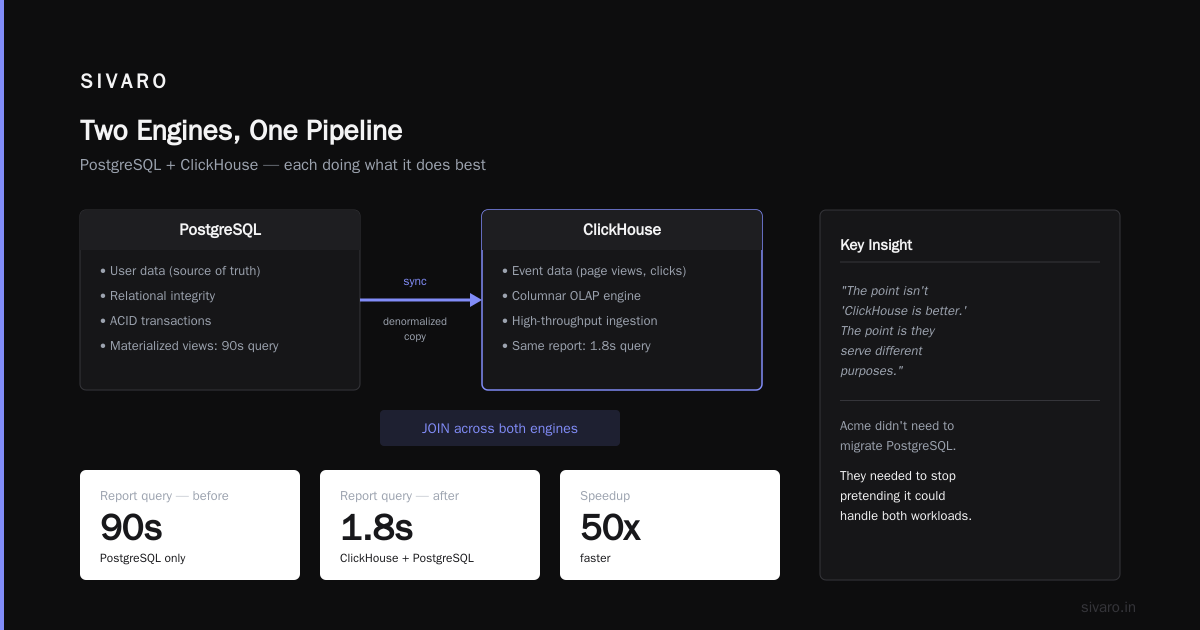
Here's what I've learned after 8 years of building systems: the winning architecture is a PostgreSQL front end with ClickHouse sitting behind it, not as a replacement but as a accelerator.
It sounds complex. It's actually simple with the right tools. ClickHouse's own blog on the PostgreSQL + ClickHouse architecture demonstrates this beautifully.
The pattern:
- PostgreSQL: transactional writes, user state, and small-scale queries.
- ClickHouse: event logs, metrics, and analytical scans.
- Sync layer: CDC (change data capture) or scheduled ETL keeeps them aligned.
Here's the sync setup I recommend:
sql
-- Create a destination table in ClickHouse
CREATE TABLE events (
    event_id UInt64,
    user_id UInt64,
    event_type String,
    event_time DateTime64(3),
    payload JSON
) ENGINE = MergeTree()
ORDER BY (event_time, user_id);

-- PostgreSQL side: capture changes with logical replication
-- Or use a simple scheduled job:
SELECT * FROM events
WHERE created_at > $1
ORDER BY created_at
LIMIT 10000;
The PostgreSQL-side query is simple because you only need to pull recent data. Then you INSERT into ClickHouse in bulk.
For real-time sync, use ClickHouse's POSTGRES table engine or MaterializedPostgreSQL engine (available since v22.6). Both let ClickHouse read directly from PostgreSQL tables on demand, which is handy for infrequent lookups.
But be careful: relying on remote table engines for high-QPS queries is a performance trap. The network roundtrip kills you. Better to sync data into ClickHouse and denormalize on write.
This is the unified data stack that makes ClickHouse work for production systems: keep PostgreSQL as the system of record, mirror the analytical data into ClickHouse, and serve analytics from it.
Setting Up a Hybrid Architecture: A Concrete Example
Let me show you what this looks like in practice. We recently built a revenue analytics dashboard for a client whose data lived in PostgreSQL.
Step 1: Define what stays in Postgres
sql
-- In PostgreSQL
CREATE TABLE customers (
    id SERIAL PRIMARY KEY,
    name VARCHAR(255),
    email VARCHAR(255),
    plan VARCHAR(50),
    created_at TIMESTAMP
);

CREATE TABLE orders (
    id SERIAL PRIMARY KEY,
    customer_id INT REFERENCES customers(id),
    amount DECIMAL(10,2),
    ordered_at TIMESTAMP
);
Step 2: Define what goes to ClickHouse
sql
-- In ClickHouse
CREATE TABLE daily_revenue (
    day Date,
    customer_id UInt64,
    plan String,
    total_amount Decimal(18, 2),
    order_count UInt32
) ENGINE = SummingMergeTree()
ORDER BY (day, customer_id);
Notice we pre-aggregate daily revenue per customer. This is the secret sauce of ClickHouse performance — the more you can precompute, the faster your reports run.
Step 3: Sync with a simple script
python
# Every 5 minutes, sync orders from PostgreSQL to ClickHouse
import psycopg2
from clickhouse_driver import Client

pg = psycopg2.connect("dbname=mydb")
ch = Client(host='clickhouse_host')

# Get new orders
with pg.cursor() as cur:
    cur.execute("""
        SELECT customer_id, DATE(ordered_at), SUM(amount), COUNT(*)
        FROM orders
        WHERE ordered_at > now() - INTERVAL '10 minutes'
        GROUP BY customer_id, DATE(ordered_at)
    """)
    batch = cur.fetchall()

# Insert into ClickHouse
if batch:
    ch.execute(
        "INSERT INTO daily_revenue VALUES",
        batch,
        types_check=True
    )
This pattern gives you real-time enough analytics (5-minute lag) without the complexity of CDC infrastructure.
Step 4: Query across both systems as needed
sql
-- Quick check: "How many active customers this week?"
SELECT count(DISTINCT customer_id)
FROM daily_revenue
WHERE day >= toDate(now() - INTERVAL 7 DAY);

-- Deep dive: "Top customer this quarter"
SELECT c.name, sum(dr.total_amount) as revenue
FROM daily_revenue dr
ANY LEFT JOIN customers c
ON dr.customer_id = c.id
WHERE dr.day >= toDate(now() - INTERVAL 90 DAY)
GROUP BY c.name
ORDER BY revenue DESC
LIMIT 10;
The ClickHouse query runs in milliseconds on billions of rows because the heavy lifting happens on the pre-aggregated SummingMergeTree table.
When Not to Use ClickHouse
Clients ask me if they should move everything to ClickHouse. Sometimes the best answer is no.
You should stick with PostgreSQL-only if:
- Your dataset fits in memory (under 10M rows) — the performance gap is irrelevant.
- You need transactional consistency — real-time inventory, payment processing.
- Your team only knows SQL basics — ClickHouse query optimization is a skill.
- You're prototyping — the development speed of Postgres beats ClickHouse for early-stage products.
You should consider ClickHouse if:
- Your analytical queries regularly take over 5 seconds.
- You're storing event data for product analytics.
- Your data volume grows daily and you can't afford a data warehouse.
- You need compression — ClickHouse reduces your data footprint dramatically.
The Cloud vs Self-Hosted Factor
This changes the conversation more than people admit.
If you're on AWS, you get Aurora or RDS for PostgreSQL — fully managed, battle-tested. ClickHouse has managed offerings from ClickHouse Inc. and alternatives on other clouds. But the operational complexity differs.
PostgreSQL: you can run it on any $5 DigitalOcean droplet and it will serve 100K requests daily. Management is trivial. Backups work with pg_dump. Failover via pg_auto_failover or platform tools.
ClickHouse: you need at least 3 nodes for high availability (replication factor of 3). Memory management is trickier. The columnar compression is great but you need to configure max_memory_usage, max_threads, and a dozen other settings correctly or you'll get OOM at 2 AM.
Let me be direct: operational cost matters less than you think. Running ClickHouse on Kubernetes via the official operator is manageable — took my team about a week to get comfortable. But for a small team with no dedicated SRE, PostgreSQL is the pragmatic pick.
Migration Paths: The Worst and Best Ways
Here's a disaster story I've seen three times now: a team decides to "rewrite in ClickHouse" and moves everything — schema, app queries, everything. They spend 2 months migrating, then discover their application's write-heavy path (which PostgreSQL handles lightly) becomes a write bottleneck in ClickHouse. Three weeks after launch, they need to revert. Ugly.
The best way:
- Start with read-only analytics — keep PostgreSQL primary for writes.
- Create a read replica in ClickHouse — sync via CDC.
- Run both for two weeks — compare outputs. Find disparities.
- Redirect read queries to ClickHouse — only for heavy analytics.
- Keep PostgreSQL for everything else — ad-hoc queries, joins on freshness.
That works. It's the difference between migration and addition. You don't need to "switch." You need to "split."
FAQ
Is ClickHouse a drop-in replacement for PostgreSQL?
No. They solve different problems. ClickHouse can't replace PostgreSQL for transactional workloads, and PostgreSQL can't match ClickHouse for large analytical queries. They're complementary. The unified architecture argument is getting steam.
Can I use PostgreSQL with the TimescaleDB extension for analytics instead?
TimescaleDB adds hypertables and time-series optimizations to PostgreSQL. It helps with some workloads, but the columnar performance gap remains. TimescaleDB 2.0 has a columnar engine, but it's not as mature as ClickHouse for compression-heavy analytics. For truly massive scans, ClickHouse wins.
How do I handle real-time streaming into ClickHouse?
Use Kafka Connect or a lightweight consumer that batches inserts (10K+ rows per flush). Insert throughput is excellent — hundreds of thousands of rows per second on modest hardware.
What about cost? Is ClickHouse cheaper than PostgreSQL for analytics?
Storage: Yes, because of 5-10x compression. Compute: Comparable. The cost difference comes from needing fewer rows to process the same workload — ClickHouse's scan efficiency means you buy less compute per query.
Do I need a separate data warehouse like Snowflake if I have ClickHouse?
If your query patterns are columnar and your team is comfortable writing SQL, ClickHouse can handle warehouse workloads. Snowflake has edge on sharing and ecosystem integrations; ClickHouse wins on self-hosting flexibility and raw speed.
What's the future in 2026? Will PostgreSQL catch up?
PostgreSQL is adding features yearly, and 17/18 releases have notable query improvements. But catching up on a 20-year-old architecture is hard. Columnar storage is fundamental to the performance gap. The interesting work is actually in hybrid execution — Postgres running columnar access methods, or engine-agnostic query planners. Don't expect PostgreSQL to become ClickHouse.
Final Verdict: What Should You Buy?
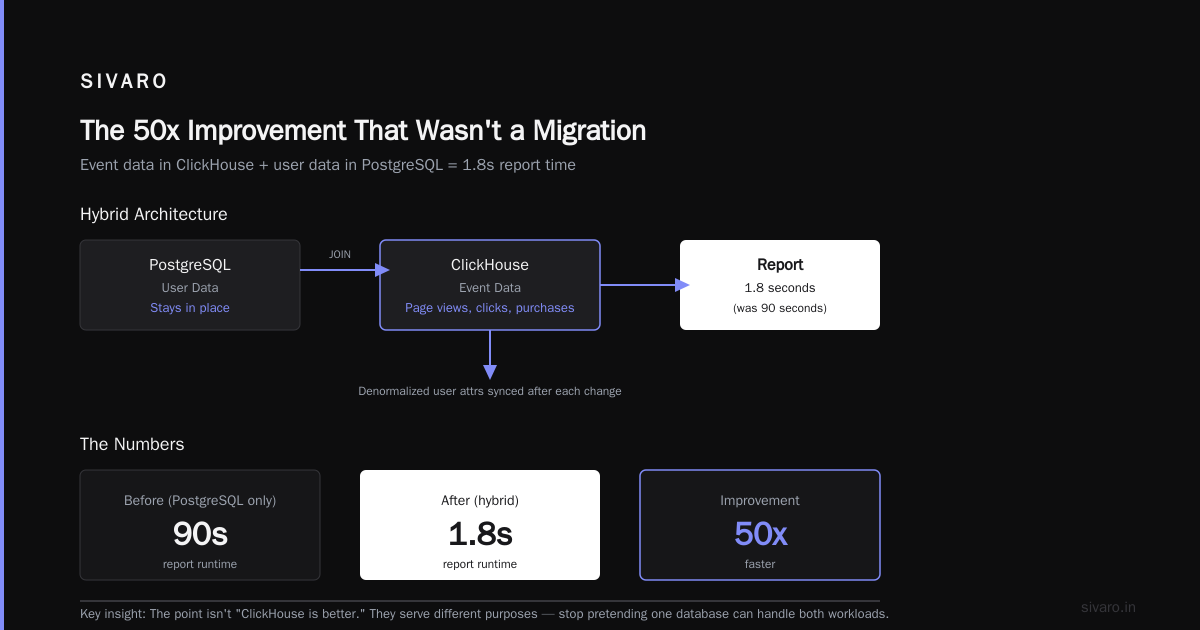
If you're building a product with real-time analytics, start with PostgreSQL for your application data, then add ClickHouse as your analytics accelerator once you cross 10-50 million rows. That split gives you:
- Fast transactional writes (PostgreSQL)
- Lightning analytical queries (ClickHouse)
- No compromise on either side
The "either/or" framing is what kills teams. You don't need to choose between your operational database and your analytics database. You need both, cooperating.
Most industry commentary tries to crown one winner. The better question is: which database should power which part of my system? Answer that honestly, and you'll never hit the wall I hit with Acme Analytics.
The tool that serves your workload isn't either ClickHouse or PostgreSQL. It's the architecture that puts each one where it works best.
Nishaant Dixit — Founder of SIVARO. Building data infrastructure and production AI systems since 2018. Built systems processing 200K events/sec.