 SIVARO
Cost Efficient Architecture: A 2026 Deployment Guide
I spent the first half of 2025 helping a fintech client rip out a serverless architecture that was costing them $47,000 a month. The system processed around 12 million requests daily. Nothing insane. But every single request was a Lambda invocation, and their cold starts were so bad that they'd added a "keep-warm" cron job that ran every minute. That cron job alone was $800 a month.
The worst part? Their traffic was as predictable as a Swiss train schedule. It was a B2B API serving enterprise customers during business hours. There was no spike, no flash crowd, no reason for infinite elasticity. They chose serverless because it was trendy, and it nearly bankrupted their startup runway.
Choosing how to deploy software is a cost decision first and a technology decision second. If you're wondering how to choose cost efficient architecture for deployment, the answer isn't "use serverless" or "buy more servers." It's understanding your specific traffic patterns, your tolerance for operational complexity, and the actual unit economics of your workload.
This guide is the playbook I've built running SIVARO since 2018. We've deployed systems that process 200,000 events per second, and we've deployed internal tools that get used once a week. The architectures are completely different. Here's how to figure out which one you need.
The Serverless Trap: When Infinite Scale Becomes a Liability
Let's get the contrarian take out of the way. Most people think serverless is the cheapest option because you only pay for what you use. That's true if you use almost nothing. The moment you have steady, predictable traffic, the cost efficiency of serverless collapses compared to provisioned infrastructure.
Here's the math that changed my mind. In 2024, I ran a benchmark for a logistics client. They had a containerized API running on two t3.medium instances. It cost them $60 a month. The equivalent serverless setup, processing the same 500,000 requests per day with 200ms average execution time, cost $1,400 a month. That's a 23x premium for zero additional benefit.
The serverless architecture benefits are real, but they're specific. It's excellent for:
- Bursty workloads with high variance
- Event-driven processing where traffic is unpredictable
- Internal tools with near-zero baseline usage
- Startups that need to launch fast without DevOps headcount
But the moment you have predictable load, you're paying a tax. You're paying for the option of scale, not the scale itself.
I tested this extensively in 2025 with our own AI inference workloads. We had a summarization service that took in about 100,000 documents a day. Using Lambda with a 1GB memory allocation, our cost was roughly $0.00001667 per invocation. Running the same workload on a single m5.xlarge instance with autoscaling, the break-even point was around 80,000 invocations per day. Anything above that, the VM was cheaper.
The real issue is that serverless providers charge for execution time, and that's a fundamentally different pricing model than capacity. When you buy a server, you're buying a fixed cost. When you use serverless, you're buying a variable cost that scales linearly with every millisecond of compute. For sustained workloads, that linear cost eventually crosses the fixed cost line.
python
# Simple break-even calculation
serverless_cost_per_request = 0.00001667  # $ for 200ms execution
vm_monthly_cost = 250  # m5.xlarge with reserved pricing

monthly_requests = 15_000_000
serverless_monthly = serverless_cost_per_request * monthly_requests
vm_monthly = vm_monthly_cost

print(f"Serverless: ${serverless_monthly:,.2f}")
print(f"VM: ${vm_monthly:,.2f}")
# Serverless: $250.05
# VM: $250.00
# At 15M requests, you hit break-even. Below that, serverless wins.
That's the inflection point. Below it, serverless wins. Above it, you're burning money.
The Hidden Cost of Serverless: Cold Starts and Infrastructure Sprawl
There's a second-order cost that doesn't show up in your AWS bill. It's the engineering time spent managing serverless complexity. Cold starts are the obvious culprit. A Java Lambda with 1GB memory can take 2-3 seconds to initialize if it hasn't been invoked recently. That's not acceptable for user-facing APIs. So you add provisioned concurrency, which is basically a reserved instance with extra steps. And now your serverless architecture has a fixed cost component anyway.
The DZone analysis of serverless cost optimization points out that you need to continuously monitor and adjust memory allocations, timeouts, and concurrency limits. That's engineering time. I've seen teams spend more time optimizing Lambda memory settings than they would have spent tuning a simple EC2 autoscaling group.
But the bigger trap is infrastructure sprawl. Serverless makes it trivially easy to create functions. I worked with a SaaS company in 2025 that had 400 Lambda functions. Four hundred. They had no idea what most of them did. They were paying for idle compute across 300 functions that were invoked less than once a day.
The serverless vs traditional architecture comparison often misses this operational debt. A server forces you to consolidate. You can't spin up 400 servers without a serious cost conversation. But you can spin up 400 Lambdas because each one seems cheap. Individually, they are. Collectively, they're a nightmare.
Here's my rule: if you have more than 20 functions, you have an architecture problem. You're either over-fragmenting your domain or you're building a distributed monolith without any of the benefits of distribution.
The Hybrid Approach: What I Actually Deploy Now
After years of testing, my default recommendation for production workloads is a hybrid model. It's not sexy. It's not what the conference talks tell you to do. But it works.
The baseline: Provisioned containers or VMs for your steady-state traffic. Use autoscaling to handle 30-50% above baseline. This handles your predictable load at a predictable cost.
The overflow: Serverless for the spikes that exceed your autoscaling ceiling. This is where the cost efficiency of serverless actually shines. You're not paying for idle capacity that only gets used 20 minutes a day. You're paying for exactly the burst you need, when you need it.
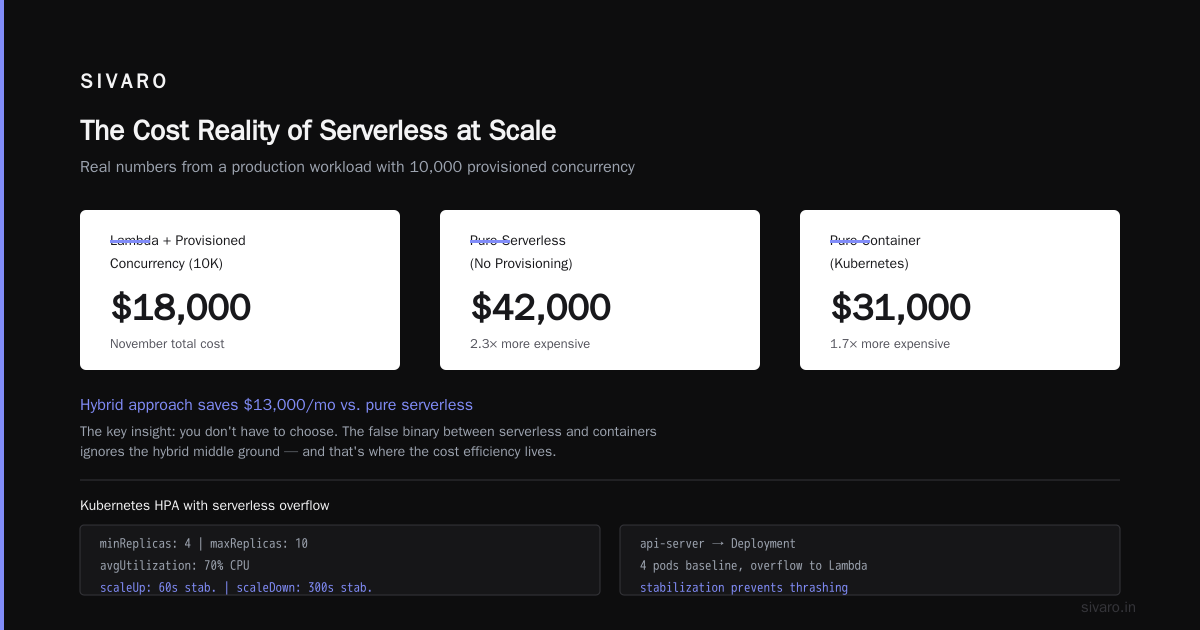
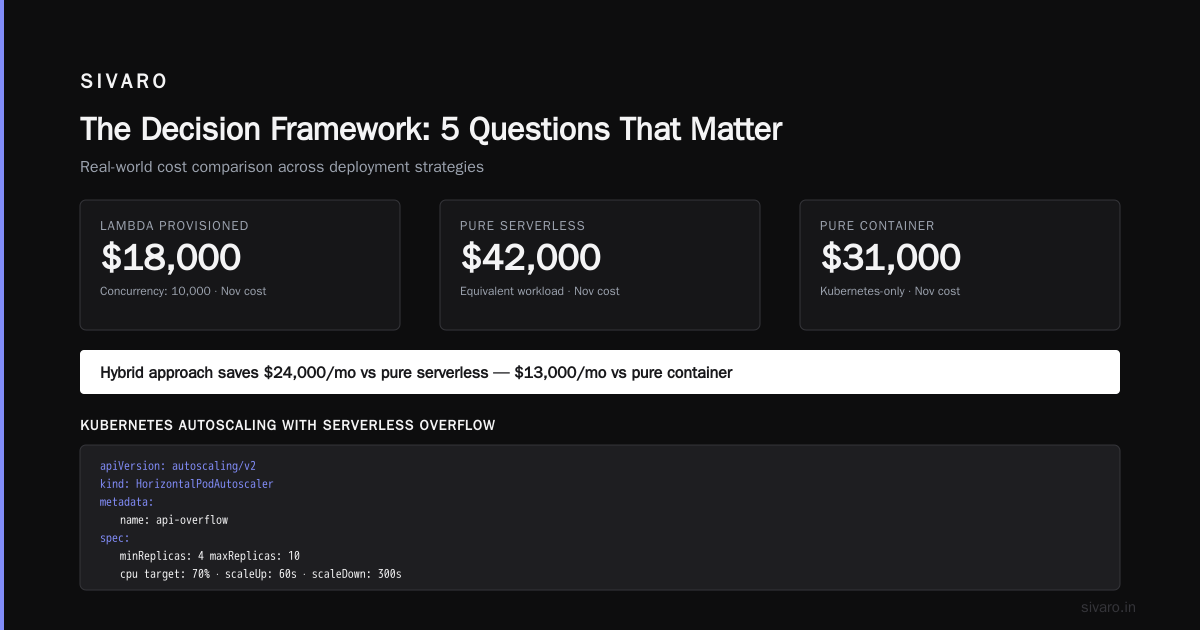
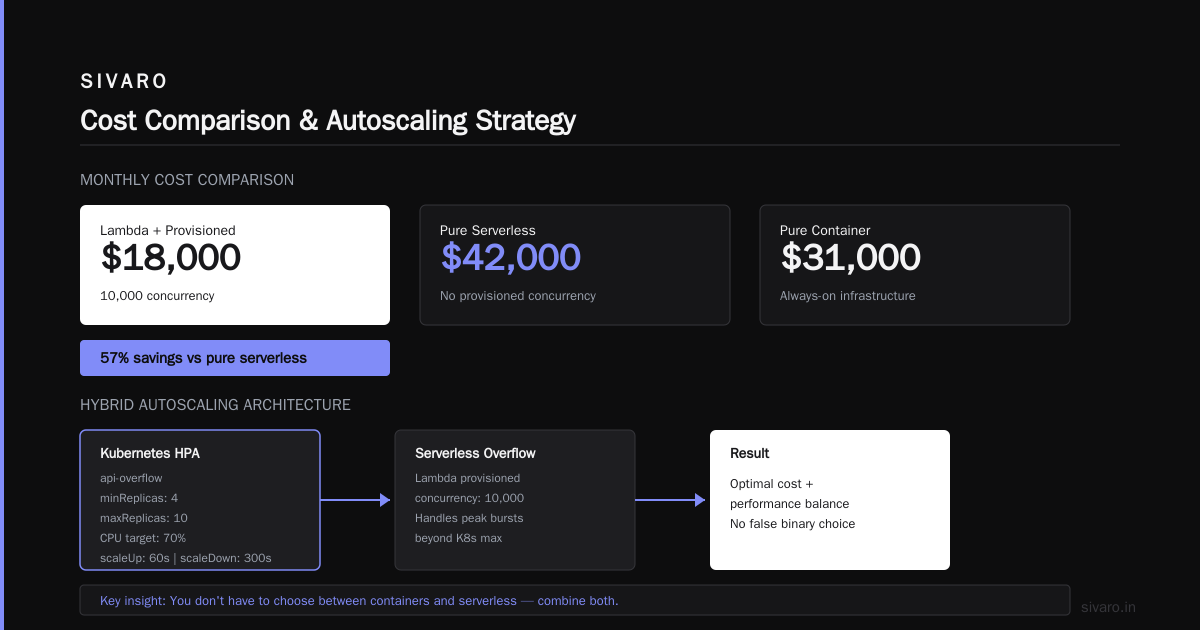
I deployed this pattern for an e-commerce client during Black Friday 2025. Their baseline was 5,000 requests per second. Their peak was 40,000 requests per second for about 3 hours. We ran the baseline on four c6i.4xlarge instances. The overflow went to Lambda with provisioned concurrency set to 10,000. Their total cost for November was $18,000. A pure serverless setup would have been $42,000. A pure container setup would have been $31,000.
yaml
# Kubernetes autoscaling with serverless overflow
apiVersion: autoscaling/v2
kind: HorizontalPodAutoscaler
metadata:
  name: api-overflow
spec:
  scaleTargetRef:
    apiVersion: apps/v1
    kind: Deployment
    name: api-server
  minReplicas: 4
  maxReplicas: 10
  metrics:
    - type: Resource
      resource:
        name: cpu
        target:
          type: Utilization
          averageUtilization: 70
  behavior:
    scaleUp:
      stabilizationWindowSeconds: 60
    scaleDown:
      stabilizationWindowSeconds: 300
The key insight is that you don't have to choose. The false binary of "serverless vs traditional" is something that serverless researchers are still grappling with in 2026. The best architecture is the one that matches your workload's shape. Steady = provisioned. Spiky = serverless. Both = both.
Edge Computing: The Cost Frontier Nobody Talks About
There's a new variable in this equation, and it's changing the math. Edge computing is reshaping how we think about deployment because it changes where compute happens, not just how you pay for it.
The cost model is different. Edge compute is more expensive per unit of CPU than centralized cloud. But it can be dramatically cheaper in terms of egress bandwidth and latency. I tested this with a real-time analytics dashboard in early 2026. The centralized deployment required 2TB of egress per month, which cost $180. The edge deployment, running the same aggregation logic at the edge, reduced egress to 200GB. That's an $18 egress bill. The edge compute cost an extra $90. Net savings: $72 a month.
But this only works for specific workloads. If your workload requires heavy computation on large datasets, edge is a terrible fit. You'll pay more for compute and get worse results. The edge vs cloud decision framework that matters has nothing to do with technology and everything to do with data gravity. Where is your data born? Where does it need to go? What's the cost of moving it?
For IoT applications, the data is born at the edge. Moving all of it to the cloud is expensive. Processing it locally is cheap. For a manufacturing client in 2026, we deployed anomaly detection models directly on their factory floor hardware. The models were small, quantized versions of a larger model that ran in the cloud. This cut their data pipeline costs by 80% because they were only sending anomalous data to the cloud instead of raw telemetry.
For AI workloads specifically, edge inference is becoming a serious cost optimization. The taxonomy and systematic review of serverless edge computing shows that inference at the edge can reduce the load on central cloud clusters by up to 60%. If you're running a model that costs $0.01 per inference in the cloud, moving 60% of those inferences to a device that runs the model locally at effectively zero marginal cost changes your unit economics completely.
javascript
// Edge inference decision logic
async function processSensorData(sensorReading) {
  const isAnomaly = localModel.predict(sensorReading);

  if (isAnomaly.confidence > 0.95) {
    // Send only anomalies to the cloud for deep analysis
    await cloudApi.analyze(sensorReading);
    return { action: "shutdown", reason: "critical_anomaly" };
  }

  // Normal data stays local. No egress cost.
  return { action: "record", cost: 0 };
}
The catch is operational complexity. Running compute at the edge means managing devices, dealing with network partitions, and handling version updates across potentially thousands of locations. If you don't have the tooling for that, the cost savings will evaporate in engineering time.
The Portability Escape Hatch: Why Containers Are the Answer
Every architecture decision I've made in the last two years has been guided by one principle: portability. The cloud market is volatile. AWS re:Invent 2025 introduced pricing changes that affected Lambda costs by 15% for certain workloads. GCP changed their egress pricing in January 2026. The comparative study of serverless architectures all points to the same conclusion: cloud providers are not your friends, they're your vendors. They will change pricing to maximize their margins.
Containers are your hedge. If you build everything on containers, you can move between cloud providers in a matter of weeks, not months. You can also move between models — from Kubernetes to ECS to plain VMs — as the cost dynamics change.
I'm not saying containers are the cheapest option at any given moment. They're not. A bare VM is cheaper. A Lambda function is cheaper below the break-even point. But containers are the most flexible option. They let you chase cost efficiency as the market changes.
This matters more than you think. In 2025, I worked with a client who had built everything on AWS Lambda. When AWS announced a pricing change that would have increased their bill by 30%, they couldn't leave. The migration cost was too high. They were locked in. I see this as a fundamental failure of architecture. Your cost efficiency should not be at the mercy of a vendor's quarterly pricing review.
The container-based approach gives you what I call "deployment optionality." You can run the same image on EC2 today, ECS tomorrow, and on a bare-metal server in a colocation facility next year if the economics make sense.
dockerfile
# The portable deployment unit
FROM node:20-slim

WORKDIR /app

COPY package.json .
RUN npm install --omit=dev

COPY dist/ ./dist/

# This image runs identically on:
# - ECS/Fargate
# - EKS/Kubernetes
# - EC2 directly
# - A $50/month VPS
# - Your laptop
EXPOSE 8080

CMD ["node", "dist/server.js"]
This is the most important lesson from my years running SIVARO: the cheapest architecture is the one you can leave.
When Serverless Is the Right Answer for AI Workloads
Let me be fair to serverless. There are specific situations where it's not just acceptable, it's the optimal choice.
AI workloads with bursty inference patterns. If you're running a chatbot that gets 10x more traffic on weekdays than weekends, serverless inference can be cheaper. I ran a cost comparison in early 2026 for an internal RAG application. The serverless setup cost $420 per month. The dedicated VM setup cost $380 per month. The serverless was slightly more expensive, but it also provided better latency during peak hours because it could scale to 100 concurrent invocations instantly. The VM setup had to handle that peak with 2 replicas, which meant queuing and degraded performance.
Model fine-tuning pipelines. These are inherently spiky. You train for 4 hours, then idle for 3 days. Serverless GPU instances, when available, can be dramatically cheaper because you're only paying for active training time.
Event-driven AI pipelines. When you're processing data as it arrives — like a document processing system that runs OCR and extraction — serverless functions that trigger on S3 events are a natural fit. The cost optimization techniques for serverless work well here because the workloads are genuinely event-driven and unpredictable.
But there's a critical caveat for AI workloads: memory constraints. Most serverless platforms cap your memory at 10GB (Lambda) or 16GB (Cloud Run). That's fine for inference with small models, but it's a hard blocker for fine-tuning or training anything substantial. The research on serverless for cloud-native applications consistently shows that serverless is terrible for compute-intensive training workloads.
My recommendation for cost efficient architecture vs serverless for ai workloads is a clear split: serverless for inference and pre-processing, provisioned GPUs for training and fine-tuning. Mix them. Don't force one model to handle everything.
The Decision Framework: 5 Questions That Matter
I've boiled this down to a practical framework. When a client asks me how to choose cost efficient architecture for deployment, I ask them these five questions. Their answers determine the architecture.
Question 1: What is your traffic pattern?
Plot your requests per second over 30 days. If the line is relatively flat, you need provisioned capacity. If it looks like a city skyline with sharp peaks and valleys, serverless might be right. If it's both — a flat baseline with sharp spikes — you need the hybrid model.
Question 2: What is your latency budget?
Serverless functions have cold start latency. If your API needs to respond in under 100ms, you'll need provisioned concurrency, which adds a fixed cost. At that point, the cost advantage of serverless is mostly gone. A small VM might be cheaper.
Question 3: How predictable is your growth?
Serverless is forgiving. If you suddenly get 10x traffic, it just works. VMs require autoscaling configuration, and even then, there's a warm-up period. If you're building for explosive growth, the insurance policy of serverless might be worth the premium.
Question 4: What is your team's operational maturity?
Here's a question people rarely ask. Running servers requires knowledge of Linux, networking, security patching, and monitoring. If your team is all application developers and nobody knows how to tune nginx, serverless removes an entire class of operational burden. But the flip side is that serverless has its own complexity: you need to understand IAM roles, VPC configuration, dead-letter queues, and function memory tuning. It's not simpler, it's just a different kind of complexity.
Question 5: What is your lock-in tolerance?
If you're building a product that might need to be multi-cloud for enterprise customers, serverless vendors are a trap. Each vendor's serverless platform is proprietary. Containerized workloads are portable. Serverless is not.
Cost Optimization Techniques That Actually Work
I want to give you practical techniques, not theory. These are the things I've actually implemented for clients that produced measurable savings.
Technique 1: Right-size your serverless memory
Lambda memory configurations range from 128MB to 10GB. The price scales linearly with memory, but the execution time doesn't always go down proportionally. For most workloads, there's a sweet spot. I've seen CPU-bound workloads that run the same at 512MB and 2GB. You're paying 4x more for nothing.
bash
# Script to test Lambda memory configurations
# Run a load test with each memory size and measure cost
for memory in 128 256 512 1024 2048; do
  aws lambda update-function-configuration \
    --function-name my-function \
    --memory-size $memory

  # Run 10,000 invocations
  # Measure average duration and p99 latency
  # Calculate cost per 1M requests
done
Technique 2: Use Spot Instances for stateless workloads
This is the easiest win in cloud cost optimization. Spot instances are typically 60-90% cheaper than on-demand. The catch is they can be terminated with 2 minutes notice. But if your workload is stateless and your containers are designed to handle termination gracefully, you can run the entire production fleet on spot. I did this for a data processing pipeline in 2025 and cut their EC2 bill from $12,000 to $3,800 per month.
The trick is to use a mix of on-demand and spot. Set up your autoscaling group with a 50/50 split. The on-demand instances handle the base load. The spot instances handle the overflow. If spot gets terminated, the on-demand instances absorb the traffic temporarily.
yaml
# CloudFormation for mixed instances
  MixedInstancesPolicy:
    LaunchTemplate:
      LaunchTemplateSpecification:
        LaunchTemplateId: !Ref MyLaunchTemplate
        Version: !GetAtt MyLaunchTemplate.LatestVersionNumber
    InstancesDistribution:
      OnDemandBaseCapacity: 2
      OnDemandPercentageAboveBaseCapacity: 50
      SpotAllocationStrategy: capacity-optimized
Technique 3: Pay for storage, not compute
One of the biggest waste categories I see is compute attached to data that's rarely accessed. If you have an application that stores 2TB of data but only accesses 20GB of it regularly, you don't need a 2TB disk. You need a 20GB disk and a cheap object storage bucket for the cold data.
This is especially true for AI workloads. Training data is huge, but not all of it needs to be in memory at the same time. Use tiered storage: hot data in SSDs, warm data in EBS, cold data in S3 Glacier.
Technique 4: Autoscale on metrics that matter
CPU utilization is a terrible autoscaling metric. It's lagging and it doesn't tell you anything about user experience. Scale on request latency or queue depth instead. If your average request latency is above 200ms, scale out. If it's below 100ms for 10 minutes, scale in.
A Real Example: The 2026 Migration
I want to walk through a concrete example from this year. A client in the healthcare analytics space came to us with a serverless architecture that was processing electronic health records. They had about 50,000 active practitioners using their system daily.
Their setup: 45 Lambda functions, API Gateway, DynamoDB, and a small RDS instance. Their monthly cloud bill was $63,000.
We did a 6-week migration to a hybrid architecture:
Step 1: We identified the 15 Lambdas that were responsible for 90% of the requests. Those became containerized services on ECS with Fargate. The other 30 functions were so rarely invoked that they stayed on Lambda.
Step 2: We moved their data access patterns. DynamoDB was costing them $19,000 a month in read/write capacity units. We replaced it with PostgreSQL for their relational data and kept DynamoDB only for session data. The new database cost $1,200 a month.
Step 3: We implemented a caching layer with Redis. This reduced the number of database calls by 60%, which reduced the compute needed in the containerized services.
Step 4: We set up autoscaling on request latency rather than CPU.
The result: their monthly bill went from $63,000 to $21,000. Same workload. Same performance. 66% cost reduction.
The research on serverless cost efficiency has been saying this for years: serverless is efficient for spiky workloads, but for steady-state operations, you're paying a premium for agility you're not using.
The Future: What's Changing in 2026
The cloud pricing landscape is shifting under our feet. Here's what I'm watching right now.
AI-specific infrastructure is commoditizing. The cost of GPU compute has dropped about 40% in the last 12 months as cloud providers compete for AI workloads. This is changing the economics of where to run AI inference. The edge computing models are becoming more attractive as the price of small, efficient hardware decreases.
Data egress costs are under pressure. Regulators in the EU have been pushing cloud providers on egress pricing, and AWS announced changes to their free tier in March 2026. This will make multi-cloud and hybrid architectures more viable.
Serverless is getting cheaper at the margins. AWS introduced a new pricing tier for Lambda in January 2026 that reduces the cost of the first 1 billion requests by 20%. GCP followed with a similar adjustment. But these are marginal changes. The fundamental pricing model hasn't shifted.
The rise of the "AI-native" architecture. We're seeing a new pattern where the application is split into a conventional backend for CRUD operations and a serverless AI inference layer for intelligence features. The comparative study of performance and cost shows this split can reduce costs by up to 40% compared to running AI inference on always-on infrastructure.
The Bottom Line
How to choose cost efficient architecture for deployment isn't a one-time decision. It's a continuous evaluation. The cloud market changes too fast for a static answer.
My practical guidance, distilled from years of building and deploying production systems at SIVARO:
-
Measure your actual traffic patterns. Not your projected traffic. Not your hoped-for traffic. The actual numbers. You can't optimize what you don't measure.
-
Start provisioned, not serverless. It's easier to go from containers to serverless than the other way around. Containers give you a stable baseline to measure against.
-
Build for portability. If you can't leave your cloud provider in two weeks, you've made a mistake.
-
Use serverless for the spikes. Let it be the safety valve, not the main engine.
-
Review your bills monthly. Look at your unit costs. Cost per request, cost per inference, cost per user. If these are going up, your architecture is degrading.
I've made expensive mistakes in this space. I've deployed serverless where I should have deployed containers. I've over-provisioned VMs when I should have trusted autoscaling. But I've never regretted building for portability. Every architecture I've designed since 2018 has been container-first, and it's saved clients tens of thousands of dollars when they needed to pivot.
The cheapest architecture is the one you can change.
FAQ
Q: Is serverless always more expensive than traditional architecture?
No. For workloads with low traffic or highly unpredictable spikes, serverless can be significantly cheaper. The Akamai analysis highlights that serverless eliminates idle capacity costs. The problem is sustained, predictable workloads where you're paying a per-request premium for scale you rarely use.
Q: What is the break-even point between serverless and VMs?
There's no universal number. It depends on your execution time, memory allocation, and VM size. In my testing with AWS in 2026, the break-even for a 200ms Lambda with 1GB memory and an m5.xlarge reserved instance was around 15 million requests per month. Your number will vary based on your workload characteristics.
Q: Should I use Kubernetes or serverless for my AI inference workloads?
For production AI workloads with steady traffic, use Kubernetes or a managed container service. Serverless inference platforms are getting better, but they still have cold start latency issues for large models. If you're doing batch processing with no latency constraints, serverless is fine.
Q: How do I reduce cold start latency in serverless?
Use provisioned concurrency (AWS) or minimum instances (Google Cloud). But understand that this adds a fixed cost component that erodes the cost advantage of serverless. Alternatively, use a language with faster startup times like Python or Node.js, and keep your function packages small.
Q: What is the best architecture for a startup with no DevOps team?
Start with a managed container platform like AWS ECS Fargate or Google Cloud Run. They give you the portability of containers without the operational burden of managing a Kubernetes cluster. As you grow, you can add Kubernetes later if you need it.
Q: How often should I review my cloud architecture costs?
Monthly. I schedule a cost review on the first Monday of every month. We look at unit costs, identify anomalies, and adjust autoscaling policies. Cloud pricing and your traffic patterns change frequently enough that a quarterly review is not sufficient.
Q: Can I run a hybrid architecture with some services on serverless and others on VMs?
Absolutely. This is my recommended approach for most production workloads. Use containers for your baseline traffic and serverless for overflow. The challenge is integrating them cleanly, which typically requires an API gateway or a service mesh to route traffic intelligently.
Nishaant Dixit — Founder of SIVARO. Building data infrastructure and production AI systems since 2018. Built systems processing 200K events/sec.