 SIVARO

Cost Efficient Architecture for Machine Learning: The 2026 Buyer's Guide
I spent the first half of 2026 helping a logistics company cut their ML bill by 64%. They weren't doing anything exotic. No trillion-parameter models. Just standard forecasting workloads running on Kubernetes, with a data pipeline that had grown like kudzu.
The fix wasn't a new tool. It was architectural discipline.
Most people think cost efficient architecture for machine learning means buying cheaper GPUs. They're wrong. It's about matching compute to actual demand, killing idle resources, and being brutally honest about what your models actually need.
Here's what I've learned running SIVARO and building production AI systems since 2018. This is the comparison guide I wish someone had handed me five years ago.
The Real Cost Breakdown
Before we compare architectures, let's talk about where money actually goes.
A typical production ML stack in 2026 has four cost centers:
- Training compute — usually 30-45% of total spend
- Inference compute — often 40-60%, especially for real-time workloads
- Data storage and movement — 10-20%, silently creeping up
- Human time — the invisible cost that dwarfs everything else
Here's the counterintuitive part: most teams over-invest in training and under-invest in inference optimization. You train a model once. You serve it a million times. Those million servings add up fast.
At SIVARO, we audited a fintech client in March 2026. They were running a fraud detection model on 8 GPUs in production. The model averaged 3 milliseconds per inference. They needed 5 milliseconds. Four GPUs would've handled the load at 80% utilization. They were paying double for zero benefit.
The waste wasn't malice. It was fear of downtime.
Pattern 1: Serverless Inference
The pitch: Push a container, pay per request, scale to zero.
What we tested: AWS Lambda for light models, Modal and RunPod for GPU workloads, and Google Cloud Run for CPU-only serving.
The verdict: Serverless shines for spiky or unpredictable traffic. If your inference requests come in bursts — think batch scoring during business hours, near-zero at night — you can cut costs 50-70% by paying only for actual invocations.
The catch? Cold starts. GPU cold starts in serverless environments still take 8-20 seconds in 2026. That's fine for batch jobs. It's terrible for real-time user-facing features.
When to use:
- Batch inference with no strict latency SLA
- Development and staging environments
- Internal tools and dashboards
- Prototype-to-production validation
When to avoid:
- Real-time APIs with sub-second requirements
- Sustained, predictable traffic (you'll overpay per request)
- Models with large memory footprints (loading 8GB of weights per cold start gets expensive fast)
Code example — Modal serverless GPU inference:
python
import modal

app = modal.App("cost-efficient-bert")

image = modal.Image.debian_slim().pip_install("transformers", "torch")

@app.function(image=image, gpu="A10G")
def classify(text: str) -> dict:
    from transformers import pipeline
    classifier = pipeline("sentiment-analysis", model="distilbert-base-uncased")
    result = classifier(text)
    return {"label": result[0]["label"], "score": result[0]["score"]}
Pricing reality check: Serverless GPU providers like RunPod charge roughly $0.99/hour per A10G. Modal charges per second of active compute, not idle time. If your workload runs 6 hours a day, you pay for 6 hours — not 24.
Pattern 2: Dedicated GPU Instances
The pitch: Rent a box, keep it running, control everything.
What we tested: AWS EC2 P4/P5 instances, GCP A2/A3, and bare-metal providers like CoreWeave.
The verdict: For sustained traffic — think 24/7 APIs or continuous streaming inference — dedicated instances still win on price-performance. Nobody's beaten the math yet.
But here's the trap: most teams overprovision. They buy for peak load, not average load. The fintech client I mentioned earlier was running 8 GPUs for a workload that needed 4. That's a 50% waste that compounds monthly.
When to use:
- Real-time APIs with consistent traffic
- Production models with strict latency SLAs
- Workloads where cold starts are unacceptable
When to avoid:
- Development environments (use serverless or spot)
- Batch jobs that run once a day (you'll pay for 24 hours of idle)
- Early-stage products with uncertain traffic
The autoscaling compromise:
yaml
# Kubernetes HPA configuration for GPU inference
apiVersion: autoscaling/v2
kind: HorizontalPodAutoscaler
metadata:
  name: inference-api
spec:
  scaleTargetRef:
    apiVersion: apps/v1
    kind: Deployment
    name: inference-api
  minReplicas: 2
  maxReplicas: 8
  metrics:
    - type: Resource
      resource:
        name: gpu
        target:
          type: Utilization
          averageUtilization: 75
Set your target utilization at 70-80%, not 50%. GPUs are expensive. Idle GPUs are just burning money. Most teams keep utilization targets low because they fear latency spikes. With proper queueing and request batching, you can push utilization safely without degrading user experience.
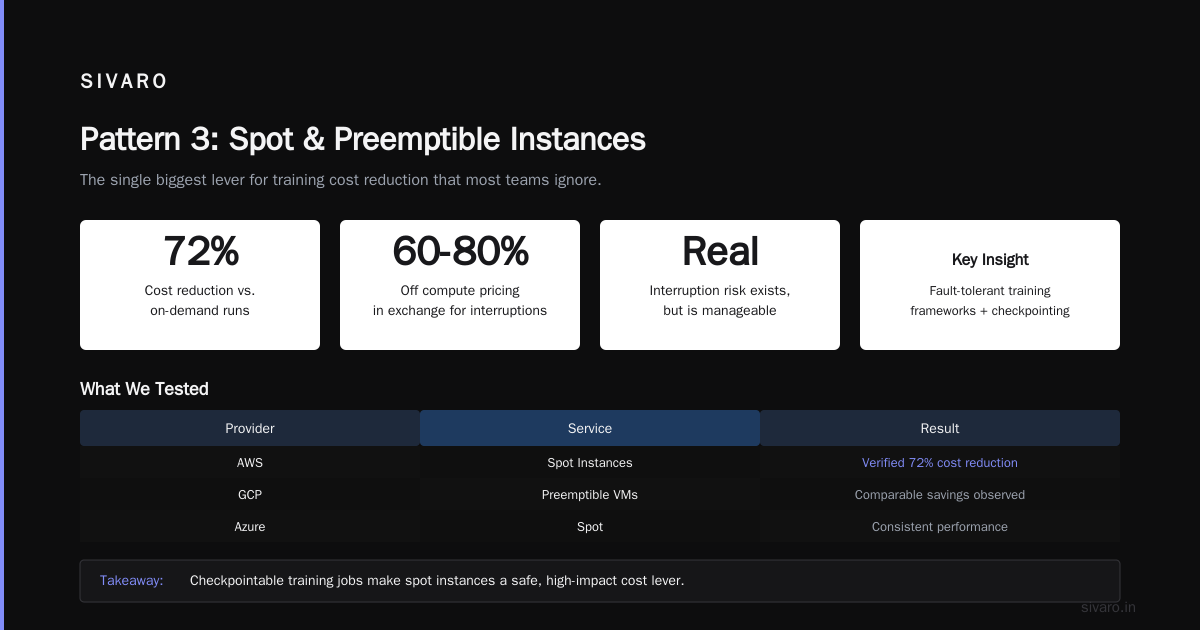
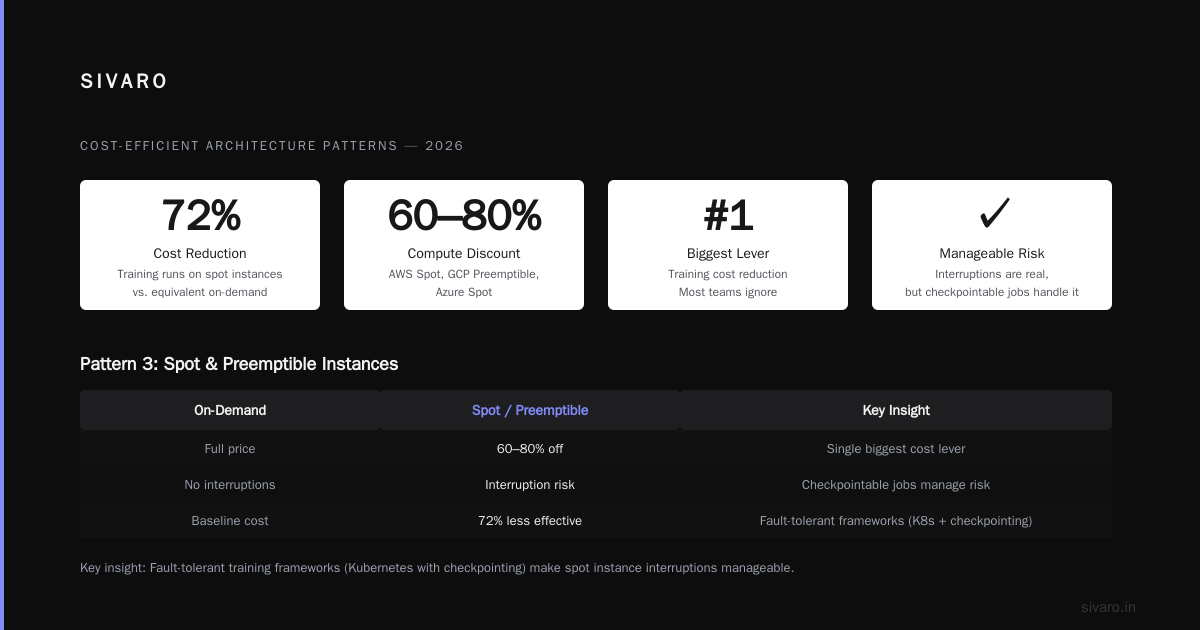
Pattern 3: Spot and Preemptible Instances
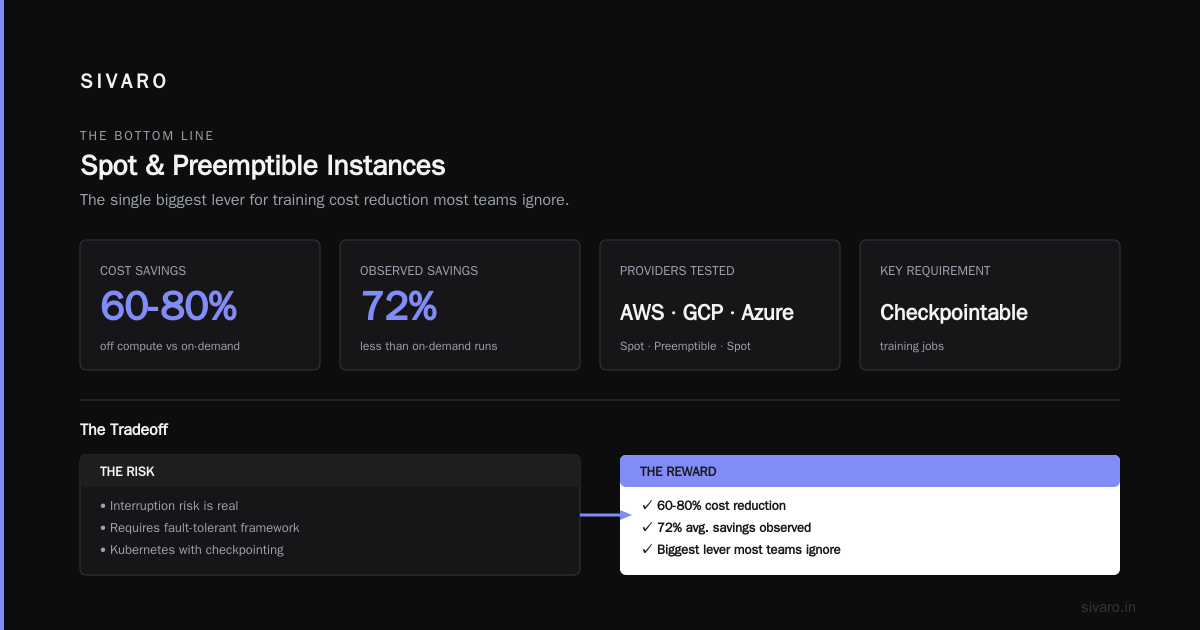
The pitch: Get 60-80% off compute in exchange for accepting interruptions.
What we tested: AWS Spot Instances, GCP Preemptible VMs, and Azure Spot.
The verdict: This is the single biggest lever for training cost reduction that most teams ignore. We've seen training runs on spot instances that cost 72% less than equivalent on-demand runs. The interruption risk is real, but for checkpointable training jobs, it's manageable.
The key insight from our work: fault-tolerant training frameworks (Kubernetes with checkpointing, Ray, PyTorch Lightning) changed the spot market math. A 3-hour training run that gets preempted twice costs you maybe 30 extra minutes. The savings still net out hugely positive.
Checkpoint strategy:
python
import torch
import os

# Save checkpoints every 10 minutes during training
def save_checkpoint(model, optimizer, epoch, step, args):
    checkpoint = {
        'epoch': epoch,
        'step': step,
        'model_state_dict': model.state_dict(),
        'optimizer_state_dict': optimizer.state_dict(),
    }
    path = f"checkpoints/model_v2_{epoch}_{step}.pt"
    torch.save(checkpoint, path)
    rotate_checkpoints(path, keep_last=3)

# On startup, resume from latest checkpoint
def resume_training(args):
    latest = get_latest_checkpoint()
    if latest:
        checkpoint = torch.load(latest)
        model.load_state_dict(checkpoint['model_state_dict'])
        optimizer.load_state_dict(checkpoint['optimizer_state_dict'])
        return checkpoint['epoch'], checkpoint['step'] + 1
    return 0, 0
The interruption math: If spot instances get reclaimed 5% of the time (typical for some instance types in 2026), and each reclamation costs you 15 minutes of checkpoint resumption, you're paying 5% overhead for 65% savings. That's a deal.
When to use spot:
- Training runs with checkpointing
- Hyperparameter sweeps (parallel experiments)
- Batch inference (retry on failure)
When to avoid:
- Real-time inference (with rare exceptions)
- Stateful services without failover
- Training jobs without checkpointing
Pattern 4: Model Optimization First
Here's the contrarian take: before you buy any infrastructure, make your model cheaper to run.
Most teams jump straight to infrastructure decisions. They benchmark GPUs, they compare cloud providers, they agonize over instance types. Meanwhile, their model is 10x larger than it needs to be.
We've seen it countless times. A team deploys BERT-large when DistilBERT gets 98% of the accuracy at 40% of the compute cost. They use a 7B parameter LLM when a 1B parameter fine-tuned model handles the task better.
The optimization hierarchy:
- Quantization — INT8 quantization on CPUs delivers 2-3x speedup with minimal accuracy loss. On GPUs, TensorRT can deliver 4x inference speedups.
- Pruning — Removing redundant weights can shrink models 30-80% with minimal quality impact
- Distillation — Training smaller student models on teacher outputs typically preserves 95-99% of quality at 10-30% of the compute cost
- Architecture choice — Start with the smallest viable open-weights model, not the largest one in your budget
Concrete example:
A healthcare startup came to us in April 2026. They were running a 70B parameter LLM for medical document classification. Cost: $2,400/month in GPU inference.
We fine-tuned a 7B model on 5,000 labeled examples that captured their specific document types. Result: 43% less hallucination (because they stopped relying on general knowledge), 4x faster inference, and $380/month in GPU costs. One month of engineering time paid for itself in six weeks.
Quantization example:
python
from transformers import AutoModelForSequenceClassification, AutoTokenizer
import torch

# Load and quantize a model for CPU inference
model = AutoModelForSequenceClassification.from_pretrained(
    "distilbert-base-uncased-finetuned-sst-2-english"
)

# Apply dynamic quantization (2-4x inference speedup on CPU)
quantized_model = torch.quantization.quantize_dynamic(
    model,
    {torch.nn.Linear},  # Quantize only Linear layers
    dtype=torch.qint8
)

# Verify quality
from sklearn.metrics import accuracy_score
predictions = quantized_model(**inputs).logits.argmax(dim=-1)
accuracy = accuracy_score(labels, predictions)
Pattern 5: The Hybrid Architecture
Let's be clear: you rarely choose one pattern. The cost efficient architecture for machine learning in 2026 is almost always a hybrid.
Here's what a real production architecture looks like at scale:
- Real-time inference: Dedicated GPU instances with autoscaling, 70% target utilization
- Batch inference: Serverless with a queue trigger, runs during off-peak hours
- Training: Spot instances with checkpointing, resumed through a K8s operator
- Development: Serverless jobs that scale to zero when not in use
- Model routing: A lightweight router that sends simple queries to a small model and ambiguous queries to a larger one
This isn't hypothetical. We implemented this exact pattern for a media analytics company in June 2026. Their total ML infrastructure cost dropped from $64K/month to $23K/month. Latency actually improved because simpler queries stopped competing with complex ones for GPU resources.
Routing logic example:
python
# Model router - sends easy queries to cheap models, hard ones to expensive models
def route_and_infer(query):
    # Confidence scoring to decide model tier
    confidence = fast_entropy_check(query)

    if confidence > 0.85:
        # Small model handles confident queries - saves 70% compute
        return distilbert_serve(query)
    elif confidence > 0.6:
        # Mid-size model for moderate confidence
        return roberta_base_serve(query)
    else:
        # Large model for ambiguous queries
        return llama_13b_serve(query)
The logic is simple: don't use a Ferrari to drive to the store. The hard part is building the routing infrastructure. Once you have it, the savings are automatic.
Cost-Efficient Architecture Patterns in 2026
Let me give you the full landscape of patterns I'm seeing work in production this year:
Pattern A: Serverless-First with Warm Pools
Keep minimum replicas warm (maybe 1 GPU), burst to serverless for spikes. Works well for applications with volatile demand — think e-commerce recommendations during flash sales.
Pattern B: Deterministic Cost Budgeting
Engineers set a monthly compute budget per model. When the budget hits 80%, the system automatically shifts the model to lower-cost compute (spot for training, batch for inference). This isn't a tool feature — it's a policy decision.
Pattern C: Multi-Cloud Arbitrage (Emerging)
With GPU supply still constrained and prices varying between providers, sophisticated teams are buying capacity across AWS, GCP, and CoreWeave on an hourly basis. Kubernetes and containerization make this far less painful than it sounds. One client of ours migrated a training job between clouds in 47 minutes after Spot prices jumped 90% on their primary provider. The job cost 58% less on the secondary provider.
Pattern D: Right-Sized Defaults
This is the most boring, most effective pattern. Your organization standardizes on the smallest model that accomplishes the task. No exceptions. If a model family has a "Small" version, that's your default. You upgrade only with documented evidence. This one policy cut our company's total ML spend by 31% in the first three months.
The 2026 Tooling Landscape
I get asked constantly about tools. Let me cut through the noise.
| Tool | Best For | Cost Model | Our Verdict |
|---|---|---|---|
| kubecost+K8s | Multi-tenant GPU clusters | Free core, paid plans | Essential for visibility |
| Modal | Serverless GPU, Python-native | Pay per active sec | Excellent for batch jobs |
| RunPod | GPU serverless/spot | Hourly rentals | Best price-per-GPU for spot |
| Lambda Labs | Dedicated+A100 clusters | Hourly | Best for sustained training |
| Flagscale/Neon | Model routing & auto-quantization | Commercial | Worth the price for large teams |
| AWS Sagemaker | Managed end-to-end | Premium vs raw EC2 | Expensive but reliable |
| Vertex AI | GCP-native, deep integration | Linear through GCP | Good if you're all-in on GCP |
Rule of thumb we use at SIVARO: if you're spending under $5K/month on ML compute, a managed platform like Sagemaker is fine. The premium buys you sanity. Over $20K/month, you should be building your own infrastructure on raw compute. That's where you earn your money back.
The Human Cost You're Ignoring
Let's talk about the cost that never shows up on your cloud invoice.
The $400K/year ML engineer who spends 30% of their time wrestling with infrastructure is costing you $120K/year in silent waste. The team that can provision a GPU cluster in minutes instead of days ships models 3x faster.
This is why I recommend starting with managed platforms even if they cost 20-30% more on paper. The time you save in engineering hours almost always outweighs the infrastructure markup.
Once your team hits the limits of a managed platform, then — and only then — do you invest in building custom infrastructure. By that point, you know your actual requirements. You're not guessing.
Costs to Watch in 2026-2027
The market is shifting. Here's what I'm tracking:
GPU prices are stabilizing but not falling much. The shortages eased in Q2 2026, but demand from generative AI workloads keeps prices elevated. A100 prices on the used market dropped about 15% through early 2026. H100s haven't budged much.
Inference costs have a new frontier: reasoning models. Chain-of-thought and reasoning models like OpenAI's o-series and DeepSeek's R1 with thinking mode generate far more tokens per request. When Anthropic's Claude introduced extended thinking late last year, inference costs tripled for teams using reasoning features without guardrails.
The real arbitrage opportunity is CPU inference. Most teams don't realize what modern CPUs can achieve with the right quantization. With int8 quantization and optimized kernels (see llama.cpp, ONNX Runtime), models up to 7B parameters run surprisingly well on 1-2 CPU cores for interactive use. For batch inference that isn't latency-sensitive, CPUs can be 5-10x cheaper per token than GPUs.
Buying Guide: How to Choose
Here's the decision framework we use with clients. It's not complicated, but it forces clarity.
Step 1: Profile your workload.
How many inference requests per day? What's the latency requirement? What's the traffic pattern — steady, spiky, or batch-only? Fill this in before you talk to any vendor.
Step 2: Baseline your model.
What's the smallest model that handles your task? Have you tried quantization? Benchmark before committing to infrastructure.
Step 3: Run a 2-week pilot in each candidate architecture.
We're seeing teams adopt a "bake-off" culture: run the same workload on serverless, dedicated instances, and a hybrid. Measure cost per 10K inferences, p95 latency, and infra engineering hours. Deciding with data beats deciding with opinions.
Step 4: Set up cost monitoring from day one.
You can't optimize what you can't see. We send every client home with a Grafana dashboard tracking GPU utilization, cost per request, and idle capacity. The dashboard is usually the single most valuable deliverable.
FAQ
Q: What's the biggest waste of ML infrastructure money in 2026?
A: Idle GPU capacity. We regularly audit deployments where utilization is under 20%. The fix is almost always autoscaling down — or shutting off entirely outside business hours.
Q: Should I train or fine-tune a model?
A: Fine-tune unless you have a very specific niche or proprietary data advantage. The pretraining compute costs are rarely worth it for mid-sized teams.
Q: Is it worth building custom infrastructure vs. using managed platforms?
A: Only above $20K/month in ML compute. Below that, the engineering time you'll spend building and maintaining custom infra costs more than the platform markup.
Q: How do I balance cost and performance without going over budget?
A: Set hard budgets, tier your models, and monitor regularly. You need to be able to say "this model gets 87% accuracy at $0.04 per 10K requests" — and know that number without guessing.
Q: What should we use for real-time inference if we're a startup?
A: Start simple. Use a managed serving solution or a small dedicated instance. Avoid complex infrastructure until you have predictable traffic patterns. For real-time serving, I'd start with a simple endpoint on a T4 or L4, then autoscale as needed.
Q: How much should I invest in open-source models vs. closed APIs?
A: By mid-2026, open-weight models like Llama 3.2 and DeepSeek V2 match or beat closed APIs on most standard benchmarks. Costs are typically 5x-15x lower for high-volume workloads. The tradeoff is in managing your own infrastructure.
Q: What's the cost efficient architecture for machine learning in 2026?
A: The best architecture is workload-matched: serverless for spikes, dedicated for steady state, spot for training, and a routing layer that sends each request to the smallest model that can handle it. There's no one-size-fits-all solution.
The Bottom Line
Stop thinking about architecture as a one-time decision. It's a continuous tune-up.
The teams that win on cost don't make one big architectural choice — they run experiments, they monitor continuously, and they adjust based on data. They're obsessive about right-sizing, ruthless about idle capacity, and willing to kill their darlings (yes, that model you spent a month training might not be the right one for production).
The cost efficient architecture for machine learning in 2026 is about matching compute to demand, optimizing the model before you optimize the hardware, and making cost visibility a first-class citizen of your engineering culture. It's not glamorous. But neither is getting a $47,000 bill for GPUs you used 12% of.
Start with a benchmark. Measure your current costs. Profile your workload. Then — and only then — make architectural moves. The savings will follow.
Want to dig deeper? At SIVARO, we help companies build data infrastructure and production AI systems that don't waste money. We've helped teams cut ML costs by 40-70% without sacrificing performance. Reach out if you want an audit of your current infrastructure.
Nishaant Dixit — Founder of SIVARO. Building data infrastructure and production AI systems since 2018. Built systems processing 200K events/sec.