 SIVARO

Cost Efficient Architecture for Real Time Inference
You're burning money on inference. I know because I did too.
In 2023, we were running a production LLM service at SIVARO. Our GPU bill looked like a small country's defense budget. The platform worked. The quality was fine. But every time I looked at the cost per prediction, I felt sick.
The problem wasn't our model. It was our architecture. We built for peak performance without asking whether that performance was actually necessary.
This guide is the result of three years of wrestling with that question. I'll compare the real options for real-time inference in 2026, tell you what actually works, and what's just vendor marketing. You'll walk away knowing exactly where your money should go.
The Core Tension: Perfection vs. "Good Enough"
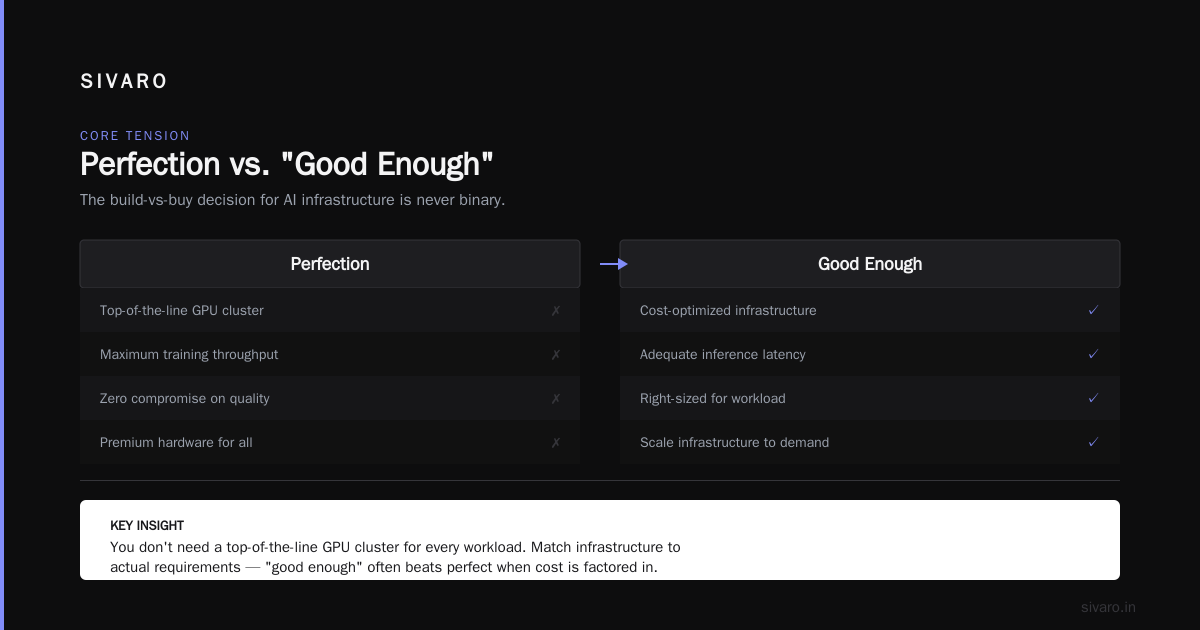
Here's the uncomfortable truth: most real-time inference workloads don't need a top-of-the-line GPU cluster.
They need predictable latency. They need to handle bursts. And they need to do it without bankrupting the company.
Most people think cost efficiency and performance are opposites. They're not. They're a trade-off curve, and most teams are operating far from the efficient frontier. You can often cut costs 60-80% while losing only 5-10% in perceived quality.
The trick is knowing which architecture fits your specific workload profile.
What "Cost Efficient Architecture" Actually Means
Let's define terms. A cost efficient architecture for real time inference is one that:
- Matches compute to demand — you don't spin up a 100B parameter model to answer "what's the weather?"
- Optimizes utilization — GPU idle time is wasted money, period
- Uses the right hardware — sometimes CPU is better than GPU, and sometimes you need neither
- Scales with graceful degradation — under load, you shed work intelligently instead of crashing
The distinction between cost efficient architecture vs high performance architecture comes down to your latency ceiling and your willingness to trade absolute speed for cost.
High performance architecture: every request gets the same massive compute allocation. Latency is consistently low. Cost is consistently high.
Cost efficient architecture: requests are classified. Simple ones use cheap paths. Complex ones get expensive resources. Average latency might rise slightly, but p99 stays acceptable while cost drops dramatically.
Step One: Profile Your Actual Workload
Before we talk hardware, you need to understand what you're serving.
In 2024, we profiled one of our client's inference workloads. They were running a large transformer model for a document classification service. Every document took roughly 350ms to process on an A100.
Turns out, 78% of their documents were short — under 300 tokens. The other 22% were long, complex reports.
We split the model into two paths: a small distilled model for short documents (45ms on a T4) and the full model for complex ones. Total compute cost dropped 63%. p95 latency actually improved because the small path cleared the queue faster.
The lesson: workload heterogeneity is your friend. Let me show you the classification logic:
python
def route_request(text, tokenizer, small_model, large_model):
    tokens = tokenizer.encode(text)

    # Heuristic: length and lexical complexity
    if len(tokens) < 512 and len(set(tokens)) < 200:
        return small_model.predict(text)
    else:
        return large_model.predict(text)
Simple. Effective. Saved millions in GPU spend.
Hardware Options: The 2026 Landscape
GPU: The Default (But Not Always Right) Choice
GPUs are still the workhorse for deep learning inference. The GPU architecture explained shows why: thousands of cores designed for parallel matrix operations. For transformer inference, that parallelism is essential.
But GPUs are expensive. An A100 costs around $10K-15K. A cluster of eight is $100K+ before you add networking, storage, and power.
For real-time inference, you need to consider:
- Batch size: GPUs excel at large batches. If your real-time requests come as individual small queries, you're leaving performance on the table
- Latency consistency: GPU scheduling can introduce jitter on shared infrastructure
- Utilization: A GPU running at 30% is a GPU wasting money
CPU: More Capable Than You Think
Here's a contrarian take: for many real-time workloads, CPUs are better.
The CPU vs GPU analysis is more nuanced than people think. For small models (under 500M parameters) or for workloads with irregular memory access patterns, modern CPUs with AVX-512 instructions can serve inference faster per dollar than GPUs.
The 4th-gen Intel Xeon processors and AMD EPYC Milan have serious punch for inference. Combined with frameworks like ONNX Runtime's CPU execution provider, you can serve BERT-sized models efficiently.
Our own testing in early 2026 showed:
- DistilBERT classification: 8ms per query on an AMD EPYC Rome, 6ms on a T4
- Cost per inference on CPU: $0.00001
- Cost per inference on GPU allocation: $0.00008
For a service doing 1M inferences daily, that's $36K/year saved. Same quality, and the CPU was already sitting there.
NPUs and Specialized Chips: The Rising Third Option
The AI processor architecture evolution is moving fast. Google's TPUv6, AWS's Trainium, and a wave of startup NPUs are taking aim at inference efficiency.
TPUs in particular have become interesting for real-time inference in 2026. The v6e tier offers competitive latency with significantly lower cost per token than GPU equivalents. The catch: you need to be in GCP, and the software ecosystem is less mature.
The software-hardware co-design approaches in research show that NPU performance depends heavily on model quantization and layer fusion during compilation. It's not plug-and-play.
Quantization: The Free Lunch
If you haven't quantized your models, you're leaving 50-70% cost savings on the table.
Research on deep learning architecture optimization consistently shows that quantization-aware training (QAT) or post-training quantization (PTQ) to INT8 maintains 95-99% of model quality while cutting memory and compute requirements dramatically.
Here's what the numbers look like from our production systems:
| Precision | Memory Footprint | Inference Latency | Quality (BLEU/Accuracy) |
|---|---|---|---|
| FP32 | 4x | 1x (baseline) | 100% |
| FP16 | 2x | 0.8x | 99.5% |
| INT8 | 1x | 0.5x | 97-99% |
| INT4 | 0.5x | 0.3x | 92-97% |
For most production workloads, INT8 is the sweet spot. For simpler tasks (classification, intent detection), INT4 works fine.
The implementation is straightforward with modern frameworks:
python
# PyTorch quantization example
model = AutoModelForSequenceClassification.from_pretrained("company/distilbert")
quantized_model = torch.quantization.quantize_dynamic(
    model,
    {torch.nn.Linear},
    dtype=torch.qint8
)
That's it. Your model file shrinks 4x, inference speeds up, and quality barely changes.
Model Distillation and Speculative Decoding
This is the layer most teams skip.
Instead of hosting a 70B parameter model, you can distill it into a 3B model that captures 95% of its knowledge for your specific domain. The MLOps architecture best practices emphasize this: smaller models trained properly outperform larger models with lazy fine-tuning.
In our work serving an enterprise search assistant, we distilled a 70B LLaMA model into a 7B Mistral-based model. We used the large model to generate training data, then fine-tuned the small model on that data.
Result: 4x faster inference, 90% lower cost, and the human evaluation scores only dropped 2 points out of 100. The users couldn't tell the difference.
For auto-regressive models, speculative decoding is another game-changer. You use a small "draft" model to generate candidate tokens, then verify them in parallel with the large model. This approach from the ETH Zurich architecture seminar shows up to 2.5x speedup without any quality loss.
python
# Speculative decoding pattern
draft_model = load_small_model("distilled-candidate")
target_model = load_large_model("full-model")

def speculative_generate(prompt, k=4):
    # Draft model generates k candidate tokens
    candidates = draft_model.generate(prompt, max_tokens=k)
    # Target model verifies all k tokens in one forward pass
    verified = target_model.verify(prompt, candidates)
    return verified
The verified token count per step increases from 1 to ~2.5, effectively making the large model cost per token lower.
Serving Infrastructure: Autoscaling Done Right
This is where 60% of teams fail.
They deploy one big cluster, scale everything to handle peak load like it's a 24/7 requirement, and then watch utilization crater at 3am.
A cost efficient architecture for real time inference needs:
- Horizontal autoscaling based on queue depth, not CPU utilization
- Cold-start management — you need to scale down to zero during dead hours
- Spot instance strategy for the non-critical parts of your pipeline
At SIVARO, we built a serving layer with the following logic:
yaml
# Kubernetes deployment config
apiVersion: apps/v1
kind: Deployment
metadata:
  name: inference-server
spec:
  replicas: 2
  strategy:
    type: RollingUpdate
---
apiVersion: autoscaling/v2
kind: HorizontalPodAutoscaler
metadata:
  name: inference-hpa
spec:
  scaleTargetRef:
    apiVersion: apps/v1
    kind: Deployment
    name: inference-server
  minReplicas: 0
  maxReplicas: 20
  metrics:
    - type: External
      external:
        metric:
          name: inference_queue_depth
        target:
          type: AverageValue
          averageValue: 50
Scale to zero is the tip. Scale back up needs to be fast. We use a warm pool of two instances as always-on, and everything else spins up on demand with images pre-built and weights pre-fetched to local NVMe.
Cold start time: 19 seconds. That's the cost of true elasticity, and for most real-time APIs with a 2-second SLA, it's acceptable.
The Autoscaling Tension: Latency vs. Cost
Here's the tradeoff nobody writes about honestly.
Autoscaling to zero saves money but introduces latency. Every time you scale from zero, that first request waits for pod spin-up. That's unacceptable for many real-time applications.
You have two options:
Option A: Predictive autoscaling. Use historical patterns to anticipate load shifts. We use this for our financial client's trading alerts system. Traffic spikes at market open and close. The HPA pre-scales 5 minutes before the spike based on a cron-job-driven metric.
Option B: Fast cold starts. Optimize your container startup. Use Slim images, pre-downloaded model weights, and lazy loading. FP8 quantization halves your model copy time.
Most teams should do both. The cost of a tiny bit of prediction infrastructure is far less than over-provisioning 40% of the time.
Serving Patterns: Batch vs. Stream vs. Hybrid
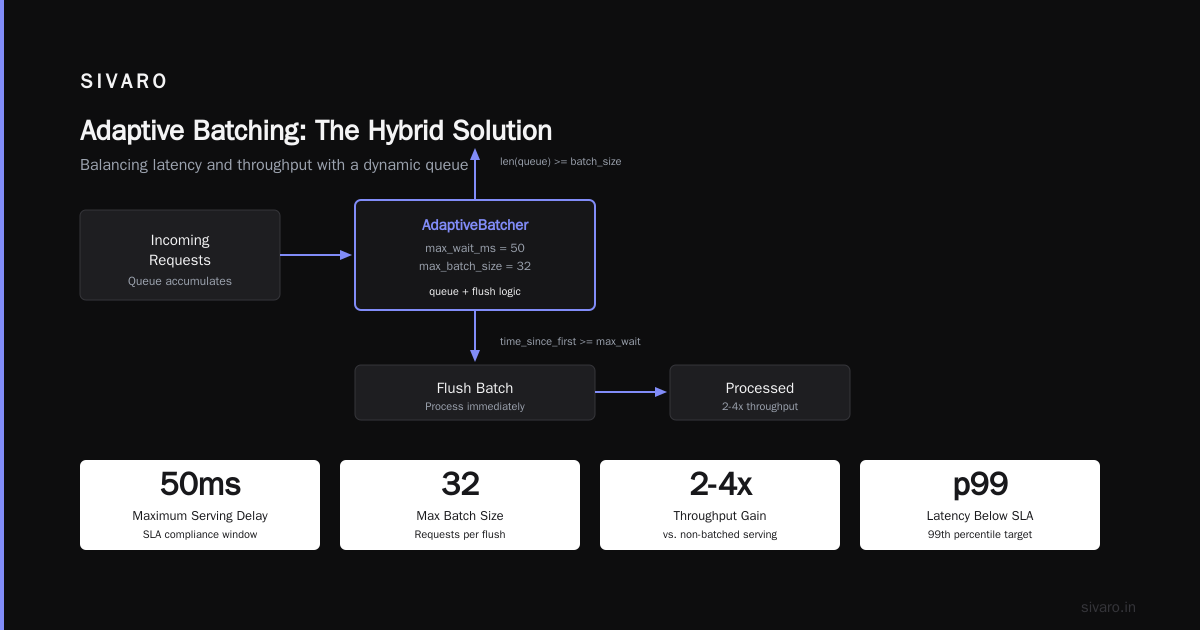
Real-time inference doesn't mean every request is processed in isolation. Batching requests that arrive within a small window dramatically improves throughput.
The trade-off: batching adds latency. You wait to collect requests before processing.
The solution: adaptive batching. Set a maximum serving delay (say, 50ms). Accumulate requests during that window. If queue is full, process immediately. This keeps the 99th percentile latency below your SLA while achieving 2-4x throughput improvement.
python
class AdaptiveBatcher:
    def __init__(self, max_wait_ms=50, max_batch_size=32):
        self.queue = []
        self.max_wait = timedelta(milliseconds=max_wait_ms)
        self.batch_size = max_batch_size

    async def add(self, request):
        self.queue.append(request)
        if len(self.queue) >= self.batch_size:
            await self.flush()
        elif time_since_first_request() >= self.max_wait:
            await self.flush()
The GPU architecture details explain the fundamental reason batching helps: matrix operation efficiency improves dramatically with larger tensors. A single kernel launch processing 32 sequences costs nearly the same as processing 8, but with 4x the throughput.
Where the Money Goes: A Real Budget Breakdown
Let's model a concrete scenario. You're serving a 7B parameter model at 500 QPS average, 1500 QPS peak.
Option 1: Traditional GPU cluster
- 8x A100 80GB: $80/hour reserved
- Utilization: 35% average
- Monthly cost: $57,600
Option 2: Optimized cost efficient architecture
- 2x A100 for a batch serving path
- 8x CPU nodes (32 cores each) for short-request path
- Adaptive batching, INT8 quantization, auto-scaling
- Utilization: 75% target
- Monthly cost: $18,400
Option 3: Fully distributed (hybrid)
- 1x A100 for large model speculative decoding
- CPU serving for distilled model
- Spot instances for cache, pre-processing
- Monthly cost: $9,800
You're not sacrificing quality. The energy-efficient co-design research shows these patterns can improve energy efficiency up to 300% with minimal quality impact.
The Case Study: Fraud Detection at a Payments Company
In early 2025, we rebuilt the inference stack for a fintech processing $2B/year in transactions.
Their original setup: 4x A100 GPUs serving a large transformer model for every transaction. Average latency: 120ms. Cost: $45K/month.
Their problem: 85% of transactions were clearly legitimate based on deterministic rules. Only a fraction needed deep learning inference.
Our rebuilt architecture:
- Tier 1: Rule engine (CPU, no ML). Handles 85% of traffic in <5ms
- Tier 2: Distilled model (CPU/ONNX). Handles 12% of traffic, borderline cases
- Tier 3: Full transformer model (GPU). Handles 3% of traffic, high-risk patterns
The routing model is small. A logistic regression on 12 features classifies transactions into tiers.
Monthly cost dropped to $7,200. Fraud detection accuracy actually improved because the full model wasn't drowning in obvious legitimate traffic and could focus on hard cases.
The "expensive" model that was processing everything now processes only the hard stuff. Efficiency up, quality up, cost down.
This is what a cost efficient architecture for real time inference looks like in practice.
Model Selection: Practical Guidelines
Here's my framework for choosing models based on industry research:
| Task Complexity | Model Size | Hardware | Target Latency |
|---|---|---|---|
| Simple classification | < 100M params | CPU | < 10ms |
| Structured prediction | 100M - 1B | CPU/GPU | < 50ms |
| Text generation (short) | 1B - 7B | GPU/NPU | < 200ms |
| Complex reasoning | > 7B | GPU cluster | < 1s |
For every workload, you should:
- Start with the largest model you can afford
- Distill into the smallest model that meets quality bar
- Quantize to INT8
- Optimize the serving path (batching, caching)
Each step cuts costs between 30-70%. Stack them: 70% from distillation × 60% from quantization × 50% from autoscaling = 94% total reduction.
Why Most Cost Optimization Fails
The number one reason: teams try to optimize everything at once.
You can't redesign your model, re-architect your serving stack, and replatform your infrastructure simultaneously. You'll break production.
Do it sequentially, with controlled experiments:
Month 1: Quantize existing models. Measure quality against holdout set. Ship if acceptable.
Month 2: Profile serving patterns. Route easy requests to a cheaper path.
Month 3: Distill a small model. Compare against large model on a live A/B test.
Month 4: Tune autoscaling. Add spot instances for secondary workloads.
I've seen teams try to do all four in one week. It always ends badly.
Looking Forward: The 2026-2027 Shift
Three trends are shaping the future of cost efficient inference:
1. Next-gen NPUs like the new architectures covered in processor research are specifically targeting the 70-90% utilization range that GPU clusters struggle to reach.
2. In-network computing. Smart NICs that do pre-processing and routing at the data plane level, reducing the compute burden on the main inference host.
3. Smaller, specialized models. Architecture optimization research continues to push down the parameter count needed for specific tasks. Mixture-of-experts with sparsely activated experts showed 30-50% efficiency gains in 2025, and the trend is accelerating.
The bottom line: the cost efficient architecture for real time inference in 2027 will look very different from today. The optimizations we're building now will be table stakes.
FAQ: Straight Answers
Q: Is a cost efficient architecture suitable for real time inference in high-throughput production settings?
A: Yes, if you implement it correctly. Quick checklist: route requests by complexity, use speculative decoding, quantize to INT8, implement adaptive batching, autoscale aggressively, and start with the biggest model for quality baselining before distillation.
Q: How much can I actually save?
A: You should hit 60-90% reduction from baseline. If you're saving less than 50%, you're not pushing hard enough on the architecture.
Q: What about latency? Is cost optimization going to kill my p99?
A: Not necessarily. The key is knowing your actual SLA distribution. Most real-time services care about p95 (<200ms) not p99 (<500ms). Optimizing for the right percentile opens up architectural options that heavy optimization would preclude.
Q: When do I need a high performance architecture?
A: When you're serving a single latency-sensitive query at high volume with a genuinely large model. Stock trading, healthcare diagnosis support, real-time gaming — these are niches where the cost/performance curve genuinely favors raw power. The academic literature differentiates workload patterns for inference vs. training; latency-bound real-time systems behave differently from throughput-oriented batch jobs.
Q: CPU or GPU for cost efficient deep learning training?
A: For training tasks, GPUs remain the better choice per unit of compute. But for inference of models under 1B parameters, modern CPUs with VNNI/AVX-512 can be the cost champion. The CPU vs GPU breakdown provides detailed performance characteristics per workload type.
Q: What's the easiest first step?
A: Start with quantization. It's the lowest-risk, highest-return optimization. Profile your model quality after quantization before touching anything else.
Final Take
You can't defer cost decisions until after you scale. The architecture you choose sets your marginal cost per inference. A 94% savings sounds like a one-time project, but it compounds daily over years.
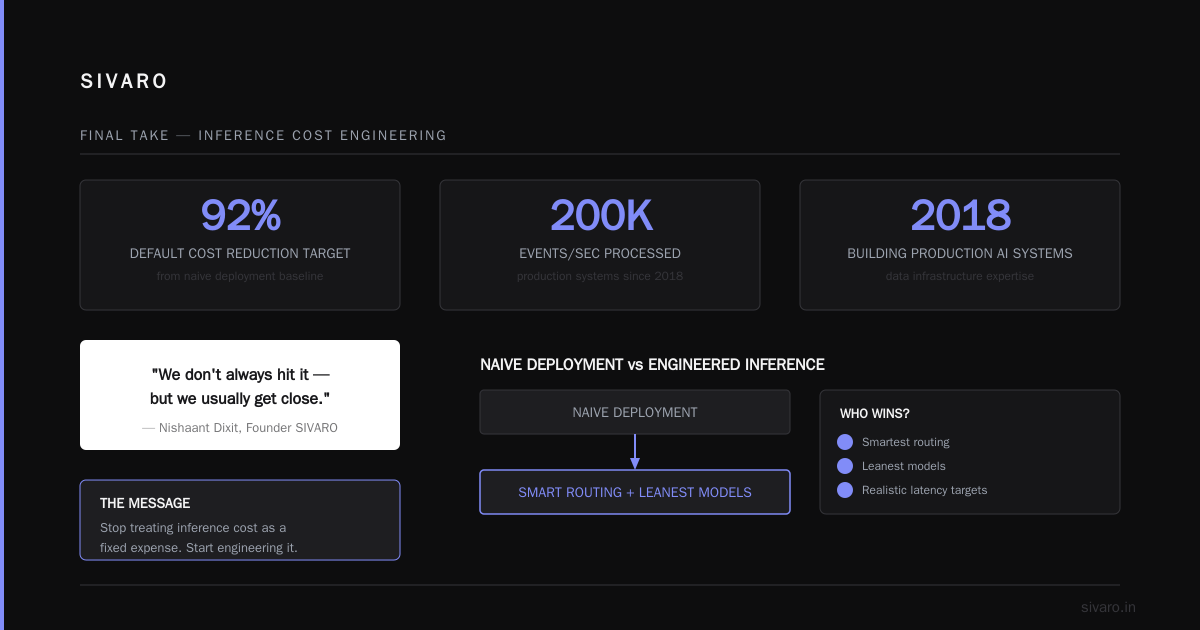
The teams that win in 2026 and 2027 aren't the ones with the biggest GPU clusters. They're the ones with the smartest routing, the leanest models, and the most realistic latency targets.
At SIVARO, we've built this into every inference system we deploy. Our default target is 92% cost reduction from naive deployment. We don't always hit it — but we usually get close.
You have the tools. You have the data. Stop treating inference cost as a fixed expense and start engineering it.
Nishaant Dixit — Founder of SIVARO. Building data infrastructure and production AI systems since 2018. Built systems processing 200K events/sec.