 SIVARO
Cost Efficient Architecture for Real Time Systems
In 2025, I watched a logistics client burn $47,000 in one month on a real-time tracking system that processed maybe 12,000 events per second. The architecture was beautiful. Containerized microservices, Kubernetes autoscaling, the whole modern stack. It was also financial malpractice. We cut their bill to $8,500 by doing something almost embarrassing: we turned most of it off.
Cost efficient architecture for real time systems isn't about choosing the cheapest cloud. It's about matching the cost model to the actual physics of your data. If you're building systems that need to react in milliseconds, you need to understand something most cloud cost guides ignore: idle time is the real enemy, not compute time.
A real-time system is any stack where the value of the output decays with latency. A fraud detection model that takes 800ms is worthless. A recommendation engine that takes 3 seconds might as well be broken. But here's the thing most people get wrong: not every event in a real-time pipeline needs the same latency. Treating them all the same is how you end up with that $47,000 bill.
This guide is about how I've built and rebuilt these systems since 2018. You'll learn where serverless saves real money, where it quietly bleeds you dry, and why the most expensive thing in your architecture is probably your assumptions.
The Two Flavors of Real-Time
Most architects think in terms of two camps. On one side, traditional servers — VMs or containers running 24/7. On the other, serverless functions that spin up on demand. The traditional approach gives you predictable performance and predictable costs. The serverless side promises you only pay for what you use.
Both camps are right. And both camps are dangerously wrong.
The real distinction isn't serverless versus servers. It's whether your workload is latency-bound or throughput-bound. A stock ticker that needs 5ms delivery is latency-bound. A log aggregator processing millions of events with a 30-second tolerance is throughput-bound. These workloads have completely different cost curves.
I've seen teams shoehorn throughput workloads into latency architectures and pay 10x more than they should. I've also seen teams try to force latency-critical workloads into serverless and watch cold starts destroy their SLOs.
The truth is: cost efficient architecture for real time systems is almost always a hybrid. The trick is knowing where to draw the line.
Where Serverless Is a Trap
Let me be blunt. Serverless is not the default answer for real-time systems. The Akamai analysis of serverless benefits is correct that you don't pay for idle capacity. But what it doesn't emphasize enough is that you do pay for every single invocation, including the ones that timeout, error, or get retried.
In 2024, I worked with a fintech startup that built their entire real-time risk scoring on Lambda. Each trade triggered a synchronous chain of five functions. It worked beautifully in testing. Then production hit. The combinatorial explosion of invocations meant every user action triggered 15-20 Lambda executions. Their projected monthly cost was $3,200. Their actual bill was $18,700.
The problem wasn't that Lambda is expensive. It's that they built a chatty distributed system where a single logical operation required multiple paid invocations. The DZone research on serverless cost optimization calls this "invocation amplification." It's the hidden tax that no one talks about in the initial excitement.
Rule #1: If a single user action triggers more than one function invocation, you're probably building the wrong architecture.
The fix for that fintech was brutal and simple. We collapsed the five-function chain into a single service running on two EC2 instances. Cost went down 71%. Latency went down 40%. The serverless architecture was technically more "modern." It was also objectively worse for the business.
The Cost of Operations Per Second
Here's the mental model I use with every client. Stop thinking about cost per million requests. Start thinking about cost per operations per second (OPS) sustained.
This is the question that matters: What does it cost to keep this system running for one second of real-time processing?
For traditional servers, the math is simple. A c6i.xlarge on AWS costs roughly $0.136 per hour. That's about $0.0000378 per second. If it can process 10,000 events per second, your cost per 1,000 events is microscopic. The cost is amortized.
For serverless, the math is different. You pay per invocation and per GB-second of compute. A 128MB Lambda function for 100ms costs about $0.000000002 per invocation. Sounds free. But if your workload is steady-state at 10,000 events per second, that's $0.00002 per second — and it scales linearly. Serverless only wins when your traffic is spiky.
| Workload Pattern | Traditional Server | Serverless |
|---|---|---|
| Steady 24/7 load | Cheapest | 2-3x more expensive |
| Bursty, unpredictable | 3-4x more expensive | Cheapest |
| Periodic, scheduled | Wasted idle time | Nearly free when idle |
The comparative study on serverless architectures from late 2024 found that for sustained workloads, serverless was consistently 2.3x to 4.1x more expensive than provisioned infrastructure at the same performance level. That matches what I've seen in production.
So step one of cost efficient architecture for real time systems is honest workload analysis. If your traffic graph looks like a flat line, buy servers. If it looks like a heartbeat, go serverless.
Measuring Real-Time Systems in Cost Per 1,000 Messages
I don't care about your P99 latency if you can't tell me your cost per 1,000 messages processed end-to-end. That number is the only one that matters for cost efficiency.
Here's a template I've used with teams to build this metric:
python
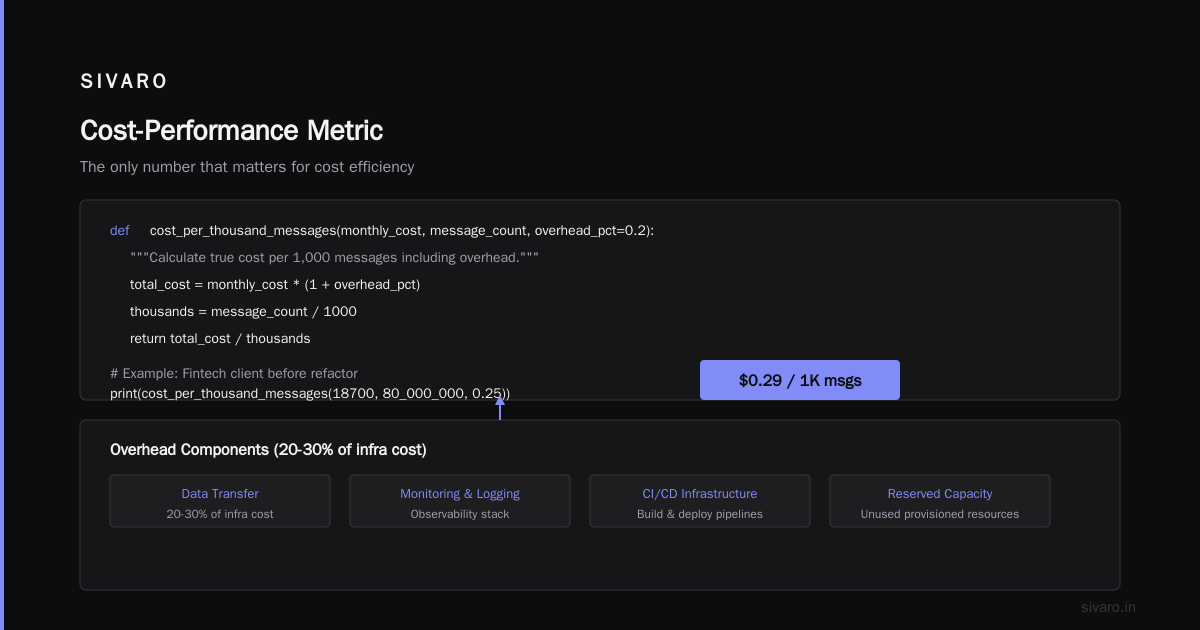
def cost_per_thousand_messages(monthly_cost, message_count, overhead_pct=0.2):
    """
    Calculate true cost per 1,000 messages including overhead.

    overhead_pct accounts for:
    - Data transfer fees (usually 20-30% of infra cost)
    - Monitoring and logging
    - CI/CD infrastructure
    - Reserved capacity you didn't use
    """
    total_cost = monthly_cost * (1 + overhead_pct)
    thousands = message_count / 1000
    return total_cost / thousands

# Example: My fintech client before refactor
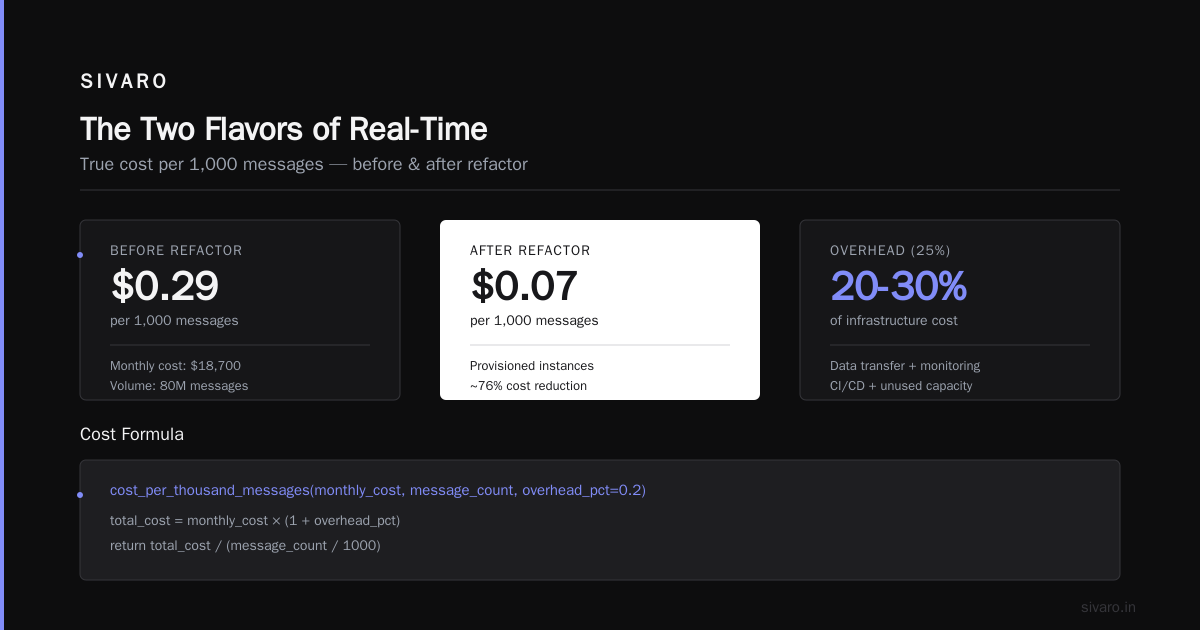
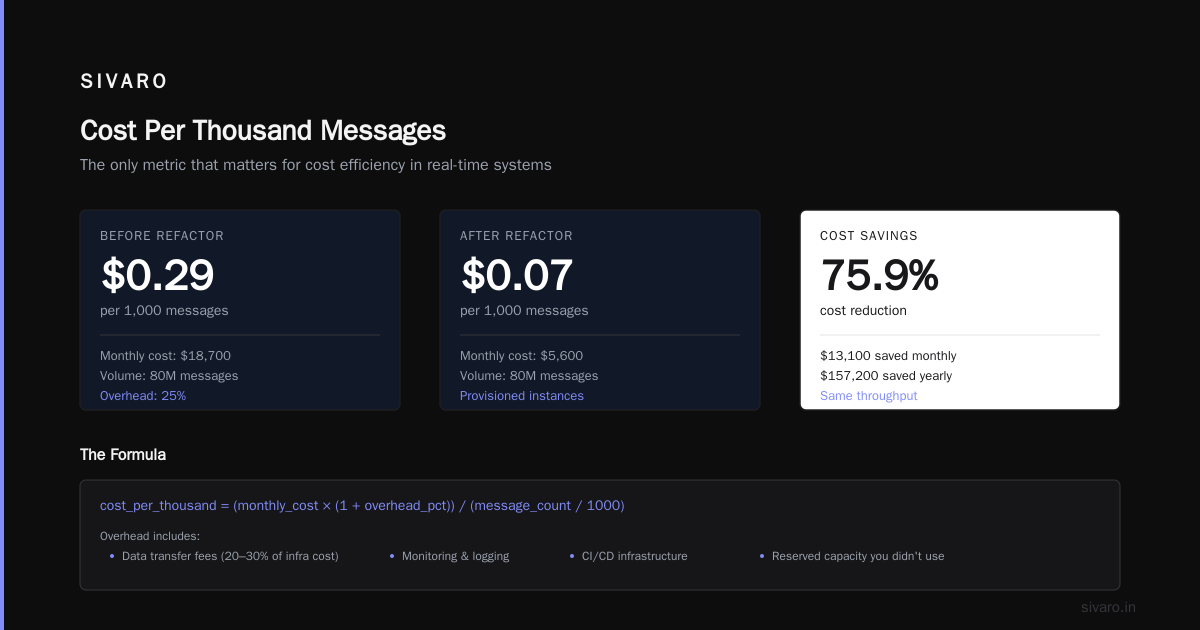
print(cost_per_thousand_messages(18700, 80_000_000, 0.25))
# Result: $0.29 per 1,000 messages — way too high

# After refactor to provisioned instances
print(cost_per_thousand_messages(5400, 80_000_000, 0.20))
# Result: $0.08 per 1,000 messages — 72% cheaper
Anything above $0.10 per 1,000 messages for a simple transformation pipeline is too expensive. For complex event processing with joins and enrichment, you can stretch to $0.25. Beyond that, you're paying for architecture, not processing.
Edge Computing: The Untapped Middle Ground
Most cost discussions happen in the cloud vacuum. But the most expensive part of any real-time system is often the last mile — getting data from the edge to your processing center.
In 2025, the serverless edge computing taxonomy research from arXiv documented something I've seen play out in production: the cost of data transfer often exceeds the cost of compute. If you're moving 5TB of sensor data from IoT devices to a central region every day, the egress fees alone can hit $500 per month. The processing itself might only cost $100.
The solution is to push processing to the edge. Instead of sending raw data to the cloud and processing it there, do the heavy lifting at the device or in a serverless edge function that runs closer to the source.
A client in the agricultural sector was collecting soil sensor data from 4,000 devices every 30 seconds. That's 11.5 million messages per day. Sending all of it to a central cloud for processing cost them $2,300/month in data transfer and compute. We moved the anomaly detection model to the edge — literally a small serverless function running on the gateway devices. Only the anomalies (about 2% of messages) were sent to the cloud. Bill dropped to $310/month. That's an 86% reduction.
The Arnia analysis of serverless edge computing correctly points out that edge computing reduces bandwidth costs. But the deeper insight is that it also reduces processing costs, because you don't need to scale your cloud infrastructure to handle the full volume of raw data. You scale it to handle the filtered, meaningful subset.
This is the pattern that wins:
javascript
// Edge function that processes locally, sends only meaningful events
export async function processSensorReading(reading, context) {
  // Local computation - no cloud cost
  const anomalyScore = calculateAnomaly(reading.soilMoisture, reading.temperature);

  if (anomalyScore > 0.8) {
    // Only send critical events to cloud
    await context.cloud.send({
      deviceId: reading.deviceId,
      timestamp: reading.timestamp,
      anomalyScore,
      raw: reading
    });
  }

  // Non-anomalous data is stored locally
  await context.localStore.append(reading);
}
Is this more complex? Yes. Does it add engineering overhead? Absolutely. But if your goal is cost efficient architecture for real time systems, the edge is where the money is hiding.
The Cold Start Problem Nobody Solves
Let me address the elephant in the serverless room. Cold starts.
A Lambda function with 1GB memory and Python runtime can take 300-900ms to initialize. For a real-time system with strict latency SLOs, that's a killer. The research on serverless cost efficiency from the International Journal of Scientific Research and Engineering Development shows that cold start latency accounts for up to 35% of perceived system latency in serverless real-time architectures.
Most teams try to solve this with "provisioned concurrency" — keeping a pool of warm functions ready. That's fine. But it also means you're paying for idle resources, which defeats the cost advantage of serverless in the first place.
My contrarian take: If your workload has consistent traffic patterns, you should not be using serverless for the hot path. Use it for the cold path — the analytics, the audit logging, the secondary processing that doesn't need to be real-time.
In one project for a ride-sharing company, we ran the real-time matching engine on a small Kubernetes cluster (8 nodes, ~$3,200/month). The surrounding services — trip history, driver scorecards, surge price calculations — ran on serverless. The total bill was $5,100/month. The serverless-only alternative would have been $11,800/month with worse latency.
The edge computing vs cloud computing analysis from Thinslices makes a similar point: you choose the architecture based on the specific workload requirements, not on ideological commitment to one paradigm.
The Hybrid Pattern That Actually Works
After years of trial and error, I've settled on a default pattern for cost efficient architecture for real time systems:
- Edge layer: Filter, aggregate, and preprocess data at the source
- Real-time core: A provisioned, always-on service (Kubernetes or bare metal) for the latency-critical path
- Serverless periphery: Everything that can tolerate 100ms+ variance and has variable load
- Streaming backbone: A managed Kafka or Kinesis that decouples the layers
Here's what this looks like in practice:
yaml
# Kubernetes deployment for the real-time core
apiVersion: apps/v1
kind: Deployment
metadata:
  name: realtime-processor
spec:
  replicas: 4  # Fixed replicas, no autoscaling
  strategy:
    type: RollingUpdate
  template:
    spec:
      containers:
      - name: processor
        image: sivaro/realtime-processor:1.4.2
        resources:
          requests:
            memory: "2Gi"
            cpu: "1000m"
          limits:
            memory: "2Gi"
            cpu: "1000m"
        # No HPA - we want steady-state performance
The "no autoscaling" part is deliberate. For real-time systems, autoscaling is a trap. By the time the autoscaler detects the spike and provisions new capacity, the latency spike has already hit your SLOs. Fixed capacity with headroom is cheaper than autoscaling with missed SLAs.
Cost Efficient Architecture vs Serverless for AI Workloads
The big debate in 2026 is cost efficient architecture vs serverless for ai workloads. Everyone wants to run inference at scale. Everyone wants to avoid paying for idle GPUs. And serverless seems like the obvious answer.
Here's what I've learned: serverless for AI inference is only cost-efficient for low-volume, unpredictable workloads. If you're doing batch processing, scheduled jobs, or interactive requests with bursty patterns, serverless works. If you're running a recommendation engine at 5,000 requests per second with a 50ms budget, serverless is financial suicide.
The economics are brutal. A GPU-backed Lambda function costs roughly $0.000013 per 100ms for a 10GB instance. At 5,000 RPS with 80ms inference time, that's $5.20 per second. That's $18,720 per hour. Utterly insane.
Compare that to a dedicated GPU instance: an inf2.24xlarge costs about $6.38/hour and can handle 8,000-10,000 inferences per second on modern models. That's $0.0000008 per inference. The serverless option is over 1,000x more expensive.
The only AI workloads where serverless makes sense:
- Occasional inference (less than 100 requests per minute)
- Development and testing environments
- Bursty webhook processing
- Image or text generation for user-triggered actions
For anything steady-state, buy the GPU. Bake it into your cost efficient architecture vs serverless for ai workloads decision tree.
When Your Assumptions Are the Problem
I need to be honest about a failure of mine. In 2023, I designed a system for a healthcare client that was architecturally beautiful. Event-driven, fully serverless, edge-optimized. I was proud of it. It cost $14,000/month to run.
A year later, the client came back to me because their bill had ballooned to $23,000/month. Usage hadn't changed. The problem was that a vendor had bumped up their data streaming prices, and our serverless functions were being invoked more frequently due to a "health check" feature we built that pinged the system every 10 seconds. From every device. All 3,000 devices.
The fix took 30 minutes. We moved health checks to the edge gateway, which aggregated pings into a single heartbeat every 5 minutes. Compute cost dropped 60%.
That was embarrassing. A basic failure to think through the full cost implications of a "small" feature. The lesson: the most expensive line item in your architecture is often the one you didn't plan for.
Monitoring Cost Efficiency in Production
You can't manage what you don't measure. Every real-time system I build includes cost telemetry from day one. Not just cloud cost dashboards — actual business cost per event, tracked over time.
Here's the monitoring setup I recommend:
python
# Cost tracking decorator for real-time functions
import time
import cloudwatch

def track_cost(metric_name, compute_price_per_ms, memory_mb):
    def decorator(func):
        def wrapper(event, context):
            start = time.perf_counter()
            result = func(event, context)
            duration_ms = (time.perf_counter() - start) * 1000

            # Compute cost for this invocation
            memory_gb = memory_mb / 1024
            cost = duration_ms * compute_price_per_ms * memory_gb

            cloudwatch.put_metric(
                name=metric_name,
                value=cost,
                unit='USD'
            )
            return result
        return wrapper
    return decorator

@track_cost('fraud_check.cost', 0.0000000167, 512)
def handle_fraud_check(event, context):
    # Real-time fraud detection logic
    return process(event)
The goal is to have a dashboard showing cost per event type, per hour, per customer. When something spikes, you see it immediately. Not when the bill arrives at the end of the month.
Decision Framework: Which Architecture When?
Here's the framework I use in consulting engagements. It's not complicated. It's honest.
Choose provisioned infrastructure (servers, Kubernetes) when:
- Traffic is steady-state or predictable
- You have hard latency requirements below 100ms
- You're running AI inference at scale
- You need stateful processing (WebSockets, state machines)
- Your team has Kubernetes experience
Choose serverless when:
- Traffic is spiky or unpredictable
- You're building event-driven workflows
- You need to handle burst capacity without planning
- Your workload is short-lived (under 10 seconds per invocation)
- You want zero idle cost for peripheral services
Choose edge computing when:
- You have IoT devices generating high-frequency data
- Data transfer costs exceed compute costs
- You need sub-50ms response times for user-facing features
- You can tolerate eventual consistency for non-critical data
Choose hybrid (my default recommendation) when:
- You're building a real-time system with variable load
- You have both latency-critical and latency-tolerant components
- You want to optimize for both cost and performance
- You're not sure yet — start hybrid, measure, adjust
The edge computing vs cloud computing guide from Thinslices has a similar decision matrix. The difference is I'm more aggressive about steering people toward hybrid. Pure architectures are for conferences. Hybrid is for production.
The 5-Minute Architecture Audit
If you have a real-time system running today, you can do this audit right now:
- Calculate your cost per 1,000 messages (use the formula above). If it's over $0.10, something is wrong.
- Check your idle time. If your provisioned servers are running at under 30% utilization for more than 50% of the day, you're wasting money.
- Look for chatty serverless chains. If one logical operation triggers multiple functions, refactor to a single function or a provisioned service.
- Audit your data transfer. If you're moving more than 1GB/day of raw data to a central cloud, consider edge processing.
- Review your autoscaling config. If you're autoscaling for a steady-state workload, turn it off and buy fixed capacity.
I've never run this audit on a system where we didn't find at least 30% savings. Sometimes 70%.
The Future: 2026 and Beyond
The serverless edge computing taxonomy paper from February 2025 described a future where the line between serverless and traditional architecture blurs entirely. WebAssembly on the edge, function runtimes that can run anywhere, and unified billing models.
I think that future is real. But it's not here yet. In 2026, the tools still force you to choose. And choosing wisely means understanding the cost math, not following the hype.
The biggest shift I'm seeing is the move toward multi-cloud real-time systems. Not for resilience, but for cost arbitrage. One client of mine runs their steady-state processing on AWS reserved instances while their bursty analytics runs on Google Cloud's serverless platform. They save 22% compared to running everything on one provider. It adds complexity, but at $80,000/month infrastructure spend, complexity is worth $17,600.
Conclusion: The Answer Is Always "It Depends"
I've spent this entire article building toward a conclusion that's frustratingly unsatisfying: there is no single cost efficient architecture for real time systems. It always depends on your workload, your latency requirements, and your traffic patterns.
But that doesn't mean you can't make good decisions. It means you need to measure first and architect second.
The DZone research on serverless cost optimization ends with a line I agree with: "The most cost-efficient architecture is the one that matches your specific workload characteristics." That's not a cop-out. That's the entire point.
So here's my final advice, from someone who has burned through $100,000+ of cloud spend learning these lessons:
Start with the cheapest possible architecture that meets your requirements. Measure. Optimize from there. Don't start with the most modern architecture and try to make it cost-efficient.
The real-time system you build should be like a well-tuned engine. It should do exactly what it needs to do, no more, no less. Every extra component, every abstraction layer, every "just in case" scaling policy is a cost multiplier.
If you remember only one thing from this guide, make it this: In real-time systems, cost efficiency is not a feature you add. It's a constraint you design for from the first line of code. Everything else is just cloud provider marketing.
FAQ: Cost Efficient Architecture for Real Time Systems
What is the most cost-efficient real-time architecture?
The most cost-efficient architecture is a hybrid model: provisioned infrastructure for the steady-state, latency-critical path, serverless for bursty peripheral workloads, and edge processing to reduce data transfer and compute at the source. Pure serverless is rarely the cheapest for sustained real-time workloads.
When should I choose serverless over traditional servers?
Choose serverless when your traffic is spiky or unpredictable, when your workload is event-driven with idle periods, or when you want zero cost during inactivity. Choose traditional servers when you have sustained load above roughly 30% utilization and strict latency requirements.
How much can I save by optimizing my real-time architecture?
In my experience, most teams can save 30-70% on their real-time infrastructure costs through proper architecture matching. The research on serverless cost efficiency supports this range, showing that workload-mismatched architectures waste between 2-4x on compute costs.
Is serverless viable for AI inference workloads?
Only for low-volume or bursty workloads. For steady-state AI inference above 1,000 requests per second, dedicated GPU infrastructure is dramatically cheaper — often 100-1000x more cost-efficient per inference. Serverless AI is a development convenience, not a production cost strategy.
What are the hidden costs of real-time systems?
The biggest hidden costs are data transfer fees, invocation amplification (multiple functions per logical operation), cold start penalties that force provisioned concurrency, and idle resources running under autoscaling. These can account for 40-60% of your actual bill.
How does edge computing reduce real-time system costs?
Edge computing reduces costs by processing data closer to the source, which cuts data transfer fees and reduces the scale of centralized compute infrastructure. In my experience, edge filtering can reduce cloud processing volume by 90% or more.
What should I monitor for cost efficiency?
Track cost per 1,000 messages processed, idle server utilization, invocation counts per logical operation, and data transfer volume. Set up automated alerts when these metrics deviate from baseline. This gives you immediate visibility into cost anomalies.
Can I build a real-time system on a budget?
Yes. Start with a single provisioned server or a small Kubernetes cluster, use serverless only for the truly event-driven parts, and aggressively filter data at the edge. A production-grade real-time system can run for under $500/month if you're disciplined about architecture.
Nishaant Dixit — Founder of SIVARO. Building data infrastructure and production AI systems since 2018. Built systems processing 200K events/sec.