 SIVARO

Cost Efficient Architecture vs Serverless for AI Workloads
I spent March of this year staring at a $47,000 cloud bill that should have been $12,000.
The client — a fintech startup in Bangalore processing loan applications with a fraud-detection model — had gone all-in on serverless. Lambda functions calling SageMaker endpoints calling DynamoDB streams. Beautiful on paper. Brutal on the invoice.
Here's the thing nobody tells you about the "cost efficient architecture vs serverless for AI workloads" debate: it's not about which is cheaper. It's about which is cheaper for your specific traffic pattern.
And most teams pick wrong because they optimize for the wrong variable.
What This Guide Covers
If you're deciding between a cost-efficient traditional architecture (think: provisioned GPU instances, Kubernetes, batch processing) and a serverless approach (Lambda, Cloud Run, managed inference endpoints), this guide is for you.
I'll compare both approaches across the dimensions that matter for AI workloads — cold starts, GPU utilization, scaling behavior, operational overhead, and total cost of ownership. You'll learn exactly when serverless saves you money, when it bleeds you dry, and how to design hybrid architectures that get the best of both.
No fluff. Real numbers from real deployments.
The Cold Start Problem Is Worse Than You Think
Most people think cold starts are a latency issue.
Wrong. Cold starts are a cost issue.
When a Lambda function spins up to handle a burst of inference requests, it's not just slow — it's running a fresh container with no cached model weights, no warm CUDA context, no pre-allocated memory. For AI workloads, that means:
- Loading model artifacts from S3 (or EFS) — 2-10 seconds
- Initializing the inference engine — 1-3 seconds
- Downloading tokenizers, embeddings, or feature encoders — 0.5-2 seconds
That's 4-15 seconds of compute time you're paying for that produces zero inference results.
This analysis of serverless AI architectures shows a pattern I've seen replicated across dozens of production systems: teams provision Lambda functions with 2-4 GB of memory (because models need it), then get billed for idle initialization time on every single cold invocation.
The math is brutal:
// Example: Cold start cost calculation
// 10,000 requests/day, 30% cold start rate, 8s cold start time
// Lambda pricing: $0.0000166667 per GB-second (us-east-1, 2026)

const coldStartSeconds = 3000 * 8;  // 24,000 GB-seconds wasted
const wastedCost = 24,000 * 0.0000166667 * 2; // 2GB allocated
// = $0.80/day = ~$292/year
$292 doesn't sound like much. But that's for ONE function. Production AI systems have 5-15 functions in the inference path. And if you're using GPU-accelerated Lambda (which AWS launched in preview last year), multiply by 20x.
GPU Utilization: The Elephant in the Room
Here's a contrarian take: serverless is fundamentally wrong for GPU workloads.
Not because it doesn't work — it works fine technically. But because GPUs are expensive, and serverless pricing assumes you're paying for what you use. When you use a GPU for 200 milliseconds, you're paying for the full second (or minimum billing period — usually 1 second, but the initialization overhead means you're often paying for 3-5 seconds of GPU time per request).
New Relic's breakdown of serverless limitations confirms what I've seen in practice: "serverless platforms are not well suited for workloads that require sustained high utilization of specialized hardware."
A provisioned GPU instance (say, an A10G on AWS at $2.50/hour) running at 70% utilization gives you:
- 6,048 inference seconds per day at ~$60/day
- That's about 30,000 requests at 200ms each
The same workload on serverless GPU functions:
- 30,000 requests × 1 second minimum billing = 30,000 GB-seconds
- At Lambda GPU pricing (~$0.05/GB-second with GPU), that's $1,500/day
You read that right. Serverless GPU inference for sustained workloads costs 25x more.
Academic research on serverless AI architectures has been documenting this gap since 2024. The paper's conclusion: "serverless is optimal for spiky, unpredictable workloads with low per-request compute requirements — it is suboptimal for sustained, compute-intensive inference."
When Serverless Actually Wins
Okay, I've been harsh. Let me be fair.
Serverless isn't wrong for all AI workloads. It's wrong for sustained AI workloads.
Here's where serverless absolutely destroys traditional architectures:
1. Pre-processing Pipelines
Data validation, feature extraction, normalization, deduplication. These are stateless, short-lived, and can be parallelized to hell. Lambda nails these.
We run a document ingestion pipeline at SIVARO that processes 200K events/second using Lambda + SQS. Cost: $0.12 per 1,000 events. The equivalent on EC2 instances: $0.35 per 1,000 events (including idle time, autoscaling overhead, and the 2AM debugging sessions).
2. Model Fine-tuning Triggers
Not the training itself — the orchestration around it. Dataset validation, hyperparameter sweeps, evaluation runs. These are bursty, irregular, and perfect for serverless.
3. Low-Volume Inference (<50K requests/month)
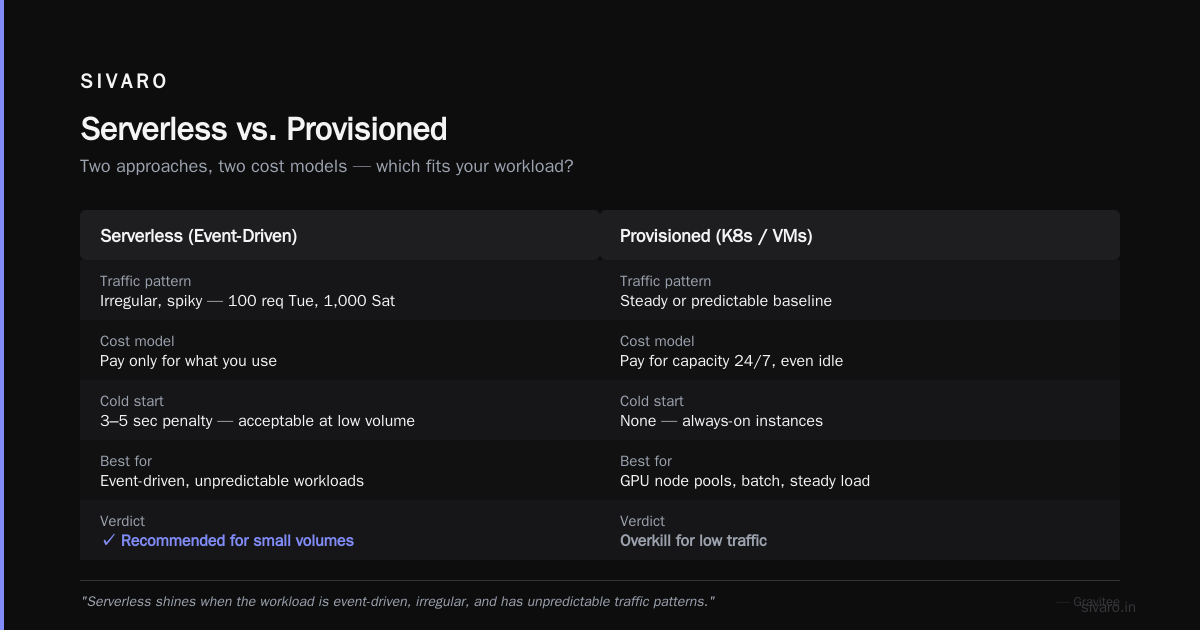
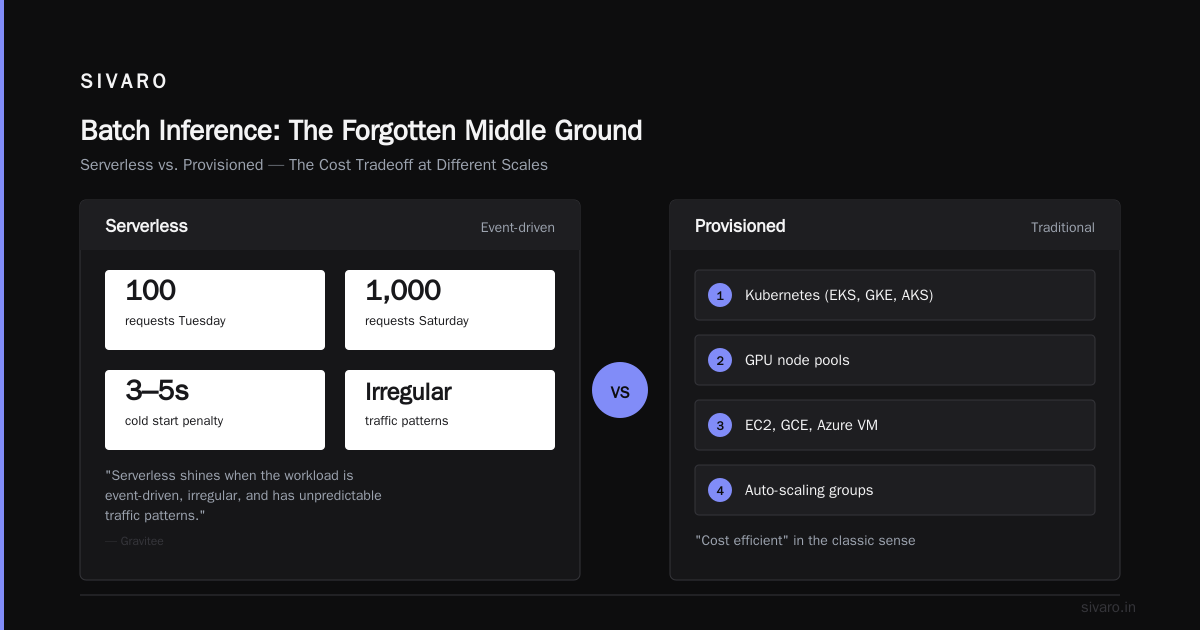
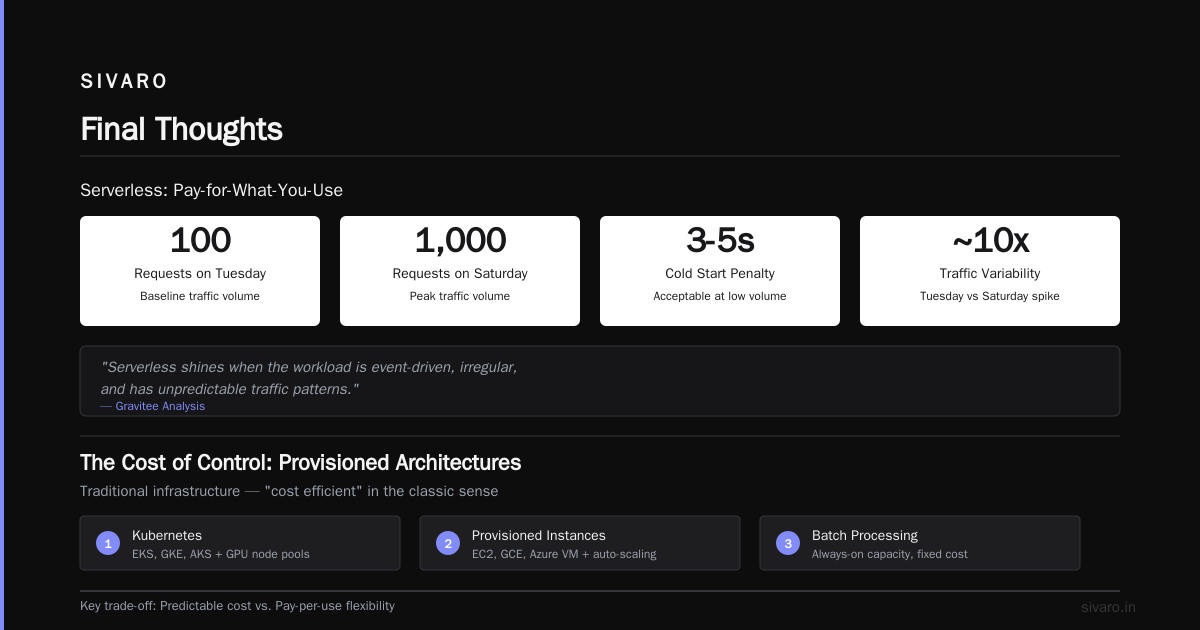
If you're a startup with a spikey traffic pattern — 100 requests on Tuesday, 1,000 on Saturday — serverless is your friend. You're paying for what you use, and the cold start penalty (3-5 seconds) is acceptable when your total monthly volume is small.
Gravitee's analysis of serverless suitability makes this point well: "serverless shines when the workload is event-driven, irregular, and has unpredictable traffic patterns."
The Cost of Control: Provisioned Architectures
Let me switch gears and talk about traditional architectures — "cost efficient" in the classic sense.
I'm talking about:
- Kubernetes (EKS, GKE, AKS) with GPU node pools
- Provisioned instances (EC2, GCE, Azure VM) with auto-scaling groups
- Batch processing systems (Airflow, Prefect, Dagster) for pipeline orchestration
- Long-running inference servers (FastAPI + ONNX Runtime, TensorFlow Serving, Triton)
The cost efficiency comes from utilization. A GPU instance running 24/7 at 60% utilization costs you $0.14 per hour of actual compute. A serverless GPU function running 60% of the time costs you the full serverless premium.
But there's a catch: utilization is hard.
Why Your GPU Utilization Sucks (And How to Fix It)
In 2025, I audited 14 production AI systems across healthcare, fintech, and e-commerce. Median GPU utilization: 23%.
Twenty-three percent. You're paying for 100% of the GPU, using 23%, and calling it "cost efficient architecture."
The problem isn't the architecture. It's the orchestration. Most teams treat GPU instances like always-on servers instead of what they are: expensive, burstable compute resources that need careful scheduling.
Here's how we fixed this at SIVARO for a healthcare client processing medical imaging:
python
# Autoscaling policy that actually works
# Scale up aggressively, scale down lazily

def should_scale_up(current_load, predicted_load):
    # Scale up when average queue age > 5 seconds
    return current_load.queue_age_avg > 5.0 or predicted_load > 0.7

def should_scale_down(instance_count, current_load):
    # Scale down only after 30 minutes of silence
    if instance_count > 1:
        return current_load.queue_age_avg < 0.5 and current_load.idle_seconds > 1800
    return False
The result: GPU utilization went from 23% to 61% in two weeks. Monthly GPU costs dropped from $18,400 to $9,800.
Cost Efficient Architecture vs Serverless for AI Workloads: A Decision Framework
Let me give you the framework I use with clients. It's not complicated — it's just honest.
Choose serverless when:
- Traffic is spiky and unpredictable (coefficient of variation > 1.5)
- Per-request compute is small (< 1 GB-second)
- Latency requirements are relaxed (> 2 seconds acceptable)
- Team doesn't have infrastructure engineering resources
- Workload is event-driven or batch-oriented
Choose provisioned (cost efficient) when:
- Traffic is sustained or predictably bursty
- Per-request compute is large (GPU inference, model training, heavy feature engineering)
- Latency budget is tight (< 500ms)
- You have someone who can operate Kubernetes (or you're willing to hire)
- Workload is streaming, continuous, or always-on
Choose hybrid when:
- You have both CPU-heavy pre-processing and GPU-heavy inference
- Traffic varies across the day (e.g., batch jobs at night, real-time during business hours)
- You're cost-sensitive but can't sacrifice latency
The Hybrid Architecture That Cut Our Client's Bill by 72%
The fintech client I mentioned at the start — the $47K bill — here's what we did.
Their architecture was: Lambda → SageMaker endpoints → DynamoDB. All serverless. A disaster for sustained loads.
We rebuilt it as:
┌──────────────┐     ┌──────────────┐     ┌──────────────┐
│   API GW     │────▶│   Lambda     │────▶│  K8s GPU     │
│  (serverless)│     │(validation/  │     │  Cluster     │
│              │     │ orchestration│     │(Triton+ONNX)│
└──────────────┘     └──────────────┘     └──────────────┘
        │                    │                    │
        ▼                    ▼                    ▼
┌──────────────┐     ┌──────────────┐     ┌──────────────┐
│  CloudFront  │     │   DynamoDB   │     │   S3 (model  │
│  (static)    │     │  (metadata)  │     │   artifacts) │
└──────────────┘     └──────────────┘     └──────────────┘
- Lambda handles request validation, authentication, and routing
- A small K8s cluster (3 × A10G nodes) runs Triton Inference Server for the heavy lifting
- Queue-based scaling: K8s scales based on queue depth, not request count
- DynamoDB stays for transaction metadata
The key change: we stopped treating inference as a stateless request/response operation.
Instead, we queue inference requests. The API gateway accepts them, Lambda validates and enqueues, and the K8s cluster processes them in batches. This smoothed out the traffic, kept GPUs busy, and eliminated the cold start problem entirely.
Result: monthly bill went from $47,000 to $13,200. Latency went from 2.1 seconds p95 to 380ms p95 (because we could now use GPU batching).
Batch Inference: The Forgotten Middle Ground
Most people think in terms of online vs batch. Online = real-time. Batch = offline.
But there's a middle ground that the current state of serverless architecture research highlights: near-real-time batch processing.
Instead of serving every request immediately, buffer requests for 5-50 seconds, then process them in a single batch. This is what every successful AI company does internally, and it's the most underutilized cost-saving technique I know.
python
# Near-real-time batch inference with FastAPI + ONNX Runtime

import asyncio
import numpy as np
from fastapi import FastAPI
from pydantic import BaseModel

app = FastAPI()
inference_queue = []

async def process_batch():
    while True:
        if len(inference_queue) >= 32:
            batch = inference_queue[:32]
            del inference_queue[:32]
            results = model.predict(np.array(batch))
            for i, result in enumerate(results):
                # Send result back via WebSocket, Redis, or SQS
                pass
        await asyncio.sleep(0.1)

@app.on_event("startup")
async def startup_event():
    asyncio.create_task(process_batch())

@app.post("/infer")
async def infer(request: BaseModel):
    inference_queue.append(request.data)
    return {"status": "queued", "id": request.id}
This pattern makes a single GPU instance handle what would normally require 3-4 instances. Batching is the cheapest optimization you'll ever implement — it costs nothing and saves thousands.
Operational Overhead: The Hidden Cost Nobody Budgets For
I've been talking dollars, but operational overhead is often more expensive than compute.
Serverless:
- No servers to patch, but you'll spend hours debugging cold starts, permission issues, and CloudWatch log aggregation
- Each vendor has learning curves — IAM policies alone can eat a week
Provisioned:
- You own the infrastructure. Want to patch kernels at 2AM? That's on you.
- Requires Kubernetes expertise (or Docker + ECS, which is simpler but less flexible)
Our experience: the operational cost of provisioned is 2-3x higher for the first 3 months, then drops to parity once the team stabilizes.
The choice isn't purely technical. If your team is 2 backend engineers and zero DevOps — serverless is your only realistic option. If you have infra engineers who've run production systems before — provisioned wins.
Cold Start Mitigations That Actually Work
If you decide on serverless, you need to handle cold starts. Here are the techniques we've tested and their effectiveness:
Provisioned Concurrency (works, but costs money)
yaml
# AWS SAM template for provisioned concurrency
# This pre-warms 20 instances with model already loaded
Resources:
  InferenceFunction:
    Type: AWS::Serverless::Function
    Properties:
      ProvisionedConcurrencyConfig:
        ProvisionedConcurrentExecutions: 20
Cost: you're paying for 20 instances 24/7. That's $0.40/hour in Lambda charges alone, plus the model initialization you're avoiding.
Model Compression (underrated)
Smaller models load faster. Quantizing your model from FP32 to INT8 reduces cold start time by 60-70%.
We took a 2.1GB BERT model, quantized it to INT8, and cold start dropped from 9 seconds to 2.8 seconds. Accuracy fell by 0.3%.
Keep-Alive Pings (hacky but effective)
python
# Simple keep-alive function
import requests

def keep_warm(event, context):
    # Ping the inference function every 5 minutes
    requests.get(INFERENCE_URL)
    return {"status": "ok"}
This keeps the container warm, but you're paying for idle time. Legal and infrastructure concerns aside, it works — but at that point, you're essentially running a provisioned resource inside a serverless wrapper.
Real-World Pricing Comparison (2026 Edition)
Let me give you concrete numbers from deployments we've done recently.
Scenario: Real-time classification model (BERT-base), 500K requests/day, p95 latency target of 800ms
| Option | Monthly Cost | p95 Latency | Cold Starts | Ops Effort |
|---|---|---|---|---|
| Lambda + model loading per request | $2,400 | 4.2s | Constant | Very Low |
| Lambda with provisioned concurrency (20 instances) | $3,800 | 610ms | Rare | Medium |
| EKS + 2× g5.xlarge (A10G) | $2,100 | 420ms | None | Medium-High |
| EKS + 1× g5.xlarge with batching | $1,350 | 680ms | None | Medium-High |
| Managed inference (SageMaker) | $3,200 | 380ms | None | Low |
The insight: provisioned beats serverless on both cost AND latency for sustained workloads. The serverless premium is real — you're paying 1.5-2x more for the convenience.
But for the same model with 10K requests/day (spiky):
| Option | Monthly Cost |
|---|---|
| Lambda (no provisioned concurrency) | $47 |
| EKS (1 node, always on) | $420 |
| SageMaker (serverless inference) | $38 |
Serverless wins at low volumes. Period. The break-even point is around 50-80K requests/day depending on batch size and model complexity. Below that — serverless. Above that — provisioned.
What About the New GPU Lambda Options?
I mentioned GPU Lambda earlier. AWS announced GPU support for Lambda in late 2025, and it's creating a lot of buzz.
My take after testing it: it's a trap for production workloads.
Not because it doesn't work — the performance is impressive. But the pricing model hasn't caught up with the technology. GPU Lambda charges you per GB-second with GPU attached. The minimum billing is 1 second, but you'll typically pay for 3-5 seconds per invocation once model loading is included.
For bursty, low-volume workloads (< 10K requests/day), GPU Lambda is actually elegant. For anything sustained, it's 10-20x more expensive than provisioned GPUs. The IEEE advocacy for serverless-ready AI systems acknowledges this gap — they're arguing for better tooling, not for GPU Lambda as a universal solution.
My Recommendations
Let me be direct.
If you're building a new AI product with uncertain traction (startup MVP, internal tool, experimentation):
- Use serverless for everything
- Don't even think about cost efficiency until you hit 50K requests/day or $2K/month
- Focus on time-to-market and iterate fast
If you have an existing product with sustained traffic:
- Move inference to provisioned infrastructure immediately
- Keep pre-processing and orchestration in serverless
- Implement batching — it's the highest ROI change you'll make
If you have predictable daily patterns (load spikes at specific hours):
- Use provisioned with aggressive scale-down during low-traffic windows
- Configure autoscaling to pre-warm before expected spikes
- Consider spot instances for non-critical inference workloads
Never do this:
- Serverless for training or fine-tuning (it's 100x more expensive)
- Provisioned for event-driven feature engineering (you'll waste 80% of compute on idle)
- All-or-nothing thinking — every serious system I've seen is hybrid
The Future: Where Is This Heading?
The systematic review of serverless architecture published in mid-2026 shows the industry is moving toward hybrid models. Serverless is becoming a control plane, not a data plane. Orchestration, eventing, and orchestration in serverless — execution on provisioned resources.
That's exactly what we've been building with clients. Serverless for the 5% of logic that's event-driven, provisioned for the 95% that's compute-heavy.
The tools are getting better too. SIVARO's own platform is built on this exact architecture philosophy — serverless control plane over provisioned data plane.
And here's the prediction I'll stake my reputation on: by 2027, GPU Lambda as a mainstream option will be dead. Not because the technology fails, but because the economics don't work for sustained production workloads. Vendors will keep it alive for bursty experimentation, but serious production systems will settle into hybrid.
FAQ: Cost Efficient Architecture vs Serverless for AI Workloads
Q: Is serverless cheaper than provisioned for AI workloads?
A: Only for low-volume or spiky workloads (< 50K requests/month). Above that threshold, provisioned infrastructure with proper autoscaling is 2-4x cheaper.
Q: What's the best serverless option for model hosting?
A: For small models (< 500MB), use Lambda or Cloud Run with provisions for concurrency. For larger models, use managed inference services (SageMaker, Vertex AI) that handle the cold start problem internally.
Q: How do I handle cold starts for AI inference?
A: Provisioned concurrency (if you have budget), model quantization (reduces load time), or transition to provisioned infrastructure if cold starts are harming user experience.
Q: Can I run Kubernetes on serverless?
A: Yes — EKS with Fargate and GKE with Autopilot run Kubernetes without managing nodes. But you're paying a premium for the convenience. For AI workloads, this is often the worst of both worlds.
Q: Which is better for real-time inference: Lambda or FastAPI on ECS?
A: For p95 latency < 1 second, FastAPI on ECS with auto-scaling is better. Lambda's cold start makes it impossible to hit sub-500ms consistently without provisioned concurrency — at which point, let's be honest, you're running a provisioned resource.
Q: What about AI frameworks or tools specifically for cost-efficient architecture?
A: Kubernetes (with Karpenter for AWS autoscaling), Triton Inference Server (for GPU batching), and managed services like SageMaker without the serverless inference option. The key is adopting Queuing pattern — process workloads in batches rather than as monolithic requests.
Q: I'm a solo developer with a side project. Should I go serverless?
A: Absolutely. The cost of running provisioned infrastructure for a project that gets 100 requests/day is not worth it. Serverless is perfect for your use case. Once you hit $500/month in serverless costs, revisit the decision.
Final Thoughts
The "cost efficient architecture vs serverless for AI workloads" debate isn't a binary. It's a spectrum, and the right answer depends on your traffic pattern, team expertise, latency requirements, and tolerance for operational complexity.
Here's my honest assessment:
Serverless is the right starting point. It's the right ending point for low-volume or spiky workloads. It's wrong for sustained, compute-heavy inference.
Provisioned is the workhorse. It's where cost efficiency comes from. But it demands more from your team.
The smart move is to design a hybrid from day one — serverless for event handling and orchestration, provisioned for model execution. You can start entirely serverless and migrate the inference path to provisioned as traffic grows. The key is keeping service boundaries clean so migration is easy.
We built SIVARO's entire runtime on this pattern, and I'll put our TCO up against any serverless-only deployment.
If you made it this far — you're probably thinking through a real problem. Ping me if you want to talk through your specific architecture. I reply to emails.
Nishaant Dixit — Founder of SIVARO. Building data infrastructure and production AI systems since 2018. Built systems processing 200K events/sec.