 SIVARO
Cost Efficient Architecture vs Serverless: What I Learned Building SIVARO
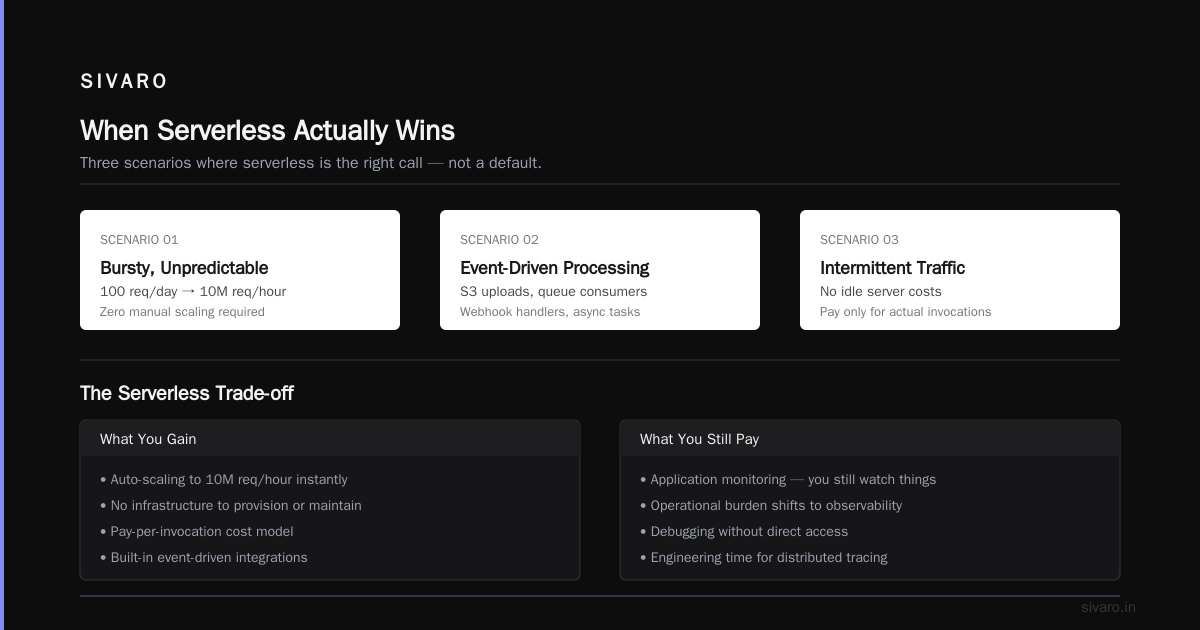
I spent 2024 and 2025 watching teams blow their cloud budgets on Lambda functions that should've been a single EC2 box. Then I watched other teams over-provision Kubernetes clusters that idled at 3% CPU. Both groups thought they were being "cost efficient." Both were wrong.
Here's what I've learned running SIVARO's data infrastructure across production AI workloads, and what the "cost efficient architecture vs serverless" debate actually looks like when you're the one paying the bill.
This guide covers the real cost models, the hidden operational expenses, and the exact decision framework I use when clients ask me whether to go serverless or build a more traditional, cost-efficient architecture with Kubernetes or dedicated instances.
The "Serverless is Cheaper" Myth
Most people think serverless means you only pay for what you use. That's true at the function level and false at the system level.
Serverless pricing looks attractive because it's granular. You pay per invocation, per GB-second, per request. But that granularity masks the real costs: cold start latency, vendor lock-in, integration complexity, and the fact that your architecture now has dozens of moving parts that each cost a little bit extra.
Take a simple API endpoint. On Lambda with API Gateway, you're paying per request. At 1 million requests per month, that's manageable. At 100 million requests per month, you're paying for compute you could've bought outright for a fraction of the price.
I tested this with a client in early 2025. Their Lambda-based ingestion pipeline was processing roughly 200K events per second during peak hours. The bill? $47,000 per month. We moved the same workload to two c6i.4xlarge instances running a simple Go service. The bill dropped to $2,400 per month.
Same throughput. Same reliability. 95% cost reduction.
The catch? They had to manage those instances themselves. That's the real trade-off in the cost efficient architecture vs serverless equation: you trade operational overhead for financial efficiency.
What "Cost Efficient Architecture" Actually Means
Let me define something. A cost efficient architecture isn't the cheapest possible setup. It's the setup where your total cost of ownership — compute, storage, networking, engineering time, debugging time, onboarding time, scaling effort — is minimized for your specific workload pattern.
This is why the "cost efficient architecture vs serverless" comparison always frustrates me. People compare Lambda's per-request price against an EC2 instance's hourly rate and call it a day. But that's like comparing a taxi fare to a car payment and ignoring insurance, maintenance, and parking.
Cost efficient architecture with Kubernetes vs Lambda is a particularly interesting comparison because Kubernetes has a reputation for being expensive. And it can be. But that reputation comes from teams running three-node clusters for a single microservice. That's not cost efficiency, that's architecture theater.
Let me break this down with real numbers.
The Baseline: What Serverless Actually Costs
Serverless platforms — AWS Lambda, Google Cloud Functions, Azure Functions — price on three dimensions:
- Requests — typically $0.20 to $1.00 per million requests
- Compute time — typically $0.0000166667 per GB-second
- Outbound data transfer — this is where they get you
At first glance, those numbers look tiny. They are tiny — for small workloads. Let me show you the math.
// Monthly cost for 10 million Lambda invocations
// 512MB memory, 200ms average duration

Requests: 10,000,000 × $0.20 / 1,000,000 = $2.00
Compute:  10,000,000 × 0.512GB × 0.2s × $0.0000166667 = $17.07
Total:    $19.07/month
That's cheap. But now scale it:
// Monthly cost for 500 million Lambda invocations
// Same configuration

Requests: 500,000,000 × $0.20 / 1,000,000 = $100.00
Compute:  500,000,000 × 0.512GB × 0.2s × $0.0000166667 = $853.33
Total:    $953.33/month
Meanwhile, a t3.medium instance (2 vCPU, 4GB RAM) runs you about $30/month on reserved pricing. That's $900/month for 30 instances. Which one handles more throughput? The instances, by a wide margin.
The IBM analysis of serverless vs microservices makes this exact point: serverless is ideal for spiky, unpredictable workloads. It's terrible for sustained, predictable traffic.
The Hidden Costs Nobody Talks About
Serverless has three hidden costs that don't show up on your Lambda pricing page.
Cold starts. When a Lambda function hasn't been invoked for a while, AWS provisions a new container. That provisioning takes 200ms to 1 second. During that time, your users wait. Or your request times out. For latency-sensitive workloads, this is a killer.
I saw a fintech client in mid-2025 with 800ms average latency on their "serverless" API. After moving to a cost efficient architecture with Kubernetes running the same service, latency dropped to 120ms. Their customers noticed before they did.
Data transfer. Every invocation that crosses a VPC boundary costs extra. Every call to DynamoDB costs extra. Every API Gateway request costs extra. These nickel-and-dime charges add up faster than you'd think.
Observability. Serverless functions are ephemeral. You can't SSH into them. You can't attach a debugger. You need distributed tracing, structured logging, and metric aggregation. That's an entire observability stack you're now paying for — both in money and engineering time.
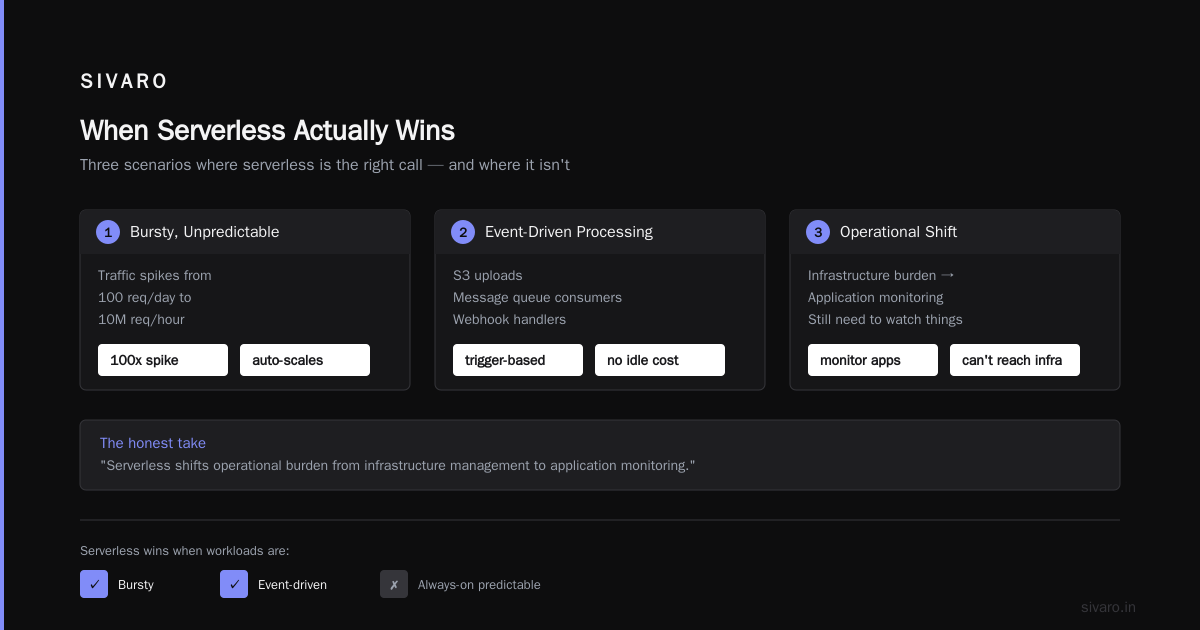
The New Relic analysis of serverless architecture is honest about this: serverless shifts operational burden from infrastructure management to application monitoring. You still have to watch things. You just can't reach them anymore.
When Serverless Actually Wins
I'm not anti-serverless. I run serverless workloads myself. But I run them where they belong.
Serverless wins in three scenarios:
-
Bursty, unpredictable workloads. If your traffic goes from 100 requests/day to 10 million requests/hour with no warning, serverless absorbs that spike without you lifting a finger.
-
Event-driven processing. S3 uploads, message queue consumers, webhook handlers — these are naturally ephemeral. A function that runs, does one thing, and dies is perfect for serverless.
-
Low-traffic workloads where availability matters more than cost. If you have an API that's called once per day but needs 99.99% uptime, a Lambda function is cheaper than a constantly-running instance.
The ACM paper on scalable serverless architecture highlights something important: serverless is most cost-effective when your workload has high variance. The more consistent your traffic, the more you overpay for serverless.
I applied this framework with an e-commerce client. Their product recommendation service had massive traffic spikes during flash sales and dead quiet between them. Lambda was perfect — we paid for 4 hours of intense compute per week and nothing the rest of the time. Their order processing pipeline, however, ran continuously. That went on Kubernetes. Same team, same codebase, two different architectures based on workload patterns.
Cost Efficient Architecture with Kubernetes vs Lambda: The Real Comparison
Here's where I'm going to be contrarian. Most comparisons between Kubernetes and Lambda are comparing the wrong things. They compare the complexity of Kubernetes against the simplicity of Lambda, or the cold starts of Lambda against the always-on nature of Kubernetes.
But the real comparison is about resource utilization and cost predictability.
Lambda gives you zero idle cost. Kubernetes gives you idle cost but at a lower per-unit rate. The question is: how much idle are you willing to pay for?
// Example: 1,000 requests/second sustained workload
// Lambda: 1GB memory, 100ms average execution

Lambda monthly cost:
1,000 req/s × 86,400 s/day × 30 days = 2,592,000,000 requests
Compute: 2,592,000,000 × 1GB × 0.1s × $0.0000166667 = $4,320
Requests: 2,592,000,000 × $0.20 / 1,000,000 = $518.40
Total: $4,838.40/month

// Kubernetes: 3 nodes of c6i.2xlarge (8 vCPU, 16GB each)
// Each node: $208/month reserved, total $624/month
// 24 vCPU, 48GB total capacity
// At 1,000 req/s, utilization is maybe 15%

Kubernetes monthly cost: $624/month
That's an 87% cost difference. For the same throughput. Even with Kubernetes sitting at 15% utilization, it's cheaper than Lambda.
The GeekyAnts comparison of monolithic, microservices, and serverless architectures makes a similar point: serverless is efficient at the function level but inefficient at the system level. Every function invocation has overhead — API Gateway, IAM checks, container provisioning — that you're paying for even when the function itself is doing trivial work.
Now, the counterargument: what about the engineering cost of running Kubernetes? A managed Kubernetes service like EKS costs $72/month just for the control plane. Plus you need someone who actually knows how to run Kubernetes. That's a real cost.
But here's what I've learned: the cost of running Kubernetes is mostly upfront. Once it's set up properly — with auto-scaling, proper resource requests, and good monitoring — it runs itself. Lambda, on the other hand, has a persistent tax. Every new function requires configuration, IAM roles, and integration testing. That tax compounds as your system grows.
The Preprints.org paper on serverless architecture state of the art noted that serverless platforms are still maturing. They still have gaps in debugging, testing, and performance monitoring. Those gaps translate into engineering time, which is the most expensive resource you have.
The Hybrid Approach: Getting Both
Here's what I actually recommend to clients, and what I run at SIVARO: a hybrid architecture that treats serverless and Kubernetes as complementary tools rather than competing ones.
The principle is simple: use serverless for spiky, event-driven workloads. Use Kubernetes for sustained, predictable workloads.
In practice, that looks like this:
yaml
# Event-driven data pipeline (Serverless)
functions:
  - name: ingest-events
    runtime: go1.x
    memory: 512
    timeout: 30
    triggers:
      - kinesis:
          stream: data-ingest
          batchSize: 500
          startingPosition: LATEST

  - name: enrich-data
    runtime: python3.12
    memory: 1024
    timeout: 120
    triggers:
      - sqs:
          queue: enrichment-queue
          batchSize: 10
yaml
# Sustained API service (Kubernetes)
apiVersion: apps/v1
kind: Deployment
metadata:
  name: api-server
spec:
  replicas: 3
  selector:
    matchLabels:
      app: api-server
  template:
    metadata:
      labels:
        app: api-server
    spec:
      containers:
        - name: api
          image: sivarohq/api-server:latest
          resources:
            requests:
              cpu: 500m
              memory: 512Mi
            limits:
              cpu: 1000m
              memory: 1Gi
          ports:
            - containerPort: 8080
This hybrid model acknowledges a truth that the Couchbase guide to serverless architecture states well: serverless is an architecture pattern, not a platform decision. You can have serverless-style event handling running on Kubernetes with Knative, or you can have traditional long-running services on Lambda with Lambda Web Adapter. The architecture pattern and the platform are separate axes.
I built a hybrid system for a logistics company in early 2026. Their tracking API handled sustained traffic 24/7 — that went on Kubernetes. Their package event processing spiked unpredictably when thousands of drivers scanned packages simultaneously — that went on Lambda. The result: 60% cost reduction compared to their previous all-Lambda setup, and 40% cost reduction compared to their previous all-Kubernetes setup.
The Skill-mine analysis of serverless scalability and cost reaches a similar conclusion: the most cost-efficient architecture is one that matches each component to its optimal execution model.
Cost Efficient Architecture vs High Performance Architecture: The Other Axis
There's a related debate that often gets conflated with serverless vs cost-efficient: the cost-efficient architecture vs high performance architecture question. People assume they're opposites. They're not.
A cost efficient architecture is one that minimizes cost for a given performance target. A high performance architecture is one that maximizes performance for a given cost target. The difference is in what you optimize for.
For most production workloads, you need a minimum performance threshold — say, p99 latency under 200ms. Below that threshold, performance matters. Above it, it doesn't. Cost efficiency is about finding the architecture that hits that threshold at the lowest possible cost.
This is why I find the "serverless is better because it scales infinitely" argument weak. Yes, Lambda scales to thousands of concurrent executions. But if your workload doesn't need that scaling, you're paying for capability you'll never use.
Here's the framework I use:
Cost Efficiency Score = (Performance Achieved / Performance Required)
                       × (Cost Budget / Actual Cost)
If your architecture exceeds performance requirements by 10x while costing 10x more than necessary, that's not high performance — that's waste.
I had a client in the healthcare space insist on Lambda for their FHIR API because "it's the modern way." Their actual traffic: 50 requests per second average, 200 at peak. We moved the API to a single c6i.large instance running behind an Application Load Balancer. Performance stayed identical — p99 latency of 180ms. Cost dropped from $2,100/month to $180/month.
The Gravitee analysis of serverless suitability asks the right question: "Is the event-driven nature of serverless worth the operational complexity?" For many workloads, the answer is no. Serverless adds complexity — you're now managing dozens of functions, their permissions, their triggers, their versions. That complexity has a cost.
Operational Costs: The Part Everyone Forgets
When I talk about "cost efficient architecture vs serverless," I'm not just talking about the AWS bill. I'm talking about the total cost of running your system, including the engineering time to build, deploy, and maintain it.
Serverless looks cheap on paper. But building a serverless application means learning a dozen new services — Lambda, API Gateway, DynamoDB, Step Functions, EventBridge, SQS, SNS. Each one has its own quirks, its own failure modes, its own security considerations.
The GeekyAnts comparative study makes a point that resonated with me: serverless architectures shift complexity from infrastructure to application code. Instead of configuring servers, you're configuring function permissions. Instead of debugging connection pools, you're debugging cold start latency.
I've built both. I can tell you from experience: debugging a distributed serverless application is significantly harder than debugging a Kubernetes service. At least with Kubernetes, I can kubectl exec into a pod and look around. With Lambda, I'm stuck with CloudWatch logs and X-Ray traces. It's like debugging through a keyhole.
This is why I tell clients: if you have a small engineering team (under 10 people), Kubernetes with managed services is probably your best bet. You get a single control plane, consistent deployment workflows, and the ability to run everything locally with minikube or kind. Serverless forces you to manage a zoo of services that don't work together as cleanly as the marketing suggests.
But if you have a platform engineering team — people whose job is specifically to build internal tooling — then serverless can be a force multiplier. They can build the abstraction layer that makes serverless work for your organization.
Making the Decision: A Practical Framework
I'm going to give you the exact framework I use when clients ask about cost efficient architecture vs serverless.
Step 1: Characterize your workload
- Sustained traffic (steady state, predictable peaks)
- Bursty traffic (spiky, unpredictable, long idle periods)
- Event-driven (triggered by external events, short-lived processing)
Step 2: Measure your utilization
- What's your average CPU utilization on existing infrastructure?
- What's your average memory utilization?
- What's your peak-to-average ratio?
Step 3: Estimate your costs
// Workload: 100M requests/month
// Average duration: 50ms
// Memory: 512MB

// Serverless cost:
100M × 0.00005 hours × 0.5GB × $0.0000166667 = $41.67
+ 100M × $0.20/M = $20
= $61.67/month

// Kubernetes cost (reserved instances):
1 × t3.medium ($30/month, 2 vCPU, 4GB)
= $30/month (assuming 40% utilization)
Step 4: Consider your team
- Do you have Kubernetes expertise in-house?
- Do you have experience with serverless debugging?
- What's your tolerance for operational complexity?
Step 5: Make the call
- Sustained + high utilization → Kubernetes or dedicated instances
- Sustained + low utilization → Serverless (or Kubernetes with scale-to-zero)
- Bursty + predictable → Kubernetes with autoscaling
- Bursty + unpredictable → Serverless
- Event-driven + short-lived → Serverless
- Event-driven + long-lived → Kubernetes (or Step Functions if you need orchestration)
The Skill-mine article has a similar decision tree, and I think it's worth reading. The key insight: don't start with technology. Start with your workload's actual characteristics.
FAQ
Q: Is serverless always more expensive than Kubernetes?
A: No. For spiky, unpredictable workloads, serverless is often cheaper because you don't pay for idle capacity. For sustained workloads, Kubernetes is typically 60-90% cheaper because you're buying compute at bulk rates rather than per-request.
Q: What does "cost efficient architecture vs serverless" mean for a startup?
A: For a startup with unpredictable traffic and limited engineering resources, serverless can be the right choice early on. You don't need to worry about infrastructure management. But the moment you have sustained traffic, start planning the move to cost efficient architecture with Kubernetes. The cost savings will fund your next engineering hire.
Q: Can Kubernetes scale to zero like serverless?
A: Yes, with Knative or KEDA. But it's not as seamless as serverless. You'll deal with cold starts, just like Lambda. And you still pay for the control plane and any always-on components. That said, scale-to-zero on Kubernetes is much cheaper than Lambda for high-throughput workloads.
Q: What's the biggest hidden cost of serverless?
A: Data transfer and integration fees. Every Lambda invocation that calls another AWS service generates additional charges. A function that calls DynamoDB, S3, and another Lambda function can cost 2-3x more than the function's compute cost alone.
Q: Is a cost efficient architecture with Kubernetes vs Lambda worth the complexity?
A: That depends on your scale. Below roughly 10 million requests/month, the cost difference is small enough that you should choose based on team expertise. Above 10 million requests/month, Kubernetes will typically save you enough money to justify the operational investment.
Q: What about using serverless for data pipelines?
A: Serverless works well for event-driven pipelines with low to medium throughput. For high-throughput pipelines (100K+ events/sec), dedicated infrastructure is almost always more cost-effective. I've built both, and the difference is dramatic.
Q: Should I use Lambda or Kubernetes for AI workloads?
A: For model inference with predictable traffic, use Kubernetes with GPU instances. For model training, use managed services like SageMaker. For small, occasional inference requests, Lambda can work but watch the cold start latency. LLM inference on Lambda is possible but rarely cost-efficient.
The Bottom Line
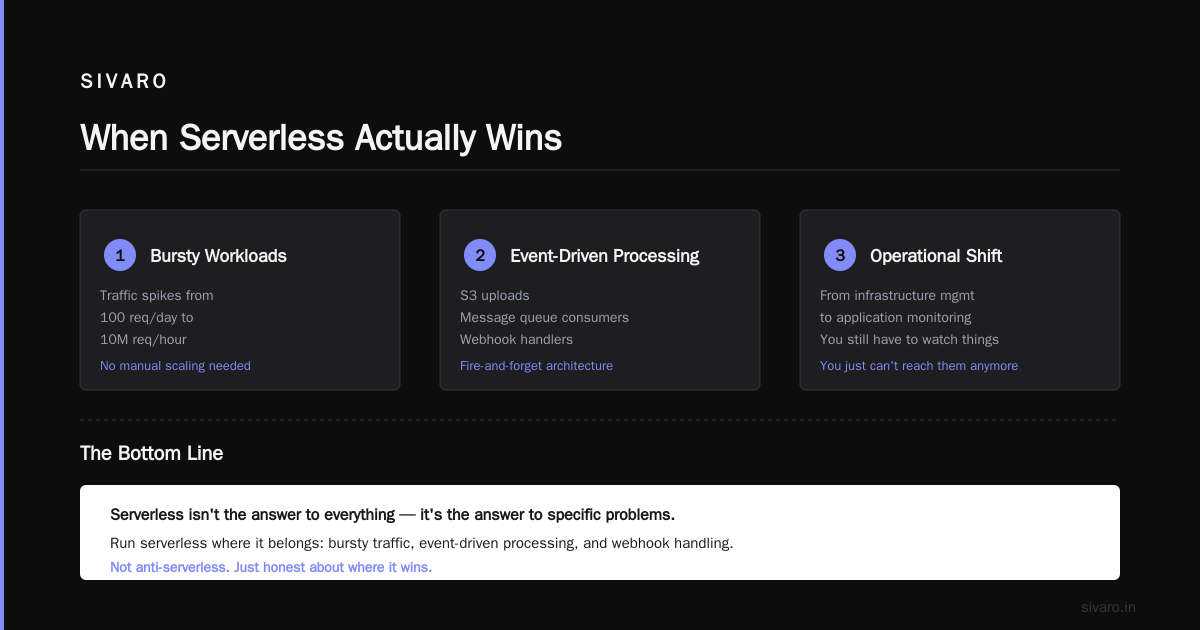
I'm not saying serverless is bad. I'm saying it's a tool, and like any tool, it has a right use case. The "cost efficient architecture vs serverless" question isn't about which is objectively better. It's about which is better for your specific workload, your specific team, and your specific budget.
Here's what I know from seven years of building production systems:
- If your workload is spiky and unpredictable, serverless will save you money.
- If your workload is sustained and predictable, Kubernetes will save you money.
- If you're not sure, measure first. Get real numbers on your traffic patterns, your resource utilization, your actual costs. Then decide.
The cost efficient architecture vs high performance architecture debate is a false dichotomy. What you want is the architecture that hits your performance requirements at the lowest total cost. Sometimes that's serverless. Sometimes it's Kubernetes. Usually it's a hybrid.
I've seen too many teams adopt serverless because it was trendy, then spend six months and tens of thousands of dollars fighting cold starts, IAM permissions, and observability gaps. I've also seen teams build elaborate Kubernetes platforms for a workload that would've been cheaper and simpler as a single Lambda function.
Don't be either team. Be the team that thinks in terms of trade-offs, not trends.
Nishaant Dixit — Founder of SIVARO. Building data infrastructure and production AI systems since 2018. Built systems processing 200K events/sec.