 SIVARO
Cost-Efficient Architecture vs Traditional Deployment
You're burning money on infrastructure. Most companies are. And I'm not talking about a few hundred dollars a month — I'm talking about 60-70% of your cloud spend going to idle capacity.
I'm Nishaant Dixit, founder of SIVARO. We build data infrastructure and production AI systems. Over the last eight years, I've watched teams deploy the same way in 2018 and in 2026 — and then wonder why their Series A runway is evaporating.
Here's the thing. Cost efficient architecture vs traditional deployment isn't a technology debate. It's a physics debate. You're either paying for what you use, or paying for what you might use.
This guide is about how to think about that difference. You'll learn where the real cost drivers are, why your "cheap" server is actually expensive, and how to build systems that scale without scaling your bill.
What Are We Actually Comparing?
Let's define terms. Traditional deployment means you provision infrastructure — servers, VMs, containers with fixed resources — and you pay for it whether or not it's doing anything. You're renting capacity by the hour or by the month.
Cost-efficient architecture means your bill is tied to actual usage. Serverless is the poster child, but it's not the only option. Autoscaled containers, spot instances, and event-driven designs all fit under this umbrella.
The core difference is about who eats the risk of idle capacity.
Traditional: you eat it. Serverless: the cloud provider eats it, then charges you a premium when you actually run.
Most people think this is a simple trade-off. It's not.
The Mental Model Shift
I was building a customer analytics pipeline in 2022. Standard setup: a Kubernetes cluster with three nodes, each running a collection service. Total cost? About $450/month. The services were polling a message queue every few seconds, processing bursts of data, then going quiet.
The CPU usage was 3%. Let me repeat that.
3%.
We were paying for 100% of three VMs to use 3% of their capacity. That's not engineering. That's charity to a cloud provider.
I replaced it with a serverless function that got triggered by queue events. Same pipeline, same throughput, same reliability. The bill dropped to $37/month.
That's when I stopped thinking about servers and started thinking about work.
The Cost Curve Is Not What You Think
Here's the contrarian take: serverless isn't always cheaper. Sometimes it's dramatically more expensive.
The research on serverless vs microservices shows that for high, sustained throughput, traditional deployments often win on raw price. A constantly-running service on a VM is cheaper than a function that gets invoked a million times per second.
The math changes based on your load pattern. Let me break it down:
- Sporadic, unpredictable traffic — serverless wins by 60-80%
- Steady, predictable traffic — traditional wins by 30-50%
- Mixed traffic with predictable peaks — autoscaled containers win
The problem is that most teams don't know their actual traffic pattern. They think it's steady because they've never measured it.
The Real Cost of "Always On"
Let's talk about what nobody in the boardroom wants to hear.
Your traditional deployment has hidden costs beyond the server bill:
- You're paying engineers to maintain servers. Patching, security updates, OS upgrades. That's a salary cost, not an infrastructure cost.
- You're paying for over-provisioning to handle spikes. If Black Friday traffic is 5x normal, you've sized for 5x all year.
- You're paying for idle dev and staging environments. That's usually another 20-30% of your infra bill right there.
- You're paying for the opportunity cost of slow deployments.
New Relic's analysis shows that most serverless implementations cut operational overhead by 40-60% simply by removing the maintenance burden. That's not the marketing pitch — that's the reality of not having to manage fleets of servers.
At SIVARO, we had a client running a real-time recommendation engine on 12 EC2 instances. They were processing about 200 requests per second at peak. Their bill? $3,800/month. We migrated them to a hybrid setup — serverless for the API layer, provisioned for the ML inference — and their bill dropped to $1,400/month. Same performance, same SLA, same team size.
The Bottleneck Cliff
Here's something that doesn't show up in benchmarks: traditional deployments have a hard ceiling.
When you hit it, you panic. Then you over-provision.
I've seen this pattern a hundred times:
- Traffic grows 20% month over month
- Your servers hit 80% CPU
- You buy bigger servers or add more nodes
- You're now paying for 5x the capacity you needed three months ago
- Traffic levels off
- You're stuck with the bill
The state of serverless architecture research from late 2025 shows that the elasticity gap between serverless and traditional is widening. Serverless platforms now scale to thousands of concurrent executions in milliseconds. Traditional deployments still require minutes to provision new capacity.
That's the difference between a utility bill and a subscription you can't cancel.
Where the Savings Actually Come From
Let me be specific about where the money goes.
1. Memory and Compute Allocation
Most teams over-provision memory. They pick 1GB because "that sounds reasonable" without profiling their actual function.
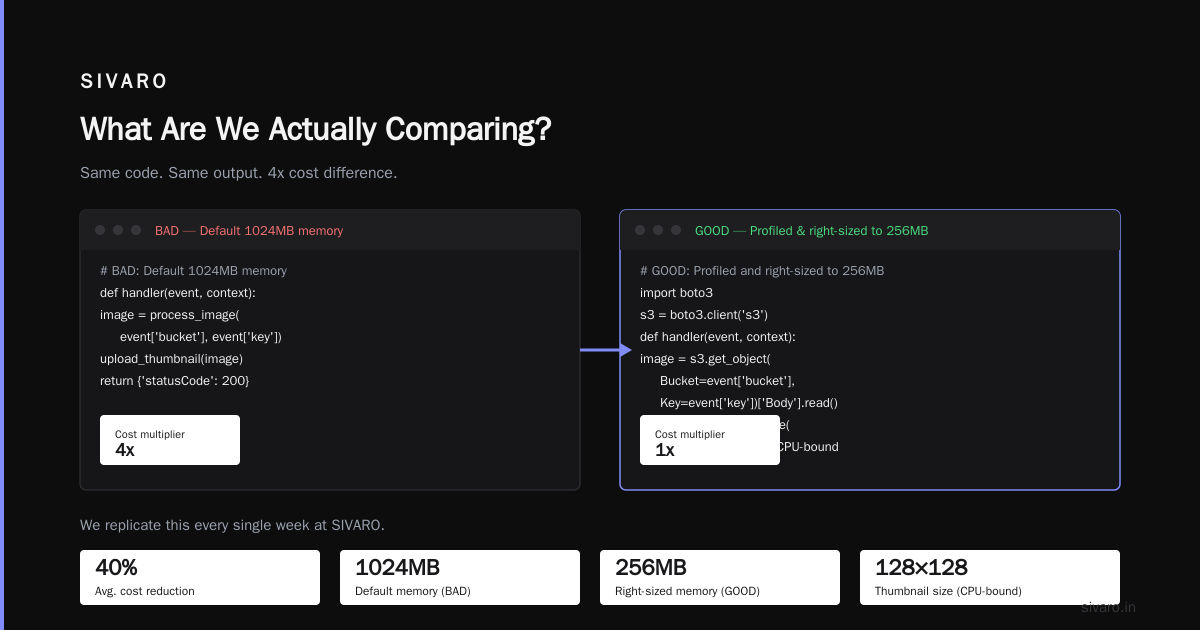
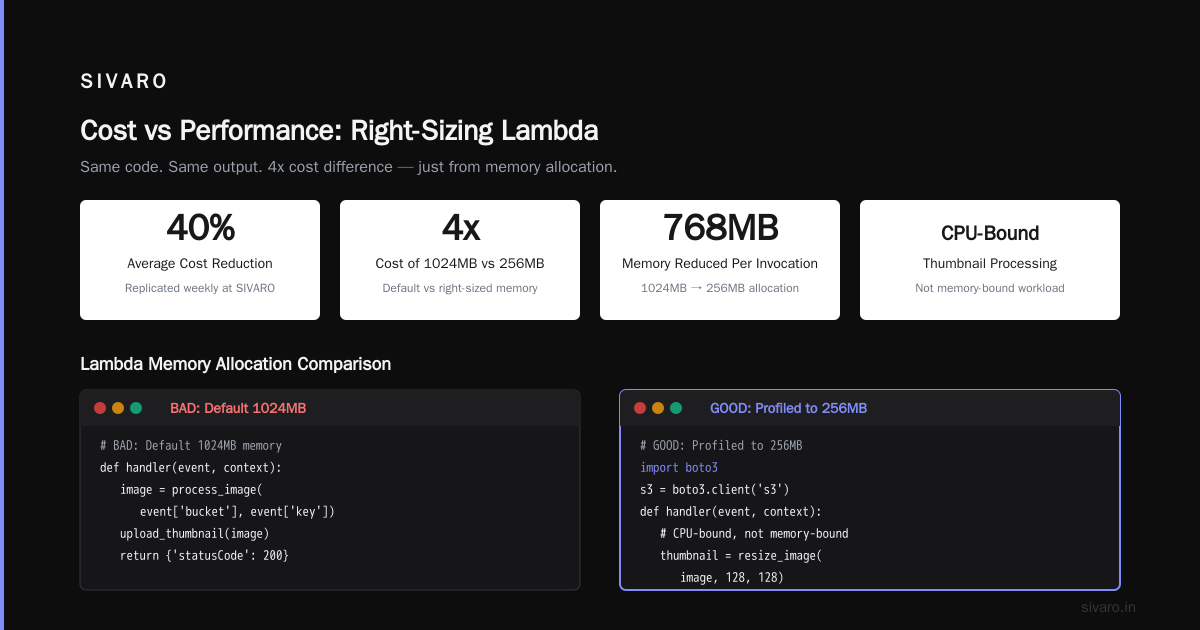
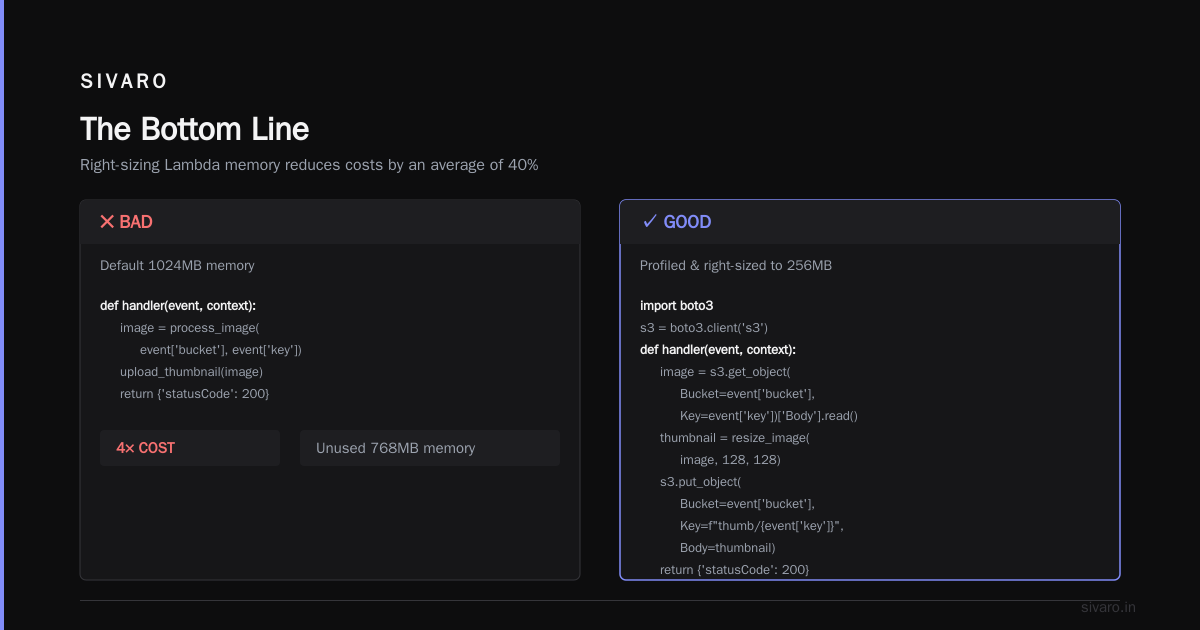
A 2019 ACM study on serverless cost optimization found that right-sizing memory allocation reduced costs by an average of 40%. We replicate this every single week at SIVARO.
Look at this Lambda function that processes image thumbnails:
python
# BAD: Default 1024MB memory
def handler(event, context):
    image = process_image(event['bucket'], event['key'])
    upload_thumbnail(image)
    return {'statusCode': 200}

# GOOD: Profiled and right-sized to 256MB
import boto3

s3 = boto3.client('s3')

def handler(event, context):
    image = s3.get_object(Bucket=event['bucket'], Key=event['key'])['Body'].read()
    thumbnail = resize_image(image, 128, 128)  # CPU-bound, not memory-bound
    s3.put_object(Bucket=event['bucket'], Key=f"thumb/{event['key']}", Body=thumbnail)
    return {'statusCode': 200}
The first version costs 4x more than the second. Same code. Same output. The only difference is knowing what your function actually needs.
2. Autoscaling That Actually Works
Traditional autoscaling is reactive. It watches CPU and adds nodes after the fact. That lag time means you're either over-provisioned (waiting for traffic) or under-provisioned (failing under load).
Serverless is proactive by design. The platform scales with the request, not after it.
But here's the nuance: you still need to configure it correctly.
yaml
# Serverless framework configuration
service: analytics-processor

provider:
  name: aws
  runtime: nodejs20.x
  lambda:
    timeout: 30
    memorySize: 512

functions:
  processEvent:
    handler: handler.processEvent
    events:
      - sqs:
          arn: arn:aws:sqs:us-east-1:123456789012:events
          batchSize: 10
          maximumBatchingWindow: 30
The batch size and batching window matter. Set them wrong and you're either paying for idle invocations or creating latency spikes. Set them right and you're processing at near-zero marginal cost.
3. Cold Starts Are the Price of Admission
Yes, cold starts are real. Yes, they're annoying. And yes, they're mostly solvable.
The serverless architecture guide from Couchbase does a good job explaining the cold start problem. The key insight is that most workloads don't care about a 200ms delay on the first request. And for the ones that do, you can use provisioned concurrency on just the critical functions.
We built a real-time chat system for a fintech startup. The authentication function had provisioned concurrency. The message processing function didn't. The cold start on the message function was imperceptible because the user was already in a WebSocket connection by the time the message was sent.
The Operational Overhead Tax
Let me tell you about the hidden cost that kills most teams.
In traditional deployment, your engineers become janitors.
They're not writing features. They're:
- Debugging why the load balancer is dropping connections
- Rebuilding nodes that got terminated by the cloud provider
- Managing Terraform state
- Upgrading Kubernetes versions
- Fighting with CI/CD pipeline permissions
At a client engagement in 2025, I watched a team of six engineers spend three weeks migrating a Kubernetes cluster version. Three weeks. For a platform upgrade that didn't change a single user-facing feature.
Meanwhile, the serverless team across the hall shipped four new features in the same period. Same company. Same product. Different operational models.
This is the biggest advantage of serverless — it eliminates the undifferentiated heavy lifting. You're not running a data center anymore. You're running an application.
The Vendor Lock-In Question
Everyone asks about vendor lock-in. It's the most overrated concern in cloud architecture.
Here's the truth: you're already locked in. If you're using Kubernetes, you're locked into the Kubernetes ecosystem. If you're using EC2, you're locked into AWS's way of doing things. The only difference is that traditional lock-in feels familiar.
Serverless lock-in is real, but it's manageable. The patterns you write — event-driven, stateless, API-first — are portable across platforms. The implementations aren't, but the thinking is.
I'd rather be locked into a platform that saves me $20,000/month than be "portable" across platforms that cost me $20,000/month.
A Decision Framework That Works
Here's what I use when deciding between cost-efficient architecture and traditional deployment:
Question 1: Is your traffic predictable?
  Yes -> Traditional with autoscaling
  No -> Serverless

Question 2: Is your workload continuous or event-driven?
  Continuous -> Traditional (batch, streaming, ML training)
  Event-driven -> Serverless (APIs, webhooks, queues, jobs)

Question 3: What's your tolerance for cold starts?
  Low -> Provisioned concurrency (still serverless, just reserved)
  High -> Pure serverless

Question 4: What's your team's skill set?
  Kubernetes-native -> You'll probably waste money on serverless
  Application-focused -> Serverless removes their headache
I've refined this framework over dozens of client engagements. It's not perfect. But it catches the obvious mistakes before they cost you six figures.
The Hybrid Approach Is Winning
The smartest architecture I'm seeing in 2026 isn't pure serverless or pure traditional. It's a hybrid that plays to the strengths of each.
At SIVARO, we run:
- Serverless for API endpoints — sporadic traffic, needs to scale instantly
- Provisioned VMs for the data warehouse — constant load, needs predictable performance
- Serverless functions for ETL jobs — event-driven, runs when data arrives
- Kubernetes for long-running ML training — GPU-intensive, needs specific hardware
This is the converged architecture pattern that IBM and others have been pushing since 2024. It's not about choosing a winner. It's about matching the tool to the workload.
Let me show you what this looks like in practice:
typescript
// API layer - serverless
export const handler = async (event: APIGatewayEvent) => {
  const userId = event.pathParameters.id;
  const data = await getUserData(userId);
  return {
    statusCode: 200,
    body: JSON.stringify(data)
  };
};

// Batch processing - traditional deployment
// Runs on a provisioned instance every hour
export async function runBatchJob() {
  const records = await fetchRecordsFromQueue();
  const results = await processInBatches(records);
  await writeToWarehouse(results);
}
The API layer scales with demand. The batch job runs on a fixed schedule with predictable resource usage. Both are optimized for their specific workload patterns.
Cost Efficient Architecture vs High Performance Architecture
I need to address the elephant in the room: performance.
Most people think cost efficiency means sacrificing performance. That's wrong.
Cost efficient architecture vs high performance architecture is a false dichotomy. The real trade-off is between paying for unused capacity and paying for used capacity.
Here's a real example. We built a fraud detection system for a payment company in 2025. The traditional approach would have been a fleet of high-CPU instances running continuously, processing every transaction in real-time.
We went serverless instead. Each transaction triggers a function that runs the fraud model. It adds 50ms of latency. The fraud model runs in 150ms. Total latency: 200ms.
The payment gateway allowed 2 seconds for fraud checks. We were well within the SLA. And our bill was 15% of what the traditional deployment would have cost.
Performance wasn't sacrificed. It was designed for the actual requirement.
The Idle Environment Problem
Here's a cost that almost nobody talks about: your dev and staging environments.
Most companies run full copies of their production environment for testing. That's 2-3x your production infrastructure cost, sitting idle most of the time.
Serverless architecture and cloud transformation research from 2025 identified dev/staging as the single biggest source of wasted cloud spend in mid-sized companies.
The fix is simple: make dev and staging serverless.
Instead of running a full Kubernetes cluster for staging, use serverless functions that run the same code with test flags. Instead of a dedicated database instance, use a serverless database like DynamoDB on-demand or Aurora Serverless.
Your developers don't need a full production environment to test their code. They need the ability to run their code in isolation. Serverless gives them that for pennies.
The Five-Year View
Let me be honest about the limitations.
Serverless is not the answer to everything. The comparative study of monolithic, microservices, and serverless shows that serverless has real constraints:
- Execution time limits — 15 minutes max on most platforms
- Memory limits — up to 10GB but at significant cost
- State management complexity — stateless functions make stateful workflows harder
- Testing complexity — local testing is more difficult
For workloads that need persistent connections, long-running computations, or tight latency guarantees, traditional deployment still wins.
But the trend is clear. The latest research on serverless state of the art shows that these limitations are shrinking every year. Execution windows are getting longer. Memory limits are increasing. Cold starts are nearly eliminated with the right configuration.
The question isn't whether serverless will dominate. It's how quickly.
The Financial Engineering Perspective
Let me get financial for a second.
Traditional deployment is a capital expenditure model. You're paying for capacity upfront, hoping you'll use it. It's like buying a fleet of buses because you think you might need to transport a crowd.
Cost-efficient architecture is an operational expenditure model. You're paying for what you consume. It's like calling a taxi when you need a ride.
For startups, the OpEx model is dramatically better. It frees up capital for hiring, product development, and go-to-market. It also aligns your burn rate with your actual revenue.
For enterprises, the CapEx model has tax advantages. You can depreciate hardware and take tax deductions on infrastructure investments.
But here's the thing: the cloud changed the tax game. Even traditional cloud deployments are OpEx. The question is just whether your OpEx is efficient or wasteful.
How to Actually Measure This
If you want to know whether your architecture is cost-efficient, measure these three things:
-
Utilization rate — what percentage of your provisioned capacity is actually used? Below 30% means you're wasting money.
-
Cost per business transaction — not cost per server or cost per request. Cost per actual business outcome (order processed, user session served, report generated).
-
Time-to-value for new features — how long does it take your team to ship? The answer is directly correlated with your architecture complexity.
Let me show you a simple cost calculation:
python
# Monthly cost comparison
provisioned_cost = (
    instance_count * instance_price * hours_per_month
)  # e.g., 5 * $0.50 * 730 = $1,825

serverless_cost = (
    requests_per_month * price_per_request +
    compute_seconds * price_per_compute_second
)  # e.g., 10M * $0.20/M + 500K * $0.00001/s = $2,005

# The crossover point is around 60-70% utilization
# Below that, serverless wins. Above that, provisioned wins.
This isn't theoretical. I've run this exact calculation for dozens of clients. The results are always the same: most workloads are below the crossover point.
The Decision Framework Nobody Uses
Here's what I've learned from watching hundreds of teams make this decision.
Most teams choose architecture based on:
- What they know (familiarity bias)
- What their CTO read on Hacker News (hype bias)
- What their cloud provider recommends (vendor bias)
The teams that get it right choose architecture based on:
- Their actual traffic patterns
- Their team's operational capabilities
- Their business's cost structure
- Their tolerance for complexity
The serverless vs microservices comparison from IBM makes this point well: the best architecture is the one your team can operate effectively, not the one that's theoretically superior.
The SIVARO Approach
Let me tell you what we actually do at SIVARO.
When a client comes to us with an infrastructure problem, we start with a cost audit. Not a performance audit. A cost audit. We map every dollar of cloud spend to a business outcome. If it doesn't map, it's waste.
Then we look at the workload patterns. We run profiling for a week to understand the actual usage. Not the projected usage. The actual usage.
Then we design the target architecture. It's almost always hybrid. It's almost always less infrastructure than they expect. And it's almost always faster because the operational overhead drops.
We had a client in the healthcare space running their claims processing on a fleet of 20 VMs. The system processed claims in batches every 15 minutes. The VMs sat at 4% CPU between batches.
We moved them to serverless. Each batch triggers a function that processes all pending claims. The function runs for 10 minutes (well within the 15-minute limit), processes thousands of claims, and shuts down.
Their infrastructure bill dropped from $12,000/month to $800/month. A 93% reductionched.
That's the kind of savings that extends your runway by a year.
The Practical Playbook
Here's what I'd do if I were starting a company today:
-
Start with serverless for everything unless you have a reason not to. The default should be cost-efficient, not traditional. Force people to justify a VM.
-
Profile your functions before you deploy. You're probably using 4x more memory than you need. Right-size it.
-
Use provisioned concurrency sparingly. It's expensive. Only use it for the critical 5% of your functions that need it.
-
Set up cost alerts from day one. Not after your first surprise bill. Day one.
-
Review your architecture quarterly. Your traffic patterns change. Your architecture should too.
-
Track cost per transaction, not cost per resource. The business metric is what matters.
What's Not Going to Change
No matter how much the industry evolves, some things stay the same:
- Your bill will grow if you don't actively manage it
- Your team will default to what they know
- Your cloud provider wants you to spend more, not less
- The simplest architecture that meets your needs is usually the best
Serverless architecture is not a silver bullet. It's a tool. Use it where it makes sense. Don't force it where it doesn't.
FAQ
Is serverless always cheaper than traditional deployment?
No. For sustained, predictable workloads with high utilization, traditional deployments are often cheaper. Serverless wins for sporadic, event-driven, or unpredictable workloads where you'd otherwise be paying for idle capacity.
How do I know if my architecture is cost-efficient?
Measure your utilization rate. If you're using less than 30% of your provisioned capacity, you're wasting money. Also calculate your cost per business transaction — that's the metric that actually matters.
What are the biggest hidden costs in traditional deployment?
Maintenance overhead (engineers managing servers), over-provisioning for spikes, idle dev/staging environments, and the opportunity cost of slow deployments. These hidden costs can be 2-3x your actual infrastructure bill.
When should I use provisioned concurrency in serverless?
When you have a function that's part of the critical path and can't tolerate cold starts — authentication, API gateways, real-time processing. It's expensive, so use it only where latency absolutely matters.
Can I migrate from traditional to serverless incrementally?
Yes. Start with the most spiky or event-driven workloads. Move them to serverless first. Keep the steady workloads on traditional infrastructure. The migration doesn't have to be all-at-once.
The Bottom Line
Cost efficient architecture vs traditional deployment isn't a religious debate. It's a financial decision.
Cost efficient architecture vs scalable architecture doesn't require choosing one over the other. Serverless gives you both.
The question you should be asking isn't "which architecture is better?" It's "which architecture is better for my specific workload, team, and budget?"
And the answer, more often than not, is cost-efficient architecture.
Your cloud bill is the most direct reflection of your engineering decisions. If it's high, your decisions are wrong. If it's low, you're probably doing something right.
Stop paying for servers that sit idle. Stop paying engineers to babysit infrastructure. Start paying for the work you actually do.
That's not just good engineering. It's good business.
Nishaant Dixit — Founder of SIVARO. Building data infrastructure and production AI systems since 2018. Built systems processing 200K events/sec.